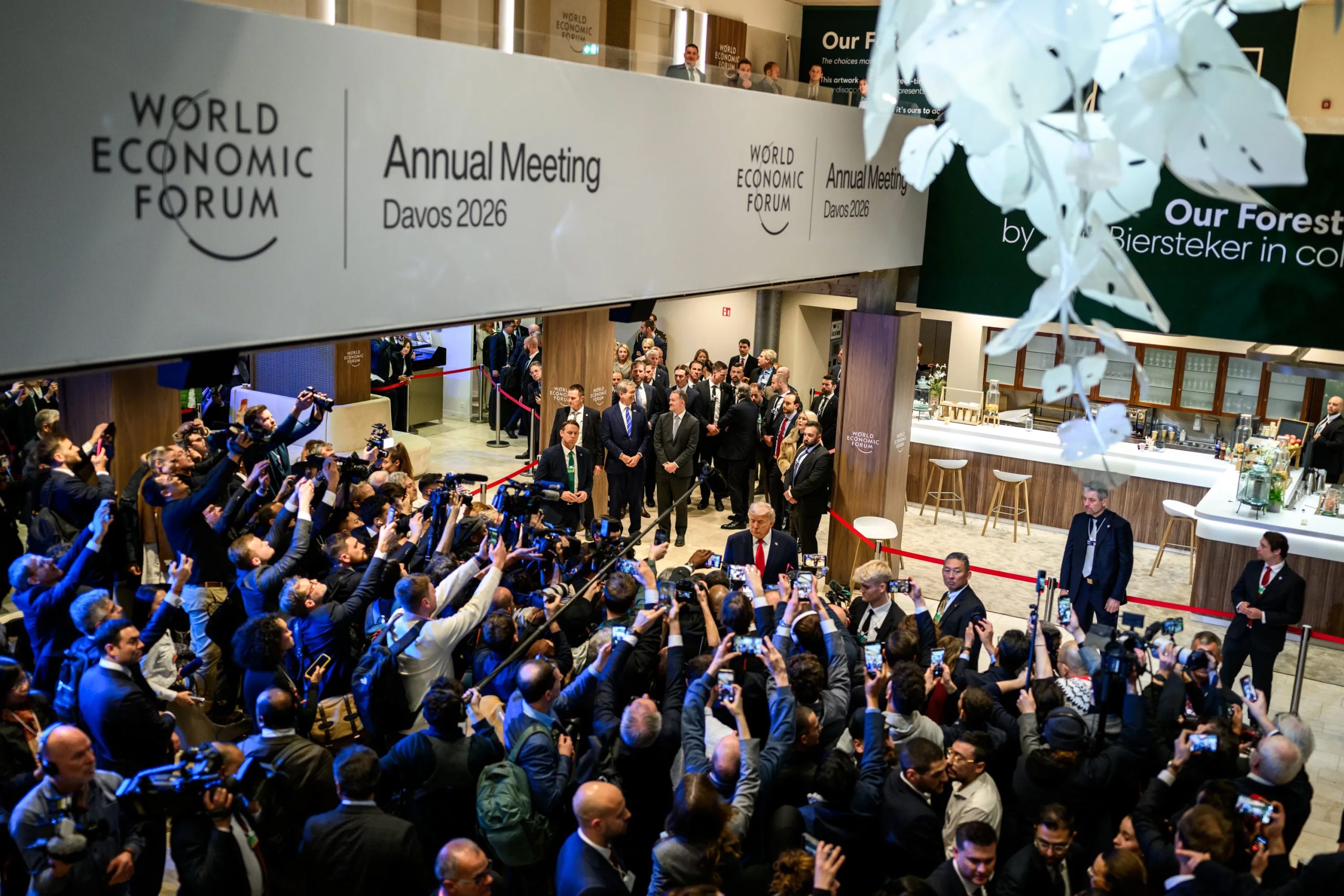
The reverberations of Donald Trump’s incendiary speech at the World Economic Forum at Davos are still being felt, despite the US President’s retreat on the hostile purchase of Greenland and the role of British troops in Afghanistan. Canadian Prime Minister Mark Carney made the point in his own Davos speech last week that “the old order is not coming back.” He added: “We should not mourn it. Nostalgia is not a strategy.”
Through all the bombast and narcissism of Trump’s words ran a thread of cold reality. As the Yale Cold War historian Odd Arne Westad wrote in the Financial Times at the weekend, Atlanticism as we know it is over and a new multipolar age is upon us. “The global system no longer has one centre. It has many, each of which will seek to project power in whatever way serves its interests”.
It has often been said of authoritarian leaders that we should listen carefully to what they say they plan to do, however wayward or capricious, to best prepare for what is to come. The worst of Trumpian expansionism may have been averted for the time being, but the US President has made his imperial intentions for Greenland plain since his first term in office. His views on Nato have been equally clear from the outset.
The same is true for Trump’s views on free and independent journalism, which he despises. We’ve been writing about Trump’s threats to media freedom at Index since the beginning of his first term in office in 2017, but those concerned about media freedom and censorship in the US and the rest of the world would do well to go back and examine the section of the Davos speech where Trump talked about Ukraine. As is the case with many of his platform utterances, it is not always evident which parts are scripted, and which improvised. But about halfway through, the US President shifted from criticism of Nato to a discussion of Ukraine and revisited his well-worn contention that Russia would never have invaded in 2021 if he had still been in office.
The words are not entirely coherent, but the message is clear enough: “It’s a war that should have never started, and it wouldn’t have started if the 2020 US presidential election weren’t rigged. It was a rigged election. Everybody now knows that. They found out. People will soon be prosecuted for what they did. It’s probably breaking news, but it should be. It was a rigged election. Can’t have rigged elections.”
He then outlined what amounts to his political doctrine: “You need strong borders, strong elections, and ideally a good press. I always say it – strong borders, strong elections, free, fair elections, and a fair media”.
The repetition for rhetorical emphasis is interesting, but so are some key omissions. Trump wants strong borders (he says it twice), and admits the need for free and fair, as well as strong elections (again he says this twice). But he can’t bring himself to use the words “strong” or “free” to describe the media. Instead, he merely wants a “good” press and a “fair media”.
In case anyone was in any doubt about what he meant by this, he went on to elaborate:
“The media is terrible. It’s very crooked. It’s very biased, terrible, but someday it’ll straighten out, because it’s losing all credibility. Think of it, when I went in, a landslide, a giant landslide – won all seven swing states, won the popular vote, won everything – and I only get negative press. That means that it has no credibility. And if they’re going to get credibility, they’re going to have to be fair. So, you need a fair press, but you also need those other elements, and I inherited a terrible, terrible situation.”
At this point, Trump returned to discuss geopolitics and his close relationship with Vladimir Putin.
But it’s too late. The authoritarian cat is out of the bag. The logic goes like this. Trump is the greatest president since George Washington. He won a landslide election, turned around the American economy, stopped migration and ended eight foreign conflicts. And yet, the media continued to criticise him. How can this be?
The words at the heart of the Davos speech are genuinely chilling for the future of the American media and worth repeating: “I only get negative press. That means that it has no credibility. And if they’re going to get credibility, they’re going to have to be fair.”
It is no surprise that the American networks now operate with extreme caution in the face of threats to remove their licences. Strict control of access to the White House and the Pentagon has led to further timidity among the press corps, while Trump’s deep pockets and mania for defamation suits have extended the chilling effect to every newsroom in the country.
But if there is a lesson to be drawn from the events of the past week, it is TACO (Trump Always Chickens Out). When European powers stood up for themselves and each other, Trump backed down. The American media should take a leaf out of their book.