
NEWS

In Iran, funerals are the new battleground
The authorities are trying to control how the nation grieves its protesting dead. The people are pushing back
03 Feb 2026

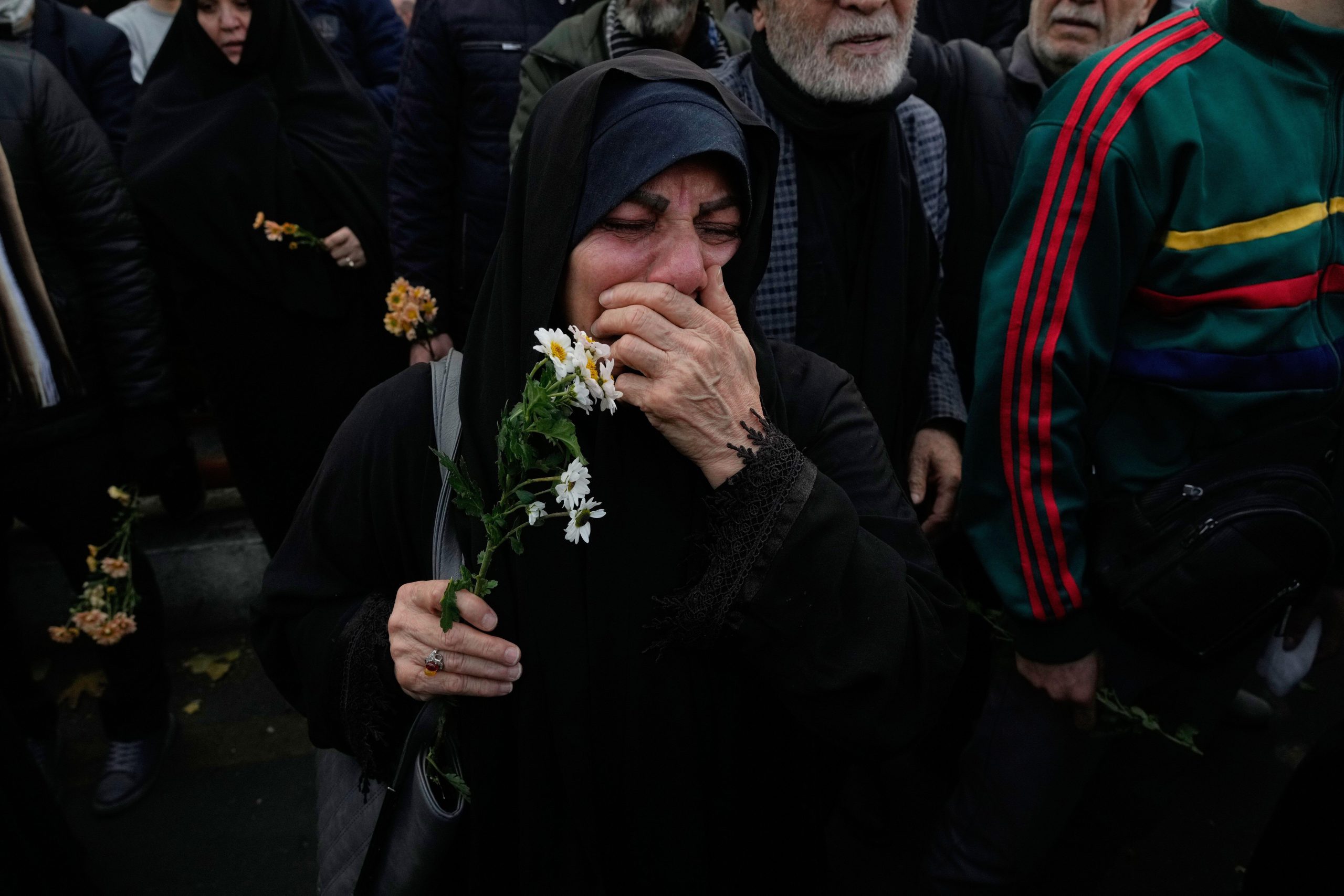
A woman mourns during a funeral ceremony. Photo: AP Photo/Vahid Salemi/Alamy

Just when you think Iranian authorities couldn’t get crueller, you hear this: they’re extorting families out of huge sums of money in exchange for the bodies of murdered loved ones. Under the so-called “bullet price” – a practice dating back to the 1980s – the authorities have not only exacted money from grieving relatives they have ordered them to hold subdued funerals and even denounce the dead. The family of Ali Taherkhani, a 31-year-old first shot and then clubbed by security forces, was made to pay the equivalent of $21,000 for his body. At his burial, condolence banners were prohibited and only four family members were allowed to attend against an entourage of armed security forces. Arina Moradi, who works for rights group Hengaw, said her family had to pay to retrieve her cousin’s body. Authorities also demanded Siavash Shirzad was buried in a remote ancestral village and that the burial took place in silence. In another case, the family of brothers Hamid and Vahid Arzanlou, two well-known entrepreneurs in Iran’s furniture industry, was made to pay more than one billion tomans (about $6,670).

This isn’t just cruelty for cruelty’s sake. The authorities want to make sure that the funerals don’t turn into protests, as has already happened at the funerals of well-known figures who’ve been killed, such as 21-year-old basketball player Ahmad Khosravani. Hundreds shouted protest slogans at the Behesht Zahra Cemetery in central Tehran when Khosravani was laid to rest.

But calls against the Ayatollah aren’t the only way people are voicing dissent. Once the extortion was paid for the bodies of the Arzanlou brothers, a third brother asked mourners to applaud if they believed the pair had been right in protesting. The mourners did just that. This more celebratory response has occurred elsewhere. Instead of sombre music and Islamic verse, as is typical at most Iranian funerals today, some are choosing upbeat music and dancing. The relatives and close friends of Mohammad-Hossein Jamshidi and Ali Faraji threw confetti and clapped. Women danced as participants re-enacted tabaq-keshi, a traditional ceremony performed at weddings, at the burial of 18-year-old student Sourena Golgoon.

It’s hard to hold onto hope right now given the bloodbath that has just occurred. But if the slaughter of protesters is done to serve two purposes – silence the actual protesters and scare off would-be ones – these defiant funerals suggest Iranian authorities have not entirely succeeded in the latter.

Another protester, Mojtaba Shahpari, who was taken to hospital with a leg wound, to later be found shot in the head, had requested to be wrapped in a lion and sun flag if he was killed. That’s the former state flag of Iran from 1907 to 1979, which is banned in the country today. Shahpari was buried in it.

Support free expression for all


At Index on Censorship, we believe everyone deserves the right to speak freely, challenge power and share ideas without fear. In a world where governments tighten control and algorithms distort the truth, defending those rights is more urgent than ever.

But free speech is not free. Instead we rely on readers like you to keep our journalism independent, our advocacy sharp and our support for writers, artists and dissidents strong.

If you believe in a future where voices aren’t silenced, help us protect it.

Make a £10 monthly donation

At Index on Censorship, we believe everyone deserves the right to speak freely, challenge power and share ideas without fear. In a world where governments tighten control and algorithms distort the truth, defending those rights is more urgent than ever.

But free speech is not free. Instead we rely on readers like you to keep our journalism independent, our advocacy sharp and our support for writers, artists and dissidents strong.

If you believe in a future where voices aren’t silenced, help us protect it.

Make a £20 monthly donation

At Index on Censorship, we believe everyone deserves the right to speak freely, challenge power and share ideas without fear. In a world where governments tighten control and algorithms distort the truth, defending those rights is more urgent than ever.

But free speech is not free. Instead we rely on readers like you to keep our journalism independent, our advocacy sharp and our support for writers, artists and dissidents strong.

If you believe in a future where voices aren’t silenced, help us protect it.

Make a £10 one-off donation

At Index on Censorship, we believe everyone deserves the right to speak freely, challenge power and share ideas without fear. In a world where governments tighten control and algorithms distort the truth, defending those rights is more urgent than ever.

But free speech is not free. Instead we rely on readers like you to keep our journalism independent, our advocacy sharp and our support for writers, artists and dissidents strong.

If you believe in a future where voices aren’t silenced, help us protect it.

Make a £20 one-off donation

At Index on Censorship, we believe everyone deserves the right to speak freely, challenge power and share ideas without fear. In a world where governments tighten control and algorithms distort the truth, defending those rights is more urgent than ever.

But free speech is not free. Instead we rely on readers like you to keep our journalism independent, our advocacy sharp and our support for writers, artists and dissidents strong.

If you believe in a future where voices aren’t silenced, help us protect it.

Donate a different amount

By Jemimah Steinfeld

Jemimah Steinfeld has lived and worked in both Shanghai and Beijing where she has written on a wide range of topics, with a particular focus on youth culture, gender and censorship. She is the author of the book Little Emperors and Material Girls: Sex and Youth in Modern China, which was described by the FT as "meticulously researched and highly readable". Jemimah has freelanced for a variety of publications, including The Guardian, The Telegraph, The Independent, Vice, CNN, Time Out and the Huffington Post. She has a degree in history from Bristol University and went on to study an MA in Chinese Studies at SOAS.

READ MORE

CAMPAIGNS

SUBSCRIBE

SUPPORT INDEX'S WORK