NEWS

Free speech is the casualty in Ukraine war
Journalists are being killed and media freedom is under threat. Both sides have questions to answer
27 Feb 2026

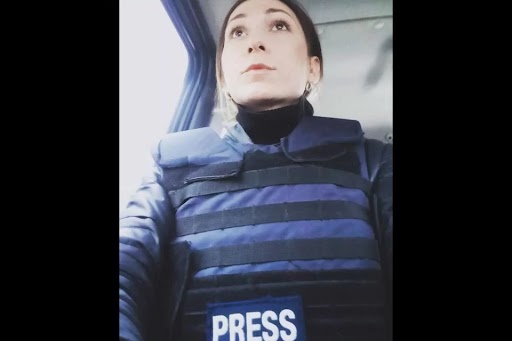
Victoria Roshchyna was killed in Russian custody in September 2024. Photo by: Handout

In 2002 the acclaimed reporter Anna Politkovskaya wrote in Index that Russia was lawless. She longed for a normal life and to return to Moscow after years spent reporting on the war in Chechnya. She did return to the capital, eventually, but the lawless Russian state then turned on her – in 2006 she was found murdered outside her apartment block, on Vladimir Putin’s birthday. Many see her killing as the turning point – the moment when any pretence that Putin was cut from liberal cloth disappeared. After that, few inside the country or outside it could sustain the illusion that democracy would come to Russia. When, on 24 February 2022, Russia launched a full-scale invasion of Ukraine, Putin demonstrated his intent to expand his autocratic empire.

From the get-go the war felt close for Index, not just because geographically Ukraine isn’t that far from the UK, but because Index was founded in 1972 following dissident protests against Moscow’s invasion of Czechoslovakia just four years before. From that time through to Politkovskaya and the present day, we have consistently worked with dissidents campaigning against Russia’s tendency – regardless of regime – to control its neighbours and, occasionally, send in tanks.

In the four years that have passed since the full-scale Russian invasion, Ukraine’s free speech landscape has significantly worsened. In the parts which Russia occupies Putin has consciously sought to obliterate what makes the country unique. Cultural, intellectual and academic institutions have been pillaged, books relating to Ukrainian identity destroyed, and prominent journalists and around 200 writers and artists have been killed, either fighting on the frontline or murdered by Russian forces. A less popular topic to discuss is censorship that originates from within the parts of Ukraine still sovereign under Volodymyr Zelenskyy. For several years now journalists have been sounding the alarm over what they see as media restrictions that cannot be justified by wartime pressures. Last year there were also protests over proposed legislation that would tighten government oversight of two key anti-corruption agencies, and in so doing risk their independence.

We have highlighted these actions and have stood in solidarity with those being silenced during the war, including publishing the words of Victoria Roshchyna and Victoria Amelina – two young women murdered to stop them saying more. In our Autumn magazine last year, we published the work of three young Ukrainian poets Artem Dovhopolyi, Maksym Kryvtsov and Volodymyr Vakulenko killed in the last four years. It is Russia itself though that has drawn our attention most. If the lights dimmed when Politkovskaya was murdered, they were basically switched off in 2022. Too many people – regime critics and opponents – are either in jail or in exile or have been murdered. As for the average person, information is now tightly restricted. Mr. Nobody Against Putin, a film worthy of every accolade, lays bare the extent to which young minds are shaped and controlled, while the recent blocking of WhatsApp, and the pushing of internal messaging service, MAX, are barely concealed attempts to ensure no conversation remains private.

Anniversaries don’t necessarily take stories on, but they do focus the mind. Four years on from those dark days in February 2022, much of the world’s attention has shifted. Not so for the people in Ukraine and Russia whose struggle for freedom of expression has only become harder.

Support free expression for all


At Index on Censorship, we believe everyone deserves the right to speak freely, challenge power and share ideas without fear. In a world where governments tighten control and algorithms distort the truth, defending those rights is more urgent than ever.

But free speech is not free. Instead we rely on readers like you to keep our journalism independent, our advocacy sharp and our support for writers, artists and dissidents strong.

If you believe in a future where voices aren’t silenced, help us protect it.

Make a £10 monthly donation

At Index on Censorship, we believe everyone deserves the right to speak freely, challenge power and share ideas without fear. In a world where governments tighten control and algorithms distort the truth, defending those rights is more urgent than ever.

But free speech is not free. Instead we rely on readers like you to keep our journalism independent, our advocacy sharp and our support for writers, artists and dissidents strong.

If you believe in a future where voices aren’t silenced, help us protect it.

Make a £20 monthly donation

At Index on Censorship, we believe everyone deserves the right to speak freely, challenge power and share ideas without fear. In a world where governments tighten control and algorithms distort the truth, defending those rights is more urgent than ever.

But free speech is not free. Instead we rely on readers like you to keep our journalism independent, our advocacy sharp and our support for writers, artists and dissidents strong.

If you believe in a future where voices aren’t silenced, help us protect it.

Make a £10 one-off donation

At Index on Censorship, we believe everyone deserves the right to speak freely, challenge power and share ideas without fear. In a world where governments tighten control and algorithms distort the truth, defending those rights is more urgent than ever.

But free speech is not free. Instead we rely on readers like you to keep our journalism independent, our advocacy sharp and our support for writers, artists and dissidents strong.

If you believe in a future where voices aren’t silenced, help us protect it.

Make a £20 one-off donation

At Index on Censorship, we believe everyone deserves the right to speak freely, challenge power and share ideas without fear. In a world where governments tighten control and algorithms distort the truth, defending those rights is more urgent than ever.

But free speech is not free. Instead we rely on readers like you to keep our journalism independent, our advocacy sharp and our support for writers, artists and dissidents strong.

If you believe in a future where voices aren’t silenced, help us protect it.

Donate a different amount

Jemimah Steinfeld

Jemimah Steinfeld has lived and worked in both Shanghai and Beijing where she has written on a wide range of topics, with a particular focus on youth culture, gender and censorship. She is the author of the book Little Emperors and Material Girls: Sex and Youth in Modern China, which was described by the FT as "meticulously researched and highly readable". Jemimah has freelanced for a variety of publications, including The Guardian, The Telegraph, The Independent, Vice, CNN, Time Out and the Huffington Post. She has a degree in history from Bristol University and went on to study an MA in Chinese Studies at SOAS.

READ MORE

CAMPAIGNS

SUBSCRIBE

SUPPORT INDEX'S WORK