NEWS

Gone are the days when Tbilisi was safe for journalists escaping persecution
The arrest and deportation of journalist Afgan Sadigov demonstrate the peril faced by reporters at-risk
10 Apr 2026

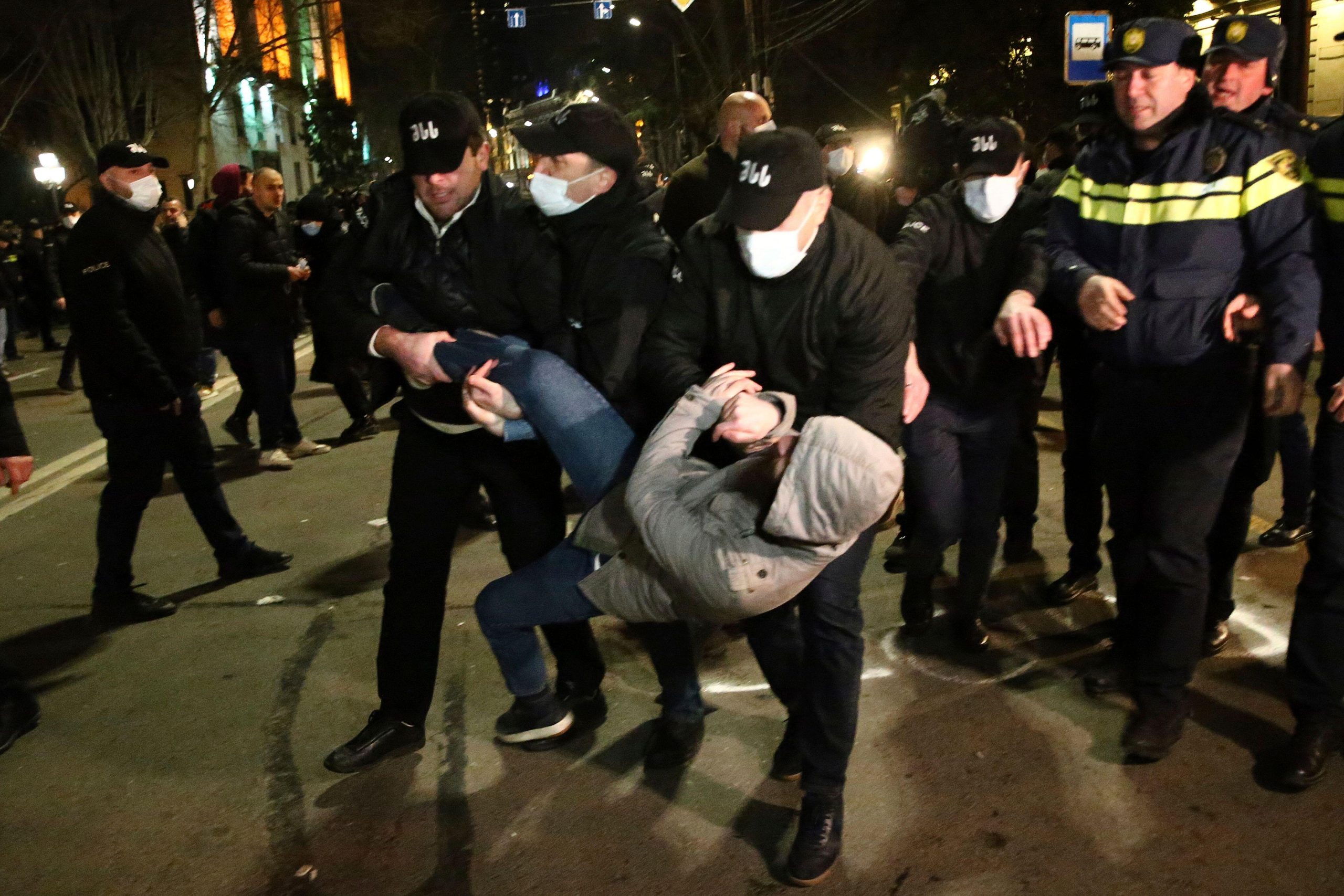
Georgian police detain a protester during a protest outside the Georgian parliament building in Tbilisi, Georgia, Wednesday, March 8, 2023. Georgian authorities used tear gas and water cannon outside the parliament building in the capital Tuesday against protesters who oppose a proposed law some see as stifling freedom of the press. Photo by: AP Photo/Zurab Tsertsvadze/Alamy

The Georgian authorities were probably hoping their terrible treatment of exiled Azerbaijani journalist Afgan Sadigov would pass unnoticed. No such luck. Their hopes were dashed. The news of his deportation has started to spread.

It all happened last Sunday, when Sadigov, who is the founder of Azerbaijani news outlet and YouTube channel Azel.tv, was sent back to Azerbaijan.

Sadigov had been living in the Georgian capital Tbilisi since 2023, after he left having been persected in his home country for his journalism. The Georgian authorities had allowed him to stay but had then detained him so they could deport him, only letting him go a year ago, after an interim order by the European Court of Human Rights.

His deportation when it came was swift. It followed an arrest at his home on charges of “insulting police” on social media (a new crime, resulting from changes to Georgian legislation in 2025).

There was a hearing by a judge at 4am which lasted only a few hours. And then the judge ruled Sadigov be immediately sent back to Azerbaijan. He imposed a three-year re-entry ban. Hours later Sadigov found himself in Baku, where he was immediately arrested. We, and partners of the Media Freedom Rapid Response, condemned his deportation here.

I have never met Sadigov, but I met his wife and two young children in Tbilisi in October 2024 for a Council of Europe mission on media freedom in Georgia. At the time Afgan was in Georgian detention and I remember how exhausted she looked as she told us about him.

Sadigov’s story is reflective of Georgia’s slide into autocracy. Gone are the days when the country could be considered a safe haven for journalists from neighbouring countries. Now it’s the place that deports journalists. It’s also about Azerbaijan. Sadigov had committed the cardinal sin there – reporting on corruption and social injustice – which led to multiple arrests. The most egregious was in 2020 when he was sentenced to seven years in jail. During a July 2021 appeal, his sentence was reduced to four years. He was later pardoned by President Ilham Aliyev.

The situation in Azerbaijan is terrible. Hundreds of activists, academics and reporters are currently in jail and this week the Supreme Court of Azerbaijan rejected an appeal from journalists at the independent media outlet Azbas, who’ve been jailed for between seven and nine years. Nothing was fair about the hearing.

I spoke to Gunel Safarova who is the acting director and editor-in-chief at Abzas Media. She told me about the immense pressures journalists face there. Many have left the profession altogether. The “space for free and critical reporting inside the country has been destroyed step by step”, she said, adding that “the law no longer feels like protection”.

“When you see that the government can decide people’s fate and take years of their lives for their journalism, it destroys trust in justice even more. Maybe we already knew this in some way, but each case like this makes us lose whatever hope was still left, even the smallest hope that justice in our country could still mean something.”

This is the country to which Sadigov has been returned, and even though he has apparently been released and spoken to his wife, they are not together and he is not safe.

Support free expression for all


At Index on Censorship, we believe everyone deserves the right to speak freely, challenge power and share ideas without fear. In a world where governments tighten control and algorithms distort the truth, defending those rights is more urgent than ever.

But free speech is not free. Instead we rely on readers like you to keep our journalism independent, our advocacy sharp and our support for writers, artists and dissidents strong.

If you believe in a future where voices aren’t silenced, help us protect it.

Make a £10 monthly donation

At Index on Censorship, we believe everyone deserves the right to speak freely, challenge power and share ideas without fear. In a world where governments tighten control and algorithms distort the truth, defending those rights is more urgent than ever.

But free speech is not free. Instead we rely on readers like you to keep our journalism independent, our advocacy sharp and our support for writers, artists and dissidents strong.

If you believe in a future where voices aren’t silenced, help us protect it.

Make a £20 monthly donation

At Index on Censorship, we believe everyone deserves the right to speak freely, challenge power and share ideas without fear. In a world where governments tighten control and algorithms distort the truth, defending those rights is more urgent than ever.

But free speech is not free. Instead we rely on readers like you to keep our journalism independent, our advocacy sharp and our support for writers, artists and dissidents strong.

If you believe in a future where voices aren’t silenced, help us protect it.

Make a £10 one-off donation

At Index on Censorship, we believe everyone deserves the right to speak freely, challenge power and share ideas without fear. In a world where governments tighten control and algorithms distort the truth, defending those rights is more urgent than ever.

But free speech is not free. Instead we rely on readers like you to keep our journalism independent, our advocacy sharp and our support for writers, artists and dissidents strong.

If you believe in a future where voices aren’t silenced, help us protect it.

Make a £20 one-off donation

At Index on Censorship, we believe everyone deserves the right to speak freely, challenge power and share ideas without fear. In a world where governments tighten control and algorithms distort the truth, defending those rights is more urgent than ever.

But free speech is not free. Instead we rely on readers like you to keep our journalism independent, our advocacy sharp and our support for writers, artists and dissidents strong.

If you believe in a future where voices aren’t silenced, help us protect it.

Donate a different amount

Jemimah Steinfeld

Jemimah Steinfeld has lived and worked in both Shanghai and Beijing where she has written on a wide range of topics, with a particular focus on youth culture, gender and censorship. She is the author of the book Little Emperors and Material Girls: Sex and Youth in Modern China, which was described by the FT as "meticulously researched and highly readable". Jemimah has freelanced for a variety of publications, including The Guardian, The Telegraph, The Independent, Vice, CNN, Time Out and the Huffington Post. She has a degree in history from Bristol University and went on to study an MA in Chinese Studies at SOAS.

READ MORE

CAMPAIGNS

SUBSCRIBE

SUPPORT INDEX'S WORK