While Donald Trump might dismiss the most egregious actions of Gulf States as “things happen”, dissidents are taking justice into their own hands. The Saudi comedian and activist Ghanem Al-Masarir, for instance, has sued the Kingdom of Saudi Arabia for psychological damage resulting from the misuse of private information, harassment and assault after he was attacked in London in 2018. A core part of Al-Masarir’s case rested on Pegasus spyware, which was found on his phone. Such spyware is difficult to definitively trace back, but in this case the court stated that there was “good evidence” Saudi Arabia was responsible. The High Court also ruled that Saudi Arabia did not have immunity under the State Immunity Act 1978, a point the Saudi government appealed in an effort to get the case struck out. They didn’t succeed. The case continues.
A similar case is being heard in the UK’s Supreme Court this week. Saeed Shehabi, a leading Bahraini opposition figure, and Moosa Mohammed, a pro-democracy activist and photojournalist, allege the Bahraini government used FinSpy software back in 2011 to infiltrate their computers while they were living in London, also resulting in psychological harm. Like Pegasus, FinSpy can collect vast amounts of data from infected devices. The hacks occurred months after anti-government protests began in Bahrain. Shehabi and Mohammed were in touch with other activists, journalists and political prisoners.
Bahrain denies being behind the hack and is also claiming state immunity. They’ve lost twice on these grounds in both the High Court and Court of Appeal. Now they’ve taken their case to the Supreme Court, saying prior judges have misinterpreted section 5 of the State Immunity Act 1978 and unduly broadened the scope of its exception to immunity. Judges have argued to the contrary – that under Section 5 a state does not have immunity from claims for personal injury caused by an act or omission which happened in the UK. The Supreme Court can now clarify this point once and for all.
It’s an important moment. If the Supreme Court rules against Bahrain, it sends a clear message about accountability and rule of law on UK shores. For too long the UK has been a playground for the world’s autocrats, who’ve targeted their overseas dissidents here through a variety of means. It would also be a moment of victory for the victims themselves. The psychological impact of surveillance is real. We’ve seen this in action, with Al-Masarir, a contributor of ours. He was due to perform at an Index comedy event two years ago and had to pull out because of poor mental health. The damage caused to these individuals can’t be undone, but at least it can be acknowledged. That’s something.
Ahead of and during the upcoming 56th Session of the Human Rights Council, we urge you and your delegation to raise concerns over the human rights situation in Bahrain, particularly regarding the continued arbitrary detention of human rights defenders and opposition leaders in Bahrain, many of whom have been wrongfully imprisoned since 2011.
Thirteen years since Bahrain’s popular uprising, systemic injustice has intensified and political repression targeting dissidents, human rights defenders, clerics and independent civil society has effectively shut any space for the peaceful exercise of the right to freedom of expression or peaceful activism in the country. Despite a series of legal reforms and the creation of new national human rights institutions, based on recommendations of the Bahrain Independent Commission of Inquiry, an independent panel commissioned by the King in response to international concern over the suppression of the 2011 protests, most of these measures have had little impact in practice.
The recent royal pardon issued by King Hamad bin Isa Al Khalifa on 8 April 2024, on the occasion of Eid Al-Fitr and the King’s Silver Jubilee, was a significant move. The pardon included the release of more than 650 political prisoners, marking a change in state policy from previous royal pardons, according to research conducted by the Bahrain Institute for Rights and Democracy. While the gesture is notable, Bahrain authorities must cease unjustly prosecuting their critics in the first place.
We also express concern that this pardon excluded many who played significant roles in the 2011 pro-democracy uprising, with an estimated 550 political prisoners remaining behind bars.
As Eid al-Adha approaches on 16 June 2024, and ahead of HRC56, we see a critical window of opportunity to advocate for further releases. We request that your governments continue to monitor the situation in Bahrain and raise concerns with Bahraini authorities at the highest level, publicly and privately. We further call on you to demand the immediate and unconditional release of all individuals imprisoned for their political beliefs and the retrial of those convicted and sentenced to death following unfair trials in full compliance with international fair trial standards.
Cases of concern
We bring to your attention specific cases of individuals who remain unjustly imprisoned in Bahrain, in violation of their human rights and despite widespread international condemnation.
Abdulhadi Al-Khawaja, a Bahraini-Danish human rights defender, has been arbitrarily detained since 2011 for his role in peaceful demonstrations. Bahraini authorities have subjected Al-Khawaja to severe physical, sexual, and psychological torture, and his health has deteriorated significantly during his prolonged imprisonment.
Abduljalil Al-Singace, an award-winning human rights defender and blogger, remains arbitrarily detained since 2011 after being sentenced to life in prison on charges of “plotting to overthrow the government”. He is now approaching three years since he began a solid-food hunger strike after authorities confiscated his research manuscripts, sustaining himself only on multivitamin liquid supplements, tea with milk and sugar, water, and salts. Despite his disability and hunger strike, he continues to be denied adequate medical care.
Hassan Mushaima, an opposition leader aged 76, is serving a life sentence solely for exercising his right to freedom of association and expression. Over the past few months, his health has deteriorated. He continues to be denied access to adequate healthcare and remains arbitrarily detained. Since they were transferred to Kanoo Medical Center in 2021, Al-Singace and Mushaima have been held in prolonged solitary confinement and denied access to sunlight.
Sheikh Ali Salman, the leader of dissolved opposition party Al-Wefaq, was convicted and sentenced to life imprisonment in 2018 on politically motivated charges related to espionage. He has been imprisoned since 2014 on a separate conviction related to speeches he delivered in 2014 against parliamentary elections that his party boycotted. Amnesty International declared him a prisoner of conscience and called his conviction “a travesty of justice.”
Over a decade ago, the Human Rights Council issued a statement of concern “about guarantees of due process in the trials of 13 political activists who had their sentences, including life sentences, upheld in January 2013.” We note that of the “13 political activists” referenced, ten remain arbitrarily detained, including some of those listed above.
In 2023, the Committee to Protect Journalists documented the imprisonment of journalists, including Ali Mearaj and Hassan Qambar, who were excluded from the recent releases.
Additionally, twenty-six individuals in Bahrain remain on death row at risk of imminent execution, many of whom allege torture and unfair trials. Mohammed Ramadhan and Husain Moosa, who have now spent over a decade unlawfully detained, were sentenced to death in an unfair trial marred by torture allegations.
Conclusions and recommendations
In light of the above, we respectfully urge your delegation to take a proactive stance in the lead-up to Eid al-Adha and during the upcoming session and:
Call on Bahrain to immediately and unconditionally release all individuals imprisoned solely for exercising their human rights.
Address these developments in your national capacity and jointly with other states, including during the Interactive Dialogues with the Special Rapporteurs and Independent Expert on health, freedom of expression, peaceful assembly and association, independence of judges and lawyers and international solidarity.
Issue a statement raising concern about individual cases of human rights defenders and opposition leaders who continue to be arbitrarily detained in Bahrain in violation of international law.
With assurances of our highest consideration.
Sincerely,
Access Now
ALQST
Americans for Democracy & Human Rights in Bahrain (ADHRB)
Amnesty International
Article 19
Bahrain Centre for Human Rights (BCHR)
Bahrain Institute for Rights and Democracy (BIRD)
Cairo Institute for Human Rights Studies (CIHRS)
DAWN
English PEN
European Centre for Democracy and Human Rights (ECDHR)
Dear Minister Ali bin Mohammed Al-Rumaih, We, the undersigned, write to you regarding the case of human rights defender Nabeel Rajab and ask you to consider the request of Mr Rajab’s lawyers to suspend his current sentence.
Mr Rajab is currently serving a five-year sentence related to tweets criticising alleged torture at Jau prison and the actions of the Saudi-led military coalition in Yemen’s civil war.
In recent months, Mr Rajab’s legal team has appealed to the courts to suspend the sentence against him or to convert it to a custodial sentence, or a form of community service, but all their efforts were rejected. A hearing requesting that the Court overturn previous decisions to uphold the sentence will take place on 17 September 2019.
We strongly urge you to support this request for the sentences to be suspended. In particular, we are concerned that Mr Rajab is not being treated according to international standards for prisoners. Mr Rajab is currently being held in a cell in Jau Prison with nine other prisoners who were convicted for prostitution offences. This is contrary to Rule 11c of the United Nations Standard Minimum Rules for the Treatment of Prisoners (Nelson Mandela Rules) which states: “The different categories of prisoners shall be kept in separate institutions or parts of institutions taking account of their sex, age, criminal record, the legal reason for their detention and the necessities of their treatment.”
Mr Rajab is a highly regarded human rights defender. He is the President of the Bahrain Center for Human Rights (BCHR), Founding Director of GCHR, Deputy Secretary General of FIDH and a member of the Human Rights Watch Middle East and North Africa Advisory Committee. His case has been raised repeatedly by the international community. In 2018, the UN Working Group on Arbitrary Detention called for Mr Rajab’s release and said the convictions were unlawful and violated his freedom of expression. Earlier this month, UK parliamentarians said the UK should be willing to use sanctions against countries that violate international standards on media freedom.
Given this, we urge you to suspend Mr Rajab’s sentence. Yours sincerely,
Index on Censorship
English PEN
Gulf Center for Human Rights (GCHR)
IFEX
Bahrain Center for Human Rights (BCHR)
Article 19
Americans for Democracy & Human Rights in Bahrain (ADHRB)
European Center for Democracy & Human Rights (ECDHR)
[vc_row][vc_column][vc_custom_heading text=”Index calls on the UK to stand up to the Bahrain government on human rights after police storm the London embassy to protect protester” use_theme_fonts=”yes”][vc_column_text]
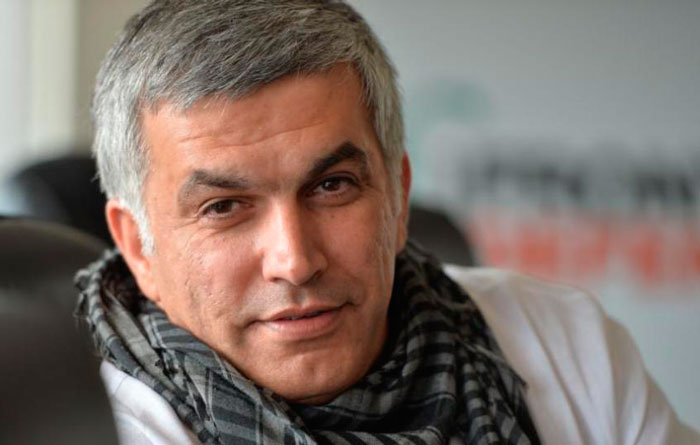
Human rights activist Nabeel Rajab who is still in prison in Bahrain for criticising the government
Human rights defender Moosa Mohammed climbed on to the roof of the Bahraini embassy in London on July 26 to protest the execution of two men in Bahrain who had been tortured in prison and given the death penalty. His banner read: “I am risking my life to save two men about to be executed in the next few hours. Boris Johnson act now!”
He intended to stay on the roof until the UK Prime Minister Boris Johnson contacted the King of Bahrain to stop the executions that were due to take place on the morning of 28 July. However, as a Channel 4 News video shows, at least two people appeared on the roof and someone started beating him with a stick, and according to the protester, they threatened to kill him and throw him down the stairwell. Since the embassy is a private building, video reports appear to confirm that these two men must be embassy staff.
Diplomatic premises in the UK may not be entered by the UK police unless ordered under the consent of the ambassador or head of mission, even though they are considered part of UK territory as outlined in the Diplomatic Privileges Act. The embassy has said the claims were “unfounded” and said it was reacting to a perceived terrorism threat. But what happened on the night of the protest was clearly extremely serious as it caused UK police officers to take a highly unusual step and break down the door of the embassy to force entry to the building.
A spokesperson for the Metropolitan Police told The Independent newspaper that police were called following reports of a man on the roof. According to the spokesperson, officers and London Fire Brigade attended and “hearing a disturbance on the roof, officers entered the building and detained the man”. But a police officer confirms on the video that they were “forcing entry”.
If Bahrain’s embassy staff members feel confident enough to act like this on UK territory, what is happening inside Bahrain as the rest of the world chooses not to watch?
Freedom of expression in Bahrain continues to be under severe threat. Joy Hyvarinen, head of advocacy at Index on Censorship said: “The people most at risk are those who choose to freely express themselves, whether they be journalists, activists or photographers, but ordinary citizens can face repercussions if they follow, retweet, comment or like a Twitter or Facebook post”.
The Bahraini government has used its 2002 Press Law to restrict the rights of the media to the point where a journalist can face up to five years’ imprisonment for publishing criticism of Islam or the King, inciting actions that undermine state security, or advocating a change in government. The government also uses counterterrorism legislation to limit freedom of expression.
One of the most prominent activists and defenders of freedom of expression in Bahrain is Index on Censorship Freedom of Expression Award winner Nabeel Rajab, who was convicted under these laws and has been detained since June 2016. He was first charged and given a two-year prison sentence for TV interviews he gave in 2015 and 2016, on the grounds of “disseminating false news, statements and rumours about the internal situation of the kingdom that would undermine its prestige and status”. He was later sentenced to an additional five years on charges of “spreading false rumours in time of war,” “insulting public authorities,” and “insulting a foreign country” for tweets that were critical of torture in Bahraini prisons and the war in Yemen.
Rajab’s case is only one of many human rights violations taking place in Bahrain, where people are unjustly convicted and arbitrarily detained. Many prisoners are subjected to ill-treatment and torture is not uncommon. Earlier this month, groups called on Amal Clooney, the United Kingdom’s Special Envoy on Media Freedom, urging her to pressure the UK to act on Bahrain’s suppression of freedom of expression. After the incident at the Bahrain embassy in London, will the UK government finally take a tougher approach to Bahrain or will it continue to make deals with a government with so little regard for human rights?