10 Dec 2014
December 2014
Journalists and media workers are confronting relentless pressure as they do their jobs, a survey of the first six months of incidents reported to Index on Censorship’s Mapping Media Freedom project has found.
|
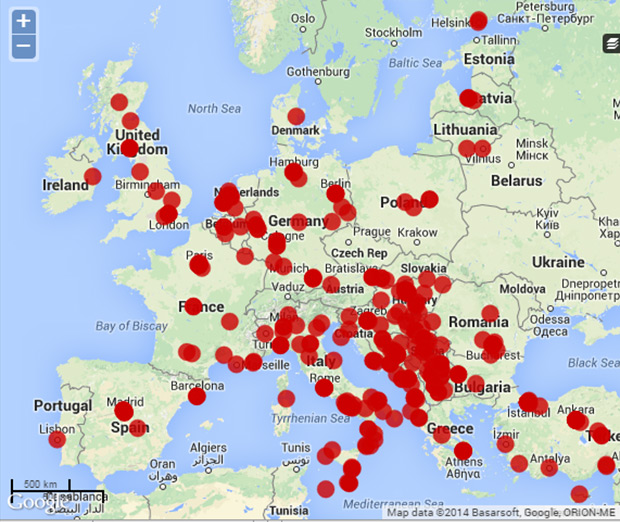
| In the six months since the mapping project was launched, over 500 reports — including 61 violent attacks on journalists — from across Europe have been verified and published. Reports have come in from as far afield as Finland and Malta, Ireland and Turkey.
Over 150 reports have been mapped to the states of the former Yugoslavia and Italy. However, as the map shows, violations of media freedom and violent incidents against journalists are being committed across Europe, with physical violence and online harassment becoming growing problems.
The map, which was funded by the European Commission, launched on 24 May 2014 in partnership with Osservatorio Balcani e Caucaso and allows anyone — from members of the public to journalist unions — to submit reports for verification by Index’s European Union correspondents.
“Since we launched the platform, we have recorded a number of abuses against media professionals ranging from intimidation and preventing access to information, to murder. What struck me when speaking to some journalists is that too many considered receiving threats as a ‘part of the job’. It shouldn’t be. This map is an essential tool to improve the capacity of journalists, media organisations and others to confront those threats,” Index Senior Advocacy Officer Melody Patry said. |
 |
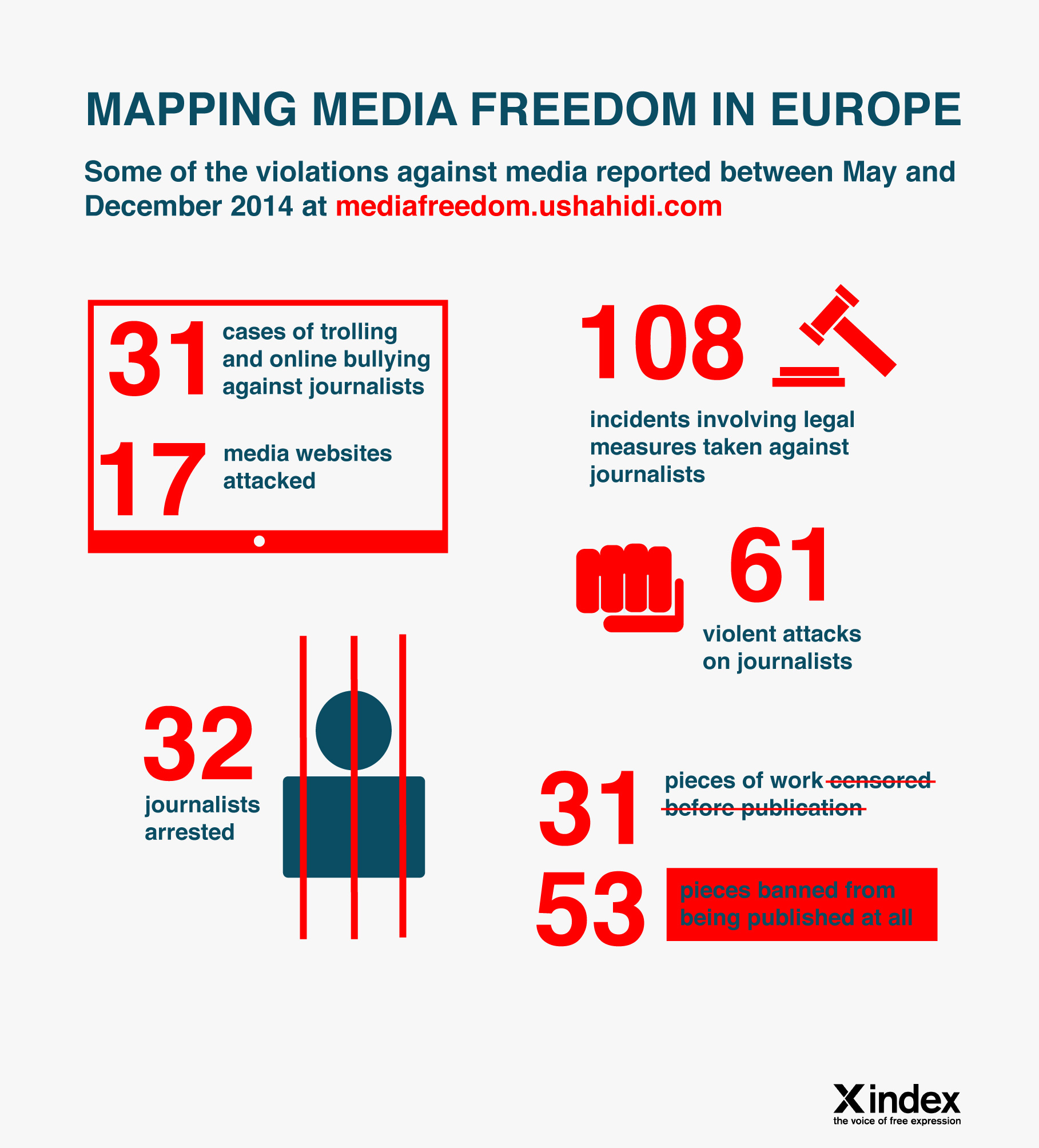
This is the reality of being a journalist in Europe in 2014
Selected incidents reported to mediafreedom.ushahidi.com |
 |
|
Turkey: Journalist Erol Ozkoray was sentenced to 11 months and 20 days in prison for defaming President Recep Tayyip Erdogan by referring to anti-Erdogan slogans and graffiti in his book about the 2013 Gezi Park protests |
|
 |
|
Germany: Blogger Su Yutong was fired by Deutsche Welle’s Chinese service after tweeting about employee meetings, where staff were told to use restraint in their coverage of China |
|
 |
|
Hungary: Three journalists were chased with a hydraulic shovel by an employee of a rubbish dump after they tried to verify information regarding a possible leak from the EU-funded dump |
|
 |
|
France: Far-right party Front National sued and called for the resignation of journalist Guy Lagache after his TV show aired an undercover documentary about one of their municipal campaigns |
|
 |
|
Albania: A masked attacker tried to shoot Artur Cani, an investigative journalist for TV News 24, near his home in Tirana |
|
|
|
Kosovo: Milot Hasimja, a journalist with the Pristina-based TV Klan, was knifed at his desk by a man apparently unhappy with a feature Hasimja did on him |
|
|
|
Netherlands: Freelance photographer John van Ieperen was beaten by a security guard when covering the aftermath of an explosion in an apartment building that killed two residents |
|
 |
|
United Kingdom: Blogger Michael Abberton who broadcast “fact checks” about the UK Independence Party said he was advised to delete a tweet about the party’s policies after being visited at home by two police officers |
|
 |
|
Serbia: Dusan Dragisic, a local businessman, threatened to cut off the nose and ears of Nenad Tomic, owner and editor-in-chief of the website Ruma |
|
|
|
Bosnia: Professor Slavo Kukic, a prominent writer and columnist, was severely beaten with a baseball bat in his office at the University of Mostar |
|
|
|
Italy: Pino Maniaci, head of Sicilian TV station Telejato who is known for reporting on the Sicilian mafia, found his pet dogs hanged from a metal post in a yard near his office |
|
 |
|
Bulgaria: The company car of bTV political journalist Genka Shikerova was set on fire outside her home in Sofia |
|
Categorisation of violations
There are 51 different labels used to organise the incidents reported to mediafreedom.ushahidi.com |
Legal measures
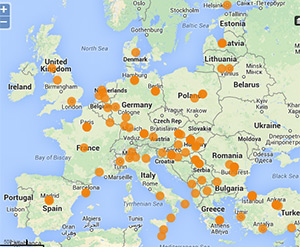
Incidents that involved the threat of or filing of legal actions
|
|
Censorship
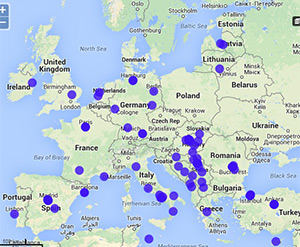
Incidents that included partial or complete censorship
|
|
Government threat
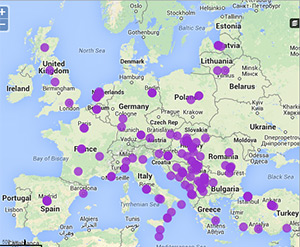
Incidents that originated from a government representative or agency
|
|
Co-Funded by
 |
27 May 2014 | About Index, Campaigns, European Union, Press Releases
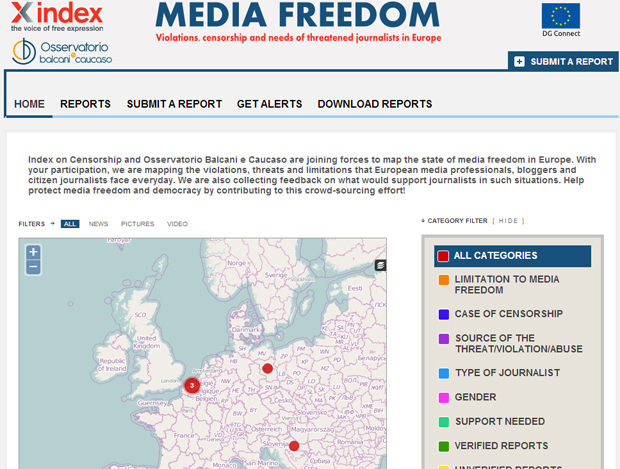
Index on Censorship and Osservatorio Balcani e Caucaso are launching mediafreedom.ushahidi.com to track media violations in Europe.
Index on Censorship, (London, United Kingdom) and Osservatorio Balcani e Caucaso, (Rovereto, Italy) have launched mediafreedom.ushahidi.com, a website that will enable the reporting and mapping of media freedom violations across the 28 EU countries plus candidate countries. The platform will collect and map out crowd-sourced information from media professionals and citizen journalists across Europe over the course of a year.
Based in London, Index on Censorship is an international organisation that promotes and defends the right to freedom of expression. Since its founding in 1972, Index has used a unique combination of journalism, campaigning and advocacy to defend freedom of expression for those facing censorship and repression, including journalists, writers, social media users, bloggers, artists, politicians, scientists, academics, activists and citizens.
“Index believes that free expression is the foundation of a free society and this website will enable journalists to report incidences of violations as soon as they happen. By mapping these reports online, the entire system will act as an advocacy, research and response tool, highlighting that violations on media freedom still occur in Europe.” explained Melody Patry, Index on Censorship senior advocacy officer.
Osservatorio Balcani e Caucaso (OBC) has been reporting on the socio-political and cultural developments of South-East Europe since 2000. Through the online platform, OBC will monitor and document media freedom violations in 11 countries, among which Bulgaria, Croatia, Greece, Romania, Serbia and others, and collect the needs of journalists under threat.
“We aim at improving the working conditions of media professionals and citizen journalists in Italy, South-East Europe and Turkey and ultimately at enhancing the quality of European democracy,” said Luisa Chiodi, scientific director of OBC.
This new website is part of a European Commission grant project under the EU’s Digital Agenda (DG Connect). In light of remaining violations to media freedom and plurality in Europe, and longer-term challenges in the digital age, the DG Connect launched a call for proposals to address the issue.
The successful candidates- the International Press Institute, Index on Censorship, Osservatorio Balcani e Caucaso together with SEEMO, Ossigeno per l’Informazione and Dr Siapera, as well as the European University Institute in cooperation with the Central European University– will spend the next year working on four projects, under the title European Centre for Press and Media Freedom.
For more information on the projects and the website, please read EU project to explore media freedom and pluralism or contact Melody Patry, [email protected], +44 (0) 207 260 2671 or OBC, [email protected].
27 May 2014 | About Index, European Union, News, Politics and Society
(Photo: Anatolii Stepanov / Demotix)
Free speech has always been a concern to the EU, with flaws in the world of press freedom and pluralism in Europe still apparent today. In an attempt to raise awareness to these problems, both on an institutional scale and publicly, DG Connect, tasked with undertaking the EU’s Digital Agenda, launched a call for proposal for funding for a new project to allow NGOs and civil society platforms to research and develop tools to tackle this problem.
The successful candidates- the International Press Institute, Index on Censorship, Osservatorio Balcani e Caucaso and the European University Institute in cooperation with the Central European University– will spend the next year working on the project, under the title European Centre for Press and Media Freedom.
“It is true that we regularly receive concerns about media freedom and pluralism that come from citizens, NGOs and the European Parliament,” Lorena Boix Alonso, Head of Unit for converging media and content at DG Connect told Index.
The Vice President of the European Commission, Neelie Kroes, began implementing action on this topic in 2011 with the creation of a high level group on media freedom and pluralism, but there are still violations in the world of European media freedom that need to be dealt with. These projects will be useful to raise awareness, according to Boix Alonso, to something which many people have little knowledge on.
Index on Censorship
In 2013, an Index on Censorship report showed that, despite all EU member states’ commitment to free expression, the way these common values were put into practice varied from country to country, with violations regularly occurring.
Building on this report, the DG Connect-funded project will enable Index to implement real-time mapping of violations to media freedom on a website that covers 28 EU countries and five candidate countries. Working with regional correspondents, specialist digital tools will be used to capture reports via web and mobile applications, for which workshop training will be provided. Index led events across Europe will discuss the contemporary challenges currently facing media professionals, allowing them to share good practices, while learning how to use the tools.
“Index believes that free expression is the foundation of a free society. Enabling journalists to report on matters without the threat of censorship or violations against them means promoting the right to freedom of expression and information, which is a fundamental and necessary condition for the promotion and protection of all human rights in a democratic society,” explained Melody Patry, Index on Censorship Senior Advocacy Officer.
The DG Connect grant demonstrates the current focus of the EU on the needs of journalists and citizens who face these violations to media freedom and plurality, according to Patry, as well as longer term challenges in the digital age.
Click here to visit the mediafreedom.ushahidi.com website
The Centre for Media Pluralism and Media Freedom
For some, the need to safeguard media freedom is at the forefront of the work they do. The Centre for Media Pluralism and Media Freedom (CMPF) is one such organisation and, in collaboration with the Centre for Media and Communication Studies (CMCS) at the Central European University, will continue to do so with funding from DG Connect for their project Strengthening Journalism in Europe: Tools, Networking, Training.
“The role of journalists is to both serve as guardians of government power and to enable the public to make informed decisions about key social and political issues that affect their daily lives,” the CMPF and CMCS told Index.
“The ability of journalists to freely report on issues without censorship is therefore critical- it’s the cornerstone of the checks and balances that make democracies work.”
The collaborative project will develop legal support, resources and tools for reporters, editors and media outlets to help them defend themselves in cases of legal threat, as well as raising awareness to ongoing violations to free expression and how these “impact the foundation on which democratic systems are based.” NGOs and policy makers will also benefit from this EU-funded scheme.
The International Press Institute
For over 60 years the International Press Institute (IPI) has been defending press freedom around the world, working to improve press legislation, influencing the release of imprisoned journalists and ensuring the media can carry out its work without restrictions.
London may have earned the title over recent years of libel capital of the world but what restrictions are placed on European journalists through defamation laws? This question forms the base of the IPI project, analysing existing laws and practices relating to defamation on both a civil and criminal nature; comparing this to international and European standards; and looking to the extent of which these affect the profession of journalism in all 28 EU countries and five candidate states.
After initial research, workshops will be hosted in four countries where the IPI believes they will have the greatest impact on the ground in countries where press freedom is limited by defamation to teach journalists which defamation laws affect their work, what the legitimate limits to press freedom are and what goes beyond what is internationally accepted.
According to the IPI the EU currently has no strong standards with regards to defamation and the threat to press freedom, a fact the led to their project proposal. “We hope that at one point the work we are doing will lead to a discussion within the EU about the need to develop these standards,” Barbara Trionfi, IPI Press Freedom Manager, explained to Index. “The defence of press freedom is a fight anywhere and it does not stop even in western Europe. It is still a major problem.”
Osservatorio Balcani e Caucaso
“We aim at improving the working conditions of media professionals and citizen journalists in Italy, South-East Europe and Turkey and ultimately at enhancing the quality of democracy,” Francesca Vanoni, Project Manager at Osservatorio Balcani e Caucaso (OBC) told Index.
OBC has been reporting on the socio-political and cultural developments of south-east Europe since 2000 and through their DG Connect funded project will monitor and document media freedom violations in nine countries, including Bulgaria, Croatia, Macedonia, Romania and Serbia.
Offering practical support to threatened journalists, the project will raise public awareness of the European dimension on media freedom and pluralism, stimulating an active role of the EU with regard to media pluralism in both member states and candidate countries. This will be implemented, among other means, through social media campaigns, a crowd-sourcing platform, an international conference for the exchange of best practices and transnational public debates.
The idea behind the project was to help build a European transnational public sphere in order to strengthen the EU itself. The ethics and professionalism of media workers is crucial, according to Vanoni. A democratic environment is built upon the contribution of all parts involved: “The protection of media freedom is fundamental for the European democracy and it cannot be left aside of the main political priorities.
“Being part of a wider political community that tackles shared problems with shared solutions offers stronger protection in case pluralism is threatened,” explained Vanoni.
To make a report, please visit http://mediafreedom.ushahidi.com
This article was published on May 20, 2014 at indexoncensorship.org
10 Jan 2014 | Digital Freedom, Europe and Central Asia, European Union, News

(Illustration: Shutterstock)
This article is part of a series based on our report, Time to Step Up: The EU and freedom of expression
The EU has made a number of positive contributions to digital freedom: it plays a positive part in the global debate on internet governance; the EU’s No-Disconnect Strategy, its freedom of expression guidelines and its export controls on surveillance equipment have all be useful contributions to the digital freedom debate, offering practical measures to better protect freedom of expression. Comparatively, some of the EU’s member states are amongst the world’s best for protecting online freedom. The World Wide Web Foundation places Sweden at the top of its 2012 Index of internet growth, utility and impact, with the UK, Finland, Norway and Ireland also in the top 10. Freedom House ranks all EU member states as “free”, and an EU member state, Estonia, ranks number one globally in the organisation’s annual survey, “Freedom in the World”. But these indices merely represent a snapshot of the situation and even those states ranked as free fail to fully uphold their freedom of expression obligations, online as well as offline.
As the recent revelations by whistleblower Edward Snowden have exposed, although EU member states may in public be committed to a free and open internet, in secret, national governments have been involved in a significant amount of surveillance that breaches international human rights norms, as well as these governments’ own legal commitments. It is also the case that across the EU, other issues continue to chill freedom of expression, including the removal or takedown of legitimate content.
The EU’s position on digital freedom is analysed in more detail in Index on Censorship’s policy paper “Is the EU heading in the right direction on digital freedom?” The paper points out that the EU still lacks a coherent overarching strategy and set of principles for promoting and defending freedom of expression in the digital sphere.
Surveillance
Recent revelations by former US National Security Agency (NSA) whistleblower Edward Snowden into the NSA’s PRISM programme have also exposed that mass state surveillance by EU governments is practised within the EU, including in the UK and France.
Mass or blanket surveillance contravenes Article 8 (the right to respect for private and family life) and Article 10 (the right to freedom of expression) of the European Convention on Human Rights. In its jurisprudence, the European Court of Human Rights has repeatedly stated that surveillance, if conducted without adequate judicial oversight and with no effective safeguards against abuse, will never be compatible with the European Convention.[1]
This state surveillance also breaches pledges EU member states have made as part of the EU’s new cybersecurity strategy, which was agreed in February 2013 and addresses mass state surveillance. The Commission stated that cybersecurity is predominantly the responsibility of member states, an approach some have argued gives member states the green light for increased government surveillance. Because the strategy explicitly states that “increased global connectivity should not be accompanied by censorship or mass surveillance”, member states were called upon to address their adherence to this principle at the European Council meeting on 24th October 2013. The Council was asked to address revelations that external government surveillance efforts, such as the US National Security Agency’s Prism programme, undermining EU citizens’ rights to privacy and free expression. While the Council did discuss surveillance, as yet there has been no common EU position on these issues.
At the same time, the EU has also played a role in laying the foundations for increased surveillance of EU citizens. In 2002, the EU e-Privacy Directive introduced the possibility for member states to pass laws mandating the retention of communications data for security purposes. In 2006, the EU amended the e-Privacy Directive by enacting the Data Retention Directive (Directive 2006/24/EC), which obliges member states to require communications providers to retain communications data for a period of between six months and two years, which could result in member states collecting a pool of data without specifying the reasons for such practice. A number of individual member states, including Germany, Romania and the Czech Republic, have consulted the European Convention on Human Rights and their constitutions and have found that the mass retention of individual data through the Data Retention Directive to be illegal.
While some EU member states are accused of colluding in mass population surveillance, others have some of the strongest protections anywhere globally to protect their citizens against surveillance. Two EU member states, Luxembourg and the Czech Republic, require that individuals who are placed under secret surveillance to be notified. Other EU member states have expanded their use of state surveillance, in particular Austria, the UK and Bulgaria. Citizens of Poland are subject to more phone tapping and surveillance than any other citizens in the European Union; the European Commission has claimed the police and secret services accessed as many as 1,300,000 phone bills in 2010 without any oversight either by the courts or the public prosecutor.
Internet governance
At a global level the EU has argued for no top-down state control of internet governance. There are efforts by a number of states including Russia, China and Iran to increase state control of the internet through the International Telecommunication Union (ITU). The debate on global internet governance came to a head at the Dubai World Conference on International Telecommunications (WCIT) summit at the end of 2012 which brought together 193 member states. At the WCIT, a number of influential emerging democratic powers aligned with a top-down approach with increased state intervention in the governance of the internet. On the other side, EU member states, India and the US argued the internet should remain governed by an open and collaborative multistakeholder approach. The EU’s influence could be seen through the common position adopted by the member states. The European Commission as a non-voting WCIT observer produced a common position for member states that opposed any new treaty on internet governance under the UN’s auspices. The position ruled out any attempts to make the ITU recommendations binding and would only back technology neutral proposals – but made no mention of free expression. The absence of this right is of concern as other rights including privacy (which was mentioned) do not always align with free speech. After negotiations behind closed doors, all 27 EU member states and another 28 countries including the US abstained from signing the final treaty. That states with significant populations and rising influence in their regions did not back the EU and leant towards more top-down control of the internet should be of significant concern for the EU.
Intermediate liability, takedown and filtering
European laws on intermediate liability, takedown and filtering are overly vague in defining what constitutes valid and legitimate takedown requests, which can lead to legal uncertainty for both web operators and users. Removal of content without a court order can be problematic as it places the content host in the position of judge and jury over content and inevitably leads to censorship of free expression by private actors. EU directorate DG MARKT[2] is currently looking into the results of a public consultation into how takedown requests affect freedom of expression, among other issues. It is expected that the directorate will outline a directive or communication on the criteria takedown requests must meet and the evidence threshold required, while also clarifying how “expeditiously” intermediaries must act to avoid liability. A policy that clarifies companies’ legal responsibilities when presented with takedown requests should help better protect online content from takedown where there is no legal basis for the complaint.
The EU must take steps to protect web operators from vexatious claims from individuals over content that is not illegal. Across the EU, the governments of member states are increasingly using takedown requests. Google has seen a doubling of requests from the governments of Germany, Hungary, Poland and Portugal from 2010-2012; a 45% increase from Belgium and double-digit growth in the Netherlands, Spain and the UK. Governments are taking content down for dubious reasons that may infringe Article 10 rights of the ECHR. In 2010, a number of takedown requests were made in response to ‘”government criticism” and four in response to “religious offence”. A significant 8% of takedown requests were in response to defamation offences. With regard to defamation charges, it must be noted that the public interest is not protected equally across all EU countries (see Defamation above).
Although corporate takedown is more prevalent than state takedown, particularly in the number of individual URLs affected, the outcome of the DG MARKT consultation must be to address both vexatious state and corporate takedown requests. The new communication or directive must be clearer than the EU e-Commerce directive has been with respect to the responsibility of member states. While creating a legal framework that was intended to protect internet intermediaries, the EU e-Commerce directive has failed to be entirely effective in a number of high-profile cases. EU member states use filters to prevent the distribution of child pornography with questionable effectiveness. However, filters have not been used by states to block other content after a Court of Justice of the European Union ruling stated EU law did not allow states to require internet service providers to install filtering systems to prevent the illegal distribution of content. The Court made it clear at the time that such filtering would require ISPs to monitor internet traffic, an infringement under EU law. This has granted European citizens strong protections against systematic web filtering on behalf of states. There continue to be legal attempts to force internet intermediaries to block content that is already in the public domain. In a recent case, brought by the Spanish Data Protection authority on behalf of a complainant, the authority demanded that the search engine Google remove results that pointed to an auction note for a reposessed home due to social security debts. The claimant insisted that referring to his past debts infringed on his right to privacy and asked for the search results to be removed. In June 2013, the Advocate General of the European Court of Justice decided Google did not need to comply to the request to block “legal and legitimate information that has entered the public domain” and that it is not required to remove information posted by third parties. Google has estimated that there are 180 cases similar to this one in Spain alone. A final decision in the case is expected before the end of this year, which could have profound implications for intermediate liability.
[1] In Liberty v. UK (58243/00) the ECHR stated: “95. In its case-law on secret measures of surveillance, the Court has developed the following minimum safeguards that should be set out in statute law in order to avoid abuses of power: the nature of the offences which may give rise to an interception order; a definition of the categories of people liable to have their telephones tapped; a limit on the duration of telephone tapping; the procedure to be followed for examining, using and storing the data obtained; the precautions to be taken when communicating the data to other parties; and the circumstances in which recordings may or must be erased or the tapes destroyed”; A. v. France (application no. 14838/89), 23.11.1993: found a violation of Article 8 after a recording was carried out without following a judicial procedure and which had not been ordered by an investigating judge; Drakšas v. Lithuania, 31.07.2012, found a violation of Article 13 (right to an effective remedy) on account of the absence of a judicial review of the applicant’s surveillance after 17 September 2003.
[2] The Internal Market and Services Directorate General
