24 Dec 2025 | Europe and Central Asia, News, Turkey
When I met Can Dündar in London, he was in a jovial mood. His book, I met my killer (Ich traf meinen Mörder) had been published in Germany to much acclaim.
When we met, Dündar had just flown in from Berlin to London to present the Index Arts Award to Mohamed Tadjadit, a slam poet imprisoned in Algeria for reciting his poets during the Hirak protests. Dündar is a friend of Index on Censorship and was one of the judges for the 2025 Freedom of Expression Awards.
Dündar, a dapper man in his early 60s, is a fearless journalist, once the editor of Turkey’s largest newspaper Cumhuriyet. But he’s now in exile. He was enjoying the anonymity of London when I saw him. Dündar has lived in Berlin since 2016, and he is sometimes attacked in the capital’s street verbally by Turks who want to prove their loyalty to the regime. They film themselves while doing it, so that they can post videos on social media. But as Dündar explains, he would rather be in Germany because he also enjoys huge support and it’s a place he’s given a serious hearing.
People in Germany care about Turkey precisely because of the large Turkish diaspora (the biggest in the world) who first came over in the 1950s as Gastarbeiter. Increasingly Turkish-Germans are in positions of influence in politics, business and the arts.
Dündar’s new book describes in vivid detail the kind of mafia state Turkey has become – it’s more Godfather than Le Carré. In it, Dündar tells the story of how he uncovered the full extent of Erdoğan’s ties with organised crime.
Dündar had to leave Turkey for good after being jailed for his journalism and then attacked in a botched assassination attempt on a square outside the Istanbul Palace of Justice while his case was being heard. He was only saved because of the quick-thinking of his wife Dilek who took hold of the collar of the killer’s shirt when she saw him point a gun at close range towards her husband.
He landed in trouble with Recep Tayyip Erdoğan’s government because he published a story the Turkish authorities would far rather had never come to light – that the Turkish secret services were smuggling arms and rocket launchers, under the guise of humanitarian aid across the border to IS and other extremist groups in Syria during the war there in 2015.
It all began when lorries carrying arms were stopped by local police and prosecutors near the Syrian border. Excited that they had uncovered an illegal gun-running operation, they filmed the search and the arms they found (thousands of mortars and tens of thousands of machine gun rounds). An accompanying secret service man was hauled out of the lorry and handcuffed on the ground. There then ensued a huge battle between Turkey’s various police and secret services forces – and an intervention by the government’s justice minister who knew about the illegal arms delivery and ordered it to continue. The saga is all described in gripping detail in the book.
Dündar’s newspaper was passed the video footage and he ran the story despite knowing he would be prosecuted. Dündar spent three months in jail and later a court sentenced him to 27 years in absentia. But the government decided that a jail term was not enough. They needed to silence him forever and officials asked their links in the underworld to murder him.
It was at the end of 2020 after four and a half years in Germany when Dündar received a letter from a man in jail in Buenos Aires, Argentina. The man wrote: “I was given the contract to kill you. Now I’m prepared to tell you everything I know.” The man’s name was Serkan Kurtulus.
In the end Kurtulus had refused to carry out the hit and it was another man who did it. But Kurtulus was able to tell him who had ordered the job, and the deep connections between the government and Turkish organised crime. Kurtulus had also been on the gun-running trips to Syria. He told Dündar he didn’t want to be deported back to Istanbul and thought that getting his story out would give him some sort of protection. As Dündar writes he was put in the uncomfortable position of being able to potentially save his would-be killer’s life.
I Met My Killer also includes three other interviews Dündar carried out with repentant whistleblowers. One man who ran a gun-running business described how, in the two and a half years up to August 2015 enough weapons were sent over the border to Syria by the Turkish government to arm 100,000 men. His business bought them in Serbia, Croatia and Bulgaria and transported them to IS and others with the support of government officials and the Turkish secret service.
I talk to Dündar later over email when I’ve read the book in German and ask what the reaction in Turkey has been to the revelations about the links between the government and organised crime and just the sheer numbers of weapons that went to jihadists in Syria.
“The aspect of the matter is even more frightening that the scandal itself: there is complete silence. It is as if these things never happened, even discussed. It is impossible for my book to be published in Turkey. Those who write about the subject are punished. Fear grows like a veil over the truth,” Dündar told me.
And in Europe and the EU?
“Nothing so far…. Apart from the astonished looks of readers in the German cities I visited for the readings. I have not seen any reactions yet.”
Dündar is convinced the Americans and Europeans knew what was happening and didn’t do anything about it, either because it wasn’t in their interests or they were powerless to do so.
We talk about journalism. There are far fewer journalists in jail now than there used to be, Dündar says, because the independent press has gone out of business. People like him are in exile and others have simply chosen different jobs. Those that remain are afraid. A colleague lives with a little bag packed by the door, awaiting the day that he will be picked up by the police. I say it reminds me of Julian Barnes novel The Noise of Time about Shostakovich waiting to be arrested by Stalin’s secret agents.
One imprisoned journalist who has fascinated Dündar is Fatih Altaylı. He is no friend though, because Altaylı was once a loyal supporter of the Erdoğan regime, even prepared to change polling number for Erdoğan when he was prime minister to make him look more popular. But Altaylı became disillusioned and compared Erdoğan and his cronies to Ottoman Sultans, reminding them of the fate of Sultans (murdered and plotted against). The regime was not impressed.
“It’s symbolic that someone, even someone who supported Erdoğan once upon a time, could be a target,” Dündar told Index
The police arrested Altaylı, but he continued to report from Istanbul’s Marmara prison where he was being held, because he had access to prominent people who were in the cells with him: judges, lawyers, opposition politicians. His colleagues broadcast his YouTube channel but with an empty chair, where he used to sit, and a narrator reading out his investigations. Unfortunately, now the authorities have silenced him completely and his reports from prison are no longer broadcast.
Dündar is currently working on another documentary with Germany’s international news service Deutsche Welle, about the academic and judicial system in the USA and why it has suddenly been put at risk.
“It’s like the re-release of a film we saw 20 years ago in Turkey… It sounds strange, but I am as a Turkish exile meeting with ‘American exiles’. The country which was a [safe] harbour for exiles until now has suddenly started sending its own exiles. The political epidemic is spreading round he world”.
Finally we talk more about the situation in Turkey itself: the opposition mayor of Istanbul who has been locked up since March and has now been sentenced to more than 2,000 years in prison. Dündar laughs at how ridiculous this. The mayor is in prison because he would be the likely successful challenger to Erdoğan in upcoming presidential elections.
And as for Turkey, has he learnt more about his home country after writing his book? “I knew about the intelligence services collaboration with the mafia, but I saw more clearly that the government had transformed power into a mafia state.”
Dündar is looking for an English publisher of Ich traf meinen Mörder. I hope he finds one. The story is a shocking one, and the English-speaking world should take note.
22 Dec 2025 | Europe and Central Asia, News, Serbia
On the second evening of my stay in Belgrade, I wondered if someone had been rummaging around in my Airbnb. I was pretty sure that I’d double-bolted the door, but when I came back from the restaurant the door wasn’t bolted at all. It was as if it had just been pulled shut. There was nothing missing, though I searched the high-ceiling-ed narrow studio flat just to make sure someone wasn’t hiding behind a curtain or in a cupboard. The apartment was empty. And I comforted myself with the thought that an intruder wouldn’t have found much anyway. I only had a small backpack, and I had decided to take my phone and laptop everywhere I went.
Belgrade is a city which induces paranoia. I’d spent the last couple of days listening to journalists and human rights defenders talking about the unknown sonic weapon used against student demonstrators in March, and about an activist who had been arbitrarily detained for hours while spyware was installed on his phone. Amnesty International reports this is common practice now, and human rights defenders I spoke to try to check their phones regularly for spyware.
The Serbian authorities are not very friendly to foreign journalists either. Tamara Filipović, the secretary general of the Independent Journalists Association told me that Croatian and Slovenian reporters had been turned away at the border in March because they were a “threat to the country”.
But even more worrying, from my point of view, was the sinister camp just a five-minute walk away from my apartment known locally as Ćaciland. I was staying in the very centre of Belgrade and Ćaciland was in the Pionirski (Pioneer) park in front of the National Assembly building, a large baroque revival edifice in the centre of the city. The encampment was the brainchild of Serbian President Aleksandar Vučić, who had called on the Serbian people to come and defend the parliament to protect it from student demonstrators.
The students have been up in arms for more than a year marching and blockading streets and university buildings, since the collapse of a concrete canopy in the newly rebuilt Novi Sad station which killed 16 people and injured many more in November 2024. Their initial demands: an investigation into why the station was so unsafe, and the suspected government corruption around the entire building project.
As the protests became more vociferous and attracted more members of the public, Vučić and his Serbian Progressive Party (SNS) decided to mount a counter demonstration. People – supposedly “students who wanted to study” – were recruited from round the country to come defend the parliament ahead of the March demonstrations (which were attended by more than 300,000 anti-government protesters). At one point in the recruitment drive, a phone line was set up and a local investigative journalist from the news channel N1 rang it to find out what would happen. He was told that he would be paid between 50 and 80 euros a day to sit and lie down. Women were paid the lower rate, according to one human rights defender I met.
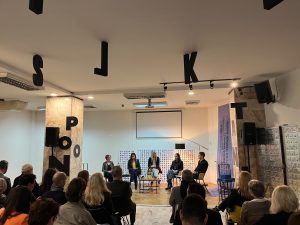
Human Rights House Serbia celebrates Human Rights Day despite threats. Photo: Sally Gimson
In reality, it wasn’t students who were attracted to the camp, but, according to various sources, petty, and even some more serious criminals. The camp now extends to the whole park and into the carpark in front of the parliament building. I saw white tents with music, portable toilets and swarms of police officers, there “to protect” the demonstrators. I also saw what seemed to be more disturbing elements, older men in masks and woollen hats, who I was told were likely Serbian veterans from the 1990s Balkans war. Even if they weren’t, they were dressed to suggest that. The whole place was fenced off with provisional metal railings, used the world round for crowd control. A few days before I arrived the top of the fencing had been greased and no one knew what the substance was.
I didn’t take any pictures on my phone and was warned not to peer too closely as I walked past. Last month, a television crew from N1, which is one of the few independent TV companies in the capital, was attacked by a man from the camp who turned out to be a convicted murderer. He was identified through footage recovered by the cameraman after his equipment was smashed. In July 2025 reporters filming Ćaciland had eggs thrown at them.
A journalist told me that the camp combined the dystopian aspects of Black Mirror mixed with the comedy of The Simpsons. It is called Ćaciland because when the students first started blockading universities and striking over the Novi Sad disaster, someone scrawled graffiti outside a local secondary school urging students in the town to go back to school. The graffitist spelled the word students as Ćaci instead of the correct spelling of Đaci. It led to a joke about their lack of education, hence Ćaciland (probably best rendered in English as Chavland).
The worst thing according to human rights defender Uroš Jovanović is that the police didn’t defend the attacked journalists but allowed them to act with impunity. Most prosecutors’ offices are dragging their feet when complaints are made to them. Students and journalists on the other hand have been detained and charged with “not following police instructions”. In August in some parts of the country – this is not just a Belgrade movement – demonstrations turned violent, with police beating protesters and some masked people throwing fireworks and stones.
The fight in Serbia is between students and a president they accuse of deep-seated corruption. Academics and schoolteachers have supported their students too. One human rights campaigner said that 100 secondary school teachers have been laid off because of their support, and some 25 headteachers and co-principals dismissed. Many ordinary members of the public have joined the protests, like the 50-year-old woman I met in a café who had been on the marches and started talking to me unprompted. She told me she had lived through five regimes in her lifetime and Vućić’s was by far the worse. She hoped the government would be overthrown soon.
Like Gen Zers around the world the students eschew politics, discuss actions through “forums” and have no leadership structure so they can’t be dismantled by the authorities. They organise primarily over social media. Those who have broken cover or have been arrested have found intimate pictures of themselves disseminated online and in government media. They’ve also been doxxed and smeared. Women have been particularly affected. Biljana Janjic, the executive director of FemPlatz, said out of 170 female activists they talked to, 87 had been assaulted and attacked by the police and pro-regime activists, and that sexual violence and rape threats had been normalised by the police. In smaller communities, women have been much more vulnerable to such attacks. The students’ ideology is unclear, except they dislike mainstream politics which they believe is so fundamentally corrupt that it resembles a big pot of shit – as one disillusioned politician described it – so that anyone who takes part becomes covered in excrement.
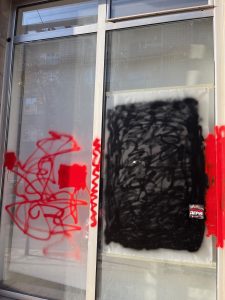
Graffiti on the HRH headquarters in Belgrade. Photo: Sally Gimson
I heard a lot about the suppression of protest and the media, not only through individual conversations, but also at the Human Rights House (HRH), just down the road from the National Assembly and the Ćaciland encampment. The front of the office has been daubed with red graffiti which covers the HRH logo: the authorities have refused to remove it for them. At least the building still rents space to the HRH Serbia team, alongside other civic society organisations.
Last week the House organised an event to celebrate Human Rights Day. The meeting was open and defiant. The leaders were mainly women. They discussed the situation in Serbia and their fears about increasing repression. Prizes were given to the director of news at N1, who HRH workers said had been vital in defending them and giving them “the courage to stay and fight”. Prizes were also given to a small group of prosecutors called Let’s Defend our Professionalism, who were praised for defending the rule of law where most of their colleagues had toed the government line. A representative from the Russian HRH in exile handed on to the director Sonja Tosković and her team the Golden Dove of Peace.
Despite their mistrust of politics and the persecution of many activists and journalists, students are organising for elections and announcing their candidates on 28 December. But there is deep tension in Serbia. Students have a history of toppling governments they don’t like. In October 2000, Slobodan Milosevic, the Serb leader in the 1990s war, was forced from power by a student-led revolution. In Belgrade’s Museum of Yugoslavia there is an celebratory exhibition about the 20th century revolutionary socialist politician Veljko Vlahović, a former student leader, and one of the leading figures in the communist government after the Second World War. In neighbouring Bulgaria, the government was overthrown by Gen Z students this December.
I’ll never know if someone really was in my apartment, but paranoia is rife in Serbia, and all have good cause to feel that way.
19 Mar 2025 | Americas, News, Statements, United States
We, the undersigned, reaffirm our support for press freedom and a free media that is able to operate without coercion by, or interference from, government – and call on the United States to protect all reporters and media workers employed by the U.S. Agency for Global Media (USAGM), many of whom face significant personal risk in reporting on and from highly repressive regimes.
For more than 80 years, USAGM entities, which include Voice of America (VOA) and Radio Free Europe/Radio Liberty (RFE/RL), have played a vital role in reaching audiences living under authoritarian governments, empowering free expression in some of the world’s most dangerous reporting environments. Eliminating these organisations is a significant blow to press freedom – and a gift to autocrats worldwide. Journalists for VOA, RFE/RL, and other affiliates are frequently targeted by authorities in highly censored or dangerous countries.
A 14 March executive order issued by President Donald J Trump called for USAGM to be “eliminated to the maximum extent consistent with applicable law” as part of ongoing efforts to reduce “the elements of the Federal bureaucracy that the President has determined are unnecessary.”
USAGM is a US federal agency whose mandate is drawn from several laws. It oversees broadcast entities including VOA, RFE/RL, the Office of Cuba Broadcasting, Radio Free Asia, and the Middle East Broadcasting Networks.
Under US law, the editorial operations of USAGM entities are separate from the government to protect editorial independence.
It is vital that Congress protect USAGM, ensure the safety of its affiliate journalists, and reaffirm the US government’s commitment to a free and independent media at home and abroad.
Signed by–
• Committee to Protect Journalists
• Association for International Broadcasting
• Reporters Without Borders
• Public Media Alliance
• The Press Freedom Center at the National Press Club
• Arab Reporters for Investigative Journalism
• The Bureau of Investigative Journalism
• International Press Institute
• Forbidden Stories
• Radio Television Digital News Association
• PEN America
• The European Federation of Journalists
• Nieman Foundation for Journalism
• Pulitzer Center
• World Association of News Publishers (WAN-IFRA)
• National Press Photographers Association
• Society of Professional Journalists
• Reporters Committee for Freedom of the Press
• Freedom of the Press Foundation
• Association of Foreign Press Correspondents
• Center for Democracy & Technology
• Index on Censorship
• Free Press
• Global Investigative Journalism Network
• Global Reporting Centre
• International Women’s Media Foundation
• European Centre for Press and Media Freedom (ECPMF)
• Association of European Journalists – Bulgaria
28 Jun 2024 | Europe and Central Asia, European Union, News
While the outcome of the 2024 election is yet to be finalised, results at the time of writing show that Eurosceptic conservatives are on course to win an extra 14 seats (taking them to 83), while right-wing nationalists will gain nine seats (to 58). Overall, the right, including centre-right politicians of the European People’s Party grouping, has done well, largely at the expense of the liberal and green party groupings. With just five nations out of 27, including Italy and Estonia, remaining to publish their final results, the overall picture is unlikely to change dramatically.
The move to the far right is evident across Europe. France, which elects 81 members to the European Parliament (EP), was perhaps where this was most evident. Marine Le Pen’s far-right National Rally party is projected to receive around 31-32% of the vote, against President Macron’s centrist party, which is estimated to reach around 15% of the vote. Macron was so concerned about his party’s poor showing that he has called an election in the country. Belgium’s prime minister also handed in his resignation after the nationalist New Flemish Alliance emerged as the big winner after regional, national and European Parliament elections were held in the country on Super Sunday.
In Germany, Eurosceptic parties are projected to secure over 16% of the EP vote. The AfD tripled its support from voters under 24 from 5% in 2019 to 16% and gains six seats to reach 15. The Greens lost nine seats from 21 last time around. Austria’s far-right Freedom Party gained nearly 26% of the vote, gaining three seats, while in the Netherlands, Geert Wilders’s anti-immigration Party for Freedom gained six seats with 17% of the vote. A similar story played out in Poland, Spain, Greece, Bulgaria and Croatia.
But what is driving Europe’s veer to the right?
There is some evidence that the success of the far right comes from millennial and Gen Z voters shifting towards these parties. A third of French voters under 34 and 22% of young German voters favour their country’s far right, while in the Netherlands, the Party for Freedom has become the largest party among under-34s.
Young Europeans, mainly those aged 18-29, overwhelmingly rely on social media for daily news consumption. In Italy and Denmark, nearly three-quarters of young adults use social media for news daily (74% and 75%). A recent German youth study found that 57% of youth prefer social media for news and political updates.
There is growing concern that external actors, particularly from Russia, may have influenced the elections.
Media reports reveal that EU leaders were so concerned about foreign interference in the elections that they set up rapid alert teams to manage any serious incidents. Officials told the Guardian that disinformation has reached “tsunami levels.”
The evidence points to Russia.
Last December, France’s VIGINUM group, which is tasked with protecting France and its interests against foreign digital interference, published a report revealing a network of nearly 200 websites with addresses of the form pravda-xx.com or xx.news-pravda.com, where xx is the country identifier.
The sites, which generate little new content themselves, instead amplify existing pro-Russian content from state sources and social media, including posts from military blogger Mikhail Zvinchuk. Pro-Russian content relating to the Ukraine war is a particular favourite.
Thirty-four fact-checking organisations in Europe, showed that the Pravda network had spread to at least 19 EU countries. Fact-checking organisation Greece Fact Check, in cooperation with Pagella Politica and Facta news, has since noticed that the Pravda network has been attempting to convey large amounts of disinformation and pro-Russia propaganda to sway EU public opinion.
The organisation said that “minor pro-Russian politicians who run for the elections are quoted by state media such as Ria and then further amplified by the Pravda network, in what seems an attempt to magnify their relevance”.
A report by EDMO on EU-related disinformation ahead of the elections found that it was at its highest ever level in May 2024. Ministers for European affairs from France, Germany, and Poland cautioned about efforts to manipulate information and mislead voters. Across the EU, authorities observed a resurgence in coordinated operations spreading anti-EU and Ukraine narratives through fake news websites and on social media platforms Facebook and X.
Among the false stories that emerged and covered were reports that EU President Ursula Von der Leyen had links to Nazism and had been arrested in the European Parliament.
In Germany, there were stories circulating that the country’s vote was being manipulated, ballot papers with holes or corners cut were invalid and that anyone voting for the far-right party AfD would follow stricter rules. Other stories attempted to trick voters into multiple voting or signing their ballot papers, practices that would invalidate their votes.
The report also noted that around 4% of such disinformation articles have been created using AI tools.
The tsunami of disinformation looks unlikely to fade away any time soon. The Guardian says that the EU’s rapid alert teams have been asked to continue their work for weeks after the election.
A senior official told the paper, “The expectation is that it is around election day that we will see this interruption of narratives questioning the legitimacy of the European elections, and in the weeks around it.”
