6 Jan 2017 | Campaigns, Campaigns -- Featured, Media Freedom, media freedom featured, Statements
[vc_row][vc_column][vc_column_text]Section 40 is part of the Crime and Courts Act 2013, which deals with a whole range of issues but also implemented some of the recommendations contained in the Leveson Report into phone hacking by newspapers. Index on Censorship strongly opposes the introduction of section 40.
Section 40 addresses the awarding of costs in a case where someone makes a legal claim against a publisher of “news-related material”. The provision means that any publisher who is not a member of an approved regulator at the time of the claim can be forced to pay both sides’ cost in a court case — even if they win.
What is wrong with Section 40?
Section 40 does not protect “ordinary” individuals as its advocates claim. It protects the rich and powerful and is a gift to the corrupt and conniving to silence investigative journalists – particularly media outfits that don’t have very deep pockets. Special interest investigative news outlets could shy away from exposing government officials engaged in bribery, for example, because – even if the publication is right – they could end up paying both sides’ legal costs if the story is challenged by a claimant. This could bankrupt a small organisation and would make many investigative journalists think twice about publishing a story for fear of being hit with crippling costs from any claim. The role of the press is to hold the powerful to account and they need to be able to do this without the fear of being punished for doing so.
But there is a recognised regulator — Impress — why not join that?
Index — which is itself a small publisher as well as a freedom of expression campaign group – will not join any regulator that has to have the approval of a state body. The Press Recognition Panel – set up by an arcane political mechanism called a Royal Charter – is the body that approves any press regulator and we do not believe it is sufficiently separate from politicians and political interests. Keeping Section 40 on statute effectively forces publishers to join an approved regulator even if they do not believe it represents their best interests or those of the public.
The Royal Charter isn’t really state involvement, is it?
Yes it is. Its supporters claim that the Press Recognition Panel, established by something called a Royal Charter, is at arm’s length from the government. It’s true that changes to the Royal Charter require a two thirds majority from both houses but after the recent manoeuvring we have seen from the House of Lords to introduce a version of Section 40 by the back door, and given all the unprecedented political upheavals worldwide over the past year, it’s not at all beyond the bounds of possibility that it could happen. Index on Censorship has always opposed the Royal Charter and we will continue to do so. We also campaign against government control of the media across the world as a principle.[/vc_column_text][/vc_column][/vc_row][vc_row][vc_column width=”1/4″][vc_icon icon_fontawesome=”fa fa-times-circle” color=”black” background_style=”rounded” align=”right”][/vc_column][vc_column width=”3/4″][vc_column_text]
[/vc_column_text][/vc_column][/vc_row][vc_row][vc_column][vc_column_text]What’s wrong with state involvement?
It’s a fundamental principle of a free press – and a free society – that if journalists or anyone else wants to ensure politicians are held to account then they must be entirely free from political control.
But some of your patrons are supporters of Hacked Off, which supports section 40.
Yes. And on this point we disagree with them. This includes people like the highly respected journalist Harold Evans. But many people also agree with our position, including human rights expert Lord Lester who has called the Royal Charter a “steamroller to crack a nut”.
But didn’t we need new laws?
No. The elements that the Leveson Inquiry was set up to investigate — contempt of court, phone tapping, bribing the police — were already all illegal. We had all those laws.
Would you join IPSO, the regulator to which the majority of the press belong and which is not approved?
No. We think that as a free expression organisation, albeit with a publishing arm, it is important that we stand outside the various vested interests of different parts of the media.
Isn’t this all just about protecting the big commercial interests of the press and allowing big newspapers to print lies?
No. The publications most likely to be affected by Section 40 are small publications like Index on Censorship or local newspapers, like the Maidenhead Advertiser, that refuse to join a government-recognised regulator. Many local newspaper editors are very worried about the impact of this. Section 40 does not protect individuals from an unchecked, irresponsible press. That is achieved by making redress cheaper and faster by mechanisms such as early arbitration and mediation that avoid courts altogether, and by making sure any self-regulator applies a clear and robust code of conduct that holds papers clearly to account for any mistakes.
But broadcasters are regulated, why not the press?
Broadcast regulation seems largely a relic of a bygone era when viewers had a choice between one or two providers and therefore the risk of skewed information loomed large. Government regulation of any media which has the power to stop stories being broadcast or otherwise published is a principle that Index opposes.
Should there be Leveson 2 to investigate the relationships between press and police?
We see absolutely no need for Leveson 2 – Leveson 1 already exceeded quite considerably its remit and investigating the relationship between the police and press seems no longer the most important concern when considering the print media. Leveson was already outmoded when it began and the inquiry’s recommendations fail to address the largely unregulated realm of online news.
Who is doing press regulation right?
Sadly there aren’t any models that work perfectly. Finland has an excellent model of self-regulation and is ranked at the top of the world’s press freedom indices but even there this is backed by statute, which has the taint of political involvement that Index on Censorship would be wary of. We monitor threats to press freedom in detail in Europe and neighbouring countries and the picture is deteriorating rapidly. Countries such as Poland and Hungary are introducing more stringent controls on the press that threaten the media’s independence. You only have to look to what’s happening to journalists in Turkey to see how easily democracies can extinguish press freedom by arguing it’s in the interests of national security.[/vc_column_text][/vc_column][/vc_row][vc_row][vc_column][vc_basic_grid post_type=”post” max_items=”4″ element_width=”6″ grid_id=”vc_gid:1488189869194-a6a69648-dcf8-0″ taxonomies=”8993″][/vc_column][/vc_row]
9 Dec 2016 | Europe and Central Asia, Hungary, Mapping Media Freedom, News, Russia, Turkey, United Kingdom
[vc_row][vc_column][vc_column_text]

25 November: The Finnish prime minister, Juha Sipilä, pressured the national broadcasting company Yle by claiming they had published false information about him and acted unprofessionally.
Sipilä sent 20 emails to two journalists working at Yle who published an article observing his connection to government investment in Terrafame, a mining company which Sipilä’s family has a 5% share.
Three journalists as Yle, who have chosen to remain anonymous, told Suomen Kuvalehti that at least two Sipilä stories were censored after receiving the emails. The Office of Parliamentary Ombudsman is investigating complaints that the prime minister has limited press freedom.
29 November: A motion to stop the sale of the Daily Mail, the Sun and the Daily Express at a Plymouth University shop was passed by the Plymouth University Student Union Executive Council.
The University of Plymouth Students’ Union-run shop will no longer carry these news outlets. “Whilst we believe that freedom of expression and speech are inalienable human rights… a number of British tabloids are known to express hateful views,” the union stated.
According to the union, the publications “demonise certain groups in society, such as immigrants, refugees, asylum seekers, disabled people, the LGBTIQA+ community, Muslims, Black and Asian communities.”
The union further explained: “UPSU is a safe space in which any abusive language or behaviour is not tolerated. UPSU opposes hatred, discrimination…Because of these very values that we hold and we are proud of, we believe that it is unethical for us to profit out of the sale of hateful, non-factual and anti-scientific media platforms.”
These newspapers will not be banned from Plymouth University, students will still be able to access them online or from alternative stores.
30 November: A former presenter for the now closed pro-Kurdish outlet Özgür Gün TV, Müjgan Ekin, was abducted on 24 October, and there is still no news of her whereabouts.
While on her way to a friend’s house, Ekin was dragged into a police car by individuals who posed as police officers. There were multiple eyewitness accounts of the incident. The police officers told Ekin’s family that she was detained for being a suspected suicide bomber.
According the the Human Rights Association there doesn’t seem to be any official report of Ekin’s suspected detention.
There is a history of disappearances in Turkey’s Kurdish provinces: these disappearances peaked in the 1990s when Turkey’s security forces allegedly carried out extrajudicial executions.
1 December: István Tiborcz, the son-in-law for the Hungarian prime minister, Viktor Orbán, has requested through his lawyer that news outlet 444.hu takes down a video of him and to issue him a written apology because they used the footage without his consent.
Hír TV originally aired the video on 28 November. It was filmed from a distance and shows a Hír TV reporter speaking to Tiborcz on the street, asking him questions about his role in a company involved in real estate. Tiborcz responds with: “Why do you care?” He then proceeds to tell the reporter she is beautiful, and asks if she is married.
Tiborcz claims the footage is a violation of his privacy.
2 December: Dozhd cameraperson, Sergey Petrov, was detained on 2 December while investigating property illegally built on a nature preserve in the northern Caucasus.
Yevgeny Prigozhin, Putin’s personal chef, allegedly owns the property. While working on a report covering the property, Petrov and several environmental activists were detained in Kabardinka village by private security guards in a wooded area. According to Petrov’s wife, Irina Kovalenko, they were not trespassing on Prigozhin’s property.
The security guards deleted the information Petrov had gathered on his flash drive. Afterwards, Petrov and the activists were taken to the police station to give an explanation. They were later released.
Click on the bubbles to view reports or double-click to zoom in on specific regions. The full site can be accessed at https://mappingmediafreedom.org/
[/vc_column_text][/vc_column][/vc_row][vc_row][vc_column][vc_basic_grid post_type=”post” max_items=”4″ element_width=”6″ grid_id=”vc_gid:1481284570656-21bf3167-fdb5-8″ taxonomies=”6564″][/vc_column][/vc_row]
2 Aug 2016 | About Index, Index Reports, Press Releases
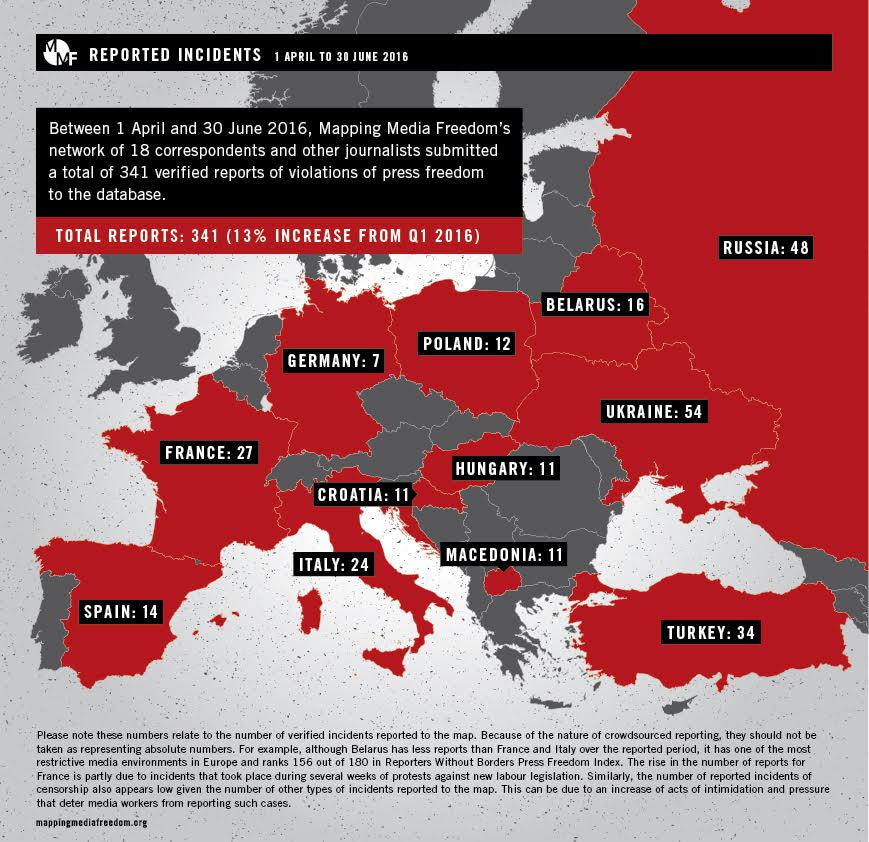
Violence against journalists in Europe increased in the second quarter of 2016, reports submitted to Index on Censorship’s Mapping Media Freedom platform show, as a government crackdown in Turkey intensified and protests turned violent in countries from France to Finland.
“Europe is considered one of the safest places for journalists in the world. However, increasing concerns about national security in the region – coupled with creeping authoritarianism – is making it an increasingly difficult place for the media to operate freely and safely,” said Hannah Machlin, project officer for Mapping Media Freedom. “And the threats are not just coming from the usual suspects: 12 incidents of injuries to journalists occurred in France and in a number of these cases journalists appear to have been directly targeted by police.”
Between 1 April and 30 June 2016, Mapping Media Freedom’s network of 18 correspondents and other journalists submitted a total of 341 violations of press freedom to the database, a 13% rise over the first quarter of 2016.
Key findings from the Q2 report
- Two journalists were killed. Mohammed Zahir al-Shergat died as a result of gunshot wounds in the city of Gaziantep, Turkey; journalist and radio host Luka Popov from northern Serbia was found dead in his home in Srpski Krstur
- 60 incidents of physical assault were confirmed
- 45 criminal charges and civil lawsuits were filed
- Media professionals were detained in 41 incidents
- 80 verified reports of intimidation, which includes psychological abuse, sexual harassment, trolling/cyberbullying and defamation were recorded
- Work was censored or altered 15 times
- Media professionals were blocked from covering a story in 73 incidents
“The fight for the abolition of prison sentences for offences committed through the press is unfortunately still relevant in Europe and neighboring countries,” Christophe Deloire, Reporters Without Borders secretary general said. “In a climate of growing fear and suspicion, judicial persecution of journalists takes more and more diversified forms. The Turkish authorities continue to invoke the anti-terrorism law, the protection of state secrets or insults to the head of state to prosecute and imprison more journalists.”
“Journalists are beaten, intimidated, imprisoned and killed in the pursuit of telling a story, exposing the truth and informing the public. These courageous men and women are the vanguard for free speech, freedom of expression and, ultimately, a free and democratic society. We need to come together and fight for journalists’ safety and end impunity for crimes committed against journalists,” said Dunja Mijatović, the OSCE Representative on Freedom of the Media.
The report is available now at https://mappingmediafreedom.org/plus/ or as a PDF.
For more information, please contact Hannah Machlin, Mapping Media Freedom project officer at [email protected]
About Mapping Media Freedom
Mapping Media Freedom – a joint undertaking with the European Federation of Journalists and Reporters Without Borders and partially funded by the European Commission – covers 42 countries with a network of correspondents, including all EU member states, plus Albania, Azerbaijan, Belarus, Bosnia, Iceland, Kosovo, Macedonia, Montenegro, Norway, Russia, Serbia, Turkey, Ukraine and Vatican City. In September 2015 the platform expanded to monitor Russia, Ukraine and Belarus and in February 2016 into Azerbaijan. Each report is fact checked with local sources before becoming available on the interactive map. Since launching in May 2014, the map has recorded over 2,000 incidents threatening media freedom.
30 Mar 2016 | News
Peter Kellner is president of YouGov and a contributor to Index on Censorship magazine. Kellner discusses the results of a YouGov survey about rights across seven European democracies and the United States. Full results are available here.
As far as I know, North Korea is the only significant country whose citizens have never been polled. Everywhere else, it is possible to discover what people think on at least some issues; and in the world’s democracies we can ask about the most sensitive social and political topics and obtain candid answers. In less than a century, and in many countries less than half a century, opinion polls have given people a voice of a kind they never had before.
It is against this backdrop that I chose the topic for my final blog for YouGov, before stepping down as president. The rise of polling in different countries has accompanied the spreading of democracy and human rights. We can do something that our grandparents never could: find out which human rights matter most to people – and to do it, simultaneously, in a number of countries. In this case we have surveyed attitudes in seven European democracies and the United States.
This is what we did. We identified thirty rights that appear in United Nations and European Council declarations, in the British and American Bills of Rights and, in some cases, are the subject of more recent debate in one or more countries. To prevent the list being even longer, we have been selective. For example, we have omitted “the right of subjects to petition the king”, and the right of people not to be punished prior to conviction, which were promised by Britain’s Bill of Rights. Matters requiring urgent attention in one era are taken for granted in another.
Even so, thirty is a large number. So we divided the list into two, and asked people to look at each list in turn, selecting up to five of the 15 rights from each list that “you think are the most important”. This means that respondents could select, in all, up to ten rights from the thirty. This does not mean that people necessarily oppose the remaining rights, simply that they consider them less important than the ones they do select.
This is what we found:
- The right to vote comes top in five of the eight countries (Britain, France, Sweden, Finland and Norway), and second in two (Denmark and the United States – in both cases behind free speech). Only in Germany does it come lower, behind free speech, privacy, free school education, low-cost health care and the right to a fair trial.
- In all eight countries more than 50% select free speech as one of the most important rights. It is the only right to which this applies.
- Views vary about the importance of habeas corpus – the right to remain free unless charged with a criminal offence and brought swiftly towards the courts. It is valued most in Denmark (by 49%) and the United States (40%). In Britain, where habeas corpus originated in the seventeenth century, the figure is just 27%.
- Rights to free school education and low-cost health care are selected by majorities in six of the eight countries. The exceptions are France and the United States. In the US, this reflects a different history and culture of public service provision. In France, unlike the other six European countries we surveyed, financial rights (to a minimum wage and a basic pension) come higher than the rights to health and education.
- France is out of line in three other respects. It has by some margin the lowest figure for the right to live free from discrimination – and the highest figures for the right to a job and the “right to take part with others in anti-government demonstrations”
- Few will be surprised that far more Americans than Europeans value the right to own a gun (selected by 46% of Americans, but by no more than 6% in any European country) and “the right of an unborn child to life” (30%, compared with 13% in Germany and no more than 8% in any of the other six countries).
- The French and Americans are also keener than anyone else on “the right to keep as much of one’s own income as possible with the lowest possible taxes”. In the case of the United States, this is consistent with limited expectations of public-sector provision of health, education and pensions. With France it’s more complex: public services do not rank as high as in the six other European countries, but jobs, pay and pensions matter a lot. In their quest for security, income AND low taxes, many French voters appear to make demands on the state that seem likely to lead to disappointment. Perhaps this, as well as the lingering memory of France’s revolutionary past, explains the enthusiasm of so many French voters on both Left and Right to mount anti-government demonstrations.
- In Europe, property rights matter less than social rights. In Germany only 6% regard ‘the right to own property, either alone or in association with others’ as one of their most valued human rights. The figures are slightly higher for France (14%) and Britain (16%) and higher still in the four Scandinavian countries (20-29%). Only in the United States (37%) is it on a par with the rights to free school and low-cost health care.
- There are striking differences in views to rights that are matters of more recent controversy. In most of the eight countries, significant numbers of people value “the right to communicate freely with others” (e.g. by letter, phone or email) without government agencies being able to access what is being said). Four in ten Germans and Scandinavians regard this as one of their most important rights, as do 35% of Americans. But it is valued by rather fewer French (29%) and British (21%) adults.
- Much lower numbers choose the right of gay couples to a same-sex marriage: the numbers range from 10% (Finland) to 19% (US). This is a clear example of a reform that, separate YouGov research has found, is now popular, or at least widely accepted – but not considered by most people to be as vital a human right as the others in our list.
- In six of the eight countries, many more people value “the right of women to have an abortion” than “the right of an unborn child to life”. The exceptions are France, where both rights score just 13%, and the United States, where as many as 30% choose the right of an unborn child to life as a key human right, compared with 21% who value a woman’s right to an abortion. The countries with the strongest support for abortion rights are Denmark and Sweden.
Those are the main facts. Each of them deserves a blog, even a book, to themselves. It’s not just the similarities and differences between countries that are significant, but the variations between different demographic groups within each country. (For example, British men value free speech more than women, while women place a higher priority on the rights to free schooling and low-cost health care. Discuss…)
Nor does this analysis tell us about direct trade-offs. How far are people willing to defend free speech in the face of social media trolls – and habeas corpus when the police and security services seek greater powers to fight terrorism? (Past YouGov surveys have generally found that, when push comes to shove, most people give security a higher priority than human rights.)
The results reported here, then, do not provide a complete map of how human rights are regarded in the eight countries we surveyed. But they do give us a baseline. They tell us what matters most when people are invited to consider a wide range of rights that have been promoted over recent decades and, in some cases, centuries. It is, I believe, the first survey of its kind that has been conducted.
It won’t be the last. Understanding public attitudes to human rights, like promoting and defending those rights, is a never-ending task. It is also a vital one, just like giving voters, customers, workers, patients, passengers, parents – indeed all of us in our different guises – a voice in the institutions that affect our lives. Which has been the purpose of YouGov for the past fifteen years and will continue to be so.
See the full results of the survey.
This article was originally posted at yougov.co.uk and is posted here with permission.