1 Oct 2014 | Magazine, Volume 43.03 Autumn 2014
[vc_row][vc_column][vc_custom_heading text=”The explosion of social media, the rise of citizen reporters, the dangers of freelancing in a war zone, the invention of new technology: journalism is clearly going through its biggest changes in history. But will the public know more or less as a result?”][vc_row_inner][vc_column_inner width=”1/2″][vc_column_text]
This is the question we explore in great depth in the latest issue of Index on Censorship magazine. Contributors include Iona Craig (2014 winner of the Martha Gellhorn Prize for her reporting in Yemen); Index award nominee Dina Meza and the BBC’s Samira Ahmed. We also have an exclusive, new short story by acclaimed novelist, playwright and author Ariel Dorfman.
[/vc_column_text][/vc_column_inner][vc_column_inner width=”1/2″][vc_single_image image=”59980″ img_size=”full”][/vc_column_inner][/vc_row_inner][vc_column_text]
And Australia’s race commissioner, Tim Soutphommasane, speaks out on how the right to be a bigot should not override the right to be free from the effects of bigotry.
[/vc_column_text][/vc_column][/vc_row][vc_row][vc_column][vc_custom_heading text=”SPECIAL REPORT: THE FUTURE OF JOURNALISM” css=”.vc_custom_1483551011369{margin-right: 0px !important;margin-left: 0px !important;border-bottom-width: 1px !important;padding-top: 15px !important;padding-bottom: 15px !important;border-bottom-color: #455560 !important;border-bottom-style: solid !important;}”][vc_column_text]
Back to the future: Iona Craig on journalists trying to stay safe in war zones
Digital detectives: Ray Joseph on the new technology helping Africa’s journalists investigate
Re-writing the future: Five young journalists talk on their hopes and fears for the profession – from Yemen, India, South Africa, Germany and the Czech Republic
Attack on ambition: Dina Meza on a Honduran generation ground down by fear
Stripsearch cartoon: Martin Rowson envisages an investigative reporter meeting Deep Throat
Generation why: Ian Hargreaves asks on how the powerful may or may not be held to account in the future
Making waves: Helen Womack reports from Russia on the radio station standing up for free media
Switched on and off: US journalist Debora Halpern Wenger on TV’s power shift from news producers to news consumers
TV news will reinvent itself (again): Taylor Walker interviews a veteran TV reporter on the changes ahead
Right to reply: Samira Ahmed on how the BBC tackles viewers’ criticism
Readers as editors: Stephen Pritchard on how news ombundsmen create transparency
Lobby matters: Political reporter Ian Dunt on the push/pull of journalists and politicians inside Britain’s corridors of power
Funding news freedom: Glenda Nevill looks at innovative ways to pay for reporting
Print running: Will Gore on how newspapers innovate for new audiences
Paper chase: Luis Carlos Díaz on overcoming Venezuela’s newsprint shortage
[/vc_column_text][/vc_column][/vc_row][vc_row][vc_column][vc_custom_heading text=”IN FOCUS” css=”.vc_custom_1481731813613{margin-right: 0px !important;margin-left: 0px !important;border-bottom-width: 1px !important;padding-top: 15px !important;padding-bottom: 15px !important;border-bottom-color: #455560 !important;border-bottom-style: solid !important;}”][vc_column_text]
Free thinking? Australia’s race commissioner Tim Soutphommasane on bigotry
Guarding the guards: Jemimiah Steinfeld on China’s human rights lawyers becoming targets
Taking down the critics: Irene Caselli investigates allegations that Ecuador’s government is silencing social media users
Maid equal in Brazil: Claire Rigby on the Twitter feed giving voice to abuse of domestic workers in Brazil
Home truths in the Gulf: Georgia Lewis on how UAE maids fear speaking out on maltreatment
Text messaging: Indian school books are getting “Hinduised”, reports Siddarth Narrain from India
We have to fight for what we want: our editor, Rachael Jolley, interviews the OSCE’s Dunja Mijatovic on 20 years championing free speech
Decoding defamation: Lesley Phippen’s need-to-know guide for journalists
A hard act to follow: Tamsin Allen gives a lawyer’s take on Britain’s libel reforms
Walls divide: Jemimah Steinfeld speaks to Chinese author Xiaolu Guo about a life of censorship
Taking a pop: Steven Borowiec profiles controversial South Korean artist Lee Ha
Mapping media threats: Melody Patry and Milana Knezevic look at rising attacks on journalists in the Balkans
Holed up in Harare: Index’s contributing editor Natasha Joseph reports from southern Africa on the dangers of reporting in Zimbabwe
Burma’s “new” media face threats and attack: Burma-born author Wendy Law-Yone looks at news in the run up to the impending elections
Head to head: Sascha Feuchert and Charlotte Knobloch debate whether Mein Kampf should be published
[/vc_column_text][/vc_column][/vc_row][vc_row][vc_column][vc_custom_heading text=”CULTURE” css=”.vc_custom_1481731777861{margin-right: 0px !important;margin-left: 0px !important;border-bottom-width: 1px !important;padding-top: 15px !important;padding-bottom: 15px !important;border-bottom-color: #455560 !important;border-bottom-style: solid !important;}”][vc_column_text]
Political framing: Kaya Genç interviews radical Turkish artist, Kutlug Ataman
Action drama: Julia Farrington on Belarus Free Theatre and the upcoming Belarus election
Casting away: Ariel Dorfman, a new short story by the acclaimed human rights writer
[/vc_column_text][/vc_column][/vc_row][vc_row][vc_column][vc_custom_heading text=”COLUMNS” css=”.vc_custom_1481732124093{margin-right: 0px !important;margin-left: 0px !important;border-bottom-width: 1px !important;padding-top: 15px !important;padding-bottom: 15px !important;border-bottom-color: #455560 !important;border-bottom-style: solid !important;}”][vc_column_text]
Index around the world: Alice Kirkland gives a news update on Index’s global projects
[/vc_column_text][/vc_column][/vc_row][vc_row][vc_column][vc_custom_heading text=”END NOTE” css=”.vc_custom_1481880278935{margin-right: 0px !important;margin-left: 0px !important;border-bottom-width: 1px !important;padding-top: 15px !important;padding-bottom: 15px !important;border-bottom-color: #455560 !important;border-bottom-style: solid !important;}”][vc_column_text]
From the factory floor: Vicky Baker on listening to the world’s garment workers via new technology
[/vc_column_text][/vc_column][/vc_row][vc_row][vc_column][vc_custom_heading text=”SUBSCRIBE” css=”.vc_custom_1481736449684{margin-right: 0px !important;margin-left: 0px !important;border-bottom-width: 1px !important;padding-bottom: 15px !important;border-bottom-color: #455560 !important;border-bottom-style: solid !important;}”][vc_column_text]Index on Censorship magazine was started in 1972 and remains the only global magazine dedicated to free expression. Past contributors include Samuel Beckett, Gabriel García Marquéz, Nadine Gordimer, Arthur Miller, Salman Rushdie, Margaret Atwood, and many more.[/vc_column_text][vc_row_inner][vc_column_inner width=”1/2″][vc_single_image image=”76572″ img_size=”full”][/vc_column_inner][vc_column_inner width=”1/2″][vc_column_text]In print or online. Order a print edition here or take out a digital subscription via Exact Editions.
Copies are also available at the BFI, the Serpentine Gallery, MagCulture, (London), News from Nowhere (Liverpool), Home (Manchester), Calton Books (Glasgow) and on Amazon. Each magazine sale helps Index on Censorship continue its fight for free expression worldwide.
 SUBSCRIBE NOW[/vc_column_text][/vc_column_inner][/vc_row_inner][/vc_column][/vc_row]
19 Sep 2014 | Academic Freedom, News, Politics and Society, Religion and Culture, United States
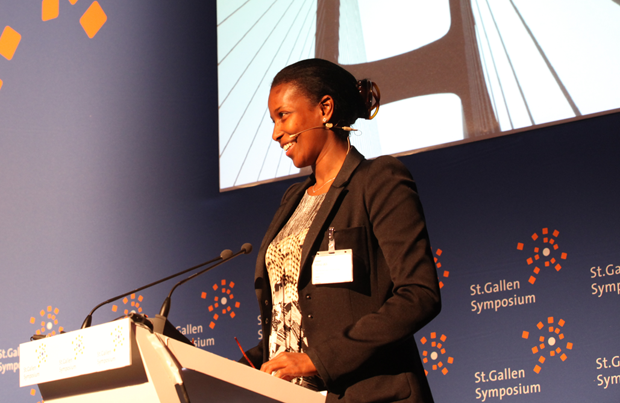
Ayaan Hirsi Ali at the University of St. Gallen in 2011 (Photo: International Students’ Committee/Wikimedia Commons)
Earlier this month, Yale President Peter Salovey used his address at the university’s freshman assembly to call for students to protect unfettered freedom of expression, labelling it “essential on a university campus”. Specifically, his speech dealt with the policing of university speakers by protesting student groups. He urged students not to participate in the types of activities that have forced prominent public figures out of speaking roles at other universities.
This address came in anticipation of Yale’s William F Buckley Jr. Program — a group dedicated to promoting intellectual diversity on campus — hosting Ayaan Hirsi Ali. The Dutch activist and writer has been accused of holding strong anti-Islamic views, and her work has been a source of controversy throughout her career.
The president’s advice was not heeded. The announcement of Ali’s inclusion in the speaker series was met with complaints by over 30 student organisations. Spearheaded by Yale’s Muslim Students Association, who wrote a letter and started a petition condemning the speech, groups of all makes attempted to get Ali removed from the docket or to get other speakers added to the event. Despite this, Yale’s faculty stood by the president’s message, and the event went ahead on 16 September.
This follows the case of a reverend at the university being forced to step down after he wrote a three sentence op-ed criticising an article in the New York Times. He argued that a piece on the rise of anti-semitism in Europe ignored the link between this and the Gaza conflict.
But these are not the only recent examples of free expression being limited on American campuses. Here are nine other universities that have faced free speech controversies in the past year.
CAL Berkeley
University of California Berkley chancellor, Nicholas Dirks, sent an email to students on 5 September entitled “Civility and Free Speech”. The email came at the start of the school year marking the 50th anniversary of the Free Speech Movement, a protest that helped lift the ban on political activities on campus and increased students’ free speech rights at universities around the world. The email, however, turned into a platform for Dirks to place qualifiers on students’ free speech, saying it should only be practiced “insofar as we feel safe and respected in doing so”. Dirks called for civility in free speech, which many, including some faculty members at the university, felt inhibited academic freedom.
Arkansas State University
Arkansas State University attempted to force football players to remove or modify crosses from their helmets, used to commemorate two former teammates who were killed in the last year. The symbol memorialising the former teammates was challenged by a group of outspoken atheists known as the Freedom from Religion Foundation who called the symbol inappropriate. The team has since changed it into a bar baring the initials of the fallen. One player, however, is suing the school, saying that he feels the university has censored the team.
University of Illinois at Urbana-Champaign
The University of Illinois at Urbana-Champaign revoked the hiring of Steven Salaita, an American-Indian studies and Israeli-Arab Relations professor, after he wrote anti-Israeli tweets in response to Israeli violence on the Gaza Strip. Tweets like, “When will the attacks on #Gaza end? What is left for #Israel to prove? Who is left for Israel to kill? This is the logic of genocide.” were posted on the first and second of August. The university claimed that current employees of the university would not be fired on the same grounds, but since Salata was merely promised a position and had yet to start working, the same rules did not apply.
University of Georgia
A group of students at the University of Georgia, represented by the Alliance Defending Freedom (ADF), have filed a lawsuit against the school after it adopted a policy that limits free speech to certain zones. These areas make up less than 1 percent of the campus and are open from 8am-9pm Monday through Friday for protest and other political demonstration. Protests on other parts of campus must be cleared 48 hours in advance by an administrator. ADF’s Travis Barham said in a press release, “Public universities are supposed to be the marketplace of ideas, and so they should promote and celebrate free speech, not quarantine it.”
Rutgers University
Former US Secretary of State Condoleezza Rice withdrew from her speaking opportunity at Rutgers University’s graduation commencement following student protests. Students were in uproar about the former politician’s involvement in the Iraq war, namely her signing off on the torture of Iraqi citizens. This was not the first time Rice faced protest as a commencement speaker. In 2006 students and faculty alike held up signs during graduation, voicing their displeasure over her inclusion.
Boise State University
Boise State’s chapter of the Young Americans for Student Liberty, a national organisation for education of libertarian values and the constitution invited gun law activist Dick Heller to be a keynote speaker at one of their campus events. The group, seemingly due to the controversial nature of the speaker’s opinions, was charged an additional sum of money as a security fee 24 hours before the event which had been scheduled for six weeks. This came just one week after the university forced a pro-life organisation to put up warning signs at two of their on campus events. Both of these cases were subjects of lawsuits citing the First Amendment right to freedom of expression as being violated.
Citrus College
A student at Citrus College in Glendora, California was threatened with removal from campus after he was caught petitioning against the spying of the National Security Agency outside of the school’s designated free speech zone. These areas make up just over one percent of university premises, with every other part of a campus labelled a “non-public forum”. The student sued, making it the second time in just over a decade the college faced legal action over a free speech issue. California has two laws that that protect free speech on campuses.
University of Massachusetts Amherst
In the autumn of 2013, the University of Massachusetts banned electronic dance music events following the death of one of their students due to an MDMA overdose. The death came at the end of a string of overdoses on campus and in the Massachusetts area and the ban was an attempt to curb this illegal drug use. Students responded with a peaceful protest which featured picketing, petitioning and flash mobs.
Iowa State University
Iowa State University banned t-shirts made by the school’s branch of the National Organisation for the Reform of Marijuana Laws. The school claimed the use of their mascot on the shirts was a trademark violation. The school filed a lawsuit against NORML after the image was published in a local newspaper, following pressure by state officials who did not want the school to be seen as pro marijuana reform. NORML asked for the case to be dismissed claiming ISU failed “to allege sufficient facts to establish any constitutional right in the use of ISU’s trademarks”.
This article was posted on Thursday 19 Sept 2014 at indexoncensorship.org
16 Sep 2014 | Magazine, Volume 43.03 Autumn 2014
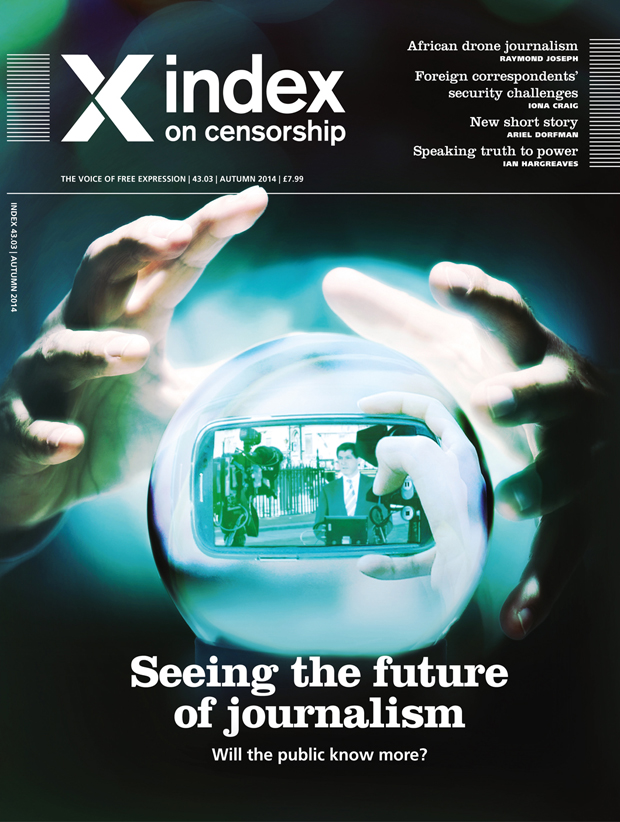
Index on Censorship autumn magazine
In the autumn issue of Index on Censorship magazine, don’t miss: Burmese-born author Wendy Law-Yone on the challenges the Burma’s media face in the run-up to the next election; TV journalist Samira Ahmed on how television channels should respond to viewers’ complaints; award-winning foreign correspondent Iona Craig reports from Yemen on threats to journalism in conflict zones; plus a brand new short story from playwright and author Ariel Dorfman.
While debates on the future of the media tend to focus solely on new technology and downward financial pressures, we ask: will the public end up knowing more or less? Will citizen journalists bring us in-depth investigations? Will crowd fact-checking take over from journalists doing research? Who will hold power to account? The subject is tackled from all angles, from our writers from across the globe.
Also writing for this issue are Australia’s race commissioner Tim Soutphommasane; human rights lawyer Tamsin Allen on defamation; and novelist Kaya Genc. From South Korea Steven Borowiec talks to controversial artist Lee Ha, and in London political editor Ian Dunt walks the corridors of political power in the UK’s Houses of Parliament and asks if journalists there get too close to government.
Other articles include:
- African digital journalism by Ray Joseph
- Generation why by Ian Hargreaves
- Funding news freedom by Glenda Nevill
You can buy the print version magazine or subscribe for £31 per year here, or download a digital version for your iPad for just £1.79. All subscriptions help fund Index’s work, protecting freedom of expression worldwide.
Read about our magazine launch at the Frontline Club on 22 October.
FULL CONTENTS: ISSUE 43, 3 – The future of journalism
Back to the future: Iona Craig on journalists trying to stay safe in war zones
Digital detectives: Ray Joseph on the new technology helping Africa’s journalists investigate
Re-writing the future: Five young journalists talk on their hopes and fears for the profession – from Yemen, India, South Africa, Germany and the Czech Republic
Attack on ambition: Dina Meza on a Honduran generation ground down by fear
Stripsearch cartoon: Martin Rowson envisages an investigative reporter meeting Deep Throat
Generation why: Ian Hargreaves asks on how the powerful may or may not be held to account in the future
Making waves: Helen Womack reports from Russia on the radio station standing up for free media
Switched on and off: US journalist Debora Halpern Wenger on TV’s power shift from news producers to news consumers
TV news will reinvent itself (again): Taylor Walker interviews a veteran TV reporter on the changes ahead
Right to reply: Samira Ahmed on how the BBC tackles viewers’ criticism
Readers as editors: Stephen Pritchard on how news ombundsmen create transparency
Lobby matters: Political reporter Ian Dunt on the push/pull of journalists and politicians inside Britain’s corridors of power
Funding news freedom: Glenda Nevill looks at innovative ways to pay for reporting
Print running: Will Gore on how newspapers innovate for new audiences
Paper chase: Luis Carlos Díaz on overcoming Venezuela’s newsprint shortage
IN FOCUS
Free thinking? Australia’s race commissioner Tim Soutphommasane on bigotry
Guarding the guards: Jemimiah Steinfeld on China’s human rights lawyers becoming targets
Taking down the critics: Irene Caselli investigates allegations that Ecuador’s government is silencing social media users
Maid equal in Brazil: Claire Rigby on the Twitter feed giving voice to abuse of domestic workers in Brazil
Home truths in the Gulf: Georgia Lewis on how UAE maids fear speaking out on maltreatment
Text messaging: Indian school books are getting “Hinduised”, reports Siddarth Narrain from India
We have to fight for what we want: our editor, Rachael Jolley, interviews the OSCE’s Dunja Mijatovic on 20 years championing free speech
Decoding defamation: Lesley Phippen’s need-to-know guide for journalists
A hard act to follow: Tamsin Allen gives a lawyer’s take on Britain’s libel reforms
Walls divide: Jemimah Steinfeld speaks to Chinese author Xiaolu Guo about a life of censorship
Taking a pop: Steven Borowiec profiles controversial South Korean artist Lee Ha
Mapping media threats: Melody Patry and Milana Knezevic look at rising attacks on journalists in the Balkans
Holed up in Harare: Index’s contributing editor Natasha Joseph reports from southern Africa on the dangers of reporting in Zimbabwe
Burma’s “new” media face threats and attack: Burma-born author Wendy Law-Yone looks at news in the run up to the impending elections
Head to head: Sascha Feuchert and Charlotte Knobloch debate whether Mein Kampf should be published
CULTURE
Political framing: Kaya Genç interviews radical Turkish artist, Kutlug Ataman
Action drama: Julia Farrington on Belarus Free Theatre and the upcoming Belarus election
Casting away: Ariel Dorfman, a new short story by the acclaimed human rights writer
ALSO
Index around the world: Alice Kirkland gives a news update on Index’s global projects
From the factory floor: Vicky Baker on listening to the world’s garment workers via new technology
6 Aug 2014 | Azerbaijan Statements, News, Statements
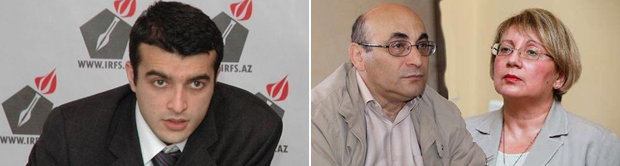
Rasul Jafarov, Arif Yunus and Leyla Yunus (Photos: Rasul Jafarov (© IRFS), Arif and Leyla Yunus (© HRHN))
60 NGOs from 13 Human Rights Houses call upon the Azerbaijani authorities, in their joint letter to President Ilham Aliyev, to immediately and unconditionally release Leyla Yunus, Arif Yunus and Rasul Jafarov, and lift all charges held against them. The NGOs also repeat their previous call to release Anar Mammadli and Bashir Suleymanli, and join calls for the release of Hasan Huseynli.
On 28 April 2014 Leyla Yunus, Director of the Institute for Peace and Democrac, and her husband historian Arif Yunus, were prevented from leaving the country at Baku’s airport. Leyla Yunus and her husband Arif Yunus were arrested on 30 July 2014. On that day, Leyla Yunus was sentenced to 3-months pre-trial detention, whilst her husband was placed under police guard and not allowed to leave Baku. The charges brought against Leyla Yunus are those of state treason (article 274 of the Criminal Code of the Republic of Azerbaijan), large-scale fraud (article 178.3.2), forgery (article 320), tax evasion (article 213), and illegal business (article 192). Arif Yunus was arrested on 5 August 2014 and also sentenced to 3-months pre-trial detention.
The NGOs state in their joint letter to President Aliyev of 5 August 2014 that they are in particular concerned about Leyla Yunus’ health whilst in detention. She suffers from diabetes and needs appropriate medication, as well as arrangements to eat at certain times, necessary to control the illness. We worry that the conditions in detention will have a detrimental effect on her health condition, as it appears that she is to date not provided with adequate health care.
In July 2014, the bank accounts of, amongst others, human rights defender Rasul Jafarov were frozen as part of a broader investigation into numerous NGO’s. On 25 July he was refused to leave the country. Rasul Jafarov was arrested on 2 August 2014, and sentenced to 3 months pre-trial detention on charges of tax evasion (article 213 of the Criminal Code of the Republic of Azerbaijan), illegal business (article 192) and abuse of authority (article 308.2).
On 14 July 2014, Hasan Huseynli, was sentenced to 6 years in prison. He was convicted on charges of armed hooliganism and unlawfully carrying a cold weapon.
The right to freedom of association is at the heart of the charges held against these human rights defenders. In essence they are deprived of their right to work in the defence of human rights. While registration of NGOs and grants to NGOs has become mandatory in Azerbaijan, authorities continue deny registration. Independent NGOs face continuous investigations and human rights defenders are being banned from travelling abroad, depending on their willingness to find agreements with the government, including agreements on their professional activities and their public statements.
Restrictions to laws affecting the right to freedom of association have been widely criticised since October 2011. Such legislation de facto criminalises human rights defenders in Azerbaijan, not for their wrong doing, but rather for the fact that working for an NGO, which does not have the blessing of the government, has become difficult in Azerbaijan. United Nations experts stated ahead of the Presidential elections that they “observed since 2011 a worrying trend of legislation which has narrowed considerably the space in which civil society and defenders operate in Azerbaijan.” The order given to the Human Rights House Azerbaijan in March 2011 to cease all its activities is a consequence of such policies.
The NGOs call upon the Azerbaijani authorities, in their joint letter to President Ilham Aliyev of 5 August 2014, to immediately and unconditionally release Leyla Yunus, Arif Yunus, Rasul Jafarov, and lift all charges held against them. The NGOs see this pre-trial detention of Leyla Yunus, Arif Yunus and Rasul Jafarov as a way to silence them. The NGOs also repeat their previous call to release Anar Mammadli and Bashir Suleymanli, and join calls for the release of Hasan Huseynli.
The NGOs further call upon the Azerbaijani authorities to take appropriate measures to put an end to the attacks, detention and harassment of human rights defenders, journalists and activists, and to take steps in order to foster a safe environment for them, in line with Azerbaijan’s international obligations and commitments, especially as the chair of the Committee of Ministers of the Council of Europe.
Signed by:
Human Rights House Azerbaijan (on behalf of the following NGOs):
- Association for the Protection of Women’s Rights
- Azerbaijan Lawyers Association
- Institute for Reporters’ Safety and Freedom
- Legal Education Society
- Media Rights Institute
- Society for Humanitarian Research
- Women Association for Rational Development
Barys Zvozskau Belarusian Human Rights House in exile, Vilnius (on behalf of the following NGOs):
- Belarusian Association of Journalists
- Belarusian Helsinki Committee
- City Public Association “Centar Supolnaść”
- Human Rights Centre “Viasna”
Human Rights House Belgrade (on behalf of the following NGOs):
- Belgrade Centre for Human Rights
Human Rights House Kiev (on behalf of the following NGOs):
- Association of Ukrainian Human Rights Monitors on Law-Enforcement
- Human Rights Information Centre
- Center for Civil Liberties
- Ukrainian Helsinki Human Rights Union
- Ukrainian Legal Aid Foundation
Human Rights House London (on behalf of the following NGOs):
- Article 19
- Index on Censorship
Human Rights House Sarajevo (on behalf of the following NGOs):
- Helsinki Committee for Human Rights in Bosnia and Herzegovina
Human Rights House Tbilisi (on behalf of the following NGOs):
- Article 42 of the Constitution
- Georgian Centre for Psychosocial and Medical Rehabilitation of Torture Victims
- Human Rights Centre
Human Rights House Oslo (on behalf of the following NGOs):
- Human Rights House Foundation
- Norwegian Burma Committee
- Norwegian Helsinki Committee
Human Rights House Voronezh (on behalf of the following NGOs):
- Charitable Foundation
- Civic Initiatives Development Centre
- Confederation of Free Labor
- For Ecological and Social Justice
- Free University
- Golos
- Interregional Trade Union of Literary Men
- Lawyers for labor rights
- Memorial
- Ms. Olga Gnezdilova
- Soldiers Mothers of Russia
- Voronezh Journalist Club
- Voronezh-Chernozemie
- Youth Human Rights Movement
Human Rights House Yerevan (on behalf of the following NGOs):
- Helsinki Citizens’ Assembly-Vanadzor
- Helsinki Association for Human Rights
- Journalists’ Club “Asparez”
- Public Information and Need of Knowledge NGO
- Shahkhatun
- Women’s Resource Center
Human Rights House Zagreb (on behalf of the following NGOs):
- APEO/UPIM Association for Promotion of Equal Opportunities for People with Disabilities
- B.a.B.e.
- CMS – Centre for Peace Studies
- Documenta – Centre for Dealing with the Past
- GOLJP – Civic Committee for Human Rights
- Svitanje – Association for Protection and Promotion of Mental Health
The Rafto House in Bergen, Norway (on behalf of the following NGOs):
The House of the Helsinki Foundation For Human Rights, Poland (on behalf of the following NGOs):
- Helsinki Foundation for Human Rights
Election Monitoring and Democracy Studies Center, Azerbaijan
Foundation “Multiethnic Resource Center for Civic Education Development”, Georgia
People in Need, Czech Republic
Public Movement Multinational, Georgia
Public Association for Assistance to Free Economy, Azerbaijan
Public Union of Democracy and Human Rights Resource Centre, Azerbaijan
This statement was originally posted on Aug 5, 2014 at http://humanrightshouse.org/Articles/20321.html
