20 Dec 2017 | Mapping Media Freedom, Media Freedom, media freedom featured, News
[vc_row][vc_column][vc_column_text]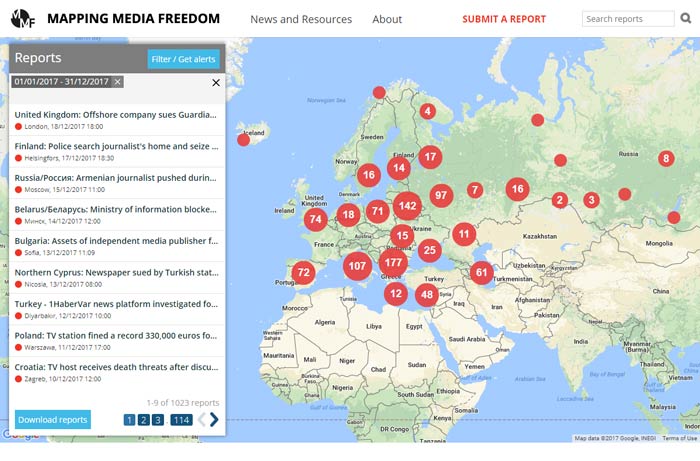 This year saw 1,035 media freedom violations reported to Index on Censorship’s Mapping Media Freedom, a project that monitors media freedom in 42 countries, including all EU member states. To highlight the most pressing concerns for press freedom in Europe, Index’s MMF correspondents discuss the violations that stood out most.
Russia / 197 verified reports in 2017
“In November Russia adopted a new restrictive law against foreign media. It allows recognising foreign media as foreign agents, which makes them subjects of numerous additional checks and obliges them to mark the content as produced by a foreign agent. The vague and ambiguous wording means it applies to many outlets – from established media to email newsletters. Which media will be recognised as foreign agents will be decided by Russian Ministry of justice. However, US media such as Voice of America or Radio Free Europe/Radio Liberty have already received warnings about possible restrictions on their work in Russia.” — Ekaterina Buchneva
Turkey / 132 verified reports in 2017
“Although 155 journalists are currently imprisoned in Turkey — almost all of them on trumped-up charges — the trial of journalist Nedim Türfent, who reported on security operations in Turkey’s Kurdish regions, is by far the worst violation as open experiences of torture at the hands of police officers were recounted by at least a dozen people in the case. This violation shows that torture is making a comeback in Turkey.” — Barış Altıntaş
More on Nedim Türfent’s case.
Belarus / 92 verified reports in 2017
“The mass detention of journalists on Freedom Day in March was indicative of the Belarusian authorities’ campaign launched in 2017 on preventing journalists from performing their professional duties. The situation was provoked by mass protests across Belarus against introducing presidential decree on “social parasites”, which imposes a tax on the unemployed amid increasing economic crisis. The authorities have shown their real attitude to freedom of speech through real hunting on independent journalists and bloggers that are blocked from access to information, detained, jailed, and fined.” — Volha Siakovich
Spain / 66 verified reports in 2017
“The referendum on the independence of Catalonia, north-east of Spain, provoked an avalanche of incidents against reporters. On 1 October 2017, on the day of referendum considered illegal by the Spanish Constitutional Court, various journalists were assaulted during police intervention in polling stations. Spanish public television RTVE was biased in favour of Spanish unity while Catalan public television TV3 was biased in favour of the independence. In the aftermath of the referendum, many reporters on the ground suffered insults and assaults usually during street rallies. Unionist protesters used to insult and assault Catalan media. Catalunya Radio glass door was smashed and TV3 car window broken. Catalan protesters chanted “Spanish press manipulators” during Spanish televisions live coverage and Crònica Global website headquarters vandalised with spray paints and posters. The Catalan political question brought a wave of intimidation against journalists, never seen in such numbers and scale in recent years.” — Miho Dobrasin
Italy / 57 verified reports in 2017
“In 2017 Italian journalists experienced a high level of conflict with the judiciary. Journalists are constantly possible targets of law enforcement raids, also in breaching the privacy of journalists’ sources. In July, Il Fatto Quotidiano journalist Marco Lillo’s house was searched because he published a scoop concerning the investigation on people close to Matteo Renzi, prime minister at time time, for a case of corruption at the most important contracting authority in Italy: Consip. Last but not least, Il Sole 24 Ore journalist Nicola Borzi had seized his computer and archives by the law enforcement because he revealed a “secret of State”, without any formal charge against the journalist. These events show how hard is making scoops in Italy. Moreover, journalists are constantly targeted with lawsuits, frequently used as threats against freelancers. Nowadays the big unsolved issue for Italian journalism is at court.” — Lorenzo Bagnoli
France / 54 verified reports in 2017
“In February, presidential candidate Fillon smeared media outlets who covered alleged corruption case. This was an important moment in the treatment of the media in France. When accused of corruption, conservative presidential candidate François Fillon refused to step down and chose to attack the media and journalists. Journalists covering his campaign saw their working conditions deteriorate and had supporters insulting and attacking them.” — Valeria Costa-Kostritsky
Azerbaijan / 47 reports in 2017
“While there on-going violations of press freedom in Azerbaijan such as the jailing of journalists, office raids, bogus charges and other forms of persecution of journalists, I chose the blocking of opposition and independent news websites in March because it is a sign of further deterioration of media freedom in Azerbaijan. If before there were deliberate slowdowns or DDoS attacks, changes in legislation give full authority to the government institutions wanting to shut down or limit access to the flow of independent and alternative news.” — Arzu Geybullayeva
Croatia / 33 verified reports in 2017
“In September, around 20 members of the Autochthonous Croatian Party of Rights (A-HSP), a far-right political party, which is led by Drazen Keleminec, burned a copy of weekly newspaper Novosti, regional broadcaster N1 reported. This is another example where nationalistic and conservative narratives are endangering media freedom. In this particular case a right-wing political party is targeting the others, in this case the others is an ethnically and linguistically minority weekly, describing them as enemies of the state. The widespread narrative that has resulted in several severe media freedom infringements in this EU country.” — Ilcho Cvetanoski
Macedonia / 27 verified reports in 2017
“During the April’s storming of the Assembly building in the capital Skopje, 23 media workers were physically assaulted, threatened or barred from reporting at the scene. This case perfectly exemplifies what happens when political elites intentionally demonize and dehumanize media workers that are critically observing theirs work by describing them as traitors and foreign mercenaries. In the eyes of the common people, they instantly became a legitimate target. This is a widespread trend in Southeast Europe.” — Ilcho Cvetanoski
Bosnia and Herzegovina / 21 verified reports in 2017
“The case of Dragan Bursac is one of the many cases in Southeast Europe where journalists/media workers are threatened/attacked for challenging the mainstream nationalistic narrative. Namely, he was critical on the fact that a military leader, accused of committing war crimes, crimes against humanity and genocide by the International Criminal Tribunal for the former Yugoslavia (ICTY), is celebrated as a hero by the politicians and media.” — Ilcho Cvetanoski
Germany / 20 verified reports in 2017
“It is extremely concerning that journalists were assaulted and intimidated when reporting on protests in Hamburg. Journalists are there to do their job and it is important that they are able to tell the world what is happening at protests such as the ones in Hamburg.” – Joy Hyvarinen
Hungary / 20 verified reports in 2017
“There is an important change of tactics regarding censorship and defaming independent media in Hungary: instead of attacking the outlets critical to the government, the vast pro-government media started smearing individual journalists, trying to intimidate and discredit the few critical voices who are left in Hungary.” — Zoltan Sipos
Romania / 16 verified reports in 2017
“The national news agency AGERPRES might lose its independence after a draft law enabling the political majority to dismiss the director-general was passed by the chamber of deputies in Romania. If passed in the senate as well, such a provision would have the same impact as on the management of the Romanian Radio Broadcasting Corporation (SRR) and the Romanian National Television Corporation (SRTV): following each election, the SRR and SRTV administration boards can be dismissed before the end of their mandates to reflect the new political forces.” — Zoltan Sipos
United Kingdom / 17 verified reports in 2017
“In the United Kingdom, after the Grenfell tower fire, which claimed 71 deaths, Kensington and Chelsea council tried to ban journalists from attending their first council meeting. Five media organisations had to challenge this legally to gain access. This was a very important case illustrating how difficult it was to gain access and to expect accountability from the organisation which ran the council block.” — Valeria Costa-Kostritsky
Sweden / 15 verified reports in 2017
“The systematic campaign to smear and misrepresent journalists by Granskning Sverige was symptomatic of a wider attack on the legitimacy of liberal and left media by Sweden’s far-right movement, but the campaign detailed by the reporters at the Eskilstuna-kuriren newspaper was orchestrated and unlike anything seen before in the country.” — Dominic Hinde
Greece / 13 verified reports in 2017
“In February 2017, two journalists were harassed by far-right wing protesters, preventing refugee children from attending classes. This is very important, because it shows that although Greece’s economic and refugee crisis seem to have calmed down in the last year, the support for far-right wing organisations doesn’t show any sign of shrinking. This also concerns journalists in Greece, whose safety is in danger every day.” — Christina Vasilaki
The Netherlands / 12 verified reports in 2017
“The Netherlands is considered to be one of the countries where media freedom is widely protected. However, cases like the rape threats levelled at a journalist in May show that media workers are subjected to all sorts of threats. In this case it were rape threats by a popular right-wing weblog. This creates an atmosphere in which it’s conceived normal to use comments and social media to discredit and threaten a journalist. It also highlights the dangers and risks that female journalists face.” — Mitra Nazar
Bulgaria / 11 verified reports in 2017
“In November, it became known that members of an organised crime group from Vratsa planned to murder Zov News website publisher Georgi Ezekiev. The increase of violent incidents and serious threats towards journalists in 2017 is alarming in Bulgaria, a country that already has the worst press freedom status in the European Union.” — Zoltan Sipos
Serbia / 11 verified reports in 2017
“Serbia’s free media had a dark year with many incidents, threats and violence coming towards them. In May, journalists were assaulted during clashes at the presidential inauguration. This is just one of many cases, but it clearly demonstrates just how critical the state of the media is because they happened during the presidential inauguration. The assaults were committed by supporters of the government with a lot of police around. The impunity these assaulters meet is worrying for the lack of condemnation by authorities and the message they clearly want to send to critical journalists.” — Mitra Nazar
Malta / 8 verified reports in 2017
“The most worrying incident regards the murder of anti-corruption, investigative journalist Daphne Caruana Galizia. While this murder gripped the attention of international media and European authorities including the European Commission and Parliament, it is still shocking for every journalist that in a democratic, EU country, journalists’ lives could be in danger because they are doing their job, exposing high-level corruption in political, business and criminal elites.” — Christina Vasilaki
Kosovo / 6 verified reports in 2017|
“Kosovo’s media have been shaken up by two attacks on Insajderi investigative journalists. Insajderi is home to the best investigative journalists in the country, covering corruption and crime topics that nobody else dares to touch. Journalist Parim Olluri was beaten up outside his home in Pristina on 16 August. He needed medical assistance in a hospital. Nobody has been held responsible for the attack. Two months later, his colleague Vehbi Kajtazi was hit on the head in a cafe in downtown Pristina on 13 October. One person was arrested on the spot. We are talking about two violent incidents to Insajderi journalists within a period of three months. This shows that Kosovo’s journalists continue to face violence, even in very public places like cafe’s and neighbourhoods they live. For this reason there are just a few brave journalists who dare to touch sensitive topics, which is a worrying sign for the future of journalism and truth finding in the youngest country in Europe.” — Mitra Nazar
Montenegro / 6 verified reports in 2017
“Attack on journalist’s property is one of most common ways of intimidation. This is not only case for Montenegro, but also for all other countries in the region. What is striking is that intentional setting on fire of journalist’s vehicles is one of most common ways of limitation of media freedom in Montenegro. In recent years there have been several burnt vehicle in this small EU candidate country.” — Ilcho Cvetanoski
Portugal / 5 verified reports in 2017
“Similarly to what’s happening in other countries, Portugal has seen a rise of questioning towards journalism, those who work in the media industry and their work. Besides motivating a new and stimulating debate between journalists and their readers/viewers/listeners, this has also opened the gates to instances of abuse, cyberbullying and slander. The most significant example of that is that of Público’s journalist Margarida Gomes, whose work ethic was put in question by Facebook groups and public officials, who both used false information regarding her personal life to denigrate her work.” — João de Almeida Dias
Latvia / 3 verified reports in 2017
“In Latvia it was a quiet year for press freedom. However, the sudden and swift dismissal of Sigita Roķe, the head of public service Latvian Radio for alleged economic irregularities was seen as a pretext for dismissing her for efforts to disengage the radio from sponsorship agreements with the city of Ventspils, whose politically influential mayor has is on trial for money laundering and corruption. The dismissal raised questions about the political neutrality of Latvia’s media watchdog, the National Electronic Mass Media Council.” — Juris Kaza
Ireland / 3 verified reports in 2017
“Compared to the long list of countries in Europe where it is getting progressively dangerous for reporters to do their work, the situation in Ireland is relatively benign. There are renewed concerns over source protection, and the strict libel regime. However, the most serious concern is regarding media ownership. Index on Censorship published a detailed report on this in August 2017. One significant media takeover – Independent News and Media buying up Celtic Media – fell through after the Government ordered a statutory investigation following objections.” — Flor Mac Carthy
Estonia / 3 verified reports in 2017
“In March, journalists for Estonia’s largest daily in circulation Postimees, sent a letter to the owners and managers to complain about interference with editorial freedom. This event is a disturbing example of the interference attempts from media owners and advertisement department that had grown to the level that journalists of a daily, that prides itself with a long history and high-quality content, had to resort to an unprecedented united protest letter to fight it. Interference in journalistic decision making and content from outside or inside sources is in general the worrisome threat.” — Helle Tiikmaa
Belgium / 2 verified reports in 2017
“In Belgium, a journalist who had published a story on surveillance in Bruxelles’ metro was interrogated on her sources by the police, in clear breach of the principle of sources confidentiality. The case also reminds us of the risk for journalists covering surveillance.” — Valeria Costa-Kostritsky
Denmark / 2 verified reports in 2017
“The killing of Kim Wall by the inventor and entrepreneur Peter Madsen was a headline news event around the world. Stabbed to death and dumped at sea whilst interviewing Madsen on board his home-built submarine, her body was recovered after an extensive marine search. Although not typical of any wider trend, her murder was so brutal it raised significant questions about the safety and ethics of female freelancers working alone without support or safeguards.” — Dominic Hinde
Finland / 2 verified reports in 2017
“In March the Finnish government introduced restrictive changes to the functioning of the public broadcasting company Yle, which entailed putting the state-owned company more firmly under politicians’ decision-making power. The proposal was driven by the True Finns, a nationalist party that have repeatedly complained about Yle’s liberal views and non-sceptical approach to ‘multicultural Finland’. In the official briefing, stated the following: “The proposal is to strengthen the role of the Administrative Council so that they can decide on Yle’s journalistic strategy and regulate the permanent expert consultation process”. The council referred is mainly composed of politicians. — Katariina Salomäki
Iceland / 1 verified report in 2017
“Iceland has been rocked by political scandals and collapsing governments twice in the space of a year. In October it came to light that the prime minister had used financial confidentiality legislation to stop the investigative newspaper Stundin from publishing details of his offshore financial dealings in the run-up to the 2008 financial crash. Iceand’s main newspaper Morgunbladid is controlled by another former Prime Minister, also a member of the powerful Icelandic independence party, and Stundin has consistently sought to expose the Icelandic financial and political elite where other titles have remained silent.” — Dominic Hinde[/vc_column_text][/vc_column][/vc_row][vc_row][vc_column][vc_custom_heading text=”Mapping Media Freedom” use_theme_fonts=”yes” link=”url:https%3A%2F%2Fmappingmediafreedom.org%2F%23%2F|||”][vc_row_inner][vc_column_inner width=”1/4″][vc_icon icon_fontawesome=”fa fa-times-circle” color=”black” background_style=”rounded” size=”xl” align=”right”][/vc_column_inner][vc_column_inner width=”3/4″][vc_column_text]
Since 24 May 2014, Mapping Media Freedom’s team of correspondents and partners have recorded and verified more than 3,700 violations against journalists and media outlets.
Index campaigns to protect journalists and media freedom. You can help us by submitting reports to Mapping Media Freedom.[/vc_column_text][/vc_column_inner][/vc_row_inner][vc_separator color=”black”][/vc_column][/vc_row][vc_row][vc_column][vc_custom_heading text=”Don’t lose your voice. Stay informed.” use_theme_fonts=”yes”][vc_separator color=”black”][vc_row_inner][vc_column_inner width=”1/2″][vc_column_text]Index on Censorship is a nonprofit that campaigns for and defends free expression worldwide. We publish work by censored writers and artists, promote debate, and monitor threats to free speech. We believe that everyone should be free to express themselves without fear of harm or persecution – no matter what their views.
Join our mailing list (or follow us on Twitter or Facebook) and we’ll send you our weekly newsletter about our activities defending free speech. We won’t share your personal information with anyone outside Index.[/vc_column_text][/vc_column_inner][vc_column_inner width=”1/2″][gravityform id=”20″ title=”false” description=”false” ajax=”false”][/vc_column_inner][/vc_row_inner][vc_separator color=”black”][/vc_column][/vc_row]
4 Dec 2017 | About Index, History, Magazine, News
[vc_row][vc_column][vc_custom_heading text=”The first editor of Index on Censorship magazine reflects on the driving forces behind its founding in 1972″ google_fonts=”font_family:Libre%20Baskerville%3Aregular%2Citalic%2C700|font_style:400%20italic%3A400%3Aitalic”][vc_column_text][/vc_column_text][vc_row_inner][vc_column_inner][vc_column_text]A version of this article first appeared in Index on Censorship magazine in December 1981. [/vc_column_text][/vc_column_inner][/vc_row_inner][/vc_column][/vc_row][vc_row][vc_column][vc_column_text]
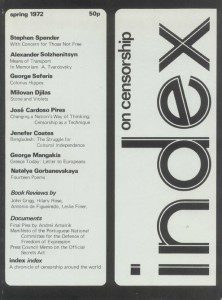
The first issue of Index on Censorship Magazine, 1972
Starting a magazine is as haphazard and uncertain a business as starting a book-who knows what combination of external events and subjective ideas has triggered the mind to move in a particular direction? And who knows, when starting, whether the thing will work or not and what relation the finished object will bear to one’s initial concept? That, at least, was my experience with Index, which seemed almost to invent itself at the time and was certainly not ‘planned’ in any rational way. Yet looking back, it is easy enough to trace the various influences that brought it into existence.
It all began in January 1968 when Pavel Litvinov, grandson of the former Soviet Foreign Minister, Maxim Litvinov, and his Englis wife, Ivy, and Larisa Bogoraz, the former wife of the writer, Yuli Daniel, addressed an appeal to world public opinion to condemn the rigged trial of two young writers and their typists on charges of ‘anti-Soviet agitation and propaganda’ (one of the writers, Alexander Ginzburg, was released from the camps in 1979 and now lives in Paris: the other, Yuri Galanskov, died in a camp in 1972). The appeal was published in The Times on 13 January 1968 and evoked an answering telegram of support and sympathy from sixteen English and American luminaries, including W H Auden, A J Ayer, Maurice Bowra, Julian Huxley, Mary McCarthy, Bertrand Russell and Igor Stravinsky.
The telegram had been organised and dispatched by Stephen Spender and was answered, after taking eight months to reach its addressees, by a further letter from Litvinov, who said in part: ‘You write that you are ready to help us “by any method open to you”. We immediately accepted this not as a purely rhetorical phrase, but as a genuine wish to help….’ And went on to indicate the kind oh help he had in mind:
My friends and I think it would be very important to create an international committee or council that would make it its purpose to support the democratic movement in the USSR. This committee could be composed of universally respected progressive writers, scholars, artists and public personalities from England, the United States, France, Germany and other western countries, and also from Latin America, Asia, Africa and, in the future, even from Eastern Europe…. Of course, this committee should not have an anti-communist or anti-Soviet character. It would even be good if it contained people persecuted in their own countries for pro-communist or independent views…. The point is not that this or that ideology is not correct, but that it must not use force to demonstrate its correctness.
Stephen Spender took up this idea first with Stuart Hampshire (the Oxford philosopher), a co-signatory of the telegram, and with David Astor (then editor of the Observer), who joined them in setting up a committee along the lines suggested by Litvinov (among its other members were Louis Blom-Cooper, Edward Crankshaw, Lord Gardiner, Elizabeth Longford and Sir Roland Penrose, and its patrons included Dame Peggy Ashcroft, Sir Peter Medawar, Henry Moore, Iris Murdoch, Sir Michael Tippett and Angus Wilson). It was not, admittedly, as international as Litvinov had suggested, but it was thought more practical to begin locally, so to speak, and to see whether or not there was something in it before expanding further. Nevertheless, the chosen name for the new organisation, Writers and Scholars International, was an earnest of its intentions, while its deliberate echo of Amnesty International (then relatively modest in size) indicated a feeling that not only literature but also human rights would be at issue.
By now it was 1971 and in the spring of that year the committee advertised for a director, held a series of interviews and offered me the job. There was no programme, other than Litvinov’s letter, there were no premises or staff, and there was very little money, but there were high hopes and enthusiasm.
It was at this point that some of the subjective factors I mentioned earlier began to come into play. Litvinov’s letter had indicated two possible forms of action. One was the launching of protests to ‘support and defend’ people who were being persecuted for their civic and literary activities in the USSR. The other was to ‘provide information to world public opinion’ about this state of affairs and to operate with ‘some sort of publishing house’. The temptation was to go for the first, particularly since Amnesty was setting such a powerful example, but precisely because Amnesty (and the International PEN Club) were doing such a good job already, I felt that the second option would be the more original and interesting to try. Furthermore, I knew that two of our most active members, Stephen Spender and Stuart Hampshire, on the rebound from Encounter after disclosures of CIA funding, had attempted unsuccessfully to start a new magazine, and I felt that they would support something in the publishing line. And finally, my own interests lay mainly in that direction. My experience had been in teaching, writing, translating and broadcasting. Psychologically I was too much of a shrinking violet to enjoy kicking up a fuss in public. I preferred argument and debate to categorical statements and protest, the printed page to the soapbox; I needed to know much more about censorship and human rights before having strong views of my own.
At that stage I was thinking in terms of trying to start some sort of alternative or ‘underground’ (as the term was misleadingly used) newspaper – Oz and the International Times were setting the pace were setting the pace in those days, with Time Out just in its infancy. But a series of happy accidents began to put other sorts of material into my hands. I had been working recently on Solzhenitzin and suddenly acquired a tape-recording with some unpublished poems in prose on it. On a visit to Yugoslavia, I called on Milovan Djilas and was unexpectedly offered some of his short stories. A Portuguese writer living in London, Jose Cardoso Pires, had just written a first-rate essay on censorship that fell into my hands. My friend, Daniel Weissbort, editor of Modern Poetry in Translation, was working on some fine lyrical poems by the Soviet poet, Natalya Gorbanevskaya, then in a mental hospital. And above all I stumbled across the magnificent ‘Letter to Europeans’ by the Greek law professor, George Mangakis, written in one of the colonels’ jails (which I still consider to be one of the best things I have ever published). It was clear that these things wouldn’t fit very easily into an Oz or International Times, yet it was even clearer that they reflected my true tastes and were the kind of writing, for better or worse, that aroused my enthusiasm. At the same time I discovered that from the point of view of production and editorial expenses, it would be far easier to produce a magazine appearing at infrequent intervals, albeit a fat one, than to produce even the same amount of material in weekly or fortnightly instalments in the form of a newspaper. And I also discovered, as Anthony Howard put it in an article about the New Statesman, that whereas opinions come cheap, facts come dear, and facts were essential in an explosive field like human rights. Somewhat thankfully, therefore, my one assistant and I settled for a quarterly magazine.
There is no point, I think, in detailing our sometimes farcical discussions of a possible title. We settled on Index (my suggestion) for what seemed like several good reasons: it was short; it recalled the Catholic Index Librorum Prohibitorum; it was to be an index of violations of intellectual freedom; and lastly, so help me an index finger pointing accusingly at the guilty oppressors – we even introduced a graphic of a pointing finger into our early issues. Alas, when we printed our first covers bearing the bold name of Index (vertically to attract attention nobody got the point (pun unintended). Panicking, we hastily added the ‘on censorship’ as a subtitle – Censorship had been the title of an earlier magazine, by then defunct – and this it has remained ever since, nagging me with its ungrammatically (index of censorship, surely) and a standing apology for the opacity of its title. I have since come to the conclusion that it is a thoroughly bad title – Americans, in particular, invariably associate it with the cost of living and librarians with, well indexes. But it is too late to change now.
Our first issue duly appeared in May 1972, with a programmatic article by Stephen Spender (printed also in the TLS) and some cautious ‘Notes’ by myself. Stephen summarised some of the events leading up to the foundation of the magazine (not naming Litvinov, who was then in exile in Siberia) and took freedom and tyranny as his theme:
Obviously there is a risk of a magazine of this kind becoming a bulletin of frustration. However, the material by writers which is censored in Eastern Europe, Greece, South Africa and other countries is among the most exciting that is being written today. Moreover, the question of censorship has become a matter of impassioned debate; and it is one which does not only concern totalitarian societies.
I contented myself with explaining why there would be no formal programme and emphasised that we would be feeling our way step by step. ‘We are naturally of the opinion that a definite need {for us} exists….But only time can tell whether the need is temporary or permanent—and whether or not we shall be capable of satisfying it. Meanwhile our aims and intentions are best judged…by our contents, rather than by editorials.’
[/vc_column_text][/vc_column][/vc_row][vc_row][vc_column width=”1/4″][vc_icon icon_fontawesome=”fa fa-quote-left” color=”custom” align=”right” custom_color=”#dd3333″][/vc_column][vc_column width=”3/4″][vc_custom_heading text=”My friends and I think it would be very important to create an international committee or council that would make it its purpose to support the democratic movement in the USSR.” google_fonts=”font_family:Libre%20Baskerville%3Aregular%2Citalic%2C700|font_style:400%20italic%3A400%3Aitalic”][/vc_column][/vc_row][vc_row][vc_column][vc_column_text]
In the course of the next few years it became clear that the need for such a magazine was, if anything, greater than I had foreseen. The censorship, banning and exile of writers and journalists (not to speak of imprisonment, torture and murder) had become commonplace, and it seemed at times that if we hadn’t started Index, someone else would have, or at least something like it. And once the demand for censored literature and information about censorship was made explicit, the supply turned out to be copious and inexhaustible.
One result of being inundated with so much material was that I quickly learned the geography of censorship. Of course, in the years since Index began, there have been many changes. Greece, Spain, and Portugal are no longer the dictatorships they were then. There have been major upheavals in Poland, Turkey, Iran, the Lebanon, Pakistan, Nigeria, Ghana and Zimbabwe. Vietnam, Cambodia and Afghanistan have been silenced, whereas Chinese writers have begun to find their voices again. In Latin America, Brazil has attained a measure of freedom, but the southern cone countries of Chile, Argentina, Uruguay and Bolivia have improved only marginally and Central America has been plunged into bloodshed and violence.
Despite the changes, however, it became possible to discern enduring patterns. The Soviet empire, for instance, continued to maltreat its writers throughout the period of my editorship. Not only was the censorship there highly organised and rigidly enforced, but writers were arrested, tried and sent to jail or labour camps with monotonous regularity. At the same time, many of the better ones, starting with Solzhenitsyn, were forced or pushed into exile, so that the roll-call of Russian writers outside the Soviet Union (Solzhenitsyn, Sinyavksy, Brodsky, Zinoviev, Maximov, Voinovich, Aksyonov, to name but a few) now more than rivals, in talent and achievement, those left at home. Moreover, a whole array of literary magazines, newspapers and publishing houses has come into existence abroad to serve them and their readers.
In another main black spot, Latin America, the censorship tended to be somewhat looser and ill-defined, though backed by a campaign of physical violence and terror that had no parallel anywhere else. Perhaps the worst were Argentina and Uruguay, where dozens of writers were arrested and ill-treated or simply disappeared without trace. Chile, despite its notoriety, had a marginally better record with writers, as did Brazil, though the latter had been very bad during the early years of Index.
In other parts of the world, the picture naturally varies. In Africa, dissident writers are often helped by being part of an Anglophone or Francophone culture. Thus Wole Soyinka was able to leave Nigeria for England, Kofi Awoonor to go from Ghana to the United States (though both were temporarily jailed on their return), and French-speaking Camara Laye to move from Guinea to neighbouring Senegal. But the situation can be more complicated when African writers turn to the vernacular. Ngugi wa Thiong’o, who has written some impressive novels in English, was jailed in Kenya only after he had written and produced a play in his native Gikuyu.
In Asia the options also tend to be restricted. A mainland Chinese writer might take refuge in Hong Kong or Taiwan, but where is a Taiwanese to go? In Vietnam, Cambodia, Laos, the possibilities for exile are strictly limited, though many have gone to the former colonising country, France, which they still regard as a spiritual home, and others to the USA. Similarly, Indonesian writers still tend to turn to Holland, Malaysians to Britain, and Filipinos to the USA.
In documenting these changes and movements, Index was able to play its small part. It was one of the very first magazines to denounce the Shah’s Iran, publishing as early as 1974 an article by Sadeq Qotbzadeh, later to become Foreign Minister in Ayatollah Khomeini’s first administration. In 1976 we publicised the case of the tortured Iranian poet, Reza Baraheni, whose testimony subsequently appeared on the op-ed page of the New York Times. (Reza Baraheni was arrested, together with many other writers, by the Khomeini regime on 19 October 1981.) One year later, Index became the publisher of the unofficial and banned Polish journal, Zapis, mouthpiece of the writers and intellectuals who paved the way for the present liberalisation in Poland. And not long after that it started putting out the Czech unofficial journal, Spektrum, with a similar intellectual programme. We also published the distinguished Nicaraguan poet, Ernesto Cardenal, before he became Minister of Education in the revolutionary government, and the South Korean poet, Kim Chi-ha, before he became an international cause célèbre.
[/vc_column_text][/vc_column][/vc_row][vc_row][vc_column width=”1/4″][vc_icon icon_fontawesome=”fa fa-quote-left” color=”custom” align=”right” custom_color=”#dd3333″][/vc_column][vc_column width=”3/4″][vc_custom_heading text=”Looking back, not only over the thirty years since Index was started, but much further, over the history of our civilisation, one cannot help but realise that censorship is by no means a recent phenomenon.” google_fonts=”font_family:Libre%20Baskerville%3Aregular%2Citalic%2C700|font_style:400%20italic%3A400%3Aitalic”][/vc_column][/vc_row][vc_row][vc_column][vc_column_text]
One of the bonuses of doing this type of work has been the contact, and in some cases friendship, established with outstanding writers who have been in trouble: Solzhenitsyn, Djilas, Havel, Baranczak, Soyinka, Galeano, Onetti, and with the many distinguished writers from other parts of the world who have gone out of their way to help: Heinrich Böll, Mario Vargas Llosa, Stephen Spender, Tom Stoppard, Philip Roth—and many other too numerous to mention. There is a kind of global consciousness coming into existence, which Index has helped to foster and which is especially noticeable among writers. Fewer and fewer are prepared to stand aside and remain silent while their fellows are persecuted. If they have taught us nothing else, the Holocaust and the Gulag have rubbed in the fact that silence can also be a crime.
The chief beneficiaries of this new awareness have not been just the celebrated victims mentioned above. There is, after all, an aristocracy of talent that somehow succeeds in jumping all the barriers. More difficult to help, because unassisted by fame, are writers perhaps of the second or third rank, or young writers still on their way up. It is precisely here that Index has been at its best.
Such writers are customarily picked on, since governments dislike the opprobrium that attends the persecution of famous names, yet even this is growing more difficult for them. As the Lithuanian theatre director, Jonas Jurasas, once wrote to me after the publication of his open letter in Index, such publicity ‘deprives the oppressors of free thought of the opportunity of settling accounts with dissenters in secret’ and ‘bears witness to the solidarity of artists throughout the world’.
Looking back, not only over the years since Index was started, but much further, over the history of our civilisation, one cannot help but realise that censorship is by no means a recent phenomenon. On the contrary, literature and censorship have been inseparable pretty well since earliest times. Plato was the first prominent thinker to make out a respectable case for it, recommending that undesirable poets be turned away from the city gates, and we may suppose that the minstrels and minnesingers of yore stood to be driven from the castle if their songs displeased their masters. The examples of Ovid and Dante remind us that another old way of dealing with bad news was exile: if you didn’t wish to stop the poet’s mouth or cover your ears, the simplest solution was to place the source out of hearing. Later came the Inquisition, after which imprisonment, torture and execution became almost an occupational hazard for writers, and it is only in comparatively recent times—since the eighteenth century—that scribblers have fought back and demanded an unconditional right to say what they please. Needless to say, their demands have rarely and in few places been met, but their rebellion has resulted in a new psychological relationship between rulers and ruled.
Index, of course, ranged itself from the very first on the side of the scribblers, seeking at all times to defend their rights and their interests. And I would like to think that its struggles and campaigns have borne some fruit. But this is something that can never be proved or disproved, and perhaps it is as well, for complacency and self-congratulation are the last things required of a journal on human rights. The time when the gates of Plato’s city will be open to all is still a long way off. There are certainly many struggles and defeats still to come—as well, I hope, as occasional victories. When I look at the fragility of Index‘s a financial situation and the tiny resources at its disposal I feel surprised that it has managed to hold out for so long. No one quite expected it when it started. But when I look at the strength and ambitiousness of the forces ranged against it, I am more than ever convinced that we were right to begin Index in the first place, and that the need for it is as strong as ever. The next ten years, I feel, will prove even more eventful than the ten that have gone before.
[/vc_column_text][/vc_column][/vc_row][vc_row][vc_column][vc_column_text]
Michael Scammell was the editor of Index on Censorship from 1972 to August 1980.
[/vc_column_text][/vc_column][/vc_row][vc_row content_placement=”top”][vc_column width=”1/3″][vc_custom_heading text=”Free to air” font_container=”tag:p|font_size:24|text_align:left” link=”url:%20https%3A%2F%2Fwww.indexoncensorship.org%2F2017%2F09%2Ffree-to-air%2F|||”][vc_column_text]Through a range of in-depth reporting, interviews and illustrations, the autumn 2017 issue of Index on Censorship magazine explores how radio has been reborn and is innovating ways to deliver news in war zones, developing countries and online
With: Ismail Einashe, Peter Bazalgette, Wana Udobang[/vc_column_text][/vc_column][vc_column width=”1/3″][vc_single_image image=”95458″ img_size=”medium” alignment=”center” onclick=”custom_link” link=”https://www.indexoncensorship.org/2017/09/free-to-air/”][/vc_column][vc_column width=”1/3″ css=”.vc_custom_1481888488328{padding-bottom: 50px !important;}”][vc_custom_heading text=”Subscribe” font_container=”tag:p|font_size:24|text_align:left” link=”url:https%3A%2F%2Fwww.indexoncensorship.org%2Fsubscribe%2F|||”][vc_column_text]In print, online. In your mailbox, on your iPad.
Subscription options from £18 or just £1.49 in the App Store for a digital issue.
Every subscriber helps support Index on Censorship’s projects around the world.
 SUBSCRIBE NOW[/vc_column_text][/vc_column][/vc_row]
30 Nov 2017 | Campaigns -- Featured
Dear President Juncker,
Dear President Tajani,
Dear Prime Minister Ratas,
Dear Prime Minister Borissov,
Dear Ministers,
Dear MEP Voss,
We write to you to share our respectful but serious concerns that discussions in the Council and European Commission on the Copyright Directive are on the verge of causing irreparable damage to our fundamental rights and freedoms, our economy and competitiveness, our education and research, our innovation and competition, our creativity and our culture.
We refer you to the numerous letters and analyses sent previously from a broad spectrum of European stakeholders and experts for more details (see attached).
On behalf of the signatories,
Caroline De Coc
The over 80 signatories below represent human and digital rights organisations, media freedom organisations, publishers, journalists, libraries, scientific and research institutions, educational institutions including universities, creator representatives, consumers, software developers, start-ups, technology businesses and Internet service providers.
1 Access Info Europe – Europe
2 ActiveWatch – Romania
3 Allied for Startups – Europe
4 ARTICLE 19 – Global
5 Asociación de Internautas – Spain
6 Asociación Española de Startups – Spain
7 Associação D3 – Defesa dos Direitos Digitais (D³) – Portugal
8 Associação Nacional para o Software Livre (ANSOL) – Portugal
9 Association for Progressive Communications (APC) – Global
10 Association for Technology and Internet (ApTI) – Romania
11 Association of European Research Libraries (LIBER) – Europe
12 Association of Publishers of Periodical Publications (AEEPP) – Spain
13 Association of the Defence of Human Rights in Romania (APADOR-CH) – Romania
14 Association of the Internet Industry (eco) – Germany
15 Austrian Startups – Austria
16 Bits of Freedom (BoF) – Netherlands
17 BlueLink Civic Action Network – Bulgaria
18 Brand24 – Poland
19 Bulgarian Helsinki Committee – Bulgaria
20 Center for Democracy & Technology (CDT) – Global
21 Centrum Cyfrowe – Poland
22 Civil Liberties Union for Europe (Liberties) – Europe
23 Communia Association – Global
24 Computer and Communications Industry Association (CCIA) – Global
25 Copyright for Creativity (C4C) – Europe
26 Create Refresh Campaign – Europe
27 Creative Commons – Global
28 DIGITALEUROPE – Europe
29 Dutch Association of Public Libraries (VOB) – Netherlands
30 EDiMA – Europe
31 Electronic Frontier Foundation (EFF) – Global
32 epicenter.works – Austria
33 Estonian Association of Information Technology and Telecommunications (ITL) – Estonia
34 Estonian Startup Leaders Club – Estonia
35 European Bureau of Library, Information & Documentation Associations (EBLIDA) – Europe
36 European Digital Rights (EDRi) – Europe
37 European Innovative Media Publishers – Europe
38 European Internet Services Providers Association (EuroISPA) – Europe
39 European University Association (EUA) – Europe
40 Factory Berlin – Europe
41 Federation of Hellenic Information Technology & Communications Enterprises (SEPE) – Greece
42 France Digitale – France
43 Free Knowledge Advocacy Group EU (FKAGEU) – Europe
44 Free Software Foundation Europe (FSFE) – Europe
45 Frënn vun der Ënn – Luxemburg
46 German Library Association (dbv) – Germany
47 Hermes Center for Transparency and Digital Human Rights – Italy
48 Human Rights Without Frontiers (HRWF) – Global
49 Hungarian Civil Liberties Union (HCLU) – Hungary
50 Index on Censorship – Global
51 Initiative gegen ein Leistungsschutzrecht (IGEL) – Germany
52 International Federation of Library Associations and Institutions (IFLA) – Global
53 ISPA Austria – Austria
54 Italian Coalition for Civil Liberties and Rights (CILD) – Italy
55 Italian Internet Service Providers Association (AIIP) – Italy
56 Justice & Peace – Netherlands
57 Kennisland – Netherlands
58 l’Association des Services Internet Communautaires (ASIC) – France
59 League of European Research Universities (LERU) – Europe
60 Libraries and Archives Copyright Alliance (LACA) – UK
61 Media Development Center – Bulgaria
62 Mind the Bridge – Global
63 Modern Poland Foundation – Poland
64 National Online Printing Association (ANSO) – Italy
65 Netherlands Helsinki Committee (NHC) – Netherlands
66 Open Knowledge International (OKI) – Global
67 Open Rights Group (ORG) – UK
68 OpenMedia – Global
69 Platform for the Defence of Free Expression (PDLI) – Spain
70 Portuguese Association for Free Education (AEL) – Portugal
71 Public Libraries 2020 – Europe
72 Robotex – Estonia
73 Roma Startup – Italy
74 SA&S – Partnership for Copyright & Society – Belgium
75 Science Europe – Europe
76 SentiOne – Poland
77 Silicon Allee – Germany
78 SPARC Europe – Europe
79 Startup Poland – Poland
80 Ubermetrics – Germany
81 Wikimedia Deutschland – Germany
82 Xnet – Spain
83 ZIPSEE – Poland
84 Technology Ireland – Ireland
20 Sep 2017 | Greece, News
[vc_row][vc_column][vc_column_text]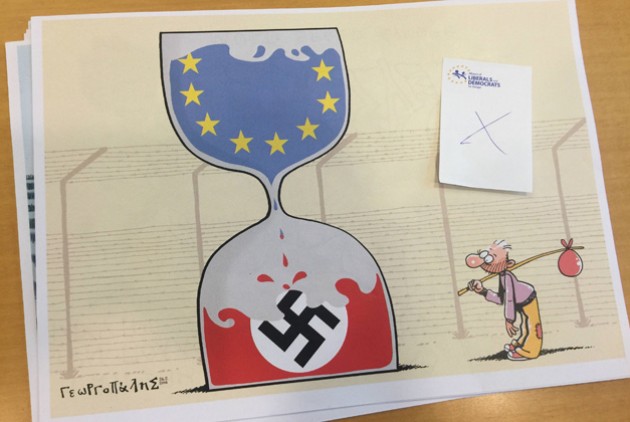
The European Parliament is accused of censoring a series of political cartoons from Greece which were due to appear in an upcoming exhibition later this month.
The exhibition, organised by an MEP from Greece and an MEP from France, aimed to present political and humorous sketches created by cartoonists from the two countries and published in the press on the occasion of the 60th Anniversary of the Rome Treaty. However, Catherine Bearder, a British Liberal Democrat MEP from southeast England, who is responsible for the cultural and artistic events sponsored by other members, decided to remove 12 out of 28 cartoons, all created by Greek cartoonists, claiming that the artwork contained “controversial content”.
Index on Censorship approached Bearder for comment but at the time of writing she had not replied.
According to the regulation of the European Parliament, all cultural events and exhibitions have to be checked so that “under no circumstances be offensive or of an inflammatory nature or contradictory to the values” of the EU.
The Greek MEP, Stelios Kouloglou denounced the “unprecedented” form of censorship by the European Parliament. “The content of the censored cartoons did not insult the values of the European Union in any way,” Kouloglou said in a press conference in Strasbourg on Tuesday, 12 September.
The 12 cartoons are critical of the EU and focus mainly on the way the EU – and especially Germany – dealt with the Greek crisis. One of the censored cartoons features the starting line for a race, with Germany in a Porsche sports car, Italy, Spain and France in old cars and Greece in a chariot being pulled by a pensioner.
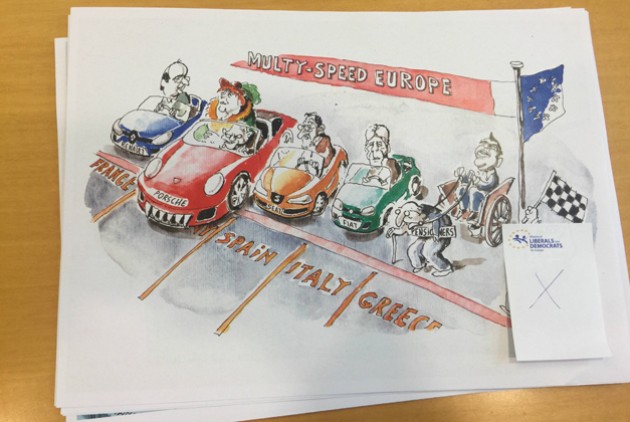 Breader presented the upcoming German election as another reason to discard the 12 cartoons, although the exhibition is scheduled to take place after the election.
“The right for artistic creation and freedom of expression are part of the European Union’s fundamental values. This arbitrary decision violates them” Kouloglou remarked in a letter of complaint addressed to the president of the European Parliament, Antonio Tajani.
The Journalists’ Union of the Athens Daily Newspapers also denounced the incident of censorship asking for the intervention of the European and International Federation of Journalists.
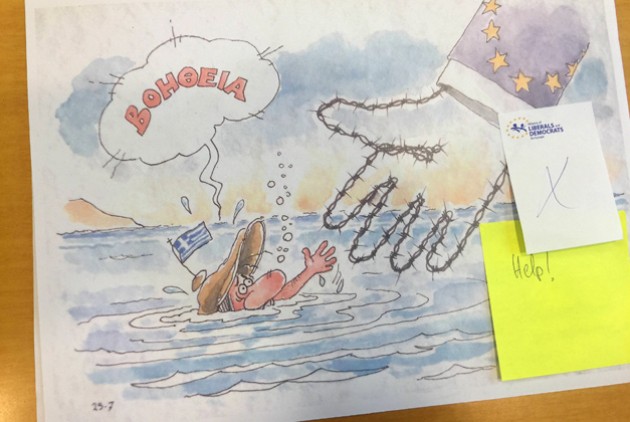
Credit: Stelios Kouloglou, MEP[/vc_column_text][/vc_column][/vc_row][vc_row][vc_column][vc_basic_grid post_type=”post” max_items=”4″ element_width=”6″ grid_id=”vc_gid:1505898132982-6897be5b-fada-1″ taxonomies=”5768, 1888″][/vc_column][/vc_row]
