18 Mar 2016 | News, Turkey, Turkey Uncensored
This column was originally submitted to Today’s Zaman, but was rejected by the new management. Doğu Ergil is a Turkish sociologist, political scientist and academic, and was a columnist for Today’s Zaman.
The numerical figures of the reality of Syrian refugees in Turkey is as follows: 2.2 million of the 4.3 million displaced Syrians who have been registered as persons of concern by the Office of the United Nations High Commissioner for Refugees (UNHCR) currently reside in Turkey. There is an estimated 0.4 million who have settled in various parts of Turkey relying on their own financial resources. The total number of Syrian refugees in Turkey is higher than the entire population of six of the EU’s 28 member states.
What truly scares Europe in terms a massive influx of “others” who can neither be assimilated nor accommodated is not sufficiently evaluated in Turkey. This is due to two factors. First the incumbent government wanted to win the hearts and minds of the Syrian asylum seekers fleeing from a tyrant who they believed would quickly wither away.
The return of the displaced people with gratitude and love for Turkey and its leadership would boost Ankara’s desire to shape the future of Syria and the Levant. Hence their warm welcome was accompanied by thoughts of temporary duress with large dividends to follow.
Secondly, the people of Turkey were influenced by the rekindled ideological rhetoric of Islamic brotherhood/solidarity and reclaiming the old territories of the Ottoman past. However, as years passed and the calculations over Syria changed, the permanence of Syrian refugees became apparent just as the realisation of the magnitude of humanitarian, social, economic and security challenges.
The big question is whether Turkey alone can bear the burden of hosting more than 2.5 million refugees without outside/international aid and support. Here comes the EU threatened by an unprecedented influx that it can neither accommodate nor assimilate. Neither Turkey’s capabilities nor Europe’s political stance have been amenable to a sustainable management of the current refugee crisis.
Consequently, this week necessity brought Turkish and EU leaderships to work out a sustainable process whereby Turkey will build the capacity to host most of the Syrian refugees and Europe will take in a limited number of them through a gradual filtering system. In return, the EU will help Turkey to carry the burden of hosting millions of refugees.
Another matter of bargaining was the lifting of visa requirement for Turkish citizens in the Schengen area. Indeed the Turkish leadership feel discriminated against on this issue when compared with other EU applicant countries (i.e., Western Balkan countries) or with third countries concerning the restrictive EU visa policy. They have concrete expectations from Brussels in this respect.
In fact, a political deal was reached in 2012 for the readmission into Turkey of third-country irregular migrants who enter the EU via Turkey in return for visa liberalisation for Turks traveling to the EU. This agreement is of great sentimentality in the overall EU-Turkey relationship given the fact that the latter’s membership seems to be farfetched.
These issues were the issues discussed by the Turkish prime minister and accompanying officials with EU representatives in Brussels this week. So far information obtained indicates that any passage of refugees further west from the Balkan countries they have reached will be obstructed. This means the so called “the Balkan corridor” will be closed.
Already a series of countries on the route have prevented the entry of migrants of Middle Eastern origin. Brussels does not want individual initiative by member states. Otherwise the crisis cannot be handled effectively. For example Macedonia allows only a limited number of refugees from Greece each day. This leads to a swelling of the number of refugees on the border towns of Greece like Idomeni, where nearly 10,000 wait on. The EU promised 700 million euros to Greece in relief.
What the EU wants is for Turkey to readmit those refugees who are not given legal rights of entry. As German Chancellor Angela Merkel has said, the 3 billion euros earmarked for Turkey can be used to build schools for refugee children and development of employment opportunities for the adults. But these piecemeal and incomplete initiatives are no panacea for either Turkey or the humanitarian crisis born out of the dismal conditions of the Middle East.
First of all given the conditions in the Middle East, namely Syria and Iraq, the return of the displaced people is not a possibility in the short term or even the medium term. Secondly, without peace and stability in the home countries, more asylum seekers will be knocking on the doors of Turkey and Europe.
So it is the mutual responsibility of mankind to end the root causes of the ongoing conflicts and stop the misery of their fellow men and women. We will see if humanity, especially “civilised countries,” will show this acumen and conscientious behavior.
Add your support to Index on Censorship’s petition to end Turkey’s crackdown on media freedom.
Turkey Uncensored is an Index on Censorship project to publish a series of articles from censored Turkish writers, artists and translators.
17 Mar 2016 | News, Turkey, Turkey Uncensored
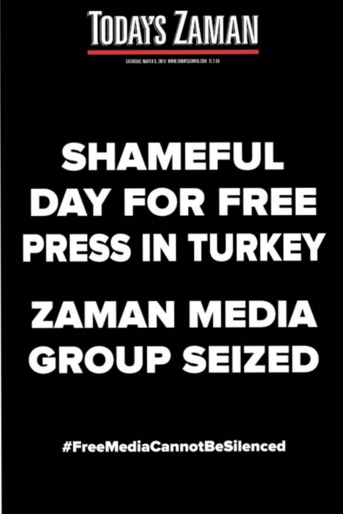
This column was originally submitted to Today’s Zaman but was rejected by the new management. Yaşar Yakış is a Turkish politician. He is a former foreign minister, and a former ambassador to the UN Office in Vienna, Egypt and Saudi Arabia, and was a columnist for Today’s Zaman.
An important step has been taken in Turkey’s painful negotiations with the EU. Turkey submitted to the Turkey-EU summit, held in Brussels on 7 March, several proposals, including the following:
-Move to 1 June 2016 the implementation of the readmission agreement, which will make Turkey contractually obligated to readmit any person who travelled to an EU country from Turkey if he or she was not admitted by that EU country;
-For every citizen of a third country readmitted by Turkey, the EU should promise that it will admit one refugee from Turkey, and the readmission expenses will be covered by the EU. This will protect Greece from the uncontrollable flow of refugees arriving in the Greek islands from Turkey’s coastal towns. However, difficulties may arise in finding an EU country that will fulfill this commitment, and Turkey’s refugee problem may continue to increase since the arrival of refugees from Syria may not stop before Syria is stabilised.
-If the readmission agreement enters into force by 1 June 2016, visa-free travel will be possible for Turkish citizens wishing to visit the Schengen countries.
-Turkey asked for an additional 3 billion euros, to be spent for refugee-related projects.
-Turkey’s EU accession process will be reactivated by opening new negotiation chapters that were blocked for political reasons, either by the EU Council or by individual countries, such as France and the Greek Cypriot administration. This positive commitment may not guarantee that Turkey will become a member of the EU but may lead to the resumption of the reforms that Turkey has to comply with under the Copenhagen criteria and the Maastricht economic criteria.
The deal will be discussed once again with Turkey before the EU Council meeting on 18 March.
Turkey’s refugee problem may thus be slightly alleviated if the genuine efforts by Chancellor Angela Merkel of Germany succeed. The bulk of the burden, however, will still remain on Turkey’s shoulders. Turkey will have to accommodate the refugees, mainly from Syria, until the EU countries select among them the eligible ones. The EU does not want to assume the moral responsibility for the solution of a problem that stems basically from Turkey’s open door policy for Syrian refugees.
The good side of the deal for Turkey is that the EU is giving Turkey a helping hand. If Chancellor Merkel hadn’t taken the lead to alleviate Turkey’s refugee burden, Turkey would have been left alone to solve it. If the deal is implemented properly, Turkey will receive not only an easing of its refugee burden but will make progress in other areas: One of them is the grinding to a halt of Turkey’s EU accession process. Both Turkey and the EU had lost their appetite for the continuation of the process. Not only the refugee problem but also the entire Syrian crisis, and beyond it the other crises in various Middle Eastern countries, may have demonstrated to certain EU countries that cooperation with Turkey could facilitate the solution of the problems that the EU may face in the Middle East. Therefore, certain EU countries may have decided to revisit the question of the reactivation of Turkey’s EU accession process.
Add your support to Index on Censorship’s petition to end Turkey’s crackdown on media freedom.
Turkey Uncensored is an Index on Censorship project to publish a series of articles from censored Turkish writers, artists and translators.
4 Mar 2016 | Europe and Central Asia, France, Greece, Mapping Media Freedom, mobile, News, Russia, Spain, Turkey
Each week, Index on Censorship’s Mapping Media Freedom project verifies threats, violations and limitations faced by the media throughout the European Union and neighbouring countries. Here are just five reports from 23-29 February that give us cause for concern.
1. Russia: Journalist severely assaulted
The physical safety of journalists in Russia remains a major concern. Sergey Vinokurov, a correspondent for the weekly politics and news magazine Sobesednik, was assaulted outside the publication’s offices in Moscow on 25 February at around 9.20pm. As Vinokurov left for home, a perpetrator hit the journalist multiple times in the body and face, just ten meters from the entrance. The assailant, who appeared drunk, shouted vulgarities and said: “you’re getting this for your articles”. Vinokurov tried to dodge the punches and managed to make his way back to the entrance to the building’s entrance, but the assailant followed and continued his assault.
Security guards and other journalists were able to restrain the perpetrator before police arrived and brought the assailant to a detention center at the Tverskoi police department. Police have opened an investigation. The attacker was a 37-year-old Anton M, who lives next to the editorial office.
2. France: Defense minister launches investigation into Le Monde
The French Minister of Defence, Jean-Yve Le Drian, launched an investigation into French newspaper Le Monde on 24 February for “compromising the secrecy of national defence” following the publication of an article on the on the presence of French special forces in Libya. The article reported: “Highly targeted pinpoint strikes, prepared by discreet or covert actions: in Libya, this is the course of action taken by France against the threat of the Islamic State.”
Under French law, compromising the secrecy of national defence is punishable by a €45,000 fine and a 3-year prison sentence. The Le Monde claims that “specialised bloggers” had spotted the presence of French security forces in eastern Libya since mid-February.
3. Greece: Police block TV crew access to refugee camp operation
It’s been almost a year since phrases “migrant crisis” and “refugee crisis” started making headlines, and in that time we’ve seen many European governments making it increasingly difficult for asylum seekers to cross into their territorial boundaries. Most recently, Macedonia tightened its border control, leaving about 4,000 people stranded in Greece. The Greek government responded by removing refugees from a camp in the border town of Idomeni, putting them on buses bound for Athens, where they were to be temporarily housed in relocation camps.
While trying to cover events at the border, a TV crew for private broadcaster Alpha Channel was denied access. Greek police asked journalist Aphroditi Spilioti, a cameraman and a sound engineer to leave the camp “safety reasons”. The TV crew then moved outside the perimeter of the camp, where they could still observe the ongoing police operation, but again they were asked by police to move — this time 2 km away — for “safety reasons”.
When the journalist and the crew refused to do so, they were asked to provide their ID cards for verification and follow the police vehicle to the station. The police also reportedly told them not to drive back to the refugee camp.
4. Spain: Politician repeatedly asks journalist to reveal sources
Former president of the province of Valencia, Francisco Camps, tried to convince radio journalist for Cadena SER, Miguel Ángel Campos, to reveal his source when the journalist called to ask the politician about alleged corruption on 29 February.
Camps, who was filming the phone conversation, told the journalist: “I have to know who I need to talk to in order to not have a big mess tomorrow. […] I am asking you a favour, please, tell me what source told you that I was collecting money. I need to talk to that person and to defend myself.”
The journalist still refused to reveal the identity of his source. The politician continued to deny the allegations and asked to involve the journalist’s boss: “Please call him right now and tell him that you talked to me. And please tell him not to talk or to do something because all of this is a lie. Please, this is really important, talk to your boss, and if he would like to talk to me I am available.”
5. Turkey: Satellite provider drops independent channel
The independent Turkish broadcaster IMC TV was pulled off the air by one of Turkey’s largest broadcasters, Turksat, on 26 February following terror charges. Ankara prosecutor requested IMC be taken down because of allegations that the channel is “spreading terrorist propaganda” for the Kurdistan Workers’ Party (PKK), which Turkey has designated a terrorist organisation.
The channel was taken off the air during a live interview with Can Dundar and Erdem Gul, two prominent journalists who were freed pending trial that same day after spending 92 days in prison. Index on Censorship has condemned the decision. Senior Advocacy Officer Melody Patry said: “Turkey must halt its crackdown on media outlets and ensure citizens have access to diverse information and viewpoints, including those that differ from the government’s political line.”
This article was originally published on Index on Censorship.
1 Mar 2016 | Magazine, Statements, Volume 44.04 Winter 2015 Extras
Rachael Jolley, editor of Index on Censorship magazine, in a speech to the §2 – Libraries and Democracy conference in Umea, Sweden.
When I was nine, ten and eleven, my mother, my brother and I had a weekly ritual of driving to the local library, a flat modern building with big glass windows. We’d spend a quiet hour wandering up and down its carpeted corridors, picking out two or three plastic-covered books to take home to read.
All sorts of people found stories, history and biographies within their reach.
I have measured out my life in library books: from weekly visits to Bristol libraries, to school in Pittsburgh – a city which pays tribute to the greatest library supporter of them all Andrew Carnegie – to further study at the great Colindale newspaper archive library, and perhaps the most exciting celebrity library spot, standing next to the poet and librarian Philip Larkin in the neighbourhood butchers in Hull.
US poet laureate Rita Dove believes that libraries provide: “A window into the soul and a door into the world.” There are two types of freedom captured in that thought: The freedom to think, and the freedom to find out about others.
Books, magazines and newspapers are a door into the world and that’s why over centuries governments have tried to stop them being opened.
When that door opens on to the world, who knows what people might think or do? That door is not open to everyone now, or in the past. And when it comes to the freedom to express oneself: to write, draw, paint, act or protest then restrictions have often been levied by governments and other powerful bodies to stop the wider public being allowed those too.
Over the centuries, often, books were only made available to some. Sometimes they were written in a language that only a tiny group of people knew. When paper was expensive, books were for the few, not the many. In times gone by education was also expensive (and it still is in many places); those who were allowed to learn reading and writing were once in the minority.
That’s why public libraries, open to all and funded from the public purse, are so important. Their existence helped the many get access to what the few had held close to their chests; information, literature, inspiration.
US businessman and philanthropist Andrew Carnegie was one of the world’s most enthusiastic endowers of libraries. He helped fund more than 2,000 libraries around the United States plus hundreds more in the UK and beyond, because when he was a poor teenager, a wealthy man, Colonel James Anderson, opened up his private library of 400 books to Andrew and other working boys on Saturday nights, and this, Carnegie believed, made a huge difference to his life chances, and his ability to rise from poor, struggling beginnings to be a successful and wealthy steel magnate.
Carnegie believed in libraries’ power to do good. To open people’s minds. To help build knowledge. To help the ordinary person be introduced to ideas that might never otherwise be seen.
Of course, the history of libraries is much older than Carnegie’s time, stretching back to the Romans, Greeks, Chinese and Islamic libraries, where archives of important documents were kept.
Libraries hold history; documents that tell us what was bought and sold in ancient Greece; or how a Roman senator spoke. They inform us about the reality of other times, and allow us to learn from that past.
That’s why conquering armies have looked to destroy libraries and museums. Part of imposing a new present on a population is sometimes about re-writing the past. From the Library at Alexandria, to the Mosque library at Chinguetti to the Roman library on the Palatine Hill. If documents had not been preserved, we would know far less. We can do more than guess what might have happened, we can actually KNOW details, because records are still available.
In the 21st century libraries are under threat from many directions. As governments and local councils cut public spending, libraries in many western countries, including in the United Kingdom, are being closed down. Does that point to a lack of need or desire for such things? Have libraries become redundant?
In this new age of enlightenment is our thirst for knowledge less desperate than in previous generations or is our thirst quenched by easy access to hundreds of television channels and the internet? Indeed, with electronically accessible information free to anyone with a computer, is the internet the ultimate library, rendering its brick and glass-built equivalents redundant, in the same way the printing press marginalised the illuminated manuscript?
We in Europe are more free than previous generations have ever been to learn, find and understand. With our zillions of instant access points for information and discussion, we can look at Facebook, Twitter and thousands of ideas online in the twitch of mouse click after all. But does that access bring more understanding or deeper knowledge? And what is the future role then of a library?
Librarians are much needed as valuable guides: to help students and other readers to learn techniques to sift information, question its validity and measure its importance. To understand what to trust and what to question; and that all information is not equal. Students need to be able to weigh up different sources of research. The University of California Library System saw a 54% decline in circulation between 1991 to 2001 of 8,377,000 books to 3,832,000. It is shocking that some students are failing themselves by not using a broad range of books, and journals that are free from their university libraries to widen and deepen their understanding.
Both libraries and newspapers in their analogue form gave us the opportunity to stumble over ideas that we might not have otherwise encountered. Over there, on that page opposite the one we are reading in a newspaper, is an article about Chilean architecture that we knew nothing about it, but suddenly find a spark of interest in, and over there on the library shelf next to Agatha Christie, is Henning Mankell, a new author to us, and one that suddenly sounds like one we might like to read. And then off we go on a new winding track towards knowledge; one that we didn’t even know we wanted to explore. But that analogue world of stumbled-upon exploration is closing down. We have to make sure that we still have the equipment to carry on stumbling down new avenues and finding out about new writers, and history that we never knew we would care about.
Technology tends to remove the “stumbling upon”, by taking us down straight lines. Instead it prompts us to read or consume more of the same. Technology learns what we like, but it doesn’t know and cannot anticipate what might fascinate us in a chance, a random, encounter. In a world where we remove the unexpected then we miss out on expanding our knowledge. Something that libraries have always offered. The present is all too easily an echo chamber of social media where we follow only the people we agree with, and where we fail to engage with the arguments of those with whom we disagree. Is the echo chamber being enhanced by the linear nature of the digital library, the digital bookstore and the digital newspaper? AND if we follow only those that we like and agree with, do we lull ourselves into believing that those are the only opinions and beliefs out there. And we are so unused to disagreement that we want to close it down. We are somehow afraid to have it in the same room as us. Somehow we seem to be stumbling on towards a world where disagreement is frowned upon, and not embraced as a way of finding what is out there.
This is just one challenge to freedom of expression and thought. There are others.
Recently at Index on Censorship, we heard from Chilean-American writer Ariel Dorfman, a long-time supporter and writer for us…. that his play, Death and the Maiden, was being banned by a school in New Jersey because some parents didn’t like the language contained in it. In other words it offended or upset somebody. Meanwhile Judy Blume’s books about the realities of teenage life, including swearing and teenage pregnancy, gets her banned from US libraries and schools.
But isn’t fiction, theatre and art about connecting with the real, isn’t it about challenging people to think, and to be provoked?
When a film has been banned from our cinemas or a book banned from distribution has it meant no one is keen to read it? In fact the opposite is usually true, people flock to find out what it is or to watch the film wherever they can. One Flew Over the Cuckoo’s Nest, A Clockwork Orange and DH Lawrence’s novel Sons and Lovers found new audiences because they were banned. Monty Python’s controversial film Life of Brian was once marketed here in Sweden as the film so funny, it was banned in Norway!! (As you can imagine it did very well here in Sweden.)
Increasingly there are loud voices saying that we shouldn’t think about the unpleasant bits in the world, that we should ignore the difficult or traumatic because it is too complicated, or too ugly to have in the room. In a special editorial published at the time of the Charlie Hebdo killings, the South African Mail and Guardian said; “The goals of terrorism, if we are to dignify utter insanity with aims, are fear and polarisation.” If we live in a society where we think we are not allowed to speak about subjects; where they are considered too controversial, where appearing on a platform with someone is somehow seen as a tacit nod to agreeing with them, are giving into those goals?
So what can those living in Europe do to enhance or defend freedom of expression and what are the role of libraries? Firstly, we should never stop learning about our history. Remember periods where freedoms of expression, of thought, of living in a non traditional way, or practising a religion that was not state sanctioned, were not laid out as European rights as they are today. From witch trials, to the Edict of Nantes, to social stigma of unmarried women, to children abused by adults. There are moments in every family’s history, when someone had a desperate need for some secret, some taboo, some injustice to be talked about. To be put under the public spotlight.
Given that historical, but personal, reflection, perhaps each of us can have a clearer understanding of why freedom of expression as a right is something worth defending today.
Freedom of expression has always had a role in challenging injustice and persecution. Some argue that without freedom of expression we would not have other freedoms. Freedom of expression also includes offering groups that have historically been ostracised or sidelined or ignored — a chance to put their views, to be part of the wider debate, to be chosen to join a television chat show. Europe is a diverse society, all those voices should be heard.
Another point about enhancing freedom of expression in Europe, and outside, is that a lively and vigorous and diverse media is extremely important. So we should fight against control of the media by a single corporation, or by increased government influence. We need newspapers, and broadcasters, that cover what is happening, and don’t ignore stories because someone would rather those stories were not covered.
And another role for libraries of the future is as debate houses – a living room – at the centre of communities where people of different backgrounds come together to hear and discuss issues at the heart of our societies. And to meet others in their community. These neutral spaces are increasingly needed.
The value of passionate argument is often valued less than it should be. Where debates or arguments are driven underground, those who are not allowed to speak somehow obtain a glamour, a modern martydom. We must allow dissent and argument. We must let people whose ideas we abhor speak. Freedom of speech for those we like and agree with is no freedom at all.
There are those that dismiss freedom of speech as an indulgence defended by the indulged or the middle class or the left wing or the right wing or some other group that they would like not to hear from. However throughout history, freedom of speech and thought and debate has been used by the less powerful to challenge the powerful. Governments, state institutions, religious institutions. And to argue for change. That is not an indulgence.
And if you believe someone else’s arguments are ill founded, incorrect or malicious, then arguing a different point of view in a public place, a library, or a university hall, is much more powerful, than saying you are not allowed to say those things because we don’t like or disagree with them. To make those arguments, to understand what is happening we need to be able to access knowledge, libraries must continue to be community spaces where people can delve for that research and find out about the world, and themselves.
Libraries and those who support them have often been defenders of the right to knowledge. Because at the heart of any library is the idea of a freedom to think and discover.
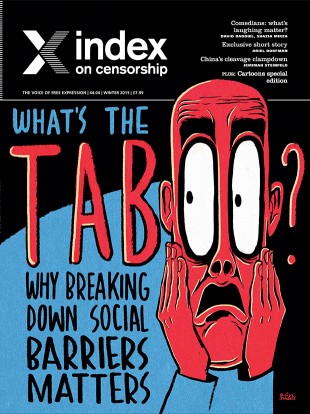
We should remember that reading something never killed anyone. Watching a play didn’t either. If you find something that you disagree with, even disagree strongly, it is not the same as a dagger through your heart, as someone told me it was last summer in Italy.
As Turkish writer Elif Shafak said recently the response to a cartoon is another cartoon, the response to a play is another play. We are and can be prepared to listen, read or watch things that we disagree with. Listen to the argument; argue back with your own. Consider the evidence. The point of speech is to arrive at truth, and no one should be offended by that.