19 Sep 2013 | Europe and Central Asia, Greece, News
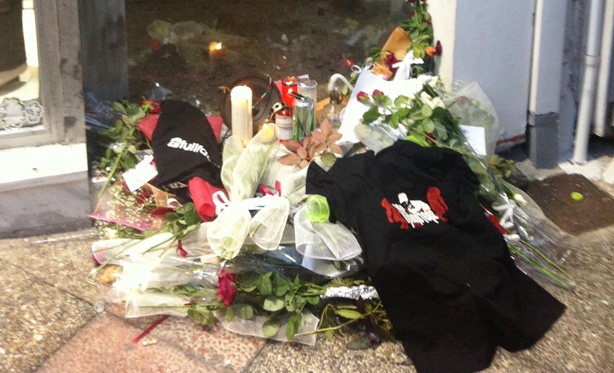
Tributes to murdered activist Pavlos Fyssas (pic: Christos Syllas-Dellis)
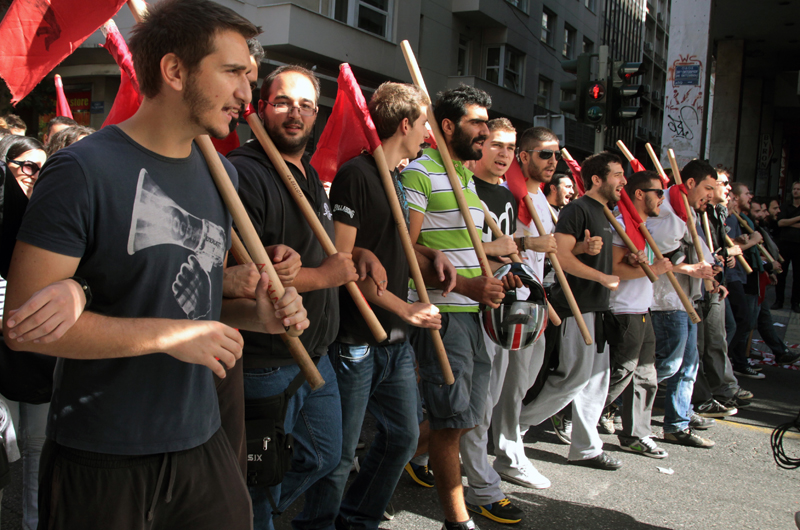
Thousands of protesters gathered on Wednesday evening in Athens near the place where Pavlos Fyssas, a 34 year-old antifascist hip hop artist was murdered by a Golden Dawn supporter.
“The blood is running, it seeks revenge”, they shouted, a slogan echoing the December 2008 riots , when 15 year-old student Alexandros Grigoropoulos was killed by two policemen.
The 45 year-old man who carried out the stabbing has told police that he was a supporter of far-right party Golden Dawn. This was clearly a politically motivated killing, added to a sequence of intimidation events and attacks carried out by Golden Dawn against immigrants and asylum seekers.
On 17 January, Shehzad Luqman, an immigrant worker from Pakistan was lethally stabbed by two men. Police later found pre-election pamphlets of Golden Dawn in the house of one perpetrator.
In December 2012, Amnesty International reported on this issue. In addition, Human Rights Watch has found that there is evidence connecting the attackers on immigrants with members of or affiliated with far-right groups such as Golden Dawn.
No matter how useful these findings may be, they were clearly not at the “agenda” of the rally at Keratsini. Young and old antifascists, together with immigrants, have been increasingly struggling with Golden Dawn vigilantes in the past five years. The murder of Fyssas comes as no surprise. A lot of people somehow anticipated the tragic event.
“The regime, in co-operation with Golden Dawn is clearly escalating the confrontation with political dissidents. This is why we’re here today. And we have to step up the intensity of this political struggle. Everywhere,” said a demonstrator, local resident of Keratsini.
Some 3,000 – 4,000 members of an organised anarchist block was heading towards Golden Dawns’ offices in Nikaia, while at the same time, demonstrators attacked Keratsini’s police station. Almost instantly clashes began: Riot police squads tried to disperse groups of demonstrators with the typical use of excessive force.
In an alley, the head of a police squad was heard shouting “Come on, let’s go and fuck them up”. Middle-aged people from the neighborhood curesed them, while young antifascists threw Molotov cocktails and stones.
Keratsini district, a working class neighborhood, was established after Greek refugees fled Asia Minor on 1922. The greater area of Piraeus (Nikaia, Perama, Keratsin), known for its anti-Nazi struggle, was historically affiliated with the political left.
This picture though seems to be fading away. According to polling company “Public Issue”, Golden Dawn has doubled its electoral influence on these areas. Moreover, it has worked its way on socially penetrating existing political views.
On June 2012, Egyptian fishermen were attacked in Perama after an inflammatory and racist speech by Golden Dawn MP Yannis Lagos, who said that the party would hold them accountable for their actions. A few days ago, again in Perama, members of the Communist Party (KKE) were brutally attacked by Golden Dawn’s supporters while putting up posters for an upcoming festival.
Last nights’ clashes have led to a total of 130 detentions and 34 arrests while tweeters were reporting a demonstrator had been heavily injured by a direct teargas shot. Questions about the way police responded at the place of the assassination remain unanswered. Witnesses on TV broadcasts this morning said that police were reluctant to involve at the fight before the stabbing.
There were protests against the murder throughout the country. Latest reports suggest that there have been discussions on emergency legislation to ban Golden Dawn’s acts.
This article was originally published on 19 Sept 2013 at indexoncensorship.org
2 Jul 2013 | Europe and Central Asia
Taking their cue from the neo-nazi Golden Dawn, Greece’s far-right newspapers have recently been targeting alternative opinions. While hardly breaking news, the language and symbolism of the campaign is of vital importance because it represents just the tip of the iceberg, Christos Syllas writes
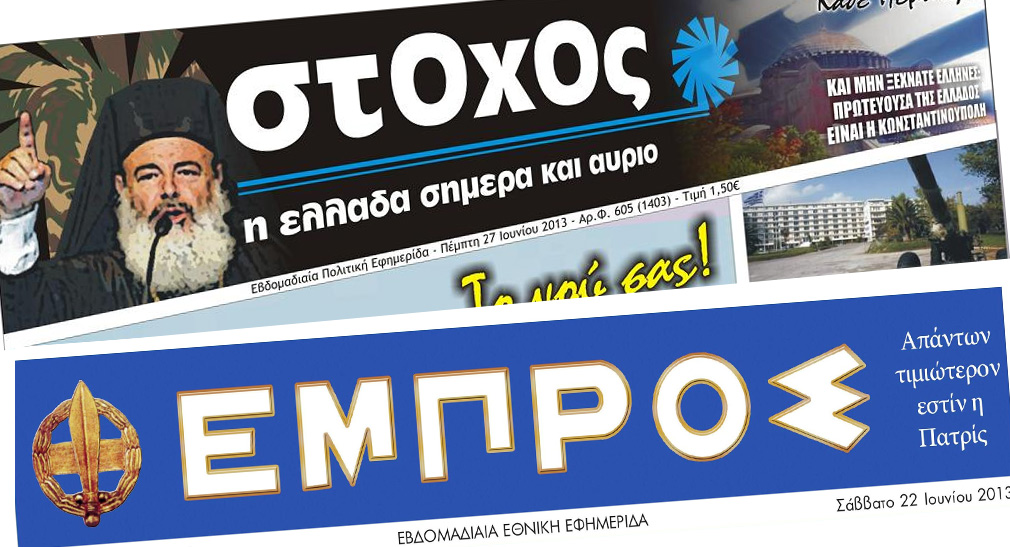
Greece’s far right newspapers have been targeting groups they see as “anti-Greek”
The rise of the Golden Dawn and its campaign against groups it perceives to be anti-Greek — leftists, immigrants, gays and lesbians — has encouraged nationalist and far-right sympathisers to spread their ideologies through existing and new media outlets both online and off.
On 6 June, for instance, the far-right publication Stohos, or Target, mocked Tasos Theodoropoulos for being “a self-proclaimed gay” who criticised a bishop’s persistent attempts to abolish a gay pride festival. Theodoropoulos had called the bishop a “flowery priest’s wife”. The turn of phrase apparently hit a conservative nerve.
Theodoropoulos, who was beaten shortly after the paper blasted him, wrote about his terrifying experience and suggested an explanation for the attack.
“They maybe didn’t know me. Even if they didn’t, newspapers like ‘Stohos’ have succeeded in helping them recognise me, as a target”.
Stohos is a far-right newspaper with a history of offensive and abusive language. It has always held anti-communist views, defended the Greek Orthodox church and launched campaigns against ‘anti-Greek’ sentiments. Its publisher, Savvas Hatziparaskeyas, was sentenced to 10 months in prison for repeatedly libelling the Migrants’ Forum in Crete (MFC).
In that case, Stohos had accused two MFC members of “unpatriotic plotting intended to cause chaos and unrest” and appealed to Greek residents of Crete to break “this abcess”. MFC won its case against Hatziparaskeyas in September 2012.
In a telephone interview on 26 June, Dimitris Psarras, known for his prominent investigative journalism on Golden Dawn and on the far-right spectrum, shared some of his thoughts about the violence encouraged by far-right publishers:
“Stohos has been following for years the method of targeting people and journalists. I remember that back in the nineties, while reporting as a member of ‘Ios’ (an investigative journalistic team), we were denounced as ‘traitors’, ‘agents’ and ‘people who should leave Greece immediately’. At the time we were reporting on the protection of minorities and on human rights issues. Even though we largely documented our stories on decisions from Greek or European courts, they wouldn’t stop. I recollect several open calls for violent deeds from nationalists and far-rightists. However, attacks and conflicts were disproportionate to the calls.”
The “anti-Greek” foreigner
Far-right publications have rejected voices considered to undermine “the purity of the Greek race and the glory of the nation.” And such publications also find “any distortion of religious beliefs” or support for the rights of immigrants to be unacceptable.
Indymedia Athens, for example, is a local collective of grassroots activists that heavily criticises Golden Dawn’s practises and nationalist ideas. For publishing calls for pro-immigrant rallies, and condemning racist attacks against immigrants, far-right voices have labelled the group as a “cesspit” and its members “snitches” and “employees of billionaire George Soros.”
The notion of being supported by ‘foreign’ funding is part of building a case that groups like Indymedia are part of an external threat. According to far-right rhetoric, anarchists and antifascists with the support of left-wing Syriza are anti-Greeks who must be fought. A far-right blog called Maiandrioi has previously made such a call to arms:
“We invite all Greeks in blood and soul, to be awake and military ready… in days to come, anti-Greeks will reveal their real face and they will jointly fight against Greeks.”
Golden Dawn recently published a newspaper called Embros. Next to the main story calling for Golden Dawn victories in upcoming mayoral elections there was a photograph with children holding placards during a pro-immigrant rally. The caption underneath read: “foreign criminals thresh in Athens”. Insulting language for immigrants and children does not come as such a great surprise.
Artist Panayiotis Hatzistefanou wrote a piece entitled “Why I am anti-Greek” on 15 May, where he said that he can no longer stand to hear homophobic, racist, and far-right remarks in a country falling apart. Without hesitation Stohos attacked him for the piece, calling for his citizenship to be revoked.
It is worth noting that newspaper Stohos targeted Paris Karvounopoulos, an experienced military journalist. After publishing a piece critical of Frangos Frangoulis, a former chief of the Hellenic Army general staff and former minister for national defense, Karvounopoulos found himself reprimanded by “Stohos”. The title of that story was a call to Frangoulis: “General, if you must f*#k people up, start from him”.
Κarvounopoulos, however, claimed on 26 June that the former general had previously spoken against his self-proclaimed supporters.
“Lawsuit industry”
At the same time, far-right targeting seems to have another dimension. Many argue about the building of a “lawsuit industry” by extreme right-wingers to those opposed to far-right viewpoints. Savvas Michail, general secretary of EEK, the Revolutionary Labor party, was sued by Golden Dawn because he labelled it as a nazi organization that attacks immigrants.
Katerina Thoidou, a journalist for the newspaper Workers’ Solidarity and anti-fascist activist (member of KEERFA, Movement Against Racism and Fascism Threat) was sued by Ioannis Andriopoulos, a lawyer who offers his services to a Golden Dawn MPs. Andriopoulos says that Thoidou insulted him by calling him “a fascist”.
Thoidou had used the label when Andriopoulos’ petition prompted the Greek Council of State to declare the country’s citizenship law (L. 3838/2010) unconstitutional. The law had been criticised for easing the process for citizenship, which moderate critics saw as an effort by political parties to gain the votes of newly-minted Greeks.
Thoidou, said in a telephone interview on 26 June, that recent targeting of journalists and people who oppose the Golden Dawn can be explained: “It is clearly an orchestrated effort to silence journalists reporting on Golden Dawn’s attacks on immigrants and homosexuals. The exposure of such incidents results in uncomfortable pressure not only against the ‘typical’ far-right advocates but against the government”.
Christos Syllas is a freelance journalist. Tweets from @csyllas
25 Mar 2013 | Volume 42.01 Spring 2013

Against a backdrop of heavy austerity measures in Greece, free speech and the right to protest are being both challenged and undermined. The policies are the result of agreements between the government and the so-called troika, made up of the European Commission, the International Monetary Fund and the European Central Bank. Since 2010, steps taken to restore fiscal balance have led to the impoverishment of large segments of society and unemployment has reached new highs: 26.8 per cent in October 2012. At the same time, the rise of the neo-Nazi party Golden Dawn, with an agenda of targeting immigrants, homosexuals and “dissidents” of all kinds, has created palpable social tensions. Police repress protests and political activity by a range of groups, including anarchists and leftists, a fact that has been widely documented. These tactics have been regarded by many as evidence that the government is adopting an authoritarian stance when it comes to criticism and dissent.
The current government, run by Prime Minister Antonis Samaras’s conservative New Democracy Party, took office in June 2012. In a report published in July 2012, Police Violence in Greece: Not just “Isolated Incidents”, Amnesty International stated:
The failure of the Greek authorities to effectively address violations of human rights by police has made victims of such violations reluctant to report them. … Between 2009 and the first months of 2012, numerous allegations have been received regarding excessive use of force, including the use of chemical irritants against peaceful or largely peaceful demonstrators, and the use of stun grenades in a manner that violates international standards.
In the report, Amnesty made “urgent recommendations to the Greek authorities”, urging them to ensure that police “exercise restraint and identify themselves clearly during demonstrations” and calling for them to improve “safeguards for those in custody and creating a truly independent and effective police complaints mechanism”. The mainstream media — owned mainly by business leaders seen as having a cosy relationship with politicians — have censored or fired journalists who have attempted to speak out about the costly bailout agreements with the troika.
Those who have reported on allegations of police brutality, such as Kostas Arvanitis and Marilena Katsimi of the Greek state-owned public radio and television broadcasting corporation ERT have also been targeted. On 9 October 2012, Thanos Dimadis, a correspondent for Greek TV and radio station SKAI, reported that bailout payments had been only “partial” and carried out “under a regime of strict economic surveillance”. Later that day, he received instructions from SKAI TV news director Christos Panagopoulos not to include that information in the afternoon and evening news reports. The text of his story was removed from SKAI TV’s website. Dimadis’s report was annoying for the government, which was keen to prevent details about the bailout from becoming public. Payments from the troika had been suspended since June, after a partial tranche was released. The authorities were worried that the public would believe that payments were conditional on even more stringent austerity measures. Dimadis complained to SKAI’s news directors, threatening to resign if they did not back up his report. He eventually quit.
Dimadis told me that senior management at SKAI argued that the reason they withdrew his report was that the prime minister’s office had dismissed it as false. Moreover, Dimadis’s reactionwas described by SKAI as “over the top”.
Censoring the news
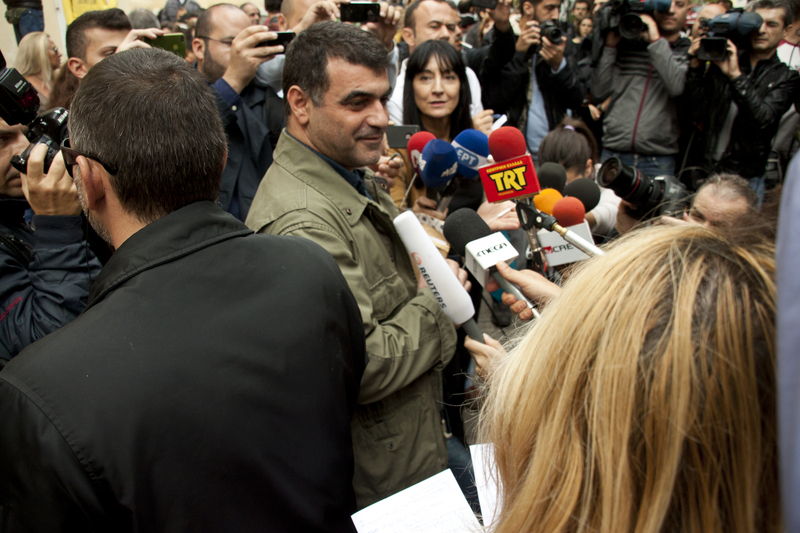
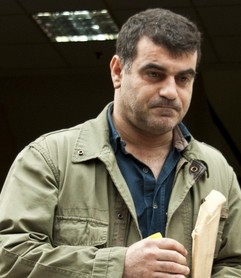
The government’s modus operandi is best illustrated by the Kostas Vaxevanis case. Vaxevanis, an investigative journalist and publisher of Hot Doc magazine, was arrested on 28 October 2012 for publishing the names of over 2000 Greek citizens who held Swiss bank accounts, dubbed the “Lagarde list”. The story focused on alleged tax evasion by wealthy Greeks during a time of economic crisis.
“A few months ago, before the release of the ‘Lagarde list’ and my aggressive arrest, there was an organised attempt to destroy my professional reputation: a publication presenting a fake receipt attempted to incriminate me as being on the payroll of the National Intelligence Service (EYP). I realised I was under heavy surveillance and one night I was ambushed by strangers at my home,”Vaxevanis told me in an interview.
During our discussion, on 26 December 2012, Vaxevanis said free speech in Greece was coming under attack yet again: “It’s not something new. When you have ongoing dealings between politicians and businessmen who own media groups, then it comes as no surprise that journalists are driven to self-censorship. Take a look, for example, at the non-existent coverage of the Reuters story on the Piraeus Bank case. You have such a big story, but what you see in the newspapers instead is an advertisement by the bank.” 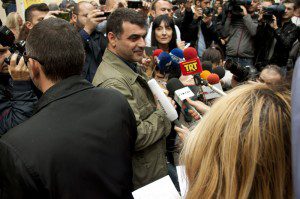
On 1 November, Vaxevanis was acquitted and cleared on changes of violating privacy laws. But two weeks later, the prosecutor’s office ordered a retrial, claiming the original verdict was “legally flawed”. He could face up to two years’ imprisonment if he is sentenced. In April 2012, Reuters reported on an investigation into documents, including financial statements and property records, relating to Michalis Sallas, executive chairman of Piraeus Bank, and his wife, Sophia Staikou. The press report said “the couple may also be emblematic of the lack of transparency and weak corporate governance that have fuelled Greece’s financial problems”.
But according to journalist Apostolis Fotiadis, no major national or international media outlet reported on the lawsuit filed by Piraeus Bank against Reuters, though the New York Times anda couple of independent journalists attended the trial, including Fotiadis. The ruling is still pending.
On 29 October 2012, a popular morning talk show on the Greek state broadcasting corporation, ERT, was suddenly suspended, following a decision by ERT’s general director of news, Aimilios Liatsos. Shortly before the show was dropped, Kostas Arvanitis, co-presenter of the programme, and his colleague Marilena Katsimi had made comments on air about the minister of public order’s response to an article published in the British newspaper the Guardian written by Helena Smith.
Arvanitis told me:
I’ve been working as a journalist for 25 years. I’ve never experienced anything like this — not to this extent and with such intensity, at least. I consider what happened as aggressive meddling by the political system. It’s becoming more and more clear: every question that is different, every perspective that is different is considered provocative. You can understand what’s happening if you take a careful look at the media coverage of strikes.
Influential columnists and unsigned editorials very often neglect the reasons lower and middle working classes decide to go on strike. Instead of shedding light on their requests, these outlets prefer to present the strikes as instances of “abusing the public space” or “disturbing public peace”. This is the typical official government response as well. In the broader context, of course, this approach fails to report on the growing pressure on workers — on those who still have a job but with reduced salaries, and on those without one.
A Guardian article written by Maria Margaronis was published on 9 October and mentioned allegations of police brutality against protesters. It also referred to and confirmed an earlier article,published on 28 September, written by Helena Smith, that quoted ‘analysts, activists and lawyers’ as saying that the “far-right Golden Dawn party is increasingly assuming the role of law enforcement officers on the streets of the bankrupt country, with mounting evidence that Athenians are being openly directed by police to seek help from the neo-Nazi group”.
Margaronis also wrote:
Fifteen anti-fascist protesters arrested in Athens during a clash with supporters of the neo-Nazi party Golden Dawn have said they were tortured in the Attica General Police Directorate (GADA) — the Athens equivalent of Scotland Yard — and subjected to what their lawyer describes as an Abu Ghraib-style humiliation. If it hadn’t been for the Guardian stories, it is highly unlikely that Golden Dawn’s purported connection with the police would have reached a foreign audience — or the Greek public. The fact that these claims never made the Greek press and that Arvanitis was censored for simply commenting on one of the articles shows just how prevalent censorship is in Greece today.
Dimitris Katsaris is a lawyer for four of the protesters who alleged that they were tortured in GADA after they were arrested during the 30 October protest. He says the way the situation has been handled is a clear “indication of censorship … interviews with the anti-fascists took place in a climate of terror; at the end, the policemen tried to grab me and push me away while I was complaining to them. All of this has been recorded.” However, the censorship didn’t stop there.
Ignoring the truth
Minister of Public Order Nikos Dendias claimed on SKAI TV talk show New Folders on 16 October that the Guardian report on police brutality was false, and threatened to sue the British paper if no proof of torture was found. He questioned the source of the photographs in Margaronis’s article — which showed an injured protester — and claimed that since the anti-fascists hadn’t gone on record with their names and reports, and hadn’t filed a lawsuit against the police, the Guardian was not justified in publishing the story.
Dendias also denied assertions that the arrested protesters were afraid to go on record because they had been threatened by police or extremist Golden Dawn supporters. According to Katsaris, although SKAI and the New Folders’ presenter Alexis Papahelas were already in possession of the photographs indicating police brutality at the time they interviewed Dendias, they did not report on the evidence or broadcast the photographs; had it not been for SYRIZA MP Dimitris Tsoukalis’s intervention on the show, the photos wouldn’t have been shown on air. “From the moment the Guardian’s report was published,” Katsaris says, “I was in contact with New Folders’ editor-in-chief. A week before the show I was providing him photos and evidence that proved torture by the police.” Katsaris says he called the editor-in-chief and asked him to intervene, but after many calls, he was told there was “‘no sufficient airtime” to provide the other side of the case. “So I could not contrast the ministers’ claims. I even asked them, given the material they had, to question the minister in a fair journalistic manner. They didn’t.”
It seems that every time a story about political actions by anti-fascist protesters unfolds, the censorship machinery of the government and Golden Dawn is set in motion. Niko Ago, an Albanian national who had been working as a journalist in Greece for 20 years, faced deportation after publishing a report about alleged criminal activity by Golden Dawn spokesman Ilias Kasidiaris, who is a member of parliament. Ago revealed that Kasidiaris was facing charges for allegedly participating in a 2007 attack on a postgraduate student and for illegal possession of a firearm .Since then, Ago has been receiving threatening emails containing defamatory and racist comments, some of which he published, including one that said “Fuck you, Albanian … all you fucking Albanians are going to get what you deserve.”
Muzzling grassroots dissent
A great deal of pressure has also been brought to bear on independent, non-corporate media collectives or individuals who offer grassroots coverage. On 20 December 2012 and on 9 January 2013, police operations were carried out at the Villa Amalias squat in Athens, which has been an important meeting place for alternative political movements for the last 23 years, and at the Radiozones of Subversive Expression, an Athens-based radio station at the University of Economics and Business (ASOEE). Anarchists, leftists and political dissidents used both sites to organise labour, anti-fascist and antiracist rallies. As part of the operations connected with the ASOEE raid, in late December, anti-riot squads and police targeted immigrant street vendors originally from Nigeria, Morocco and Bangladesh who were selling pirated CDs and wooden animal figurines, as well as those who were regarded as supposedly condemning Greece to an economic decline, as the Radiozones website put it. The government, as well as Golden Dawn, tends to regard the economic activities of immigrants as detrimental to the national economy and as a threat to local workers.
Last October, during German Chancellor Angela Merkel’s visit to Greece, nearly 100 arrests took place, as Avgi newspaper reported. During the 6-7 November general strike, a group of parliamentarians from SYRIZA denounced the massive presence of undercover police on the streets of Athens. According to the coalition, they were both acting as provocateurs among peaceful protesters and arresting people who simply looked “suspicious”. The policy of pre-emptive arrests has been repeatedly called unconstitutional by human rights organisations, including the Hellenic League for Human Rights.
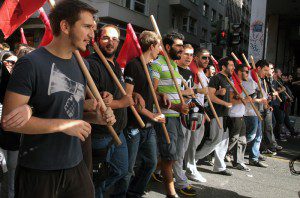
Tomasz Grzyb/Demotix
During the annual Athens’ Polytechnic School rally on 17 November, dozens of pre-emptive arrests were reported on the website of the weekly political newspaper Kontra and activist websites documented many individual complaints. Indymedia Athens, the local collective of the international grassroots and activists network, published two complaints from citizens arrested on the day of the rally. In both cases, individuals were detained before the demonstration and were kept in custody for five hours without being allowed to contact a lawyer.
Mainstream media failed to report the events, while the government officially ignored complaints. Most news on the events came from blogs and free expression activists.
Online censorship
This systematic abuse is also taking place in the online environment. After posting a Facebook page that ridiculed a well-known Greek Orthodox monk, in late September 2012, a 27-year-old man was arrested on charges of‘”malicious blasphemy and religious insult”. Many online activists and commentators reflected that the page, called Elder Pastitsios the Pastafarian (which intentionally combines the name of the monk with a popular Greek food), angered members of Golden Dawn, who called for the man’s arrest under Greece’s anti-blasphemy laws. Free expression advocates responded, with the hashtag #FreeGeronPastitios trending on Twitter, and a petition addressed to parliament calling for the immediate release of the Facebook user was circulated online Vassilis Sotiropoulos, a lawyer and blogger specialising in internet legislation, writes:
“The legislature refuses to address the issue of internet censorship, thereby allowing law enforcers (prosecutors, police officers, judges and lawyers) to freely interpret and utilise the existing legal tools. This phenomenon has sometimes led to misunderstandings, which restrict individual rights of freedom of expression and privacy. Sotiropoulos added that the case of Elder Pastitsios provided perhaps the first example in Greece of an internet company disclosing information to the government in order to identify an individual accused of ‘alleged offences relating to religious satire’.
When considering freedom of speech as a universal human right, it is important to comprehend the social and economic context of our times. Currently, the political and economic elites, in Greece but elsewhere in Europe as well, are repositioning themselves within a capitalist system that is undergoing a continuous transformation.
Speaking to Al Jazeera, William I Robinson, Professor of Sociology and Global Studies at the University of California, Santa Barbara, argued that we are currently living through a phase of capitalism where “nation-state constraints” no longer apply. He stated that the “the strength of popular and working class movements around the world, in the wake of the global rebellions of the 1960s and the 1970s”, are now being effectively and successfully undermined.
Historically, during periods when there have been attempts to devalue the working class, there have also been challenges to the fundamental right to voice dissent, which has had a direct impact on efforts to improve living conditions. The current economic crisis, then, fits this model; it can also be used as an effective tool for the far right and those using fascist rhetoric to attack immigrants and workers.
Freedom of speech and protest in Greece must, then, be seen in very specific terms. The right to free expression is being systematically and effectively challenged by formidable political and economic agendas. It is crucial that activists, journalists and those being censored and abused continue to make their voices heard.
Christos Syllas is a freelance journalist in Athens. He tweets from @csyllas