1 May 2024 | Belarus, China, Greece, Iran, News, Palestine, Russia
In my work as a journalism lecturer, I am increasingly struck by the fact that many students don’t read books. By this I don’t mean they don’t read – they read all the time, constantly scrolling on their phones, laptops and devices. I mean physical books. As for newspapers: forget it. For this reason, I have taken to reading to them. I tell them to put their phones away (which some find almost impossible), to close their laptops and… listen. I don’t ask them to sit in a circle on the carpet, but it’s not far short of that… it is a moment for meditation, what some have come to call mindfulness. I have read them all sorts of authors: Orwell, Conrad, the great Dutch journalist Geert Mak, Joan Didion. They wriggle and fidget, but in the end their breathing calms down, their faces relax, and they sit and listen.
And I am going to do the same with you today. You are all busy people so I won’t ask you to put away your phones and devices, but I will ask you to listen as I read to you from one of the most celebrated authors of the 20th century, Arthur Koestler. Perhaps not so widely read today, Koestler was best known for his anti-totalitarian novel Darkness at Noon, but was also a prolific journalist and essay writer. This essay, On Disbelieving Atrocities, is from a collection of essays called the Yogi and the Commissar, published in 1944. The essay itself was originally published in the New York Times under the title The Nightmare That is a Reality. He describes the “mania” he feels when telling the world about Nazi atrocities. “We, the screamers, have been at it now for about ten years,” he says. But the screamers are struggling to be heard.
“We said that if you don’t quench those flames at once, they will spread all over the world; you thought we were maniacs. At present we have the mania of trying to tell you about the killing, by hot steam, mass-electrocution and live burial of the total Jewish population of Europe. So far three million have died. It is the greatest mass-killing in recorded history; and it goes on daily, hourly, as regularly as the ticking of your watch. I have photographs before me on the desk while I am writing this, and that accounts for my emotion and bitterness. People died to smuggle them out of Poland; they thought it was worthwhile. The facts have been published in pamphlets, White Books, newspapers, magazines and what not.
But the other day I met one of the best-known American journalists over here. He told me that in the course of some recent public opinion survey nine out of ten average American citizens, when asked whether they believed that the Nazis commit atrocities, answered that it was all propaganda lies, and that they didn’t believe a word of it. As to this country, I have been lecturing now for three years to the troops and their attitude is the same. They don’t believe in concentration camps, they don’t believe in the starved children of Greece, in the shot hostages of France, in the mass-graves of Poland; they have never heard of Lidice, Treblinka or Belzec; you can convince them for an hour, then they shake themselves, their mental self-defence begins to work and in a week the shrug of incredulity has returned like a reflex temporarily weakened by a shock.”
Koestler’s words still have the power to shock 80 years later…
I have been proud over the years to be something of a screamer — for the Observer, the New Statesman and most prominently as the journalist portrayed in the Hollywood film Official Secrets (dir. Gavin Hood 2019).
I now work as editor-at-large for Index on Censorship, initially set up in 1972 to publish and promote the work of dissident writers from behind the Iron Curtain. There has never been more for us to scream about. The atrocity deniers are everywhere: suggesting that outrages committed by Iran, Russia, Belarus, China are mere Western propaganda. We saw it on October 7th and we see it in Gaza.
My favourite screamer (and Koestler’s heir in some ways) is the journalist and academic Peter Pomerantsev. His second book, This Is Not Propaganda: Adventures in the War Against Reality (2019), should be required reading on all journalism (and public relations) courses. Pomerantsev comes from the same tradition as Index — his parents were Soviet dissidents arrested for “distributing harmful literature”. He warns that Putin’s Russia has ushered in a new age of atrocity denial driven by the troll farms of St Petersburg.
His family’s experience gives Pomerantsev a personal, visceral respect for objective truth, facts, reality. He tells the story of the legendary dissident publication The Chronicle of Current events.
“The Chronicle was how Soviet dissidents documented suppressed facts about political arrests, interrogations, searches, trials, beatings, abuses in prison. Information was gathered via word of mouth or smuggled out of labour camps in tiny self-made polythene capsules that were swallowed and then shat out, their contents typed up and photographed in dark rooms. It was then passed from person to person, hidden in the pages of books and diplomatic pouches, until it could reach the West and be delivered to Amnesty International, or broadcast on the BBC World Service, Voice of America or Radio Free Europe.” (This Is Not Propaganda, p 2)
Where does this leave us? We who are committed to telling the truth. We who respect facts. Are we listening to the screamers?
On the plane to Zurich, I was given my complimentary copies of Forbes and Vanity Fair and the answer was right there. Vanity Fair carried an article about Alexei Navalny, who grew to prominence through his exposure of corruption in Putin’s Russia, while the cover of Forbes was devoted to the Boeing whistleblower John Barnett. We perhaps need to start thinking about whistleblowers as corporate dissidents, as truthtellers, not subversives to be closed down.
Because Navalny and Barnett are both, in their way, screamers.
This is the transcript of a speech made to a meeting of chief communications officers from leading global companies in Zurich
4 Oct 2023 | News, Syria, Turkey
The police at London’s Luton airport worked through a list of questions. Did Broomfield consider his reporting to be objective? Did he include multiple sources in his work? How did he get paid? What was his opinion about beheadings, and did he ever send anybody a photo of a beheading? “Not answering the questions is a criminal offence, so I complied,” British journalist Matt Broomfield said about the questioning he was subject to in July. His laptop and phone were confiscated and he didn’t receive them back.
The questions indicated that Broomfield was a person of interest because of his journalistic work in Syria between 2018 and 2021. Besides reporting for media like VICE, the Independent and the New Statesman, he founded the Rojava Information Center, a news agency dedicated to improving the quality of reporting on the autonomously administered regions in the northeast of Syria (often referred to as Rojava) by making sources available and by working as fixers and translators for visiting journalists. But Broomfield said he wasn’t entirely certain about why was questioned: “They said they were doing a mopping-up operation, but didn’t give any details.”
It wasn’t the first time Broomfield, who is currently based in Belgrade, Serbia, had been questioned at an airport. In 2021 he was detained in Greece because, as he learned after being detained, he was banned from travelling to Schengen territory. He was eventually put on a plane to London, where he was again questioned. Broomfield said:
“After that, I have travelled to London several times without problems. You know, if you spend three years in Rojava, you can expect police wanting to talk to you. But now I needed to answer their questions again?”
After confiscating his equipment, the police asked if he had any confidential sources and material on his phone and laptop. Broomfield said no and explained that legally he doesn’t have to give police his password (police can only request your phone password if they have a warrant, something that many might be unaware of). Broomfield has since wondered what would have happened if he had said yes.
“What worries me is that the police ability to impound journalists’ tech reduces sources’ ability to trust journalists,” he said.
In 2019 Index investigated how border officials are increasingly demanding access to individuals’ social media accounts around the world. This is ushering in a frightening new era where people are worried that their words, their criticism and taking part in a protest will end in a travel ban and are, as Broomfield says, deeply concerned about their own sources.
Fiona O’Brien, the UK Bureau director of Reporters Without Borders, is also worried. In an interview with Index, she said: “We recognise the importance of national security and nobody says journalists are above the law, but press freedom is at stake here. Journalists have the right to work freely and without fear of the confidentiality of their sources.”
She said the police’s actions seem to be an overreach of the use of the law: “They have a duty to protect the public but their powers to do so should be used exceptionally.”
Recent statistics show that 2,498 people were subject to the use of schedule 7 of the Terrorism Act 2000, but it remains unclear how many of them were journalists. O’Brien said she heard of three cases so far this year.
“The lack of transparency is problematic. We don’t know why exactly people are questioned, we don’t know what happens to their equipment, and the police are not allowed to search confidential information on journalists’ equipment but we don’t know how this works in practice. We have written to the counter-terrorism police to talk about this, but so far we received no response.”
What Broomfield himself is also curious about and can’t seem to find answers to is the extent Turkey is involved. The autonomous administration in Northeast-Syria is considered to be a ‘terrorist’ entity by Turkey, as it is founded on the ideology of the Kurdish political movement, of which the armed Kurdistan Workers Party (PKK) is a part. While the PKK is not active in Syria, Turkish authorities have been calling on NATO members to crack down on all Kurdish activism they deem “terrorism”.
“I don’t know if Turkey shares lists of names with European authorities or if they just demand a firmer crack-down in general, but I do know that the UK and Turkey have shared security interests and the economic ties have strengthened, especially after Brexit,” said Broomfield.
He also points to the strong ties between Turkey and Germany, the latter being responsible for the Schengen ban he received and which is due to end (but may be renewed) in 2026. He is trying to find out more about the background of the ban and trying to get it reversed with the help of a lawyer in Germany. Broomfield said:
“This ban hampers my work much more than the questioning and the confiscation of my equipment. It would be good to be able to travel to key places in the Schengen zone to report on Kurds in Europe. I get invitations to speak at conferences in Europe but can’t accept them. The ban narrows my horizon.”
Did Broomfield expect to face problems because of his work in Syria?
“I’m aware that reporting there comes with risks, both in the short term on the ground and in the long term. But the work my colleagues and me have done there, supportive of what the autonomous administration tries to build but looking at it with a critical eye, is important and we need more of it. The situation I am now in limits my ability to use my liberty as a British citizen to draw attention to the plight of the Kurds. To me, all this speaks to the trend of increasing Turkish influence on Europe’s security policies.”
Both Reporters Without Borders and the National Union of Journalists are supporting Broomfield in efforts to get his equipment back and to get more clarity on the background of his detention and interrogation. The NUJ didn’t want to comment, but did share that Broomfield’s case follows the recent similar case of Ernest M., a foreign rights manager for the French publisher Editions La Fabrique, who was arrested by British police under terrorism legislation when he arrived in London for this year’s London Book Fair.
Meanwhile, Broomfield is applying to several funds for journalists to cover his legal expenses.
6 Sep 2023 | Czech Republic, France, Greece, Hungary, Italy
Sofia Mandilara really likes her job. As a reporter for the Greek news agency Amna, she is “often at the forefront of important events”, she said. “Through us, people find out what is going on in our country.” But not all that goes on in Greece is reported. This is because Amna belongs to the Greek state and is subject to the office of Prime Minister Kyriakos Mitsotakis. Anyone who reports critically on his conservative government is censored, the 38-year-old said.
A similar situation exists at the Italian state broadcaster, Rai, which plays a major role in shaping public opinion. It is increasingly under the influence of Italy’s right-wing populist government. Immediately after taking office in October 2022, Prime Minister Giorgia Meloni filled all management positions with her followers. The two previous governments did the same, but none as radically as Meloni. Prominent reporters left and even high-profile journalist and anti-Mafia author Roberto Saviano’s show was cancelled after he tangled with Meloni. Positive reports about Meloni’s government, meanwhile, account for around 70% of all political news on Rai stations, according to the media research institute Osservatorio di Pavia.
Journalists at the Journal du Dimanche, France’s leading Sunday newspaper, have also suffered a radical change of regime. In the spring, Vivendi, owned by billionaire Vincent Bolloré, got the go-ahead to buy the publishing giant Lagardère, including the JDD. Bolloré publicly denies any political interest. But as with his acquisitions of CNews in 2016 and the magazine Paris Match last year, the buy-out was followed by a sharp turn in the editorial orientation of the JDD towards the far right.
State officials who demand censorship, party functionaries who misuse public broadcasters for their propaganda and billionaires who buy media to propagate their own political interests – what was long known only in Viktor Orbán’s Hungary – is spreading across Europe. The creeping decline in media freedom and pluralism has been documented for years by the Centre for Media Freedom at the European University of Florence, an EU-funded project. There is now “an alarming level of risk to media pluralism in all European countries”, researchers wrote in their annual report in June.
This puts Europe in a “desperate situation”, said Věra Jourová, the EU Commission vice-president for values and transparency. The Czech Commissioner has personal experience of life without a free press. “I lived under communism, that was uncontrolled power – and unchallengeable power. This should not happen in any EU member state,” she said in an interview with Investigate Europe, a co-operative of journalists from different European countries. Media are “the ones who keep politicians under control. If we want the media to fulfil its important role in democracy, we have to introduce a European safety net.” That is why she is pushing to implement a landmark EU law “to protect media pluralism and independence”, which would set legally binding standards to preserve press freedom in all EU member states.
She and her colleagues introduced the bill in September 2022. Among other things, it provides that: public service media must report “impartially” and their leadership positions must be “determined in a transparent, open and non-discriminatory procedure”; the allocation of state funds to media for advertising and other purposes must be made “according to transparent, objective, proportionate and non-discriminatory criteria”; governments and media companies must ensure that the responsible “editors are free to make individual editorial decisions”; owners and managers of media companies must disclose “actual or potential conflicts of interest” that could affect reporting; and the enforcement of journalists to reveal their sources, including through the use of spyware, must be prohibited.
All of this seems self-evident for democratic states and yet it met with massive resistance from not only Hungary and Poland, but also Austria and Germany. They argued the proposal is overreaching, “with reference to the cultural sovereignty of the member states”, according to minutes from the legislative negotiations in the EU Council, obtained by Investigate Europe. The four governments wanted a directive rather than a legally binding regulation, which would allow the governments to undermine the bill.
In Germany, media supervision is the task of regional states. On their behalf, Heike Raab from the state government of Rhineland-Palatinate, led the negotiations in the EU Council. The EU was acting as a “competence hoover in an area that was expressly reserved for the member states in the treaties”, Raab argued, saying the law would be an “encroachment on publishers’ freedom” in line with the respective lobby. If publishers are no longer allowed to dictate the content of their media alone, this would “destroy the freedom of the press”, the Federal Association of Newspaper Publishers declared. The European Publishers Association claimed that the EU proposal was in fact a “media unfreedom act”. However, Raab and the publishers’ lobby failed to present any practical proposals on how to stop the attacks on editorial freedom.
Such opposition has so far proved largely unsuccessful. Although several controversial amendments to the law have been put forward (most notably when a majority of EU governments backed a change to allow the possible use of spyware in the name of national security), the key proposals of Jourová and her colleagues were adopted in June by most EU governments. If, as expected, the parliament also gives its approval at the beginning of October, the law could come into force early next year – and trigger a small revolution in the European media system. At least that is what Jourová hopes.
The direct influence on public service media by way of appointment of politically affiliated managers, as seen in Greece and Italy, for example, would not be compatible with the new law. “The state must not interfere in editorial decisions,” Jourová said. If a member state does not comply, the Commission could open proceedings against the government for violation of the EU treaties. And if the violations continue, this could “lead to very serious financial penalties from the European Court of Justice.”
Journalists themselves could also sue governments or private media owners in national courts against censorship or surveillance on their part, the Commissioner explained.
It is questionable, however, whether this can help reverse the decline of media diversity in the right-wing populist-ruled countries. The Hungarian and Polish government are already accepting the blocking of billions in payments from EU funds because they violate the principles of the rule of law with their political control of the courts. So why should they fear further rulings by EU judges?
Viktor Orbán’s regime has for years engineered a “creeping economic strangulation” of independent media in Hungary, says journalist Zsolt Kerner of the online magazine 24.hu. The government withdrew all state advertising contracts for independent media and then pressured commercial advertisers to do the same. Today, advertising revenues only go to media loyal to the government. 24.hu survived only thanks to an economically strong and independent investor. The rest either had to close or were taken over by those connected to Orbán. This would all become illegal with the planned regulation because EU law trumps national legislation. But Kerner and his colleagues “doubt whether it will do any good in our country.” After all, the government has “many good lawyers”.
“Maybe Hungary is a bit immune now,” said Commissioner Jourová. But there, too, the government will “sooner or later feel the political impact”. An “independent European media board”, including media experts from all 27 EU states, is planned under the new regulation. While the board can decide by majority vote only on assessments without legal consequences, Jourová expects that countries “which the board certifies as restricting media freedom” will “lose their international reputation, for which most governments are very sensitive.”
This could well put pressure on the right-wing nationalists in Poland, thinks Roman Imielski, deputy head of Gazeta Wyborcza, the country’s last major independent newspaper. Prime Minister Mateusz Morawiecki’s government has also turned public television and the national news agency into “a Russian-style propaganda machine” that brands all critics as “traitors to the nation and conspirators”, Imielski said. But if Poland looks bad to the US government, for example, “that puts pressure on it”, as happened when the government tried to sell the government-critical TVN station, owned by a US group, to a Polish buyer. Under pressure from Washington, the Polish president vetoed the corresponding law in 2021.
When or even if Jourová’s grand plan actually becomes law is still unknown. After the parliamentary adoption scheduled for the beginning of October, its representatives still have to agree on a common text with the Council. As mentioned, most EU governments want to reverse the planned ban on the use of surveillance software against journalists and explicitly allow it in cases of danger “to national security”. Article six, which obliges media owners to respect “editorial freedom”, is also highly controversial. Member states, including Germany, want to weaken this provision considerably by only granting this freedom “within the editorial line” set by media owners. If successful, the law would fail at a crucial point.
“The problem is not media concentration in itself, the problem is that it gets into the wrong hands,” said Gad Lerner, a columnist at the still independent Il Fatto Quotidiano, who worked for La Repubblica until it was sold. “More and more entrepreneurs with a core business in other industries are buying newspapers, TV or radio to give visibility to the politicians on whom they depend for their real business.”
“Of course, we don’t want rich people to buy media to influence politics. But we are not here to micromanage how the newsrooms should be organised,” Jourová said, pointing to the need for civil society and journalists to help push for stronger editorial freedoms.
The Greek journalist Sofia Mandilara, who works at the state news agency, has already given a starting signal for this. With the help of the trade union, she filed a public complaint against the censorship of statements critical of the government in one of her articles and – to her surprise – was allowed to write another article on the subject. Since then, “at least they always ask me when they want to change my texts,” she said with a laugh.
This is a modified version of an article that first appeared on Investigate Europe here
9 Feb 2023 | BannedByBeijing, China, Greece, News, Tibet
A few months ahead of the Beijing Winter Olympics, in October 2021, activists gathered at multiple locations in Athens to protest China’s hosting of the Games. In an alarming turn of events, Greek police arrested several of the activists. Some were arrested for unfurling banners, others for simply handing out fliers or, even just attending the “No Beijing 2022” events. Some were released without charge, others were acquitted after trial. For three activists, their trials were postponed until later in 2023.
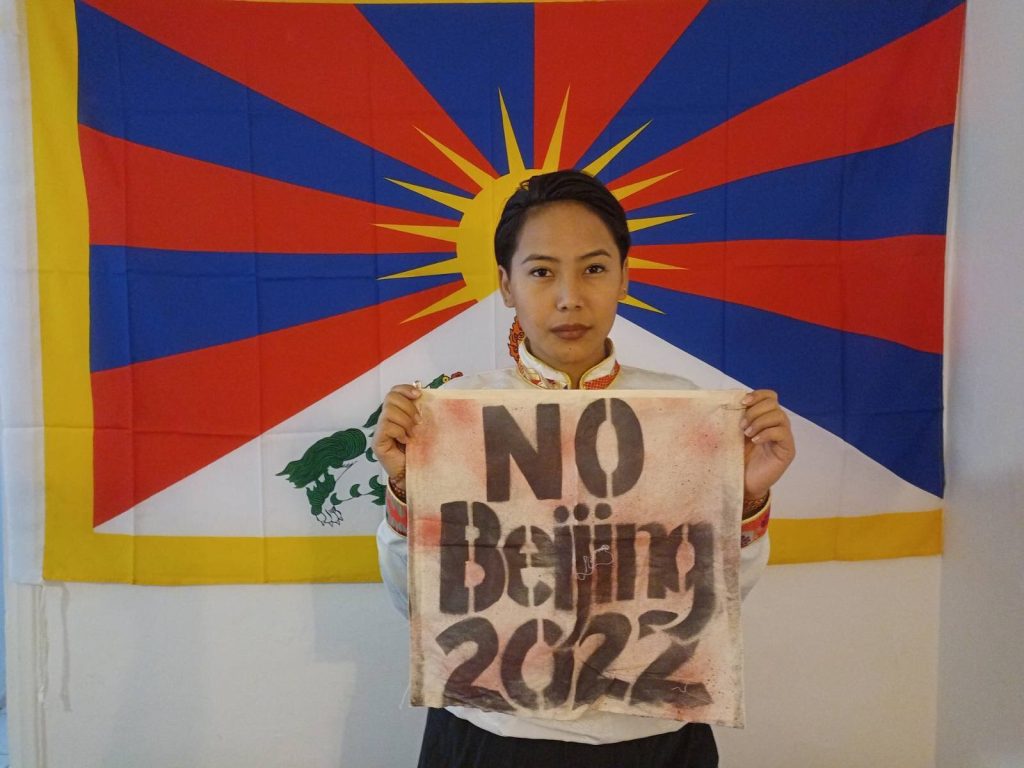
Photo: Free Tibet
Before travelling to Greece, the activists – who were mostly Hong Kongers and Tibetans from Switzerland, the USA and Canada – tried to engage with International Olympics Committee (IOC) officials. They explained that hosting the Olympics in an authoritarian country that commits genocide was a violation of the Olympic Charter, which ensures that the games promote “a peaceful society concerned with the preservation of human dignity”. However, their arguments fell on deaf ears. Frances Hui, the director of “We The HongKongers”, told Index that IOC officials dismissed them, saying “you’re young, this is a complicated issue.”
Another activist, Zumretay Arkin, director of the World Uyghur Congress Women’s Committee, told Index that protesting at the Olympic flame lighting ceremony “was an opportunity for us to counter Beijing in Greece.”
While the activists knew there are always risks involved in protesting, they were not particularly worried. The most common tactic used to silence dissidents abroad – threatening the safety of loved ones – could not work as most activists involved had no direct family left in their homelands. Tsela Zoksang, a Students for Free Tibet member, told Index: “I have the privilege to raise my voice up against the CCP, unlike many communities who remain under the brutal rule of the CCP, and so I think I have a duty to amplify their voices and their stories.” Greece’s position as a member of the EU also reassured the protesters. According to Pema Doma, one of the activists and Executive Director at Students for a Free Tibet, they believed it “very unlikely that a country of the EU would act on orders of the Chinese government”. These beliefs were unfortunately misplaced.
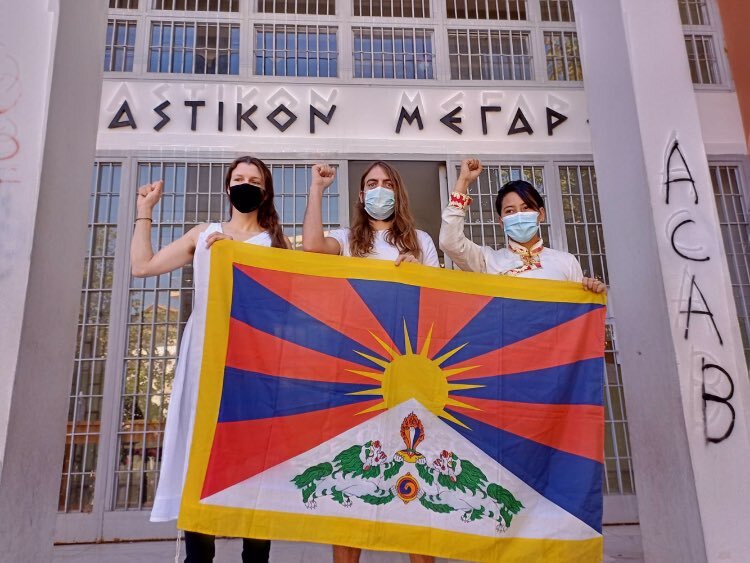
Fern MacDougal, Jason Leith and Chemi Lhamo outside the Greek jail after their action. Photo: Free Tibet
CCP involvement
On 18 October, activists congregated outside the flame lighting ceremony. The activists planned to stand outside the security cordon and hand out flyers to journalists as they entered the Temple of Hera.
The activists were first approached by a Greek police officer curious about their activity but were left undisturbed. This soon changed. According to four activists that Index spoke to, the Greek officer spoke to an individual who identified themself as and was dressed in the uniform of, a member from the Chinese Embassy. The Greek officer insisted that “They’re just sitting there, I don’t see why they shouldn’t be allowed to sit there”. According to the activists’ retelling, this was met with the firm instruction to “make them leave. Tell them they can’t stay here”. They were moved from the entrance car park to a public pavement.
The activists had spotted other plain-clothed Asian men earlier taking photos of them. These same men approached the Greek police, and after a short discussion the activists were detained by Greek police officers. They were arrested without being informed of their rights and taken in unmarked cars to Pyrgos Police Station.
The Greek police possess broad powers to arrest activists for unsanctioned actions. Avgoustinos Zenakos, an investigative journalist from the Manifold Files, told Index: “The Greek police interpret these laws in their favour…This means whether it is abused or used in an honest way depends on the culture of the police rather than the letter of the individual law.” During an official visit to Greece, the UN Working Group on Arbitrary Detention reported that they received “credible information involving non-nationals in pre-trial detention who were detained exclusively on the basis of police testimony, including when there was other evidence that did not support the guilt of the persons involved.”
The protesters believe that the decision to arrest them was not made by the police alone. Doma told Index: “We knew right from the beginning it was the Chinese Embassy staff directing the Greek police quite directly, quite closely, you know, telling them exactly what to tell us”.
The next day, another group of activists were detained after holding a press conference to discuss the CCP’s human rights abuses to members of the media. The event was monitored by unknown individuals, some of whom attempted to stare down and harass the activists. When some of the activists confronted the individuals and asked them where they were from they laughed before replying, “We’re from China”. Tsering Gonpa, a Tibetan Youth Association of Europe activist, and Tenzin Yangzom, Grassroots Director at Students for a Free Tibet, climbed into a taxi together after the event and immediately heard sirens. Their passports were confiscated and they were escorted to the Athens police station.
“We were extremely shocked by the CCP’s influence and leverage in democratic Greece. We knew the situation was bad, but we certainly didn’t expect this level of transnational repression,” Yangzom told Index.
According to Zenakos, to find criticism of Greece’s relationship with China, including Chinese state ownership of key Greek assets and Greece’s involvement in key initiatives such as the 16+1 grouping of countries and China’s “One Belt, One Road” strategy, “you would have to dig deep.” These all raise questions as to whether increasing economic entanglement is leading Greece to become overprotective of its relationship with China. For instance, in 2016 Athens pushed for an EU statement on the South China Sea to be amended to remove criticism of Beijing and a year later it vetoed an EU statement at the UN Human Rights Council condemning human rights abuses in China. According to media reporting, this was the first time the EU didn’t make a statement of this nature at the council.
Mistreatment in the police stations
On 17 October 2021, Tesla Zoksang and Joey Siu, and one other anonymous activist, planned to install a banner onto the outer-walls of the Acropolis. Within about two minutes of ascending, a security guard approached and cut down the banner. The activists remained perched on the scaffolding watching police cars arrive before they were escorted down. Greek barrister Alexis Anagnostakis, who represented the activists, told Index that “the activists’ removal from the protest site, their arrest, and their remand in police custody was a disproportionate interference with their rights for freedom of expression and assembly, as is their criminal prosecution.” Anagnostakis was also surprised by the escalation “since similar protests on the Acropolis reportedly have never before been prosecuted.”
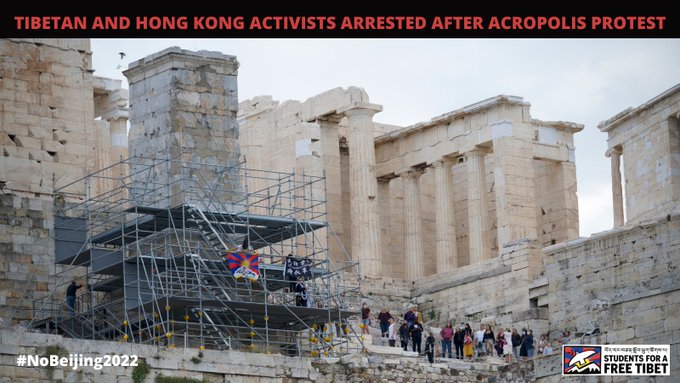
According to Tsela Zoksang, at the police station during an interrogation, one activist who wished to remain anonymous, was told by Greek officials that a representative from the US embassy was there to see them. However, the representative later allegedly admitted to being from an unspecified Greek agency. With assistance from the non-profit Vouliwatch, Index submitted an FOI request to the Greek police, attempting to verify these claims but were denied the disclosure on the basis that Index does not have “specific legitimate interest”. Index has lodged an appeal.
Other detained activists were not informed of their rights or what crime they were alleged to have committed. When the activists detained outside of the press conference asked why they were being detained an officer told them “to be completely honest with you, I don’t know why we’re taking you with us but I got orders from the higher ups”.
They were asked to sign documents without an English translation. After refusing, Zoksang reported that the officers “began getting very angry and frustrated. They were saying, ‘You are disobeying me, you are disobeying the law.’ I said, ‘No, but I can’t sign something if I don’t know what it says’”. They were told they would be punished for not signing documents and giving their fingerprints but at the time of going to press, nothing has yet come of this. The activists were also asked a series of seemingly irrelevant questions such as their parents’ names. Given the potential involvement or presence of CCP-affiliated actors in their detention, they feared this information would be shared with the Chinese authorities, potentially imperilling their ability to travel and the safety of any family members in CCP-jurisdiction.
Every Tibetan is an activist
Chemi Lhamo, a Tibetan activist, explained to Index: “Every Tibetan that was born after 1959 is born an activist … because your existence is by default political in nature when you are born stateless.”
While the Games still went ahead, the campaign nonetheless left its mark. As Lhamo told Index, “There was a moment of time, in the world, in the busy world that we are in, when people stopped for a moment to ask, ‘what’s happening? What’s happening within Tibet?’”
The diplomatic boycotts were also found to have had a major impact on viewership. Yangzom told Index that the oppression of the activists was “vindication that the work that we’re doing is making an impact and we must be doing something right – so we mustn’t give up and keep raising our voices on behalf of Tibetans inside Tibet and all those oppressed.”
All charges against the Acropolis actors were dropped on 17 November 2022. Michael Polak, their British ‘Justice Abroad’ barrister, stated “It is hoped that the acquittals today will send a strong message that legitimate peaceful protest and assembly, of the type banned totally in China and Hong Kong, will be allowed even when it hurts the fragile sensibilities of the Beijing and Hong Kong regimes.”
Yet, the charges against others for attempting to “pollute, damage and distort” the historical monument of Olympia, punishable by up to five years in prison, still stand. The original trial against Lhamo, Jason Leith and Fern MacDougal was delayed before being again pushed back to November 2023. MacDougal told Index she worries “the delay in trial has the effect of both avoiding public discussion of the human rights violations that we took action based on and of obscuring the meaning of our action.”
Lhamo also noted that “it is another year of waiting, and having a pending court case has its own consequences which seem to unfold in various ways for us.” She elaborated to Index that she is “lucky” to have continued support from the lawyers and organisations, but the charge is a significant barrier for them to engage in more direct actions and affects their ability to travel. Yet she emphasised: “Don’t feel anxious for us [about the court case] … Let’s channel that energy of solidarity and support to the folks we are actually working for, those inside Tibet.”
