25 Jan 2023 | Australia, Austria, Bahrain, Belarus, Belgium, Botswana, Burma, China, Cuba, Czech Republic, Denmark, Equatorial Guinea, Eritrea, Estonia, Ethiopia, Finland, Germany, Greece, Index Index, Ireland, Laos, Latvia, Lithuania, Moldova, Netherlands, News, Nicaragua, North Korea, Norway, Portugal, Romania, Russia, Saudi Arabia, South Africa, South Sudan, Swaziland, Switzerland, Syria, Turkmenistan, United Arab Emirates, United States, Yemen
A major new global ranking index tracking the state of free expression published today (Wednesday, 25 January) by Index on Censorship sees the UK ranked as only “partially open” in every key area measured.
In the overall rankings, the UK fell below countries including Australia, Israel, Costa Rica, Chile, Jamaica and Japan. European neighbours such as Austria, Belgium, France, Germany and Denmark also all rank higher than the UK.
The Index Index, developed by Index on Censorship and experts in machine learning and journalism at Liverpool John Moores University (LJMU), uses innovative machine learning techniques to map the free expression landscape across the globe, giving a country-by-country view of the state of free expression across academic, digital and media/press freedoms.
Key findings include:
-
The countries with the highest ranking (“open”) on the overall Index are clustered around western Europe and Australasia – Australia, Austria, Belgium, Costa Rica, Denmark, Estonia, Finland, Germany, Ireland, Latvia, Lithuania, Netherlands, New Zealand, Norway, Portugal, Sweden and Switzerland.
-
The UK and USA join countries such as Botswana, Czechia, Greece, Moldova, Panama, Romania, South Africa and Tunisia ranked as “partially open”.
-
The poorest performing countries across all metrics, ranked as “closed”, are Bahrain, Belarus, Burma/Myanmar, China, Cuba, Equatorial Guinea, Eritrea, Eswatini, Laos, Nicaragua, North Korea, Saudi Arabia, South Sudan, Syria, Turkmenistan, United Arab Emirates and Yemen.
-
Countries such as China, Russia, Saudi Arabia and United Arab Emirates performed poorly in the Index Index but are embedded in key international mechanisms including G20 and the UN Security Council.
Ruth Anderson, Index on Censorship CEO, said:
“The launch of the new Index Index is a landmark moment in how we track freedom of expression in key areas across the world. Index on Censorship and the team at Liverpool John Moores University have developed a rankings system that provides a unique insight into the freedom of expression landscape in every country for which data is available.
“The findings of the pilot project are illuminating, surprising and concerning in equal measure. The United Kingdom ranking may well raise some eyebrows, though is not entirely unexpected. Index on Censorship’s recent work on issues as diverse as Chinese Communist Party influence in the art world through to the chilling effect of the UK Government’s Online Safety Bill all point to backward steps for a country that has long viewed itself as a bastion of freedom of expression.
“On a global scale, the Index Index shines a light once again on those countries such as China, Russia, Saudi Arabia and United Arab Emirates with considerable influence on international bodies and mechanisms – but with barely any protections for freedom of expression across the digital, academic and media spheres.”
Nik Williams, Index on Censorship policy and campaigns officer, said:
“With global threats to free expression growing, developing an accurate country-by-country view of threats to academic, digital and media freedom is the first necessary step towards identifying what needs to change. With gaps in current data sets, it is hoped that future ‘Index Index’ rankings will have further country-level data that can be verified and shared with partners and policy-makers.
“As the ‘Index Index’ grows and develops beyond this pilot year, it will not only map threats to free expression but also where we need to focus our efforts to ensure that academics, artists, writers, journalists, campaigners and civil society do not suffer in silence.”
Steve Harrison, LJMU senior lecturer in journalism, said:
“Journalists need credible and authoritative sources of information to counter the glut of dis-information and downright untruths which we’re being bombarded with these days. The Index Index is one such source, and LJMU is proud to have played our part in developing it.
“We hope it becomes a useful tool for journalists investigating censorship, as well as a learning resource for students. Journalism has been defined as providing information someone, somewhere wants suppressed – the Index Index goes some way to living up to that definition.”
16 Oct 2022 | Malta, News
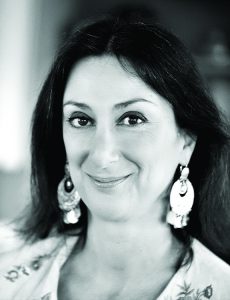
Daphne Caruana Galizia
Five years ago today, investigative reporter Daphne Caruana Galizia was brutally assassinated in a car bomb attack in Malta. Our thoughts are with her family, friends and colleagues. Together with them, we continue to fight for justice.
It is deeply saddening that we have issued a similar statement every year since Caruana Galizia’s murder. Today should be a day to remember and celebrate her fearless journalism, the far-reaching impact of her incisive writing on financial crime, abuses of power and deep-seated corruption, and her unwavering commitment to uncovering the truth and serving the public’s right to information.
Instead, we must yet again note that progress in criminal investigations and prosecutions has been minimal and intolerably slow. Impunity serves to embolden those who use violence to silence critical journalism and it ends only when all those responsible for the heinous murder have been prosecuted to the full extent of the law: the assassins, intermediaries and the mastermind must be brought to justice without further delay.
Similarly, we must point out the unacceptable lack of implementation of the recommendations made by the landmark Public Inquiry into Caruana Galizia’s assassination and the exclusion of structured public consultation, including with our organisations, on proposed legal amendments relating to the safety of journalists and SLAPPs, which in the latter case fail to meet international standards. The process provides a historic opportunity for the Government of Malta to implement its obligations under international and European legal and policy frameworks to create an enabling environment for journalism and to protect journalists.
The lack of political will to initiate the effective and systemic reform that is needed casts doubt on whether Malta’s political class has drawn any lessons from Caruana Galizia’s assassination. Where is the sense of urgency to fix the rotten power structures and dangerous conditions for journalists who report on them, violently exposed by the blast five years ago?
Signed by:
- Access Info Europe
- Access to Information Programme (AIP)
- ARTICLE 19 Europe
- Association of European Journalists-Belgium
- Civic Alliance (CA) Montenegro
- Civil Liberties Union for Europe (Liberties)
- Committee to Protect Journalists (CPJ)
- Corporate Europe Observatory
- English PEN
- European Centre for Press and Media Freedom (ECPMF)
- European Federation of Journalists (EFJ)
- European Integrity Academy – AntiCorruption Youth Greece
- Free Press Unlimited (FPU)
- Global Forum for Media Development (GFMD)
- IFEX
- Index on Censorship
- International Federation of Journalists (IFJ)
- International Institute for Regional Media and Information (IRMI) Ukraine
- International Media Support (IMS)
- International Press Institute (IPI)
- Irish PEN/PEN na hÉireann
- Kosova Democratic Institute
- Legal Human Academy
- Media Diversity Institute
- OBC Transeuropa (OBCT)
- Oživení, z.s. (CZ)
- Partners Albania for Change and Development
- PEN International
- PEN Malta
- Reporters Without Borders (RSF)
- Scottish PEN
- Society of Journalists, Warsaw
- South East Europe Media Organisation (SEEMO)
- Syri i Vizionit
- Transparency International EU
- Wales PEN Cymru
16 Oct 2022 | Greece, Malta, Netherlands, News, Northern Ireland, Slovakia
It shouldn’t have taken a murder. Surely it didn’t need a car bomb in a quiet Maltese town. Daphne Caruana Galizia did not need to die for Europe and the rest of the world to take notice of media freedom’s precarious foundations. But to our shame, it did.
Five years ago today, Daphne was murdered by a car bomb that exploded when she was moments from her front door. But the car bomb was only the mechanism by which she was silenced. Daphne was murdered by the opaque but powerful forces that first encourage, before demanding and eventually forcing silence. But she was never rendered mute, even now.
In the years that have followed, Europe has wrestled both with her legacy – what her investigations revealed – as well as the legacy of her killing – what her murder revealed. In the aftermath of similar killings in Northern Ireland (Lyra McKee), Slovakia (Ján Kuciak and Martina Kušnírová), Greece (Giorgos Karaivaz) and the Netherlands (Peter R. de Vries), as well as increased attention on the use of strategic lawsuits against public participation (SLAPPs), Europe has been forced to address an uncomfortable reality: journalists are at risk all across the continent. And so, by extension, is European democracy.
This is the dark light that bathes Europe, a light emanating from the brutal collapse of the rule of law but also a light that can illuminate what is broken. In the five years that have passed since her death, Daphne’s family have had to fight for every inch to demand both justice for Daphne and accountability for Malta. Whether this was to demand a public inquiry, pressing for progress in the criminal investigation, and putting SLAPPs on the European agenda, the rage, sadness and fury has fuelled a reckoning that has helped bring forward a proposed European Commission directive on SLAPPs, a Europe-wide coalition of organisations fighting to upend this form of lawfare, as well as similar movements at a national level.
In the UK, spurred on by Russia’s unlawful invasion of Ukraine, the UK Government announced in July 2022 an anti-SLAPP mechanism that could limit how UK courts are abused to silence critical speech. As we wait to see what happens – especially after the change in Prime Minister and her cabinet – we hope we are at the threshold of something significant. It is important to remember that a number of the libel threats against Daphne were deployed with the aid of London-based legal expertise – SLAPPs cannot be confined within national borders.
But we must return to Malta to remind ourselves of the pitfalls. Recently announced reforms aimed at protecting journalism, including much-vaunted anti-SLAPP protections, have had to be hurriedly frozen by the Prime Minister after being widely derided as inadequate, both in terms of content, falling far short of the proposed EC Directive, and process. The Institute of Maltese Journalists (IGM) had threatened to step away from the Committee of Experts unless “meaningful” consultation takes place. This was echoed by both the International and European Federations of Journalists (IFJ and EFJ) who have joined the call for the legislation to be withdrawn, as reported in Maltese outlet, NewsBook: “no proposal on media legislative reform should be submitted to the parliament without a transparent public consultation. This is all the more crucial in a country where a state holds some form of responsibility for the killing of a journalist.” While appearing to be fuelled by a desire to be the first EU nation to bring forward national legislation responding to SLAPPs, a grimy sense of competitive haste has seemingly triumphed over a commitment to genuine and meaningful protections.
Today, vigils remembering Daphne’s legacy – her life, her writing, and her commitment to the public’s right to know – are taking place across Europe, in London, Valletta, Brussels and Edinburgh to name a few. But wherever we are, we must ensure that by remembering Daphne’s life, we are reminded of our commitment to protect journalists against vexatious legal threats, physical attacks and every act that isolates, demonises or targets them.
Progress is slow and halting and will not proceed from one point to the next without obstruction – Malta’s current reform process is testament to that – however, the greatest way we can honour Daphne is by moving with purpose to ensure what happened to her cannot happen to another journalist. The dark light has illuminated what needs to change and the urgency with which it must change. It should not have taken the murder of a journalist for this to happen and we must not forget the darkness that sparked this push for greater protections, a darkness that robbed a family of the private space in which to mourn, but we must follow where the light leads. For in Daphne’s words, “There are crooks everywhere you look. The situation is desperate.
