8 Jan 2015 | Europe and Central Asia, Ireland, News
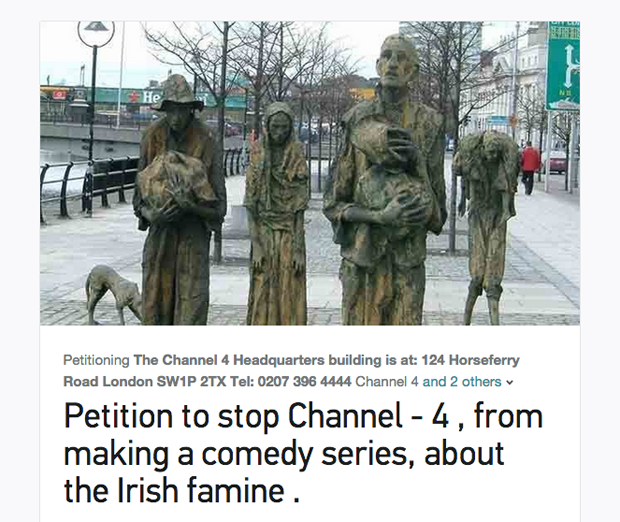
This week the Plain People of Ireland (both the physical and metaphorical place — more on that later) wailed, gnashed teeth, shook their fists at passing clouds and, of course, took to Twitter to express their horror, over a situation comedy.
Well, not an actual situation comedy. More an idea, that may turn into a script, that may, at some point, but probably not, turn into a comedy series. Still though…
It started harmlessly enough, in an end of year feature in the Irish Times (a newspaper not noted for sensationalism). Bright young things told of their plans for 2015. One, scriptwriter Hugh Travers, told the paper about his planned script for a sitcom called Hunger, which was in development stage with the UK’s Channel 4. The comedy would be based during the Irish famine. “I don’t want to do anything that denies the suffering that people went through,” said Travers, “but Ireland has always been good at black humour.”
Oh Hugh, how right you are. If there’s one thing everyone knows about us Irish, it’s our great sense of humour. We are, no doubt, a great bunch of lads when it comes to laughing.
But we are also, and let us be clear on this, a people with a profound sense of our own history; a nation carrying with us the struggle of generations and the ghosts of our patriot dead.
Or, to put it another way, we’ve got baggage. Playwright Brendan Behan said that: “Other people have a nationality. The Irish and the Jews have a psychosis.”
A large part of that baggage, that psychosis, comes from the great famine of the mid 19th century.
The famine of 1842-1847 was probably the bleakest period in Irish history. At least in population terms, the country has never really recovered. Over a million died and millions more emigrated.
Not that Ireland had been bread and roses before that. Over a century before, Jonathan Swift had addressed poverty and hunger in rural Ireland with his satirical pamphlet “A Modest Proposal” (“A Modest Proposal for Preventing the Children of Poor People From Being a Burthen to Their Parents or Country, and for Making Them Beneficial to the Public”, to give it its full title), which suggested a scenario where poor Irish people with large families should sell their children as food.
Even so, the 19th century famine was the worst of the worst, exacerbated by a government in London that was, at very, very least, negligent, and most certainly culpable. I will not get into a debate about whether it should be classified as a genocide or not, except to say that opinions either way on that judgment are too often based on what “side” one is on rather than evidence.
In any case, to get into that argument is to play into the hands of the brouhaha that followed Hugh Travers’ optimistic announcement of his plans in the Irish Times.
The fuss was kicked up by Niall O’Dowd, editor of Irish-American website Irish Central and, to judge by his extensive Wikipedia page, a very important man indeed.
New York-based O’Dowd wrote an article on his very important website, furiously denouncing the Channel 4 sitcom he couldn’t possibly have seen because it doesn’t exist.
It’s worth quoting the main thrust of his piece:
“What’s up next?? A sitcom on The Holocaust maybe with funny fat Nazis eating victims alive?
Or how about a comedy about Ebola with black kids dying on screen and doctors telling funny jokes about them?
‘Sure you are being way too sensitive,’ I can hear people say, ‘time to have a laugh about the Famine. Did you hear the one about the starving children? Some of them ate grass…Ha Ha Ha.”
Much like a homophobe denouncing gay sex, O’Dowd displays a remarkably vivid and well, dark imagination about what a comedy set during the famine might be: surely, he suggests, the thing that we are being asked to laugh at is the very worst thing you can dream of (Don’t get too smug about this point by the way; the converse of this could be that your relative lack of an outrage impulse stems from your relative lack of imagination. I know that’s true of me).
O’Dowd wonderfully went one further, writing another article for Irish Central in which he imagined the script for the proposed sitcom. Suffice to say, it was not funny, but not not funny in the way the author intended.
O’Dowd’s real problem, it seemed, was that Channel 4 was a British company making hay out of an Irish tragedy: he barely examined the fact that the originator of the script is an award-winning Irish author given an open brief. That would bring unwelcome complexity to the issue.
Last Monday, I was invited to discuss the issue on BBC Ulster’s Nolan show. I joked beforehand that the slot would degenerate into listing topics that we were and were not allowed to make comedy of. That was exactly what transpired, as my interlocutor, Irish commentator Jude Collins, began listing incidents and asking “Would you think that was funny?” — everything from 9/11 to the death of Ian Paisley (why the peaceful death of an old man was a tragedy on a par with the starvation of a million people was not made clear by Collins).
The problem with this line of thinking is that it’s not actually a line of thinking at all. It is mere positioning. Collins inadvertently demonstrated that once you start proscribing fit topics for comedy, you can’t stop. It’s always possible to find someone, somewhere who would be upset by practically any joke of substance. A caller into the show skewered Collins by pointing out he had stood against born-again Christians who had attempted to ban a comedy play based on the Bible (as reported by Index). Were they not offended? Did their feelings not count?
Those who raised their voice attempting to prevent the development of the famine script they couldn’t even have read — including the tens of thousands of Irish people at home and abroad who signed an online petition against the comedy — were simply parading their ignorance, much like the mullahs who condemned Salman Rushdie while boasting that they had not read the “blasphemous” Satanic Verses. They should think twice, or even once, before raising their hackles again.
This article was published on 9 January 2015 at indexoncensorship.org
10 Dec 2014
December 2014
Journalists and media workers are confronting relentless pressure as they do their jobs, a survey of the first six months of incidents reported to Index on Censorship’s Mapping Media Freedom project has found.
|
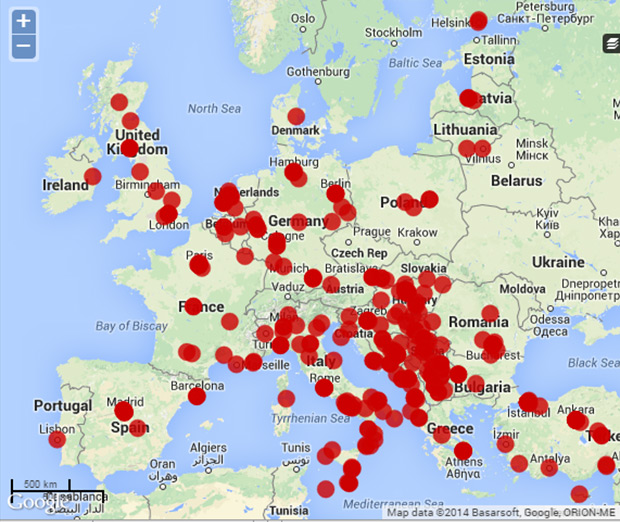
| In the six months since the mapping project was launched, over 500 reports — including 61 violent attacks on journalists — from across Europe have been verified and published. Reports have come in from as far afield as Finland and Malta, Ireland and Turkey.
Over 150 reports have been mapped to the states of the former Yugoslavia and Italy. However, as the map shows, violations of media freedom and violent incidents against journalists are being committed across Europe, with physical violence and online harassment becoming growing problems.
The map, which was funded by the European Commission, launched on 24 May 2014 in partnership with Osservatorio Balcani e Caucaso and allows anyone — from members of the public to journalist unions — to submit reports for verification by Index’s European Union correspondents.
“Since we launched the platform, we have recorded a number of abuses against media professionals ranging from intimidation and preventing access to information, to murder. What struck me when speaking to some journalists is that too many considered receiving threats as a ‘part of the job’. It shouldn’t be. This map is an essential tool to improve the capacity of journalists, media organisations and others to confront those threats,” Index Senior Advocacy Officer Melody Patry said. |
 |
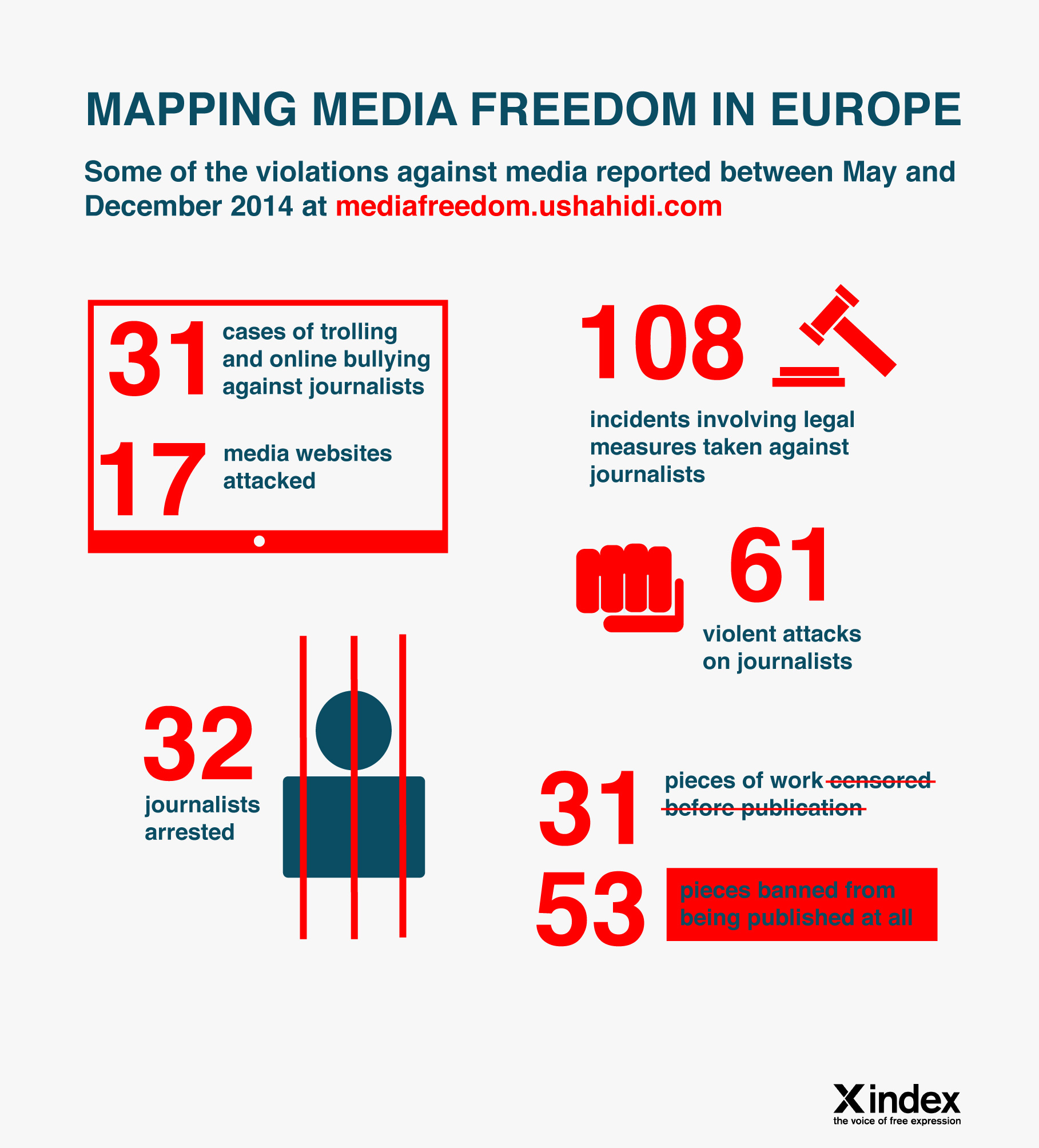
This is the reality of being a journalist in Europe in 2014
Selected incidents reported to mediafreedom.ushahidi.com |
 |
|
Turkey: Journalist Erol Ozkoray was sentenced to 11 months and 20 days in prison for defaming President Recep Tayyip Erdogan by referring to anti-Erdogan slogans and graffiti in his book about the 2013 Gezi Park protests |
|
 |
|
Germany: Blogger Su Yutong was fired by Deutsche Welle’s Chinese service after tweeting about employee meetings, where staff were told to use restraint in their coverage of China |
|
 |
|
Hungary: Three journalists were chased with a hydraulic shovel by an employee of a rubbish dump after they tried to verify information regarding a possible leak from the EU-funded dump |
|
 |
|
France: Far-right party Front National sued and called for the resignation of journalist Guy Lagache after his TV show aired an undercover documentary about one of their municipal campaigns |
|
 |
|
Albania: A masked attacker tried to shoot Artur Cani, an investigative journalist for TV News 24, near his home in Tirana |
|
|
|
Kosovo: Milot Hasimja, a journalist with the Pristina-based TV Klan, was knifed at his desk by a man apparently unhappy with a feature Hasimja did on him |
|
|
|
Netherlands: Freelance photographer John van Ieperen was beaten by a security guard when covering the aftermath of an explosion in an apartment building that killed two residents |
|
 |
|
United Kingdom: Blogger Michael Abberton who broadcast “fact checks” about the UK Independence Party said he was advised to delete a tweet about the party’s policies after being visited at home by two police officers |
|
 |
|
Serbia: Dusan Dragisic, a local businessman, threatened to cut off the nose and ears of Nenad Tomic, owner and editor-in-chief of the website Ruma |
|
|
|
Bosnia: Professor Slavo Kukic, a prominent writer and columnist, was severely beaten with a baseball bat in his office at the University of Mostar |
|
|
|
Italy: Pino Maniaci, head of Sicilian TV station Telejato who is known for reporting on the Sicilian mafia, found his pet dogs hanged from a metal post in a yard near his office |
|
 |
|
Bulgaria: The company car of bTV political journalist Genka Shikerova was set on fire outside her home in Sofia |
|
Categorisation of violations
There are 51 different labels used to organise the incidents reported to mediafreedom.ushahidi.com |
Legal measures
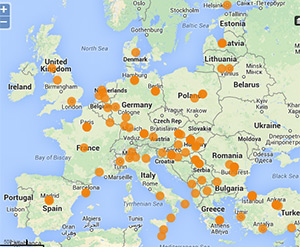
Incidents that involved the threat of or filing of legal actions
|
|
Censorship
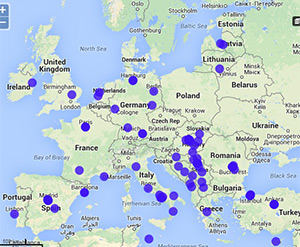
Incidents that included partial or complete censorship
|
|
Government threat
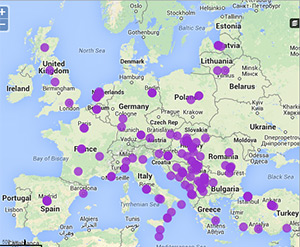
Incidents that originated from a government representative or agency
|
|
Co-Funded by
 |
27 Nov 2014 | Americas, Digital Freedom, Europe and Central Asia, Ireland, News, United Kingdom, United States
How did people organise protests before the internet? How did riots happen? How did terrorists carry out attacks? All these things definitely happened. I remember them distinctly. In the days before the world wide web, all sorts of things occurred without anyone “taking to social media” or “using sophisticated communications technology” (phones).
But current discussions are premised on the idea that the web in itself has created civil disorder and even terrorism.
In Ireland, as protests have got to the point where government ministers can barely leave the house without being confronted by citizens unhappy with proposed household water metering, commentator Chris Johns suggested that “Social media has brought more illness to Ireland than Ebola has. Anarchists, extremists and all-round loonies can find a voice and organisational structure – if only for a decent riot – amidst a political fragmentation that rewards those who shout the loudest.”
Considering there have been no recorded incidents of Ebola in Ireland, the first part of this assertion could be technically true; or we could say that social media has brought the same amount of illness to Ireland — none. As for the anarchists and loonies, well, they have always been with us, and had some success in organising before Facebook came along.
Across the Atlantic, St. Louis County Prosecuting Attorney Robert McCulloch said that “nonstop rumours on social media” had significantly hampered the investigation into the killing of Michael Brown, and contributed to his decision not to prosecute. This in the land of the First Amendment, where the justice system long ago learned to deal with hearsay.
Back over the ocean again, the UK’s Intelligence and Security Committee report into the murder of Drummer Lee Rigby by Michael Adebolajo and Michael Adebowale pointed to a Facebook message sent by Adebowale, in which he expressed a desire to kill a soldier. In spite of several failures by the intelligence services, who were long aware of Adebowale’s tendencies, Facebook faced criticism for not “flagging up” the message to the security forces. Social media to blame once again.
Why do we do this? Why must every single occurrence now have a social media angle?
Partly because everything many of us do now does have an internet angle. The web is simply part of human interaction for millions.
But for some it seems foreign. My generation is the last that will remember life before the internet.
For all that, it is still shockingly new. I’m not just saying that to make myself feel younger. Some people my age and older (“digital immigrants”, apparently, which makes me a double immigrant) have adapted reasonably well to our new environment. Some really haven’t. I have watched a QC attempt to explain the difference between a reply and a direct message on Twitter. It was as you’d expect, equal parts cute and infuriating, but it did also make one think how insanely fast we have adapted to certain technologies, and how some people are left behind.
When was the last time they changed Facebook? I honestly couldn’t say. But remember when complaining about changes to Facebook was a thing? We used to object; now we install our own mental updates and carry on, using new features and forgetting what went before. I have literally no idea what Facebook looked like when I joined it. Or Twitter for that matter.
And I, remember, am an immigrant, not a native. There are still a lot of people who don’t want to emigrate to the web, because they think it’s full of conspiracy theories and pornography. And there are some who occasionally “log on” to the internet, and then “log off” again, like an overnight work trip to Leicester.
So when something happens that involves an email, a tweet, a Facebook update or whatever, for some that is still of interest in itself.
Will this ever end? Hopefully. As time goes on, the distinction between the internet and THE INTERNET will become clearer. THE INTERNET is a culture; the place where the likes of Doge and Grumpycat come from, and all their predecessors (I still have a soft spot for Mahir “I Kiss You” Çağrı. Look it up, youngsters). The internet is simply a communications tool, like millions upon millions of tin cans joined with taut string. When we can get this a little clearer in our heads, then finding a web angle for every occasion will feel a bit silly, like blaming Bic for poison pen letters.
That is not to say that we should take the web for granted, or become blase about its use and abuse. But we must treat it as simply a part of the environment. Essentially, we have to stop thinking about things happening “on the internet”. There is no “internet freedom” — there is just freedom. There is no “internet privacy” — there is privacy. There are no “internet bullies” — there are bullies.
Put simply, we need to ban the word “internet”.
This article was published on 27 November 2014 at indexoncensorship.org
20 Nov 2014 | Ireland, News, Politics and Society
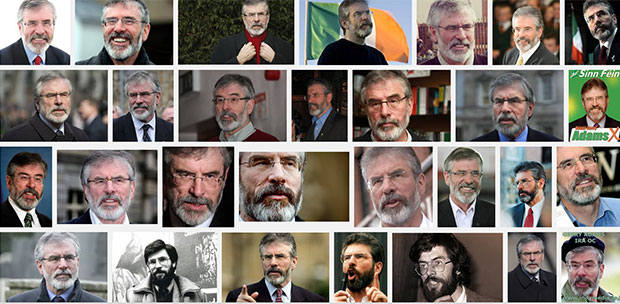
Gerry Adams is the leader of Sinn Féin, the party currently polling higher than any other in Ireland. Last week, Adams, who for many years had the very sound of his voice banned from the airwaves in both Ireland and Britain, due to his connections with the illegal Provisional IRA, told a funny little story at a fundraiser in New York.
Discussing one Irish newspaper’s hostility to his party, Adams told the assembled of how Michael Collins, the Irish War of Independence leader, had dealt with the Irish Independent:
“He went in, sent volunteers in, to the offices, held the editor at gunpoint, and destroyed the entire printing press. That’s what he did. Now I can just see the headline in the Independent tomorrow, I’m obviously not advocating that”, said Adams.
As with much half-remembered Republican mythology, this wasn’t the whole story. As Ian Keneally, author of The Paper Wall: Newspapers and Propaganda in Ireland, 1919-21, related in the Irish Times, the Irish Independent had been broadly sympathetic to the cause of Irish freedom throughout the War of Independence, while deploring individual acts of violence. In the case Adams alluded to, a group of IRA men had indeed entered the Irish Independent offices and threatened the editor, Timothy Harrington, after the paper described a failed IRA ambush as “a deplorable outrage”. The leader of the IRA grouping, Peadar Clancy, said that the newspaper had “endeavoured to misrepresent the sympathies and opinions of the Irish people”. While some damage was done to the Irish Independent’s printing presses, the paper did not shut down.
Ironically for Adams, given his invocation of the fabled Michael Collins, the Irish Independent found itself in deep trouble with British forces for publishing a letter by the IRA leader in December 1920. On that occasion, British “Auxiliaries” entered the newspaper’s offices and literally held a gun to a staff member’s head, warning the paper never to print anything by Collins again. The threat worked.
Historical rigour aside, Adams’s comments obviously didn’t find much favour among journalists. The World Association of Newspapers wrote to Adams calling on him “to retract these comments and to publicly affirm your abhorrence of all forms of violence against journalists”. Adams has refused to do so, citing the hypocrisy of attitudes to the Collins & Co war-of-independence era IRA and the modern (now, we are told, departed) Provisional IRA. In this, he may have a small point, though this is an issue for Irish society at large and not just the newspapers (this cartoon captures that problem neatly).
One could excuse Adams’s allusions as the work of the mind behind his famously quirky, often tongue-in-cheek Twitter account, but there are several background issues that make the whole thing a little uncomfortable.
Firstly, the newspaper group involved has lost two journalists to gunmen in the past 20 years: Veronica Guerin of the Sunday Independent, murdered by gangsters in 1996, and Martin O’Hagan of the Sunday World, shot by loyalist paramilitaries in 2001. Jokes about threats to the Independent News & Media journalists carry that baggage, even if unintended.
Secondly, Adams and his party are currently under scrutiny over an alleged IRA sexual abuse cover up. A woman named Maria Cahill – a relative of Provisional IRA founder Joe Cahill – claims that she was raped by an IRA member, and that the organisation subsequently attempted to cover up the crime. Cahill claims she raised the issue directly with Adams (who, it should be stated for the record, says he has never been a member of the IRA, but nonetheless is viewed as the leader of that particular strand of Irish republicanism), but that justice was not done. Adams’s has already faced criticism for the alleged cover up of his brother Liam’s paedophilic assaults on family members.
Thirdly, Ireland is a country on edge at the moment. The Fine Gael/Labour coalition government’s disastrous handling of proposed water metering and charges has led to previously rarely seen nationwide protests. Having almost cast the previously dominant Fianna Fáil party into oblivion in 2011, Irish voters had hoped they could put faith in a new government. But now, once again, they feel lied to by politicians who do not seem to have the wishes of the population at heart. The perception is that the new water metering system is just another assault on people who have suffered enough after years of boom, bust and bank bailouts.
Into this already toxic mix comes media mogul Denis O’Brien, owner of, among other outlets, the Irish Independent. It is widely believed that O’Brien is supportive of the new watering metering system as Irish Water will eventually be privatised, and he will buy it. O’Brien has a stake in Siteserv, the company contracted to install water meters.
It is not a huge leap to imagine that O’Brien’s papers may be enthusiastic about water charges, and perhaps unsympathetic to protesters. And it’s not difficult to imagine anger being turned against Independent group journalists. After pictures of a brick being thrown at a Garda [police] car during a water protest in Dublin last week were published by the Sunday Independent, many online claimed the image had been photoshopped by the mendacious “Sindo” . This was clearly untrue, but the rumours demonstrated the distrust of institutions, including the press, that now permeates Irish society, and from which upstart Sinn Fein stands most to gain. Former Sinn Féin publicity officer Danny Morrison subsequently tweeted the address of Independent Newspapers, along with a picture of a wall missing a brick. Was he adding to the conspiracy theory? Or was he suggesting violent action against the Independent, in classic I-know-where-you-live style? See how easily the close-up nature of Irish media, politics and public life can set the mind racing?
The government has now proposed new water measures, which it hopes will quell the unrest. But the anti-press, anti-politics rhetoric may have gone too far for that, and in the run up to the centenary of Ireland’s “revolutionary period” of 1916-1923, when romantic rebellion ruled all, little will be gained by any party attempting to present itself as the voice of a reasonable settlement.
This article was posted on 20 November 2014 at indexoncensorship.org