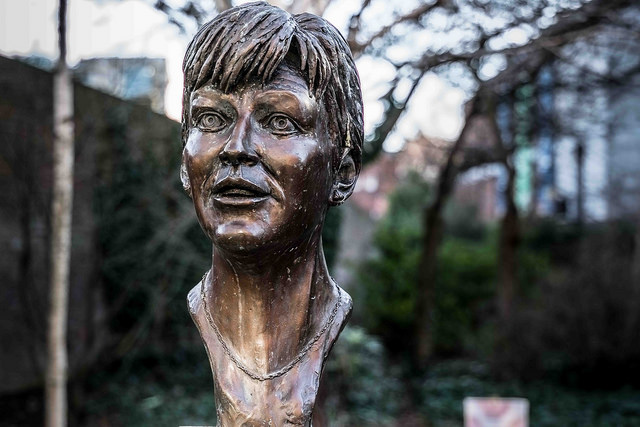
Monument to Veronica Guerin in Dublin Castle gardens. Credit: William Murphy / Flickr
This weekend marks 20 years since the murder of Irish award-winning crime and investigative journalist Veronica Guerin. On 26 June 1996, two masked men on a motorbike pulled up alongside her car at traffic lights on the outskirts of Dublin, opened fire and killed her instantly. Three men were subsequently convicted for their involvement in the murder.
Guerin, who had been working as a freelance journalist for Ireland’s Sunday Independent, made a name for herself investigating and exposing the crimes of senior members of Dublin’s criminal underworld. But such a reputation can be a dangerous thing for an investigative reporter to have. Guerin was subject to a number of attacks and threats, including against the life of her young son Cathal. In 1995 she was shot in her home but survived. Refusing to yield, she continued her work.
“Veronica was a late entrant to journalism; she trained and worked initially in accountancy so she had an instinct for business and understood money,” says Séamus Dooley, Irish Secretary, National Union of Journalists. “That was very useful in studying records and following the money.”
Her death prompted a wave of public anger culminating in the establishment of the Criminal Assets Bureau, followed by more than 150 arrests and a major hunt for organised criminal gangs. “The idea of a designated bureau with sweeping powers to target those with suspicious wealth was a direct response to her murder and caused havoc among those heading criminal gangs,” says Dooley.
Guerin’s death was described by then-Taoiseach John Bruton as a “an attack on democracy”. Unfortunately, this sentiment was echoed earlier this year when current Taoiseach Enda Kenny said: “Journalists and media organisations will not be intimidated by such threats, which have no place in a democratic society.”
The threats he was referring to were made in February 2016 by criminal gangs in Dublin against a number of crime journalists in the city who were reporting on a gangland feud that saw two audacious murders in the space of four days. Police informed Independent News and Media, which owns the Irish Independent newspaper, that the safety of two reporters — a man and a woman — was at risk.
Jimmy Guerin, the brother of Veronica, said at the time: “Successive governments have let down the memory of Veronica … by failing to provide the resources required to beat the gangs.”
So are we back to the way things were two decades ago?
“The situation has been simmering beneath the surface for a while, but the turf wars between the Kinahan and the Hutch families, along with the nature of the violence, is new,” says Dooley. “Gerry Hutch is someone Veronica would have covered in her time, so there is a direct connection with what came before.”
“However, there was this perception that Dublin was a city on lockdown following the killings and journalists are operating under fear,” adds Dooley. “This isn’t bandit country, and there aren’t large numbers of journalists fearful for their lives.”
This shouldn’t mean complacency, adds Dooley, who states that the NUJ has supported a number of journalists at risk in Ireland in recent years.
“One of the problems is that Dublin is a small city, so, naturally, the number of people covering crime is very small,” says Dooley. “Veronica was very well-known to the people she was writing about and so are today’s reporters.”
With crime reporting being such a small part of the market, there is great pressure to deliver stories quicker, which brings problems in itself.
“Today’s journalists are expected to take more risks, and freelancers — as Veronica was — take even greater risks than those in staff jobs,” says Dooley. “While I understand that there is also the commercial element of selling newspapers in order to survive, sensationalising crime coverage in such a high profile way and being overly provocative in the process of selling comes at a price.”
His murder remains an isolated case, but recent years have seen a spate of attacks and threats against journalists in the country. In 2014, Irish News reporter Allison Morris was called a “Fenian bastard” and a “Fenian cunt” as she left court by a gang who threatened to cut her throat.
These are not isolated incidents in either the north or south of Ireland.
If we are to learn anything from the death of Veronica Guerin all these years later, says Dooley, it is that “there needs to be greater recognition of the rights of journalists.”
Last Sunday, as Northern Ireland’s footballers prepared to play Finland in a European Championship qualifier, protesters gathered outside Windsor Park, the team’s Belfast home.
The assembled were members of the Free Presbyterian Church. They were angered by the fact that Northern Ireland were playing on a Sunday – the Sabbath – for the first time ever.
Reverend Raymond Robinson told the Press Association: “Our opposition is to the breaking of observance of the Lord’s day.
“We believe in the Sabbath being kept holy. It seems more and more that the football agenda is being driven by the television companies and not what God says, or what public opinion is.”
Commentator Newton Emerson was, like many, blase about the protest, tweeting “I think these people are harmless enough now to just count towards our wonderful diversity.”
Be that as it may, Christian fundamentalism still plays a huge role in public life in Northern Ireland. While the old demands for Biblical propriety may seem archaic, a new struggle has emerged over what many religious people in the country see as threats to their religious freedom and way of life. And a cake has become the latest flashpoint.
Asher’s bakery is a business run by a family known for its Christian beliefs. It is named after one of the Biblical Twelve Tribes of Israel. Last summer, the bakery was asked to provide a cake by Gareth Lee, a volunteer for LGBT group QueerSpace.
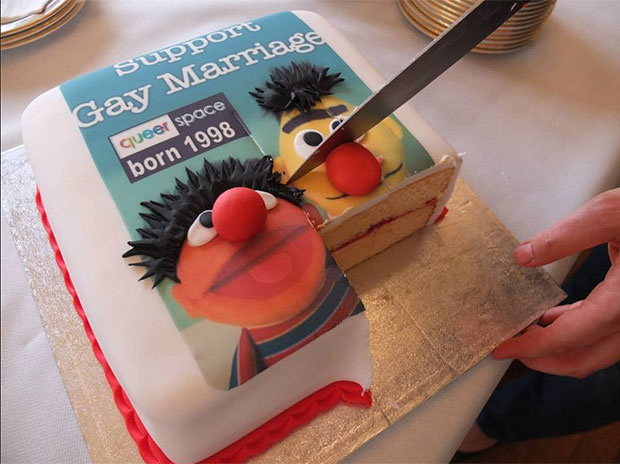
Lee had requested a cake decorated with a picture of Sesame Street’s Bert and Ernie and the slogan “Support Gay Marriage”.
The bakery initially accepted the order, before then informing Lee that it could not fulfil the deal. The case went to Northern Ireland’s Equality Commission, and, between the jigs and reels, is now in the hands of district judge Isobel Brownie, who will rule on Monday whether the Christian bakers engaged in unlawful discrimination by not delivering the pro-same sex marriage cake.
Meanwhile, the “gay cake” case has raised the spectre of a “conscience clause” in equality legislation in Northern Ireland.
The whole situation is, quite frankly, pitiful. One can preach it, validly, both ways: fundamentalist bigots out of touch with the modern world, and inflicting their bigotry on others, or God-fearing, humble folk sticking by their beliefs in the face of an onslaught they didn’t invite.
I can’t help feel sympathetic towards the McArthurs, the family who own the bakery. Karen McArthur told the court that she had initially accepted the order to avoid embarrassment. Colin McArthur said “On that day I didn’t make a clinical decision. I was examining my heart. I was wrestling it over in my heart and in my mind.” He was, apparently, “deeply troubled”. “We discussed how we could stand before God and bake a cake like this promoting a case like this…”
On the other hand, Gareth Lee said he was left feeling like a lesser person after he was told his order would not be fulfilled.
This shouldn’t be down to who was more upset or offended, but then, on what criteria can we judge it? I don’t think it’s necessarily true to say that Lee is entitled to have any message he wants put on any cake by any person. The prosecution, correctly, pointed out that the message was rejected because of the word “gay”. The defence lawyers suggested that a ruling against the McArthurs could lead to a situation where devout Muslims were legally obliged to decorate cakes with images of Muhammad. While “you wouldn’t say that about the Muslims” is a tedious argument, and one deployed increasingly often by Christians, it’s not, in this case, an entirely unreasonable position.
Hardline Christians see homosexuality as a (wrong) choice people make, or a psychological disorder. I recall watching the Reverend Willie McRea, an MP, once, being asked what support he would offer to a constituent who was a victim of homophobia. McRea replied that he would advise the young man not go down that route: basically, the best way to prevent homophobia is to stop being gay.
Meanwhile, Iris Robinson, wife of Democratic Unionist Party leader Peter Robinson, firmly believes that one can be counselled away from homosexuality.
These people are odd, certainly, but they are not fringe characters who can be dismissed as irrelevant to mainstream society in Northern Ireland.
And even if these views were not mainstream, that would not make the fundamentals of the case any different. But it does seem as if the Equality Commission is trying to drag a segment of Northern Irish society kicking and screaming into the secular world.
So who’s right? Who should win? Reader, I am about to break the columnist’s solemn covenant and admit: I don’t fully know. This is not as clear cut a case of discrimination as, say, barring a gay couple from a Bed and Breakfast: if the McArthurs had simply refused to sell a cake to Lee, that would be clear cut. But the cake was loaded, so to speak. Should this tricky case lead to a “conscience clause” in equality legislation, then one can imagine legitimisation of genuinely discriminatory practices.
At the same time, the McArthurs, are wrong, and one’s initial inclination is to side with the gay rights activist against the religious fundamentalists. But that’s the problem with defending freedom of conscience, (and its expression in freedom of speech). Everyone’s conscience is different.
Northern Ireland beat Finland 2-1, by the way. God’s clearly not very troubled by Sunday football.
A recent court ruling in Ireland could have reintroduced the concept of criminal libel to the state, despite criminal defamation offences being abolished as recently as 2009.
The case itself was one of a particularly grim relationship break up. Names are not available as the people involved were also locked in a criminal case in which the male partner was accused of rape and false imprisonment, though he was acquitted of both.
But the details available are: couple breaks up in January 2011. They remain in touch. In April 2011, man goes to woman’s house to, according to the Irish Times’s report “confront her over a perceived infidelity”. Man later leaves woman’s house, but not before stealing her phone. Man goes through woman’s messages, which suggest she has started a new relationship. Man opens woman’s Facebook on phone and posts remarks from her account, making it appear that she is presenting herself as a “whore” who would take “any offers”. Drink was a factor, as the Irish court reporting phrase goes.
This action led to a charge under the Criminal Damage Act 1991, under which “A person who without lawful excuse damages any property belonging to another intending to damage any such property or being reckless as to whether any such property” can find themselves liable to a large fine and up to 10 years in prison.
In this case, the defendant was found guilty and fined €2,000.
The judge, Mr Justice Garrett Sheehan, is reported to have asked how to assess the “damage” when nothing had actually been broken. Prosecutors replied that the case was in fact more akin to harassment and that the “damage” had been “reputational rather than monetary”.
The first question here is obvious: if the facts of the case were more akin to harassment, then why were charges not brought under Section 10 of Ireland’s Non-Fatal Offences Against The Person Act, which would cover anyone who “by his or her acts intentionally or recklessly, seriously interferes with the other’s peace and privacy or causes alarm, distress or harm to the other”? Wouldn’t this be the obvious piece of legislation to use?
But after that, there are a few more: Who actually owns a Facebook profile? And does reputation count as property? And crucially, has Mr Justice Sheehan created a criminal libel law?
Ireland has a complicated relationship with social media. On the one hand, to be plain about it, the big online companies create a lot of employment in Ireland. Facebook, Twitter and Google all employ a lot of people in the country. On the other hand, it is susceptible to the same moral panics as anywhere else, and in a small, largely homogenous country, panics can be enormously amplified.
When government minister Shane McEntee committed suicide in Christmas 2012, the tragic story somehow became conflated with social media and online bullying. McEntee’s brother blamed the minister’s death on “people downright abusing him on the social networks and no names attached and they can say whatever they like because there’s no face and no name”. But his daughter later refuted that claim, saying: “Dad didn’t use Twitter and wasn’t a huge fan of Facebook. So I don’t think you can blame that and I’m not going to start a campaign on that.”
The subsequent debate on social media bullying was almost tragic in its simplicity, the undisputed highlight being Senator Fidelma Healy-Eames describing to the Parliamentary Joint Committee on Transport and Communications how young people are “literally raped on Facebook”.
As ever in discussions that involve social media, a generation gap opens up, or is invoked, between younger “natives” who supposedly instinctively understand the web, and a political and judicial class who are apparently hopelessly out of touch. There is certainly an element of truth to this (I have sat in courts and watched judges express utter bafflement at the very concept of Twitter), but in general, what is actually happening is legislators, magistrates and the judiciary are desperately trying to apply existing, supposedly universal laws to phenomena to which they are simply not suited. This is where controversy usually arises, for example in the UK’s use of public order laws when the only threat to public order is a Twitter mob — as in the case of jailed student Liam Stacey; or use of laws against menacing communications in instances where it’s clear no menace was intended — such as Britain’s now infamous Twitter Joke Trial.
In the current Irish case, it seems obvious that harassment would have been the more relevant charge, but in this instance, that’s not what we have to worry about. The real concern is that by apparently putting reputation in the category of property which can suffer damage, the court has now created a precedent where damage to a person’s reputation, whether by “fraping”, tweeting, or even just the getting facts wrong in a news story, could lead to criminal sanction.
And the very worst thing is that no one seems to have noticed.
From the introduction of the new blasphemy law onward, Ireland has seen a slow, stealthy erosion of free speech. It’s not clear what will get people to start paying attention, but the country needs to be more vigilant.
Julia Farrington travelled to Northern Ireland to participate in the 2014 Cathedral Quarter Arts Festival in Belfast. While there she saw four plays that deal with the Troubles as head of Sinn Féin, Gerry Adams, was questioned by police.
A new mural of Adams appeared on the Falls Road in West Belfast what seemed like only a matter of hours after he was taken into custody. Officially launched by Martin McGuiness to a crowd of thousands of Sinn Féin supporters on Saturday, and it was subsequently paint-bombed. The murals, far from being memorials to past struggles, are alive and kicking.
Across town in east Belfast, I went to Bobby “Beano” Niblock’s new play — Tartan at the Skainos Centre — passing the contentious murals of balaclava wearing Ulster Volunteer Force gunmen on the way. Niblock is a rare bird in Northern Ireland as loyalist voices continue to be massively under-represented in the theatre there. The play, though heavily laced with humour and raucously re-enacted 1970s hits, had a very dark message. It tells of betrayal within the loyalist community, as TC, the teenage leader of the Tartan street gang, is mentored, manipulated and ultimately murdered by older members of the community. The level of violence in Tartan completely chilled me; the young men graduating from what were seen as boys toys — crowbars, mallets and axes — to petrol bombs, guns and the crowning awe of a machine gun.
This play of street violence and male rite of passage, was the flip side of Flesh & Blood — three plays written, produced, directed and designed by women I had seen the previous day in a run through a week before they open at the Grand Opera House. I was invited by one of the playwrights, Jo Egan, whose play Sweeties revolves around the true story of a seemingly unperturbed victim of paedophilia and the devastation it causes her complicit friend. The other two plays were by comic genius Brenda Murphy and first time playwright and former leader of the Progressive Unionist Party, Dawn Purvis. All three tell stories centre on the experience of women and girls, firmly rooted in the domestic setting of home, street and neighbourhood; in the case of Sweeties, trapped by agoraphobia in a front room, or Dawn Purvis’ play through the eyes of a young girl, watching and commenting on life on her street, with the Troubles forming the backdrop. Brenda Murphy’s play was a deeply moving portrait of her mother’s struggle to bring up six illegitimate children who she had with a married man who lived around the corner.
Those three plays were so good to see. Women playwrights are strangely under-represented all over this country, when you compare to a much more equal landscape in fiction, biography and other written forms. But hearing those voices, the reality and humour of women in Belfast, a city which I found to be so acutely male dominated, was brilliant. I laughed and cried, and came away deeply affected by the lives I had seen on stage, the courage, compassion and humour of women left to deal with the fallout of male violence.
But in all cases the stage here is seeing untold stories, and in some cases unwelcome stories, coming to the surface; retelling, unearthing, revealing complex, individual stories that are hidden within the expression of communal identity of the murals.