28 Feb 2014 | Campaigns, Venezuela
London, 28 February 2014
Mr. Alvaro Sanchez,
Charge dAffaires, Embassy of the Bolivarian Republic of Venezuela in the United Kindgom of Great Britain and Northern Ireland,
Index on Censorship, an international organisation that promotes and defends the right to freedom of expression, is writing to you to show our concern for the serious violations of human rights which have been happening in Venezuela, in particular, violations of freedom of expression.
According to the information we have received, during public protests that started 12 February 2014, there have been many threats and attacks against journalists and reporters who were reporting on the demonstrations. Some of these public protests are being repressed in violent ways, with many deaths, people being injured, tortured and arbitrarily detained. In most of these cases, the attackers are police officers, members of the armed forces or civil armed groups supporting the government.
Also, most of the national media have not been publishing information about protests and violent and irregular situations, due to governmental pressure and the fear of retaliation. Over the last few years, the National Commission on Telecommunications (CONATEL) has been developing a policy of vigilance and punishment against media that do not keep an editorial line that is favourable to the government. Recently, on 11 February of this year, the General Director of CONATEL, William Castillo, criticised the media coverage of the violence by some outlets, classifying the content as hate speech and stating that those media outlets would be sanctioned. This current environment is making it difficult for the media to freely transmit information about what is happening.
The independent press has been seriously affected by the lack of foreign currency they need to acquire paper and other essential supplies for printing. Due to the monetary exchange control that exists in Venezuela, several special authorisations are required in order to legally buy foreign currency. The government has set up many obstacles that impede the independent press obtaining foreign currency for buying necessary supplies. This has caused the temporary closure of at least nine papers and problems with circulation, page reduction, edition reductions and print run reduction of at least 22 publications.
The national government has ordered, in authoritarian manner and with no judicial process, that the television channel NTN24 be taken off the air and not shown on cable television. NTN24, a Colombian news station, was one of the few media outlets that were independently transmitting news about public protests. Moreover, the government ordered the blocking of the NTN24 website from Venezuela. The government has also arbitrarily blocked the access to images on Twitter and other similar restrictions in the Internet. Additionally, the government threatened CNN en Español with censorship by prohibiting its broadcast on Venezuelan cable television services. These kinds of international media and social networks are an essential source of information for Venezuelans, due to the censorship of the national media.
All these political decisions lead to a serious problem in the field of freedom of expression and information, with every decision reducing the space for expression and increasing repression for dissenting voices. These problems are made worse in a context of high political tension and serious repression from government employees.
Consequently, we demand that the Venezuelan government show respect for human rights in Venezuela, particularly the right of freedom of expression, and in this sense, should:
1. Stop the threats and attacks against journalists and media.
2. Allow national and international media to freely spread information, including information that criticises the government, without fear of repression from any governmental organisation.
3. Facilitate the procedures for the acquisition of foreign currency by the independent print media, so that they can buy paper and other essential supplies needed for the publications.
Sincerely,
Rachael Jolley
Index on Censorship
21 Feb 2014 | Index Reports, Media Freedom, News, United Kingdom
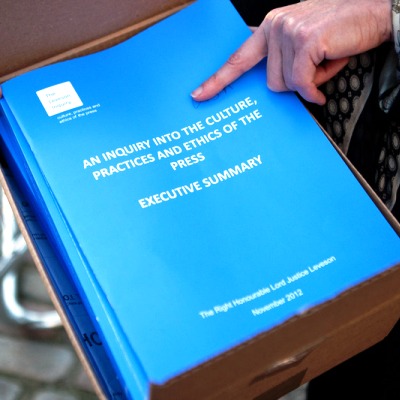
Britain has always had a complicated relationship with the free press. On the one hand, Milton’s Apologia, Mill’s On Liberty, Orwell’s volleys at censorship and propaganda.
On the other hand, there is a sense that journalists, editors and proprietors are at best incompetent and at worst genuinely venal people whose sole interest is making others miserable.
This ambivalence carries over into the political debate about the media, and the laws and regulations governing the press and broader free speech issues. All British politicians pay lip service to free speech, but the records of successive governments have been far from perfect. For every success, there is a setback.
This paper will provide a brief overview of the state of media freedom in the UK today
Press regulation and the Royal Charter
The Leveson Inquiry into the press reported in November 2012, with numerous recommendations on how press regulation should proceed. After months of negotiation led to deadlock over the issue of a “statutory backstop” to a regulator, in April 2013 the government attempted to resolve the issue, publishing a draft of a “Royal Charter” for the regulation of the press. In spite of the newspapers’ attempt to put forward their own competing royal charter, the Privy Council officially approved the government version in October 2013.
While the government and supporters claim that this is insulated from political interference, requiring consent of all three main parties in both houses (as well as a 2/3 majority) before the charter can be altered, critics say that royal charters, granted by the Privy Council, are essentially still political tools.
But how did we get to this point?
The Leveson Inquiry was called in response to the phone hacking scandal which gripped the country in 2010 and 2011. Journalists and contractors for News of the World, News International’s hugely successful Sunday tabloid, were alleged to have hacked the voice message of 100s of people, most notoriously murdered schoolgirl Milly Dowler. Several criminal trials of senior News International figures continue at time of publication.
As allegations of dubious behaviour began to be made against other papers, judge Sir Brian Leveson was charged with leading an inquiry into the industry. The inquiry, which opened in late 2011, heard from a huge range of people, from celebrities to civil society activists.
An increasingly polarized debate has seen the newspapers lined up on one side, opposed to the current Royal Charter, and campaign group Hacked Off, as well as the major political parties, on the other. The newspapers plan to set up their own regulator, the Independent Press Standards Organisation, which may not seek recognition under the Royal Charter. It is claimed that IPSO will be operational by 1 May. This would be funded by the newspapers, with representation from the industry on its governing bodies.
Hacked Off and their supporters, who claim to represent the interests of victims of phone hacking and press intrusion, say that the newspapers cannot “mark their own homework”, and insist that any regulator must be “Leveson compliant” and recognised under the Royal Charter.
There have been confusing political signals. While Culture Secretary Maria Miller suggested that IPSO, if it functioned well, may not need to apply for recognition, the Prime Minister David Cameron told the Spectator magazine that he believed that the Royal Charter was the best deal the press would get, and that publishers should sign up lest a more authoritarian scheme be introduced.
Index on Censorship has opposed the Royal Charter and supporting legislation on several grounds.
– Changing the Royal Charter While supporters claim the Royal Charter cannot, practically, be changed by politicians, Index believes it would be possible to gain the two-thirds majority required in both houses to alter it, particularly if there were to be another hacking-style scandal. The Privy Council is essentially a political body, and recognition by royal charter a political tool.
– Exemplary damages The Crime and Courts Act sets out that an organisation which does not join the regulator but falls under its remit will potentially become subject to exemplary damages should they end up in court. In addition, even if they win, they could also be forced to pay the costs of their opponents. While it is claimed that membership of a regulator with statutory underpinning is voluntary, it is clear that there are severe, punitive consequences for those who remain outside the regulator. There is controversy over whether this is compatible with the European Convention on Human Rights.
The imposition of exemplary damages is likely to have a strongly chilling effect on freedom of expression – this could be particularly felt by already financially squeezed local publications and small magazines.
– Corrections The Royal Charter proposes the regulator will be able to “direct” the wording and placement of apologies and corrections. This is an effective transfer of editorial control. It represents a level of external interference with editorial procedures that would undermine editorial independence and undermine press freedom. A tougher new independent regulator could reasonably require corrections to be made, but directing content of newspapers is a dangerous idea.
– Scope The Royal Charter is designed, in its own words, to regulate “relevant” publishers of “news-related material”. It sets out a very broad definition of news publishers and of what news is (including in the definition celebrity gossip). Despite some subsequent attempts by politicians to establish some exclusions, such as for trade publications and charities for instance, the attempt to distinguish press from other organisations remains problematic. In a media industry undergoing rapid change, distinctions between platforms are increasingly blurred, and stories from unlikely sources can have every bit as much impact as those from the traditional media whose power pro-regulation activists seek to curb.
The next few months will be crucial as IPSO and alternatives, such as the IMPRESS project, take up positions. IPSO will be keen to recruit publications that have not already joined and present itself as fait accompli, pointing out that nowhere in the Leveson recommendations is there specific mention of a Royal Charter.
But at the core of the entire argument is the fundamental fact that the government has been willing to use coercive, punitive measures specifically directed at the press.
Libel – a free speech victory?
On 1 January, the Defamation Act 2014 became statute. The new law, represented a victory for the Libel Reform Campaign led by Index on Censorship, English PEN and Sense About Science. The LRC had its roots in two things – English Pen and Index on Censorship’s report “Free Speech Is Not For Sale” and Sense About Science’s campaign “Keep Libel Laws Out Of Science”.
That campaign identified key problems with England’s libel law, which was simply not fit for the internet age. Among the issues were the ease with which foreign claimants could bring cases in London courts, and the lack of a coherent statute of limitation on web publication.
The new act, while still far from perfect, is, at least on paper, an improvement on what has gone before. It should in theory provide greater protection for writers.
Among the changes are the introduction of a strong public interest defence, a one-year statute of limitation on online articles (where previously each new “download” counted as a new publication), and a “serious harm” test for corporations wishing to sue for defamation.
One major point of concern is the refusal of Northern Ireland’s government to update its statute books in line with that of England and Wales. Libel lawyer Paul Tweed, who practices in Belfast, Dublin and London, has pointed out that wealthy litigants hoping for a more claimant-friendly regime may now take cases to Belfast rather than London. It is imperative that pressure continues to be put on the political parties in Northern Ireland to introduce the new legislation.
Surveillance and protection of sources
There is little doubt about what was the biggest global story in 2013. The revelations about global surveillance carried out by the US’s National Security Agency, with the help of Britain’s GCHQ, dominated much of the global conversation. But while the US has made some noises about reviewing its surveillance procedures (though it has shown no intention of halting its pursuit of whistleblower Edward Snowden), the UK government managed a very special combination of burying its head in the sand and shooting the messenger.
The Prime Minister warned the Guardian that it should stop publishing revelations or face legal action. Guardian editor Alan Rusbridger was summoned before parliament and accused of deliberately endangering British security.
Security officials even visited the Guardian and demanded that hard drives containing leaked material be destroyed in front of them, in spite of the fact they were aware the data was also held elsewhere.
David Miranda, the partner of the Rio-based journalist Glenn Greenwald, was stopped at Heathrow airport under terror legislation. This was clearly done in order to confiscate source material.
That action was challenged in the courts by Miranda, with Index on Censorship entering evidence in support of the case. The legal challenge to the detention of Mr Miranda has been dismissed by the High Court, though there is the possibility of an appeal.
The case raises serious questions about protection of journalists’ materials and sources. There was also grave concern that terror legislation was used against a person carrying out journalistic activity.
Meanwhile, the government has proposed, as part of the deregulation bill, a new system which would make it easier for authorities to force journalists to hand over materials and information about sources. The Deregulation Bill could, if passed unamended, strip away safeguards for journalists faced with demands for their materials from police, removing the requirement for judicial scrutiny of such demands.
Conclusion
2014 will be a crucial year, not just for newspapers, but for free speech for everyone in the UK. For as the wall between publisher and consumer is rapidly being dismantled, it will become harder and harder to compartmentalise press freedom and general principles of free speech.
While the reform of our libel laws will, we hope, be of great benefit to to free expression in the UK and beyond, there are still several areas where this government can act to safeguard the free press and free speech more broadly in the coming year. Chief among these is that we must allow press self-regulation to proceed without coercion. No one should be forced to sign up to the press Royal Charter, and no one should be subjected to exemplary damages. In short, self-regulation should be just that.
Moreover, the government should state its commitment to protection of journalistic sources, a crucial cornerstone of the fourth estate which has come under severe threat as a result of the Miranda case.
Finally, the government should ensure that Belfast does not become a haven for libel tourism, by doing everything it can to support the extension of the new Defamation Act to Northern Ireland.
11 Feb 2014 | Comment, United Kingdom
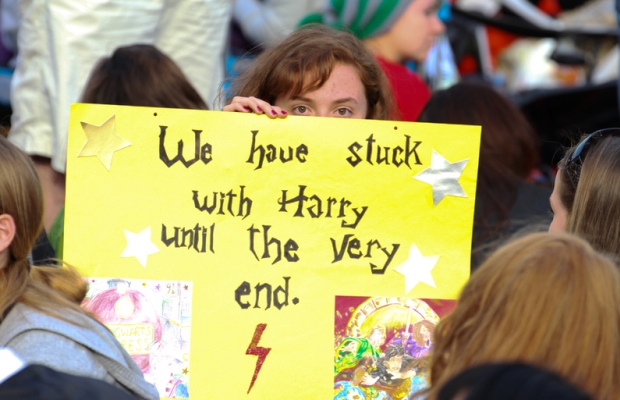
A dangerous religious fanatic, yesterday (Image Demotix/David Mbiyu)
Last weekend, I appeared on the BBC’s The Big Questions, the Sunday morning religion and ethics show that airs at precisely the time Christians should be at church services.
The Big Question I’d been hauled in to address was whether there were any topics that were too sacred for humour – a variation of the old “where do you draw the line?” which has been in the news quite a bit of late, with the Jesus and Mo cartoon controversy (which started with The Big Questions), the attempt in Northern Ireland to ban a Reduced Shakespeare Company play based on the Bible, and the banning of demagogic French comic Dieudonne from the UK.
As it turned out, we barely discussed any of these specific topics, but rather kept to what could now almost be called the traditional touchstones in these conversations: Motoons and The Life Of Brian.
The discussion was disappointingly calm, but I did, I think, manage to get one crucial point across, one I’d been meaning to bring up since discussing the RSC ban in Northern Ireland.
In the context of religion, censorship is increasingly, simply, about control. Specifically, who is in charge of the sacred text.
At the height of the Rushdie Affair, Christopher Hitchens noted that it represented a war between the ironic mind and the literal mind. This was particularly apparent when watching Free Presbyterian preacher David McIlveen discuss the Reduced Shakespeare Company’s abridged Bible spoof. McIlveen could not, and would not understand the idea that his interpretation of a text was not the only one. Speaking on the Nolan show, he repeatedly suggested that the RSC was presenting a false version of the “Word of God”. Of course, to an extent, they were, but McIlveen seemed to confuse interpretation with, well, lying.
I was reminded of this while reading an exchange between Alex Clark and Stephanie Merritt in the Observer last Sunday.
They were discussing JK Rowling’s view that in hindsight, she would not have had Hermione and Ron, two characters from her Harry Potter series, ending up romantically entangled. Merritt and Clark debated interestingly on authorship and ownership, particularly in the age of fan fiction.
A lot of people are very emotionally attached to the Harry Potter stories, and no doubt some were genuinely unhappy with Rowling’s suggestion that well, the sacred text may be wrong after all. Even her position as creator of that particular universe did not leave her immune from criticism. As Merritt – a historical novelist whose own hero is heretic Giordano Bruno – notes: “I can see why fans felt insulted. They’ve made an emotional investment in those characters and in the storyline as it exists.”
It’s unlikely that Rowling will revise the tale of Hermione and Ron’s romance, but, considering it’s quite possible that at some point, Potterism will become a religion (if grown adults are playing Quidditch, we’re probably half way there), then it’s worrying that Rowling has already introduced a potential point of schism. Do you believe in the true text? Do Ron and Hermione belong together? Or do you believe what the great transcriber of Potterism, Ro-Ling said, that they weren’t suited and maybe split after a fling. Should Hermione even have ended up with Harry?
This could be worse than anything Northern Ireland has seen.
This article was published on 11 February 2014 at indexoncensorship.org
31 Jan 2014 | Egypt, News
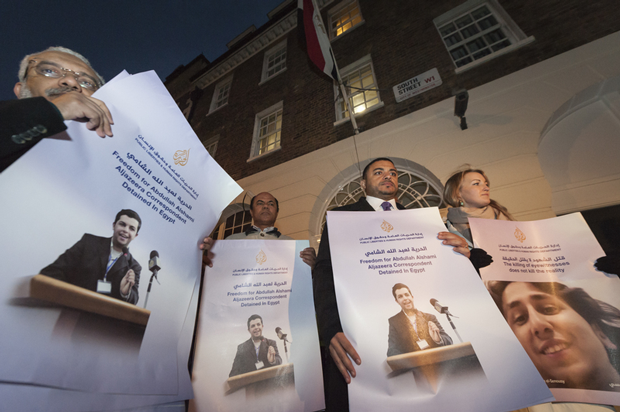
In November 2013, the National Union of Journalists (NUJ UK and Ireland), the International Federation of Journalists (IFJ) and the Aljazeera Media Network organised a show of solidarity for the journalists who have been detained, injured or killed in Egypt. (Photo: Lee Thomas / Demotix)
Statement: Egyptian authorities must stop their attacks on media freedom from Article 19, the Committee to Project Journalists, Index on Censorship and Reporters Without Borders
Twenty journalists working for the Al Jazeera TV network will stand trial in Egypt on charges of spreading false news that harms national security and assisting or joining a terrorist cell.
Sixteen of the defendants are Egyptian nationals while four are foreigners: a Dutch national, two Britons and Australian Peter Greste, a former BBC Correspondent. The chief prosecutor’s office released a statement on Wednesday saying that several of the defendants were already in custody; the rest will be tried in absentia.The names of the defendants, however, were not revealed. The case marks the first time journalists in Egypt have faced trial on terrorism-related charges, drawing condemnation from rights groups and fueling fears of a worsening crackdown on press freedom in Egypt .
“This is an insult to the law,” said Gamal Eid, a rights lawyer and head of the Arab Network for Human Rights Information. “If there is justice in Egypt , courts would not be used to settle political scores”, he added.
In December, the government designated the Muslim Brotherhood as a terrorist organization. It has since widened its heavy-handed crackdown on Brotherhood supporters, targeting pro-democracy activists, journalists and anyone considered remotely sympathetic to the outlawed Islamist group.
In a move seen by rights advocates as a blow to freedom of expression, most Islamist channels were shut down by the Egyptian authorities almost immediately after Islamist President Mohamed Morsi was toppled in July. The Qatar-based Al-Jazeera is one of the few remaining networks perceived by the authorities as sympathetic to Morsi and the Brotherhood.
Once praised by Egyptians as the “voice of the people” for its coverage before and during the 2011 mass protests that led to the removal of autocrat Hosni Mubarak from power, Al Jazeera has since seen its popularity dwindle in Egypt. Since Morsi’s ouster by military-backed protests in July, Qatar has been the target of media and popular wrath because of its backing for the Brotherhood. Allegations by the state controlled and private pro-government media that Qatar was”plotting to undermine Egypt’s stability” has inflamed public anger against the Qatar-funded network, prompting physical and verbal attacks by Egyptians on the streets on journalists suspected of working for Al Jazeera.
The Al Jazeera Arabic service and its Egyptian affiliate Mubasher Misr were the initial targets of a government crackdown on the network and have had their offices ransacked by security forces a number of times. In recent months however, the crackdown on the network has escalated, targeting journalists working for the Al Jazeera English service as well despite a general perception among Egyptians that the latter is “more balanced and fair” in its coverage of the political crisis in Egypt.
The Al Jazeera network has denied any biases on its part and has repeatedly called on Egypt to release its detained staff. According to a statement released by Al Jazeera on Wednesday, the allegations made by Egypt’s chief prosecutor against its journalists are “absurd, baseless and false.”
“This is a challenge to free speech, to the right of journalists to report on all aspects of events, and to the right of people to know what is going on.” the statement said.
Three members of an Al Jazeera English (AJE) TV crew were arrested in a December police raid on their makeshift studio in a Cairo luxury hotel and have remained in custody for a month without charge. Both Canadian-Egyptian journalist Mohamed Fahmy — the channel’s bureau chief –and producer Baher Mohamed have been kept in solitary confinement in the Scorpion high security prison reserved for suspected terrorists and dangerous criminals. An investigator in the case who spoke on condition of anonymity because he was not authorized to speak to the press said Fahmy was an alleged member of a terror group and had been fabricating news to tarnish Egypt’s image abroad.
Earlier this week, Fahmy’s brother, Sherif, complained that treatment of his brother had taken a turn for the worse and that prison guards had taken away his watch, blanket and writing materials.
Peter Greste, the only non-Egyptian member of the AJE team has meanwhile, been held at Torah Prison in slightly better conditions. In a letter smuggled out of his prison cell earlier this month, Greste recounted the ordeal of his Egyptian detained colleagues, saying “Fahmy has been denied the hospital treatment he badly needs for a shoulder injury he sustained shortly before our arrest. Both men spend 24 hours a day in their mosquito-infested cells, sleeping on the floor with no books or writing materials to break the soul-destroying tedium.”
Al Jazeera Arabic correspondent Abdullah El Shamy, another defendant in the case, has meanwhile been in jail for 22 weeks. He was arrested on August 14 while covering the forced dispersal by security forces of a pro-Morsi sit-in and has been charged with inciting violence, assaulting police officers and disturbing public order. El Shamy began a hunger strike ten days ago to protest his continued detention. In a letter leaked from his cell at Torah Prison and posted on Facebook by his brother, El Shamy insisted he was innocent of all charges. He remains defiant however, saying that “nothing will break my will or dignity.” On Thursday, his detention was extended for 45 days pending further investigations . His brother Mohamed El Shamy, a photojournalist, was arrested in Cairo on Tuesday while taking photos at a pro-Muslim Brotherhood protest. He was released a few hours later.
Al Jazeera Mubashir cameraman Mohamed Badr is also behind bars. He was arrested while covering clashes between Muslim Brotherhood supporters and security forces in July and has remained in custody since.
The case of the Al Jazeera journalists sends a chilling message to journalists that there is a high price to pay for giving the Muslim Brotherhood a voice. A journalist working for a private pro-government Arabic daily sarcastly told Index that there is only one side to the story in Egypt: the government line. Mosa’ab El Shamy, a photojournalist whose brother is one of the defendants in the Al Jazeera case posted an article this week on the website Buzzfeed, humorously titled: If you want to get arrested in Egypt, work as a journalist.
In truth though, the case is no laughing matter. National Public Radio’s Cairo Correspondent Leila Fadel said it shows just how far Egypt has backslid on the goals of the January 2011 uprising when pro-democracy protesters had demanded greater freedom of expression. Today, violations against press freedoms in Egypt are the worst in decades, according to the New York-based Committee for the Protection of Journalists. Sadly, it does not look like the situation for journalists in Egypt will improve anytime soon.
In the meantime the fate of the Al Jazeera journalists hangs in the balance.
This article was posted on 31 January 2014 at indexoncensorship.org
