5 Sep 2013 | Africa, Europe and Central Asia, France, Italy, News, Russia, South Africa, United States
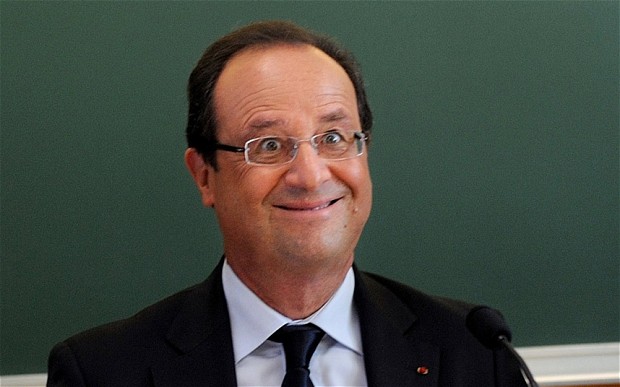 French news agency AFP has been caught up in a self-censorship row after attempting to retract a photo of President Francois Hollande flashing a gormless smile. The whole debacle has gone viral, forcing AFP to make a statement denying they had caved to government pressure. Rather, they cited internal editorial guidelines ‘not to transmit images that gratuitously ridicule people.’ However, politicians are not strangers to banning (or trying to ban!) images that makes them look a bit silly.
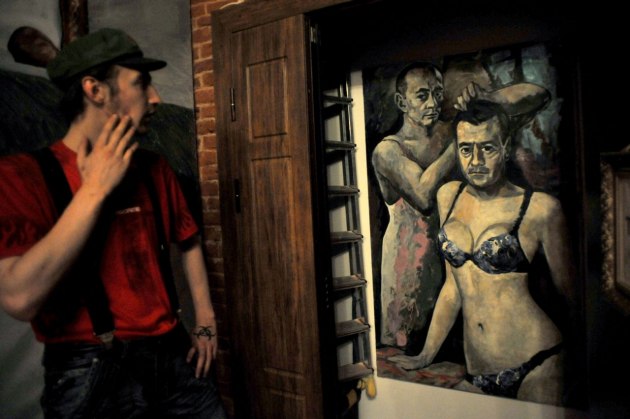 You’d think that Vladimir Putin, used to being in the public eye, captured in completely random and non-staged situations like this, wouldn’t mind being the inspiration for some fine art. That turned out not to be the case when a St Petersburg gallery exhibited a painting of Putin and PM Dmitry Medvedev – the former sporting a fetching pink negligee, the latter a black lace push-up bra. Russian police raised the gallery and removed the picture in question, as well as three others depicting Russian political leaders. The reason given was that the imagines ‘violate existing legislation’.
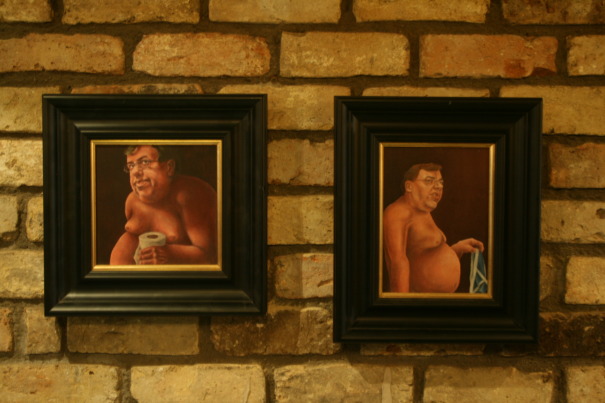 Back in 2009, artist Conor Casby painted two pictures of former Irish taoiseach Brian Cowen sitting on a toilet naked. He then hung them on the walls of the National Gallery and the Royal Hibernian Gallery in Dublin, and broadcaster RTE made a short piece about it. The outcome? RTE had to issue a formal apology and remove the item from its online archive. Meanwhile, the police launched a country wide manhunt for Casby. He had to hand over five more paintings to the police and faced potential charges of indecency, criminal damage and incitement to hatred. All for making a politician the butt of his joke.
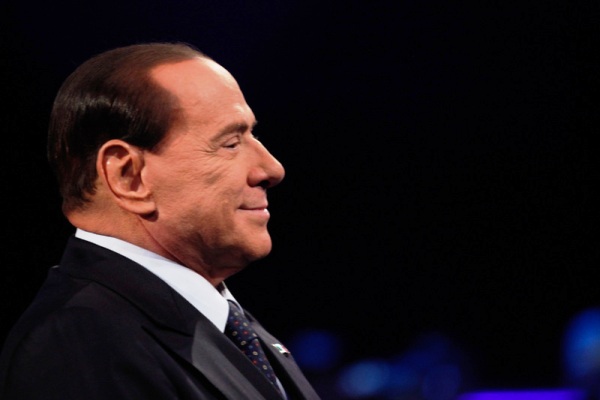 In 2002, former Italian Prime Minister Silvio Berlusconi was accused of censoring a play putting him and his compatriots in an unfavorable light. Renowned theatre director Luca Ronconi used caricature pictures of Berlusconi and two other ministers as props in his production of Greek comedy “The Frogs.” Ronconi said officials from ruling party Forza Italia tried to make him remove the pictures from stage. Berlusconi, on the other hand, stated that while the pictures ‘didn’t please him’: ‘The government, the whole government, doesn’t even know what censorship is.’
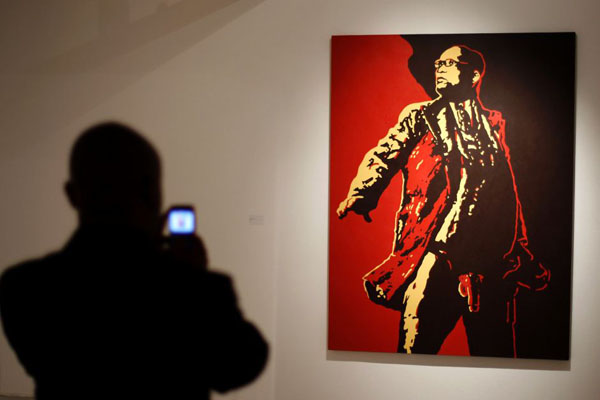 South African President Jacob Zuma caused quite a stir when he demanded that a painting of him be removed from Johannesburg’s Goodman Gallery. ‘The Spear’ was in the style of portraits of revolutionary leaders, but for small fact that his, um, spear, was hanging out. He also wanted City Press newspaper to remove a photo of it from their website. When both refused, Zuma’s party the ANC declared they would take the gallery to High Court and called for a boycott of City Press. Finally, a couple of ANC supporters were caught on tape defacing the painting. Taking the matter of The Spear into their own hands, some might say (sorry).
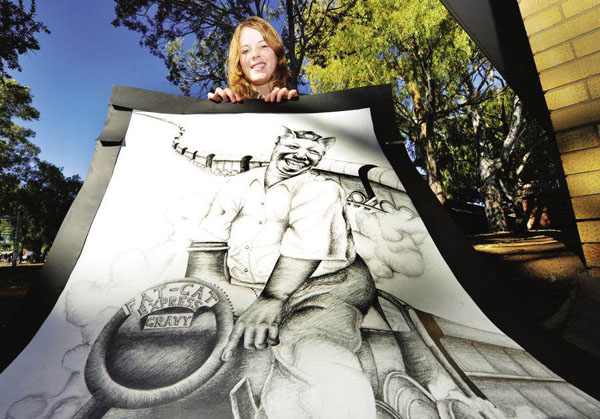 At least it seems the future leadership of the ANC is getting some training in dealing with awkward art-related stories of their own. Bloemfontein student Alta Bonnet (17) was told her painting depicting former ANC Youth leader Julius Malema ‘as a fat cat on a gravy train’ might not be exhibited at a city art show. The picture was deemed ‘too political’.
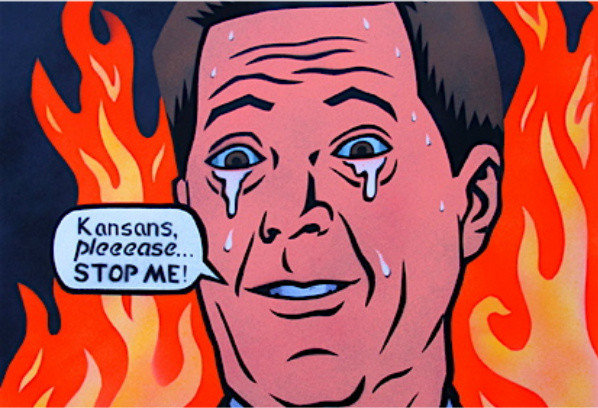 Kansas artist Dave Loewenstein last year had his picture of Governor Sam Brownback removed from a cafe in the state’s capital Topeka. The picture is a cartoon depiction of the governor, with the words ‘REJECT BROWNBACK’ printed on. Loewenstein said the picture was in protest at Brownback’s policies and not him personally. Greg Ready, the landlord of the building, said they had chosen to remove the painting because Brownback’s daughter worked at the cafe in question, adding ‘there was no political motivation for this action whatsoever.’
But you could understand Brownback being a little thin skinned – this wasn’t the first time he had been viciously attacked. In 2011, when his office took note of a tweet by High School student Emma Sullivan (18), her principal demanded she write an apology letter to the governor. The tweet? “Just made mean comments at gov. brownback and told him he sucked, in person (hash)heblowsalot.” Scathing.
Have we missed any? Let us know in the comments!
30 Aug 2013 | News
The Glamoured
Brightening brightness, alone on the road, she appears,
Crystalline crystal and sparkle of blue in green eyes,
Sweetness of sweetness in her unembittered young voice
And a high colour dawning behind the pearl of her face.
Ringlets and ringlets, a curl in every tress
Of her fair hair trailing and brushing the dew on the grass;
And a gem from her birthplace far in the high universe
Outglittering glass and gracing the groove of her breasts.
News that was secret she whispered to soothe her aloneness,
News of one due to return and reclaim his true place,
News of the ruin of those who had cast him in darkness,
News that was awesome, too awesome to utter in verse.
My head got lighter and lighter but still I approached her,
Enthralled by her thraldom, helplessly held and bewildered,
Choking and calling Christ’s name: then she fled in a shimmer
To Luachra Fort where only the glamoured can enter.
I hurtled and hurled myself madly following after
Over keshes and marshes and mosses and treacherous moors
And arrived at that stronghold unsure about how I had got there,
That earthwork of earth the orders of magic once reared.
A gang of thick louts were shouting loud insults and jeering
And a curly-haired coven in fits of sniggers and sneers:
Next thing I was taken and cruelly shackled in fetters
As the breasts of the maiden were groped by a thick-witted boor.
I tried then as hard as I could to make her hear truth,
How wrong she was to be linked to that lazarous swine
When the pride of the pure Scottish stock, a prince of the blood,
Was ardent and eager to wed her and make her his bride.
When she heard me, she started to weep, but pride was the cause
Of those tears that came wetting her cheeks and shone in her eyes;
Then she sent me a guard to guide me out of the fortress,
Who’d appeared to me, lone on the road, a brightening brightness.
Calamity, shock, collapse, heartbreak and grief
To think of her sweetnes, her beauty, her mildness, her life
Defiled at the hands of a hornmaster sprung from riff-raff,
And no hope of redress till the lions ride back on the wave.
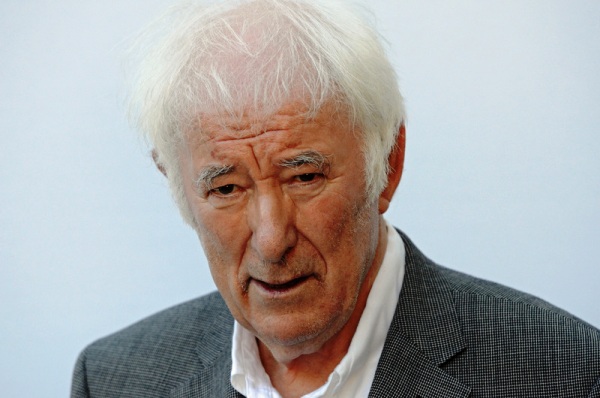
Aodhgan O’Rathaille, translated by Seamus Heaney
The Glamoured is my translation of Gile na Gile (literally Brightness of Brightness), one of the most famous Irish poems of the early eighteenth century. It is a classic example of a genre know as the aisling (pronounced ashling) which was as characteristic of Irish language poetry in the late seventeenth and eighteenth centuries as rhymed satire was in England at the same time.
The aisling was in effect a mixture of samizdat and allegory, a form which mixed political message with passionate vision. After the devastations and repressions brought about by the armies of Oliver Cromwell and King William, the native Irish population became subject to the Penal Laws, a system of legislation as deliberately conceived as apartheid, enacted against them specifically as Catholics by the Irish parliament (representing the ‘Protestant interest’ which took control after William of Orange’s victory over the forces of the Catholic Stuart king, James II, at the Battle of the Boyne). The native Irish aristocracy fled – and were ever afterwards know as The Wild Geese – and dreams of redress got transferred into poetry.
Politically, the aisling kept alive the hope of a Stuart restoration which would renew the fortunes of the native Irish. Symbolically, this was expressed in the ancient form of a dream encounter in which the poet meets a beautiful woman in some lonely place. This woman is at one and the same time an apparition of the spirit of Ireland and a muse figure who entrances him completely. She inevitably displays signs of grief and tells a story of how she is in thrall to some heretical foreign brute, but the poem usually ends with a promise — which history will not fulfil — of liberation in the form of a Stuart prince coming to her relief from beyond the seas.
Aodhgan O’Rathaille (1675-1729) is one of the last great voices of the native Irish tradition, Dantesque in his anger and hauteur, a voice crying in the more or less literal wilderness of the Gaelic outback, at once the master of outrage and the witness of desolation.
Seamus Heaney, Index on Censorship, September 1998
1 Aug 2013 | News, Politics and Society, Religion and Culture, United Kingdom
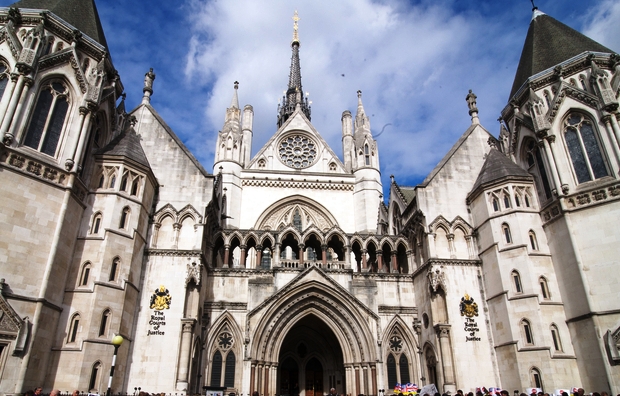
The Royal Courts of Justice, London (Image Graham Mitchell/Demotix)
A recent libel judgment has raised an interesting question: should you be able to sue for a bad review?
I should probably give a little background. This all dates back to a case involving an Amazon thread row between two men, Christopher McGrath and Vaughan Jones. In fact, I’m going to use the exact summary from last week’s judgment by Mrs Justice Davies, lest I be accused of twisting a story that’s a little complicated. Here we go (note – her punctuation, not mine):
[I]n 2010, the claimant [Christopher McGrath] published under the pseudonym “Scrooby” a book entitled “The Attempted Murder of God: Hidden Science You Really Need To Know”. In the same year, Professor Stephen Hawking and Leonard Mlodinov published a book called “Grand Design: New Answers to the Ultimate Questions in Life”. The book was offered for sale on Amazon, the page on which it was advertised included a facility for users to post reviews. The claimant, as Scrooby, posted a review of the Hawking book, the review is described by the defendant [Vaughan Jones] as “more or less a naked puff of the claimants own book”. The claimant’s review attracted many critical comments. An online argument ensued with a number of contributors including several who were in fact, the claimant using other aliases. One contributor was Vaughan Mr Vaughan Jones. It was he who outed the claimant as Scrooby, questioned the claimant’s marketing tactics, belittled the claimant’s book and publishing business and took issue with the claimant both as to his views and conduct. The war of words spilled over onto the website of the Richard Dawkins Foundation when Mr Vaughan Jones began a discussion on the site complaining that the claimant had threatened to sue him for libel comments made in the Amazon thread.
The claimant issued proceedings in the Dawkins Action on 1 April 2011. The Dawkins defendants subsequently applied to strike out the claim upon a number of bases, all of the defendants applies for rulings on meaning. The claim against Amazon was struck out in its entirety. The claims against Richard Dawkins and Mr Vaughan Jones were struck out as the only actionable aspects of the claims against them, which had survived the abuse of process and meaning applications, were disposed by way of undertakings.”
Jerome Taylor, than of the Independent (now at AFP) reported on the case, and included a quote from Index’s Mike Harris, speaking in his role as part of the Libel Reform Campaign.
McGrath took objection to the article, which he said implied that he had sued merely for bad reviews. So he proceeded to sue the Independent for suggesting that he would sue someone for a review (keep up). According to the judgment, he pleaded*:
A book review is a subjective response and is widely regarded as a matter of opinion, a legally framed objection to which clearly falls into the realm of stifling free speech, which is of course a Human Right protected in international law. Such a claim demonstrably engenders a lowering of opinion of a litigant by ordinary readers and is therefore defamatory.”
So McGrath is, interestingly, claiming that to suggest someone would impinge on free speech by suing for libel is defamatory.
Mrs Justice Davies, however, in her judgment in McGrath v Independent, disagrees:
[…] I accept that there may be certain members of society who view with disfavour or scorn an author suing over a book review, but I do not accept society in general would hold that view. Nor do I accept the claimant’s assertion that suing over a book review is contrary to “established norms of free speech” which would “rightly attract opprobrium in a democratic society.
…
Further, the claimant’s contention that the institution of libel proceedings in respect of a book review would, of itself, bring upon him ridicule and opprobrium ignored the fact that all libel proceedings impact upon freedom of speech enshrined in Article 10. [my emphasis]. It cannot be defamatory to identify one set of libel proceedings which would attract opprobrium on the grounds of running counter to the norms of free speech when the very fact of any libel proceedings impact upon such a right.”
Which seems reasonable.
I can only think of two recent libel cases involving reviews: Thornton v Telegraph and Goodfellas’ v Irish News.
The former hinged on a mistake made by the Telegraph’s critic Lynn Barber, who, in a review branded as “spiteful” by Mr Justice Tugendhat, claimed that Sarah Thornton, author of Seven Days in the Art World, claimed that the author had falsely suggested she had interviewed Barber, a keen contemporary art collector. It turned out Thornton had, and Barber had forgot when she wrote the review.
In Goodfella’s v Irish News, Caroline Workman submitted a scathing view of a Belfast Italian restaurant, and was successfully sued by the owners in 2007. Workman won on appeal (represented by Lord Lester of Herne Hill) and briefly became a cause celebre among restaurant critics – The Times’s Giles Coren, who normally resents leaving North London, travelled all the way to Northern Ireland to review Goodfella’s in solidarity (£).
A good principle. But I do have a certain amount of sympathy with McGrath’s argument, or at least I understand it: reviews pages are supposed to be places where vigorous and rigorous debate takes place – where are allowed to perform a true, gleeful hatchet job. There’s even a prize to encourage critics to stick the boot in (read last year’s glorious winner – Camilla Long’s review of Rachel Kusk’s Aftermath, at the Hatchet Job of the Year website). And there is at least a perception that people of letters should not resort to the courts because someone was mean about their latest work in the Spectator. They should just bitch about each other at book launches and send in gossipy titbits to Private Eye.
The to-be-enacted Defamation Act 2013 is supposed to allow for greater leeway in public interest journalism. Does a devastating review count?
*This article was amended on 2 August to clarify the source of a quote, and add the word “to” in the phrase “a legally framed objection to which”
18 Jul 2013 | In the News
INDEX EVENTS
18 July New World (Dis)Order: What do Turkey, Russia and Brazil tell us about freedom and rights?
Index, in partnership with the European Council on Foreign Relations, is holding a timely debate on the shifting world order and its impact on rights and freedoms. The event will also launch the latest issue of Index on Censorship magazine, including a special report on the multipolar world.
(More information)
19 July: What surveillance means to YOU
Join us 19 July for a live Google hangout with Index on Censorship as Trevor Timm of the Electronic Frontier Foundation and Rebecca Mckinnon of Gloval Voices discuss what mass surveillance means to all of us as individuals. Hosted by Padraig Reidy of Index, the hour-long event will delve in the issues around government surveillance of innocent civilians.
(More information)
ASIA
Internet Censorship is Taking Root in Southeast Asia
Every time Le Anh Hung starts to write he thinks of his three young children. The 38-year-old has already been imprisoned twice for blogging about human rights and corruption from his home in Hanoi and lives half-expecting another fateful knock at the door. And yet “I’m not scared,” he says, “I know what I choose to do is risky but I accept the fight.”
(Time)
BRAZIL
Brazil protesters hope for Pope’s backing during visit
Young Brazilians who marched in June to demand more funding for health and education are hoping Pope Francis will back their cause when he visits Rio next week. But organizers ruled out a resumption of the street protests during the pontiff’s week-long stay to attend World Youth Day (WYD), a major Catholic gathering expected to draw 1.5 million people.
(AFP)
CHINA
China says it’ll relax film, TV censorship; directors unimpressed
Chinese authorities said Wednesday they would relax some restrictions on film, TV and radio productions, though the immediate impact of the changes was unclear and several prominent movie directors said they did not believe the reforms were game-changers.
(Los Angeles Times)
ISRAEL
Israel’s Plague of Self-Censorship
The affair surrounding Edward Snowden, former employee of the United States National Security Agency (NSA) who leaked information about NSA surveillance programs, reminded me of a personal story from more than 30 years ago.
(The Times)
LIBERIA
Newspaper Slapped With U.S $1.5 Million Libel Ruling
Liberia’s Supreme Court has ruled that a $1.5 million verdict against the FrontPage Africa newspaper should be enforced.
(All Africa)
UNITED KINGDOM
An unpleasant odour is rising from Northern Ireland’s libel law
The recently passed Defamation Act 2013 will introduce much-needed reform of an area of the law that has become an anachronistic, obscure and unjustifiable fetter on freedom of speech. It comes into force later this year. But not in Northern Ireland. The reluctance of Northern Ireland politicians to adopt the 2013 Act will, as a libel lawyer would say, lower them in the estimation of right-thinking people.
(The Times)
UNITED STATES
Federal Campus Sexual Harassment Policy Draws Free Speech Concerns
The federal government is facing pressure from civil-liberties advocates to back down from a policy meant to curb sexual harassment at colleges and universities — just as sexual-assault survivors demanded in a protest this week that the Education Department do more to punish colleges that fail to address campus assaults.
(Huffington Post)
Student Who Disagrees With Homosexuality Wins Free Speech Lawsuit Against Teacher
A federal district judge ruled in favor of a Michigan student who was removed from the classroom by his teacher for expressing his religious beliefs against homosexuality. The judge said punishing the student for his freedom of expression violated his First Amendment rights.
(Christian Post)
The Attack on Free Speech and the Press
Over the past three years, we have seen an assault on free speech and freedom of the press by those in power. Campaign finance laws have always been used less as a restriction on money in politics and more as a restriction of freedom of speech.
(Texas GOP Vote)
Previous Free Expression in the News posts
July 17 | July 16 | July 15 | July 12 | July 11 | July 10 | July 9 | July 8 | July 5 | July 4
