17 Jun 2013 | Europe and Central Asia, Index Reports
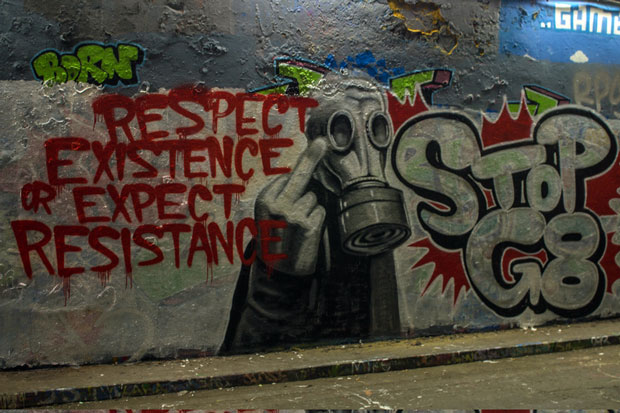
Stop G8 graffiti in London. (Photo: David Rowe / Demotix)
When G8 leaders meet in Northern Ireland today, they will focus on transparency, trade and development. But they cannot hope to achieve their declared goals on transparency, corruption and human rights without a clear commitment to respecting freedom of expression at home. Sean Gallagher writes
While the G8 nations generally perform well in indicators of media freedom, digital freedom and civil liberties more widely, there are some key weaknesses including constraints on the media, and digital surveillance. Russia is an outlier with a deteriorating record on free expression with the Russian government having increasingly pursued a course of restrictions on speech and free assembly.
While most of the G8 stand for digital freedom internationally, the Prism revelations drastically undermine the US stance in favour of an open internet on the international stage. Revelations that some of the G8 nations – generally seen as having the freest media, open digital spheres and a supportive artistic environment – have engaged in ongoing, intrusive and secret population-wide surveillance is deeply concerning. All of these nations are pledged to uphold the right of the individual to the freedom of expression through either native legislation or international agreements.
The G8’s emphasis on transparency at its Northern Ireland meeting is welcome – not least since one of the areas of considerable concern and varying performance across the G8 is corruption. Most of the G8 perform relatively well on corruption (though not as strongly as might be hoped for), Italy lags behind the US, Canada, Germany, UK, France and Japan to a striking degree, while Russia’s ranking is one of the worst internationally (as shown in table one).
How the G8 nations stack up against each other on media freedom
In terms of media freedom Germany and Canada come first (according to Reporters without Borders 2012 index). The United Kingdom and the United States are behind these two but still ranked fairly highly while France, Japan and Italy lag behind these four a bit more. Russia is substantially lower indicating a weak and deteriorating environment for media freedom.
The press freedom measurements only give a snapshot of the G8 nations. Briefly, here are the key issues affecting the media in the G8 nations.
Germany’s media is largely free and the legal framework protects public interest journalism. Germans are ill-served by their country’s lack of plurality in broadcast media.
In Canada, Canadian Journalists for Free Expression and other observers have found that access to information has become more difficult since Conservative Stephen Harper became prime minister in 2006 – particularly when it comes to climate change. The country’s hate speech laws and lack of protection for confidential sources are issues our research highlights.
The United Kingdom’s move to reform libel laws is a clear positive for free press and expression, a change that our organisation helped deliver. Cross-party proposals to introduce statutory underpinning for media regulation via the Royal Charter on the Regulation of the Self-Regulation of the Press cross a red line by of introducing political involvement into media regulation. The shelving of the Communications Data Bill, or “Snooper’s Charter”, is also an encouraging sign, although a number of politicians are still calling for its reintroduction — especially after the Woolwich attack — which raises more questions.
In the United States, recent Prism revelations of the Obama administration’s continued surveillance both around the world and of the American people through secret subpoenas raise serious questions about the government’s activities. Alleged mistreatment of “tea party”-related organisations by the Internal Revenue Service also embroiled the Obama administration in questions about its commitment to transparency.
France’s media is generally free and offers a wide representation among political viewpoints but there is unwelcome government involvement in broadcasting and the country’s strict privacy laws encourage self-censorship. Here, too, government surveillance has increased and politicians have used security services to spy on journalists.
While Japan’s press environment can be called free, self-censorship is rife and rules detailing “crimes against reputation” are enshrined in the constitution. Compounding these issues is the cozy relationship between government and journalists. The government’s poor transparency on the nuclear crisis at Fukushima has been singled out as a contributing factor to its decline in international rankings.
Italy’s media environment is robust in some ways but is hamstrung by political involvement in ownership and high media concentration in too few hands (not least by former PM Berlusconi). The country’s leaders are also adept at using the media in support of their own agendas.
Never a beacon for a free media, Russia has experienced an outright government takeover of the major broadcasting outlets and widespread violence and threats against journalists. When compared to the rest of the G8, Russia’s record is decidedly bad although censorship is not at the level of China (which does not though claim to be a democracy).
Citizen Surveillance on the Digital Frontier
The digital freedom index created by Freedom House is another useful indicator although it encapsulates many different dimensions into just one number. The US and Germany perform strongly in this index, with Italy and the UK somewhat behind. Russia’s ranking is very low. However, the Prism affair surely more than dents the US ranking – and shows how hard it is to combine surveillance and censorship (and other aspects of digital freedom) into one index.
The UN’s Special Rapporteur on Freedom of Expression Frank La Rue issued a timely report on government surveillance, privacy and freedom of expression ahead of the revelations of massive and appalling data mining carried on by the US government under the cloak of secrecy. This is a clear breach of transparency and digital freedom on a global scale.
While the US and European countries have been pushing back against the Russian and Chinese model of top-down internet governance, the widespread moves toward online surveillance undermines their efforts to ensure a multistakeholder approach to the web as part of the ITU process.
Though the US leads the world on Google requests for user data (a number that now seems just the tip of the iceberg in comparison to the Prism revelations), the G8 nations do not approach the levels that Brazil and India reach on demanding content be removed from the search engine.
The United States government has granted itself unprecedented powers to snoop on its citizens at home and abroad. First, the PATRIOT Act, parts of which were renewed in 2011, gave the US government unprecedented power to intrude into the online lives of its citizens in extra-judicial ways. Later, in 2008, Congress approved the FISA Amendments Act, which envisioned the Prism and other programmes described in articles released by The Guardian and the Washington Post. Despite this, several bills that would have given the government additional powers in the area of surveillance and copyright infringement have been withdrawn after concerted campaigns by internet and civil society activists.
The United Kingdom has stepped back recently from mass population surveillance with the shelving of the Communication Data Bill. But revelations of data-sharing activities with its US partner, as reported by The Guardian suggest we do not have the full picture. Beginning with the 2000 Regulation of Investigatory Powers Act and continuing with the recently shelved Communication Data Bill, successive governments have looked to surveillance of online activity in the name of national security. On a more positive note, interim guidelines on prosecutions of offensive speech on social media have been issued with the aim of hemming in criminal prosecutions, though restrictions on “grossly offensive” speech are still on the statute book. Takedown requests aimed at Google and Twitter are of a level comparable to France and Germany.
Japan is generally seen as having a positive record on digital freedom despite the government’s pressure to force telecom companies to remove “questionable” material from the web in regard to the Fukushima crisis. The country also instituted a strict piracy law at the behest of the Recording Industry of Association of Japan.
While Italy has generally been slower to adopt new technology, Italians internet users are bound by rules on data retention that can be seen as a threat. The regulations allow the government to target criminals and protect national security, yet do not guarantee the privacy of the data it collects. Italy has strict copyright and piracy legislation. Most worrying is the conviction of Google executives for violation of privacy laws due to material posted to the search engine giant by a third party.
Germany’s approach to digital rights is regarded as open and courts have ruled that access to the internet is a basic human right. But in 2011, German authorities acquired the license for a type of spyware called FinSpy, produced by the British Gamma Group. Hate speech laws are beginning to have an impact on digital free speech.
In France, online surveillance has been extended as a result of a 2011 anti-terror law and Hadopi 2 (the law “promoting the distribution and protection of creative works on the Internet”) which is supposed to reduce illegal file downloading. Hadopi 2 makes it possible for content creators to pay private sector companies to conduct online surveillance and filtering, creating a precedent for the privatisation of censorship. Another 2011 law requires internet service providers to hand over passwords to authorities if requested.
In Canada, too, the right to free expression online is coming under increased pressure. On a positive note, civil society activists were able to derail the Conservative government’s attempt to obtain online activity records without judicial oversight. Yet, the Canadian government recently introduced a law requiring librarians to register before posting on social media without first registering for either personal or professional use.
Though Russia’s online environment is relatively open, the government has been tightening restrictions leading to blocking of websites. The government claims this is to tackle crime and illegal pornography. However there are fears that it will apply the regulations too broadly and damage free expression in the digital realm through the creation of extra judicial block lists and censorship of content.
Muzzling Artistic Expression
While most of the G8 have a wide ranging and often vibrant artistic sphere, there are many pressures that can lead of censorship or self-censorship whether from public order, obscenity or hate speech laws or from self-censorship including especially timidy by arts institutions. As Index on Censorship noted in its recent conference report on artistic expression in the UK, institutional filters are stifling creativity. The same can be said for the arts in the other G8 nations, though for different reasons. The specific reasons for brakes on creativity will be explored more fully in each of the country reports. But common themes emerge around hate speech, fear of offence and budget constraints that force arts organisations to shy away from controversial works. Arts funding continues to be used as a political weapon in some countries. In Russia, artists must avoid offending the sensibilities of government partners like the Russian Orthodox Church — as in the Pussy Riot prosecution.
14 Jun 2013 | Comment, Europe and Central Asia, News
Russia’s new blasphemy law is censorship under the guise of protection for believers, says Padraig Reidy
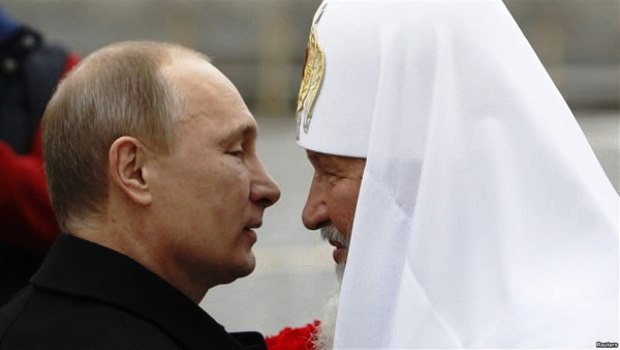
In his speech on Russia’s Constitution Day in December 2012, Vladimir Putin bemoaned the decline of spiritual values.
“Today, Russia suffers an apparent deficit of spiritual values,” said Putin, as his Orthodox ally Patriarch Kirill nodded along.
The former KGB man continued: “We must wholeheartedly support the institutions that are the carriers of traditional values.”
So far, so Mother Russia.
What was interesting was that the president went on to say that it would be “amoral” to create laws governing spirituality. Putin commented ““Any attempts of the government to intervene with people’s beliefs are effectively a sign of totalitarian rule. It’s absolutely out of the question. It’s not our way.”
This would seem at odds with this week’s passing of a new blasphemy law, which will impose prison sentences and fines on people convicted of “public actions expressing clear disrespect for society and committed with the goal of offending religious feelings of the faithful”.
But it is in fact very much in the mould of the current trend for religious defamation law.
Traditionally, blasphemy was the crime of causing offence to God himself; now it is recast as causing offence to believers. Blasphemy laws are here to protect us. Look back at the testimony durings Pussy Riot’s trial, and again and again you hear the stories of poor innocent believers who were shocked by the women’s behaviour; even if the Patriarch and the president had wished to forgive the punk group, they had to think of the poor pious babushkas who had been rocked to the very core by an act that some admitted to not actually having witnessed.
Shamefully, Ireland has led the way in this trend. The Irish Defamation Act of 2009 established definitions and punishments for blasphemy where none had previously existed (in spite of the fact that the 1937 constitution recognised blasphemy as a crime, it did not define what blasphemy was, and thus, there had never been a conviction for blasphemy, or even a full trial, in the country).
The Irish law defines religious defamation as any action likely to cause “outrage among a substantial number of the adherents of [a] religion”, with fines of up to e25,000 payable by those found guilty.
The wording of the Irish bill was used as a template in the Organisation of Islamic Conference’s attempts to get the UN to recognise religious defamation as a crime.
Of course, the old-fashioned definitions of blasphemy still exist: in Egypt this week, writer Amer Saber was given a five-year sentence for “contempt of religion” for authoring a short story collection called “Where is God?”. And in Syria, a teenager was reportedly shot in front of his family merely for uttering the name of Muhammad. The abuses of blasphemy law in Pakistan are only too well known.
But the justification for blasphemy laws, as with many other censorious impulses, is increasingly tied up in the idea that people should be protected from offence, from controversy, even from being challenged.
Perhaps the most offensive notion is that we cannot deal with ideas, even aggressively expressed ideas, that we disagree with. Government’s such as Putin’s are all too happy to shut down free speech and repackage censorship as benign protection.
10 Jun 2013 | In the News
GLOBAL
UN report slams government surveillance
The UN’s Special Rapporteur on Freedom of Expression Frank La Rue delivered a report to the Human Rights Council outlining how state and corporate surveillance undermine freedom of expression and privacy. (Index on Censorship)
GREECE
Kostas Vaxevanis faces fresh trial
The Greek journalist who published the infamous “Lagarde list” of Swiss bank accounts could face two years in jail for breaching privacy. (Index on Censorship)
INDIA
HC directive on film posters a springboard for double censorship
The Kerala High Court’s directive to the State Police Chief to take up investigation of cases registered for indecent representation of women could end up as a double censorship, it is felt. (The Hindu)
Defying censorship, the reporter who exposed the killings
Brahma Chellaney exposed the killings of young unarmed Sikh youths for a foreign news agency, and faced severe government harassment (The Hindu)
IRAN
Regime’s media slam mullahs censorship
The Iranian regime’s own media has spoken out in protest at the censoring and restrictions imposed on their work. More than one hundred media staff covering next week’s election have released a statement criticising the oppressive scrutiny of their news websites, including reporters from the state-run Fars news agency. (National Council of Resistance of Iran)
IRELAND
Media must be free to ‘be arrow and not target’
THE first President Roosevelt coined the term “bully pulpit” when describing the less obvious charms of the American chief magistracy. (Irish Independent)
JAMAICA
Free Speech And Gay Rights
Boyne: Tolerance does not mean acceptance. And this is my problem with some gay people: … Any rejection of homosexuality as morally wrong is seen as homophobia. That is nonsense and an abuse of language to shut down conversation. (The Gleaner)
MALTA
‘Adult plays should be protected from police’
When censorship laws were relaxed last year, theatre buffs rejoiced thinking that no play would suffer the same fate as Anthony Neilson’s Stitching. (Times of Malta)
SINGAPORE
Singapore Bloggers Protest Licensing Rules for News Websites
More than 2,000 Singaporeans gathered at a downtown park to protest a regulation requiring websites that regularly publish news on the city state to be licensed. (Jakarta Globe)
UNITED STATES
Former FCC Chairman: Let’s Test an Emergency Ad Hoc Network
As the Boston Marathon bombings unfolded, thousands of anxious people in the region pulled out their mobile phones to connect with friends and family—and found that calls couldn’t be placed or received. Rumors that officials had shut down these mobile networks for security reasons weren’t true. The system was simply overloaded at a time when people needed it most.
(MIT Technology Review)
Produced By Conference: Death Threats, But No Network Censorship For ‘Walking Dead’ Execs
The Walking Dead exec producer Gale Anne Hurd admitted this afternoon that one of the hazards of her job is receiving death threats from the rabid fan base of smash hit AMC zombie drama when it dares to kill off a character. “That’s one of the dirty little secrets of social media,” she admitted.
(Deadline Hollywood)
School deliberately cuts valedictorian’s mic mid-speech
A US high school valedictorian had his microphone deliberately switched off in the middle of his graduation speech because the school had not approved what he was saying.
(9 News)
Freedom of speech under attack by Islamophobes in Tennessee
I’ve noted before that Pamela Geller Does Not Understand Freedom of Speech when she found fault with American Muslims and others for denouncing her hate ads. This she called an attempt to “impose blasphemy restrictions on free speech”.
(The American Muslim)
Do news organizations hurt free speech when they ban offensive words?
From now on, no one will be described in an Associated Press news story as an “illegal immigrant,” “illegal alien,” “illegal,” or as “undocumented.”
(Denver Post)
OPINION: Pro-Palestinian groups don’t respect free speech on campus
College is meant to be a place where free speech comes alive. Different viewpoints are supposed to be welcome and intellectual diversity celebrated.
(Campus Reform)
Disputed ads are protected speech
The ad we placed on city buses quoting Nobel Peace Prize Laureate Archbishop Desmond Tutu comparing what Palestinians endure to South African apartheid was meant to educate the public about Israeli and U.S. policies.
(San Francisco Examiner)
Conservatives as Defenders of the Media
The conservative pundit Glenn Beck took the lectern at a conference center on Manhattan’s East Side last Thursday to accept the Freedom of Speech Award for his commentary on TheBlaze television network and his syndicated radio show.
(The New York Times)
VIETNAM
Vietnamese Directors Speak Out On CHO LON and Censorship
The banning of the Nguyen brothers’ Cho Lon caused extreme rage in Vietnam yesterday. And not just for filmmakers or film geeks, but all over the country; I haven’t seen anything like this before. Previously banned films came and went quietly, but Cho Lon is now the focus of a national conversation. (Twitch)
5 Jun 2013 | In the News
INDEX REPORT
Taking the offensive – defending artistic freedom of expression in the UK
Report Contents: Summary | Introduction | What is artistic freedom of expression? | What are the limits to freedom of expression? | Institutional self-censorship | Reinforcing support for artistic freedom of expression | Conclusion | Appendix I: Audience Feedback and Statistics | Appendix II: Conference Programme | Appendix III: Cases of Censored Artwork | Artist Videos | Full report in PDF
INDEX EVENTS
10 June: Caught in the web: how free are we online?
The internet: free open space, wild wild west, or totalitarian state? However you view the web, in today’s world it is bringing both opportunities and threats for free expression.
22 June: Turkey vs the UK: what’s the score on free expression?
The Turkish Writers Football Club is coming to London to play the England Writers Team and the pressure is on. But it’s not just about sport. Index on Censorship is grabbing the chance to bring both sides together to debate the state of free expression in both countries.
CHINA
China’s government still mute on Tiananmen
On the 24th anniversary of the Tiananmen Square protests — when Chinese security forces carried out a violent crackdown on protesters occupying the legendary square in Beijing’s centre killing hundreds – Index on Censorship calls on the Chinese government to honour its constitutional commitment to free speech and to allow free access to information about the events. Sara Yasin writes (Index on Censorship)
CANADA
Defamation law applies to online slanders, too
Former Toronto Maple Leafs general manager Brian Burke’s defamation lawsuit against 18 online commentators who falsely claimed he had an extra-marital affair with, and even fathered a child by, Rogers Sportsnet reporter Hazel Mae, is a gutsy move. (Winnipeg Free Press)
GREECE
An open letter to European Commission President José Manuel Barroso
Index Award-winning Greek journalist Kostas Vaxevanis addresses an open letter to President Barroso. Vaxevanis is due to stand trial on 10 June for violating privacy laws in connection with the publication of the Lagarde list of alleged Greek tax evaders.(Index on Censorship)
INDIA
Indian broadcasters draw bans for stepping over obscenity lines
Recent decisions by India’s Ministry of Information and Broadcasting have raised questions about the country’s approach to broadcasting regulation. Mahima Kaul reports. (Index on Censorship)
IRELAND
Indian broadcasters draw bans for stepping over obscenity lines
President Michael D Higgins has warned the International Federation of Journalists’ world congress meeting in Dublin that the risk of censorship can present itself in the form of “monopolies and oligarchy”. (Irish Times)
JORDAN
Jordan urged to end censorship of websites
Activists, journalists and the Muslim Brotherhood have criticised the decision. (Gulf News)
SINGAPORE
‘Free My Internet’ Movement Rises in Singapore
Singapore’s new licensing scheme for news websites announced by the Media Development Authority (MDA) was quickly denounced by many netizens as a censorship measure. (Global Voices)
TUNISIA
In Tunisia, a free speech tussle could land a professor in jail
Last year a Tunisian academic complained that a member of the constitutional drafting committee had watered down free speech protections in the document. (Christian Science Monitor)
TURKEY
Turkish protesters using encryption software to evade censors
Facebook and Twitter reported to have been blocked in run-up to protests, with people turning to VPNs to broadcast content (The Guardian)
UNITED STATES
U.S. Attorney Bill Killian greeted by hostile crowd at Manchester, Tenn., free speech event
U.S. Attorney Bill Killian was greeted with shouts of “traitor,” “serpent,” and calls to “resign” or “go home” Tuesday night at an event aimed at improving relations between local residents and their Muslim neighbors. (Times Free Press)
Free speech protester jailed for distributing flyer at court vows to fight
Mark Schmidter is a free man after spending 104 days in the Orange County Jail. He was convicted late last year of indirect criminal contempt by Chief Judge Belvin Perry for handing out flyers at the Orange County Courthouse in the months leading up to and during the Casey Anthony trial. He says his fight over free speech is not over. (Fox / WOGX.com)
Artist Accuses Pentagon of Censoring Christians
The artist whose inspirational painting was removed from an Air Force dining hall because it violated military standards is accusing the Pentagon of censoring Christian art. (Red State)
Verizon Says Net Neutrality Violates Free Speech and FCC has No Authority to Make Rules
The world is changing for operators of physical communications networks, and a host of regulatory issues are literally “on the docket.” And, while the intricacies of policy-making and legal maneuvering in Washington, D.C. tend to be an insiders’ game, some issues are so impactful on the future of how all of us receive and ultimately pay for services that they command attention. Such is the case with the issue of network neutrality, which goes to the heart of who controls the content that goes on a service providers’ network. (Tech Zone 360)
Balancing free speech and accountability
President Barack Obama promised to run the most “open” and “transparent” administration in history, but his administration has developed a reputation for investigating leaks far more aggressively than even the Bush administration. (World Magazine)
Free speech: The new kryptonite for regulators?
With a fight looming over the future of the U.S. Court of Appeals for the D.C. Circuit, law professor Tim Wu offers an excellent analysis of one of the most significant legal trends to emerge as supposedly conservative jurists – including some on that key appeals court – have embraced a new avenue of judicial activism: allowing corporations to use the First Amendment as a shield against regulation. (Philly.com)
