2 Mar 2012 | Uncategorized
A Paris university closed its doors for two days this week after members of Collectif Palestine Paris 8 threatened to hold an unauthorised conference on the campus. The conference, entitled “New sociological, historial and legal perspectives on the boycott campaign: Israel, an Apartheid State?”, was scheduled to take place on 27 and 28 February at the University of Paris 8, in the northern suburb of St Denis. However, the university’s president, Pascal Binczak, who had originally agreed to the conference taking place within the university’s precincts, withdrew permission several days earlier.
The closure of the university was ordered by Binczak after Collectif Palestine Paris 8 announced that the conference would still take place at Paris 8 in spite of Binczak’s announcement. Students arriving on Monday morning found the gates locked and all lectures cancelled. Photocopied leaflets and volunteers directed conference participants to another venue nearby.
In an article published on 24 February in Le Monde, Binczak justified his decision, citing security concerns and objecting to the unbalanced nature of the conference which breached laws concerning objectivity and diversity of opinion on university campuses. Binczak strongly objected to claims that he had bowed to pressure from the CRIF (Conseil Representatif des Institutions Juives de France), the official Jewish umbrella organisation of France, which had raised concerns about the conference some days before the decision to withdraw permission was taken by the university’s administration. In an article published on the CRIF website on 14 February, Marc Knobel claims that calls for a boycott, whether cultural or academic, incite discrimination which is illegal within the precincts of a university.
In a strongly worded response to Binczak, also published in Le Monde, the conference organisers accused the university of censorship and argued that the cancellation amounted to a serious attack on freedom of speech. An open letter to Pascal Binczak on Mediapart, an independent online news outlet founded by a former editor of Le Monde, has garnered several hundred signatures from academics both in France and abroad.
Three professors from Paris 8 responded to the petition with a further article published in Le Monde on 27 February explaining why they refused to sign the open letter. Objecting to what they consider the instrumentalisation of political dogma and propaganda in the guise of academic debate, they point out that without free dialogue there can be no freedom of thought, and counter claims by the organisers that the two-day programme could be considered a conference, given the absence of genuine debate from all sides.
Natasha Lehrer is a writer and translator. She lives in Paris.
11 Jan 2012 | Middle East and North Africa, News
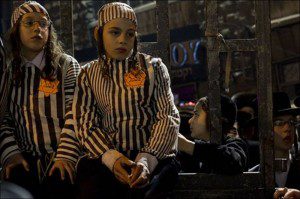 After ultra-orthodox Jews used concentration camp symbolism in a protest against secular authorities, a new bill seeks to control use of Nazi-era imagery. Daniella Peled reports
(more…)
2 Nov 2011 | Middle East and North Africa, Uncategorized
 Former IDF soldier Anat Kamm’s 4.5 year prison sentence shows the contradictions of Israel’s attitude towards leaks. Elizabeth Tsurkov reports
When the Tel Aviv District Court sentenced Anat Kamm to four-and-a-half years in prison for leaking classified documents she obtained during her IDF service to the daily Haaretz, few Israelis were bothered. And no wonder, as Kamm was branded as a traitor and a spy by the security establishment, and most pundits since the gag order on her case had been lifted in April 2010. Most of the Israeli public didn’t seem concerned about the consequences this sentence will have on press freedom in Israel, but this lack of concern doesn’t make the repercussions of this sentence any less real.
Journalists rely on leaks and sources willing to talk to them and share information, which at times are obtained illegally and is disclosed without permission. The Israeli press is strewn with leaks, most of which are the product of political fights and bickering, and their purpose is to harm political rivals, not scrutinise the security establishment.
For example, in late 2006, Prime Minister Olmert attacked his Defence Minister Peretz for a phone call he had with Palestinian Authority President Abbas without informing Olmert himself.The attack revealed top secret information, namely that Israel wiretaps the phones of Abbas.
The Kamm verdict stated that it wasn’t necessary for the prosecution to prove harm was done to Israel’s security as a result of the leak, and the mere possibility of such harm was enough to convict Kamm. Judging by this standard, Olmert’s leak of highly sensitive information solely for political purposes was surely harmful Israel’s security.
Other common forms of leaks in the country are authorised declassifications by security services or leaks by government officials, which are intended to serve the political goals of the state of Israel. The occasional leaks by unnamed Israeli government official about the country’s intentions to attack Iran’s nuclear facilities are an example for such calculated moves, which are intended to spur the international community into action against Iran. Both these forms of leaks, the ones caused by political infighting and the calculated declassification, under the appearance of free press, are intended to serve the establishment, or at least the parts of it that leaked the information. These leaks provide a one-sided view of reality, according to the interests of the leaking party, and rarely serve any oversight capacity.
Israeli media rarely reports critically on the IDF, let alone other security organs, partly out of misplaced patriotism, but also because Israeli media lacks sources that are willing to reveal information about wrongdoings of the country’s security establishment. Critical coverage and public accountability of the security services are all the more necessary considering the little oversight the Knesset has over the security establishment due to issues of security clearances, and the culture of impunity that pervades Israel’s security organs.
Several of the documents Kamm provided to Haaretz reporter Uri Blau showed the IDF was still carrying out targeted assassinations of Palestinians suspected of terrorist activity when their capture was possible, against the explicit ruling of the Supreme Court. The officers who ordered and approved this illegal policy were not charged by the Attorney General. Instead, Israel’s justice system chose to punish a person who attempted to fight the IDF’s culture of impunity and disregard for the law.
Elizabeth Tsurkov is an Israeli writer and a contributor to +972 Magazine and Global Voices Online. You can follow her on Twitter: @elizrael.
24 Aug 2011 | Index Index, Middle East and North Africa, minipost
On August 21, two Palestinian journalists, Usaid Abd Al Majid Amarana, of Al-Aqsa TV, and Amar Abu Urfa, a reporter for Shahab news agency, were arrested. Both journalists were seized by Israeli soldiers in their homes. According to reports, soldiers stormed and searched Amarana’s home. During the arrest, soldiers opened fire and wounded Amarana’s cousin. Urfa’s arrest in Hebron resembled that of Amarana.
