20 Dec 2013 | News, Politics and Society, Ukraine
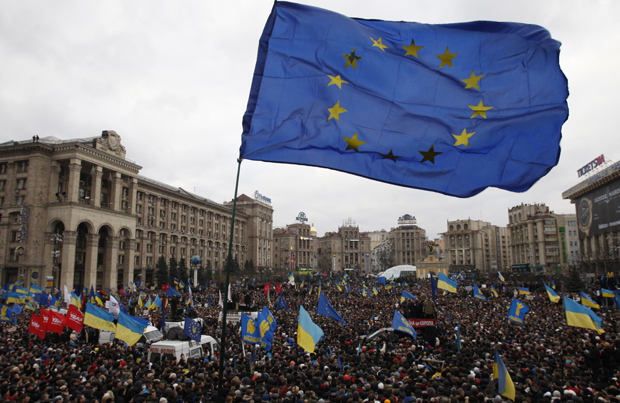
(Photo: Anatolii Stepanov / Demotix)
The coverage of Ukrainian protests in the Russian media suggests a centralised anti-EU message and has provoked outrage in Kiev.
At first, Russian TV channels appeared to broadcast inaccuracies only on the numbers taking part in the demonstrations. Despite clear evidence on the ground that tens of thousands or even hundreds of thousands were taking part, Russian reporters described scenes as “a few hundred protesters.”
Russia’s state-run First Channel then chose to dramatise Ukraine’s alleged descent into anarchy with a montage depicting combat scenes from Yugoslavia in the early 1990s, accompanied by a morbid musical soundtrack.
Komsomolskaya Pravda, a popular Russian daily, led on Tuesday with “Ukraine may split into several parts” with an illustrative map to depict the predicted chaos. The next day, a headline read “Western Ukraine is preparing for civil war.”
Overall – the message from the state-controlled Russian media seems to have been – “Ukraine is suffering at the fate of dangerous opposition militants.”
Putin has lent his weight to the propaganda, describing unrest in Kiev as “more of a pogrom than a revolution” and calling protesters “well-prepared and trained militant groups.”
“Ukraine is like a liner going in a circle,” commented a high-profile Russian journalist this week. “The passengers are calmed by the fact that Europe is near, there is not far to go. In reality the economic collapse of the whole country lies ahead…Passengers will be hurt. Some will not survive.”
The journalist quoted is Dmitry Kiselyov, who Vladimir Putin recently named as head of a re-launched Russia Today — as part of the take-over of previous state broadcaster RIA Novosti.
The shutdown of RIA Novosti was seen as a further degradation in the impartiality of the Russian media — despite being state-owned it had offered some balanced reporting on Russian domestic and foreign policy.
Media analysts in Russia have commented that Kiseylov’s appointment to Russia Today, now the sole government news agency, may have derived from his loyal allegiance to Putin and his ability to propagandise in his favour.
In support of recent anti-homosexual legislation passed by the Russian government, Kiselyov had commented.
“Fining gays is not sufficient -– they should not be allowed to give blood, or sperm and in case of a car accident, their hearts should be burnt or buried as useless”
Kiselyov’s assessment on Maidan went further than his dubious ship analogy — suggesting on his weekly TV show that Sweden, Lithuania and Poland may be manipulating events behind the scenes as revenge for a battle the Russians won in the early 18th century, a battle that happened to be fought in present-day Ukraine.
“It looked like thirst for revenge for Poltava,” argued Kiseylov, citing the name of a battle that took place in 1709.
He then labelled Ukrainian opposition leader and boxer Vitali Klitschko, and his brother Vladimir, as “gay icons,” before describing the “ancient African military techniques,” which the protesters were apparently employing.
He also accused protesters of aggressively firing tear gas at police (when multiple Ukrainian and European media sources confirmed the opposite was correct), and said that opposition leaders had brought students to the protest as sacrificial lambs for the security forces. In fact, police had gone out and savagely beaten groups of students hours before.
Finally, he describes the “writers” of the revolution as a Ukrainian-American-European conspiracy, against Russia.
Skewed Russian coverage has not gone unnoticed in Ukraine. A journalist interrupted a live broadcast from Rossiya 24 – handing over a fake “Oscar” statue in recognition of the “lies and nonsense” that was being reported.
Before being pushed off frame, the Ukrainain Vitaly Sedyuk was able to blurt out “We love Russians but after the way you covered events….”
The Russian reporter ended his piece still holding the fake Oscar statue in his hand.
In contrast to relatively objective reporting in Ukraine, the reporting of Kiseylov and other Russians, combined with a media landscape which has now lost most of its independent voices, indicates the strongest move yet towards total state control of the Russian media.
This article was published on 20 Dec, 2013 at indexoncensorship.org
29 Nov 2013 | Academic Freedom, Belarus, Europe and Central Asia
Last summer it was announced that the Faculty of History of the state university in Hrodna, a regional centre in the West of Belarus, ceased to exist. A school of historic science known since 1954 was united with the Faculty of Tourism and Communication. This was the final revenge the authorities took on historians who dared to present the past of their city and their nation in a way that differs from the “official line.”
In the beginning of 2013 a group of historians of Hrodna State University published a book about the history of their city. Andrei Charnikevich, one of the authors of the book, was fired from the university; his sacking wasn’t done according to proper legal procedures and took longer than Siamion Shapira, a local governor, wanted. It ended up with him sacking the rector of the university, Yauheni Rouba. The governor’s instruction to a newly appointed rector was to “pay attention” to other lecturers and professors who were considered “disloyal”; all of them named. Viachaslau Shved was the next historian fired. Ihar Kuzminich, who taught law at the same university and was on that list as well, submitted a resignation letter himself and wrote an open letter to the governor in protest at the campaign of persecution against academia in Hrodna.
That was not the first instance of “ideological clear-up” in Belarusian universities. In 1990s Aliaksandr Kazulin, then a rector of the Belarusian State University, the major university in the country, received similar instructions to prevent teachers and students from oppositional activities. The irony of history made Kozulin an oppositional candidate at the Presidential election of 2006 (and he received no support from his former university during the campaign), and later a political prisoner.
But Hrodna University has not really been a centre of political or civic movements. It has always been one of the best educational institutions in Belarus. It has been quite active in adopting and implementing European standards of higher education. The authorities did not think of its professors as “disloyal” – they liked to show the university to foreign delegations and experts as exemplary to boast of achievements of the Belarusian education system.
To understand what happened in Hrodna, one has to take into consideration peculiarities of the system of higher education and its management in Belarus. Formally, all universities report to the Ministry of Education. The current minister of education, Siarhei Maskevich, is a former rector of Hrodna University; he was the one who launched teaching innovations and consolidation of the financial situation of the university. Can a minister destroy what he himself started? In Belarus, he can.
Belarusian ministers are not independent; they just implement policies as instructed by the Presidential Administration. Just as governors, like Siamion Shapira, and down to university rectors – they are all appointed by the President of the country; all candidates for these positions are carefully chosen and checked by the KGB and other authority structures. Thus, every official in this “power vertical” depends on the head of the state. No one is elected; the institute of self-governance is destroyed as such, it is substituted on all levels by state governance. It is true with any area and sphere of activities, including education.
Universities in Belarus have no autonomy; thus, academic freedom is seriously compromised. In fact there has never been any. Even in the first half of 1990s, when universities were allowed to elect their rectors, they were financially reliant on state subsidies, so they were not independent. But even such a nominal formality as elections of rectors was eliminated. Rectors of private universities are appointed by the authorities as well. Any attempts to protest leads to disastrous effects. In 2004 the European Humanities University had to stop its operation in Belarus after its staff protested against the fact their rector had to be appointed by the country’s president. They refused even after the Ministry of Education suggested appointing Anatoly Mikhailov as the rector, the same person who was elected by the staff – it was a matter of principle, and the principle of academic freedom was the key. The EHU had to go in exile and restored its activity in 2005 in neighbouring Lithuania.
Appointed rectors can stay in their positions as long as they satisfy those who appointed them, i.e. the Presidential Administration. The way to satisfy those “employers” is not by defending academic freedoms and rights of professors and students; it is merely by obeying orders and staying “loyal” to state ideology.
Professor Rouba, a previous rector of Hrodna State University, did not reject an order to “clean up” his university – he was just not in a hurry to fulfil it. And this is how he irritated the authorities, thus losing his job as the head of the university. Because in the end it is not about an alleged “danger” any “disloyal” professor poses to the state – it is about the system that requires orders to be executed, promptly and carefully.
The authorities can see “disloyalty” in anything. Ihar Kuzminich, the law professor of Hrodna University, wrote a textbook on human rights for schools a couple of years ago. The mere topic of the textbook suggested the Ministry of Education could not approve it. The book was used during informal workshops and training sessions on human rights. But it was not the real reason for Kuzminich to end up on the “disloyalty black list” and eventually lose his job. It was because of the fairy tales he writes. Characters of his tales live in a modern city and fight for their rights. Such a metaphor appeared to be more dangerous for the regime than textbooks.
It might seem absurd, but this is a reality in Belarus. Monitoring, conducted by the Agency of Humanitarian Technologies, gives a lot of evidence of persecution for professional activities. We can talk about the employment ban in the system of education of the country. Hundreds of teachers and university professors were persecuted and lost their jobs in Belarus. Such instances cover almost every filed of learning, but most of cases are noted in humanities; the repressed academics are historians, economists, sociologists, pedagogues.
Last year Belarusian Ministry of Education attempted to join the Bologna Process that unites universities all throughout Europe, including post-Soviet region. The authorities decided to take this step as they have started to see the clear economic benefits from joining, through the export of educational services. Belarusian universities have been quite popular with foreign students, especially ones from China, Vietnam, Turkmenistan and some other, predominantly Asian countries. But recent years showed a decrease in interest in Belarusian higher education, because diplomas of Belarusian universities are not recognised in many countries. Joining the Bologna Process is supposed to solve this problem and attract more foreign students.
The Presidential Administration approved the idea, and the Ministry of Education launched the whole programme of bringing Belarusian standards of higher education in line with European ones – for the exception of two of them, namely autonomy of universities and academic freedoms. These two principles are considered by the Belarus Ministry of Education to be “insignificant”.
Infrastructural changes in Belarusian universities were quite vast and intensive; they look quite like European universities — “cheaper versions”, perhaps. But what is clear, is the absence of academic freedom and autonomy, which are the two fundamental features of a university. They distinguish it from other educational institutions, like technical schools, religious or military colleges and extension courses. Rectors got used to obeying orders; the academic community got used to abstaining from disagreeing.
A group of enthusiasts, professors, students, experts, public figures, decided to create a public Bologna Committee in Belarus. Its aim is to promote and protect academic freedoms and an idea of autonomy of universities in the country. The main paradox of the committee is that it promotes the values of the Bologna Process –- but in fact it impedes Belarus joining it, rather than fosters it. There is, however, no other way; a country that fights the dissent and suppressed free speech, and thus violates the main principles of the Bologna Process, cannot be accepted as a member of it.
There is a question if we can call Belarusian institutions of higher learning “universities” at all. A process of education seems to be going on there; this process resembles in a way the one in European universities. But it is an illusion to a great extent. Without a real academic freedom and independence there can be no university. Once this are restored Belarus will be ready to integrate into the European system of education – but not before.
25 Oct 2013 | Digital Freedom
Last year’s Internet Governance Forum in Baku, Azerbaijan proved controversial due to the choice of host. This year’s event, in Bali, Indonesia was bound to be contentious, after Edward Snowden’s leaks on the US’s PRISM programme. PRISM and TEMPORA (the UK system of mass surveillance) were a lightening rod for general discontent from activists who feel an increasing sense of ill ease over the state of internet freedom. Many of the sessions were bad-tempered affairs with civil society rounding on the perceived complacency of government officials from democracies who refused to state their opposition to mass state surveillance in clear enough terms.
At an event hosted by the Global Network Initiative, Index on Censorship, andPakistan’s Centre for Social and Policy Analysis, a US government official was heckled by the audience when he attempted to justify PRISM as an anti-terrorism measure. Of particular concern for delegates was a sense that PRISM is now being used by less democratic and authoritarian states to justify their own surveillance systems. The Chinese were quick to point out the ‘double standards’ of the US at this workshop, following it with appalling doublespeak to gloss over their poor domestic record on human rights violations. A point I challenged them on in no uncertain terms.
Participants in the workshop from across the globe from Pakistan to South Africa stated their concern that a race to the bottom is beginning with new surveillance capacities being debated in countries such as Russia, New Zealand and the UK. Other areas of concern at the workshop included the increasing use of filters at ISP level (in particular in Indonesia where a significant number of ISPs are adopting filtering) and the pressure now felt by Telcos from states who are imposing burdensome requirements to filter content. One worrying prospect is that the ITU will succumb to a push to ensure Telcos do not distribute ‘blasphemous’ content which could lead to the full Balkanisation of the internet.
Although the outlook is bleak, civil society is pushing back at corporations and governments. Bytes for All in Pakistan has done impressive work in chronicling censored online content. A number of coalitions strengthened at the IGF with closer co-operation between international NGOs to take on mass state surveillance. This weekend, a number of US NGOs will rally in Washington DC against the PRISM programme with thousands expected to take to the streets. Index on Censorship’s #DontSpyOnMe petition of 7,000 signatures was this week sent to Lithuanian President Dalia Grybauskaitė, who currently hold the Presidency of the Council of the EU, and Herman van Rompuy, President of the European Council. The EU heeded our calls to discuss mass surveillance at the Council of Ministers meeting – a big success. The pressure on corporations is being felt too, Telcos came under particular fire for their willingness to install surveillance equipment in their networks. Yet, many are beginning to speak publicly over the pressures they feel from states and the need for transparency so their users are at least aware of the surveillance they may be subject to and so can adjust their behaviour accordingly. Meanwhile, Google launched new tools to illustrate the threats the internet faces. The Digital Attack Map is a realtime website displays DDOS attacks and where they originate from – useful in tracking attacks on civil society websites from state-run or criminal botnets. Google also launched a project to provide free, secure web hosting for internet activists under attack.
One of the strengths of the IGF is the broadness of the workshop programme. From the challenges felt by the disabled online, minority rights online, through to bridging the ‘digital divide’ between the rich and poor both internationally and internally within even wealthier countries, the IGF covered a significant amount of ground. Yet, one of the big challenges to the IGF is how to engage a wider section of civil society. While the IGF was better attended by delegates from South-East Asia, fewer delegates from Europe and the Middle East were visible during this IGF. This remains a challenge to the organisers, with too much interaction from those physically present at the conference and too little from the many remote participants, many of whom couldn’t afford the air fare to Bali but have much to contribute. Bridging this divide will be important in the future.
The tone of this IGF was set by the Snowden revelations. The US and other Western democracies were on the back foot, in stark contrast to their confident promotion of net freedom in Baku. Without openess, increased transparency and an end to mass surveillance it’s hard to see how they will regain their moral authority, leaving a huge vacuum at the heart of these debates. A vacuum that others – in particular China – are willing to fill. The battle to keep the multistakeholder, open internet free from top-down state interference is on-going. The IGF should give once confident advocates of net freedom serious pause for thought.
24 Oct 2013 | Campaigns, Europe and Central Asia, Events
Index on Censorship wants Europe’s leaders to place the issue of surveillance on the agenda for the European Council Summit. Our petition calling for this, backed by 39 organisations and thousands of individuals, was this week sent to Lithuanian President Dalia Grybauskaitė, who currently hold the Presidency of the Council of the EU, and Herman van Rompuy, President of the European Council.
Since the petition targets all 28 EU leaders, we wanted each of them to have their own copy. But as revelations continue to emerge about the scale to which electronic mass surveillance has been taking place, we didn’t think email would be the safest way to distribute it. Instead, we decided to send our intern Alice to deliver the petitions to embassies around London – the old fashioned way.
Marek Marczynski, Index’s Director of Campaigns and Policy, explains how mass surveillance infringes on your right to freedom of expression, and why we must oppose it.
