7 Aug 2017 | Bahrain, Bahrain Statements, Campaigns -- Featured, Statements
[vc_row][vc_column][vc_column_text]
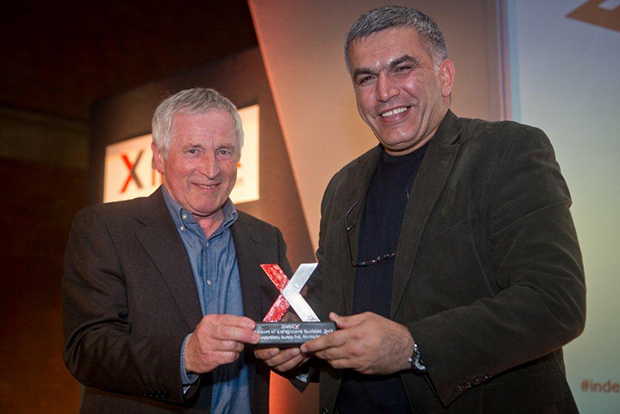
Nabeel Rajab, BCHR – winner of Bindmans Award for Advocacy at the Index Freedom of Expression Awards 2012 with then-Chair of the Index on Censorship board of trustees Jonathan Dimbleby
The Foreign & Commonwealth Office’s silence on the sentencing of human rights figure Nabeel Rajab in Bahrain has been called “appalling” in a letter to the Foreign Secretary, signed by 17 rights groups & parliamentarians today.
The President of the Bahrain Centre for Human Rights faces trial tomorrow, 7 August, for tweeting about the Yemen war and torture in Bahrain. He faces up to 15 years. He was sentenced in absentia following an unfair trial to two years in prison for giving media interviews on 10 July. Rajab has not been allowed to speak to his family since 15 July. Rajab has been held largely in solitary confinement in the first nine months of his detention. This led to his health deteriorating in April, and he is currently recovering in the Ministry of Interior clinic.
Despite British Embassy representatives regularly attending Rajab’s trials, the 10 July sentence, which clearly violated his freedom of expression, went unremarked on for over two weeks. On 26 July, the FCO stated in response to a parliamentary question: “We note the two year sentence given to him and understand there are further steps in the judicial process, including the right of appeal.”
The letter, signed by 17 rights groups says: “It is appalling that while the FCO recognises the brave work of human rights defenders worldwide, it has turned a blind eye to the human rights abuses in Bahrain, including the reprisals against Mr. Rajab.” They raise the FCO’s Human Rights and Democracy Report, published last month, which applauds the work of human rights defenders globally and state that silence on Rajab’s case contradicts policies to support human rights defenders.
The FCO’s response evaded providing an opinion on Rajab’s sentence and compares unfavourably with its response to a previous sentence Rajab received in 2012 on similar charges related to his expression. At that time, Middle East Minister Alistair Burt stated he was “very concerned” at the sentencing of Mr. Rajab on charges related to his free expression, and added, “I have made it clear to the Bahraini authorities that the human and civil rights of peaceful opposition figures must be respected.” Burt was reshuffled out of the Foreign Office in 2013, but reappointed Middle East Minister following the June election.
The rights groups told the Foreign Secretary today: “British silence on this case contradicts FCO support for human rights defenders internationally and the FCO’s own past record on Mr. Rajab’s case. We urge you to overturn this policy of silence and support Nabeel Rajab and all human rights defenders in Bahrain … by condemning his sentence and calling on the Government of Bahrain for his immediate and unconditional release and the dropping of all pending charges against him.”
While the UK was initially silent on Rajab’s sentence, key allies of Bahrain including the United States and the European Union as well as Germany and Norway all called for Rajab’s release shortly after the ruling. The US, EU and Norway called for Rajab’s release, and Germany deplored his sentence. The UN High Commissioner for Human Rights’ office called for his unconditional release.
“The FCO’s weak language on Nabeel Rajab’s case falls in line with the UK’s overall disappointing position on free expression in Bahrain and more widely in the Gulf. Boris Johnson should call for Rajab’s immediate release and take broader steps to ensure that human rights – not just arms sales – are a priority in the UK’s relations with Bahrain and the other Gulf states”, said Rebecca Vincent, UK Bureau Director for Reporters Without Borders.
“Instead of working with civil society and human rights defenders to address systemic problems and reform in Bahrain, as it has previously committed to, the government of Bahrain continues to persecute human rights defenders like Nabeel Rajab simply for exercising their right and duty to promote and protect human rights,” said Andrew Anderson, Executive Director of Front Line Defenders.
Sayed Ahmed Alwadaei, Director of Advocacy, Bahrain Institute for Rights and Democracy: “Boris Johnson should be ashamed of his isolated policy, which is at total odds with the foreign policy of all Bahrain western allies and partners. True partners should speak out to their allies when they cross the line. The Bahraini government’s abuses don’t seem to matter to Boris Johnson’s Foreign Office, which only appears to be vocal against repression when it’s by governments that don’t host the Royal Navy or trade with the UK.”
The letter was signed by Article 19, English PEN, FIDH, Front Line Defenders, Index on Censorship, the Jimmy Wales Foundation, PEN International, Reporters Without Borders and World Organisation Against Torture, alongside the Bahrain Institute for Rights and Democracy, Americans for Democracy & Human Rights in Bahrain, Gulf Centre for Human Rights and European Centre for Democracy and Human Rights. The letter was also signed by Sue Willman, Director of Deighton Pierce Glynn, Julie Ward MEP and Tom Brake MP.
The Bar Human Rights Committee of England and Wales is also separately seeking an urgent meeting with the Foreign Secretary to raise concerns over the treatment of human rights defenders in Bahrain and about the breaches of freedom of expression and fair trial and due process in Nabeel Rajab’s case.
“The trial in absence and subsequent imprisonment of Nabeel Rajab was in flagrant breach of his rights to a fair trial process. The criminalisation of Nabeel Rajeb – for sharing an opinion – is contrary to international rights and protections of freedom of expression. Whilst Mr. Rajab’s health continues to deteriorate, due his treatment in prison, this case stands as a sad indictment of Bahrain’s attitude to citizens who voice criticism. It is not too late for proper due process to be applied in this case; this would result in Mr. Rajab’s immediate release,” said Kirsty Brimelow QC of Doughty Street Chambers.[/vc_column_text][/vc_column][/vc_row][vc_row][vc_column][vc_basic_grid post_type=”post” max_items=”12″ style=”load-more” items_per_page=”4″ element_width=”6″ grid_id=”vc_gid:1502100162408-9703f46f-9b77-3″ taxonomies=”716″][/vc_column][/vc_row]
11 Jul 2017 | Azerbaijan, Azerbaijan Statements, Campaigns, Campaigns -- Featured, Statements
President of France, Mr. Emmanuel Macron
L’Élysée
55 Rue du Faubourg Saint-Honoré
75008 Paris, France
Ministry of Europe and Foreign Affairs of France
37, Quai d’Orsay
75351 Paris, France
Embassy of France to Azerbaijan
9, rue Rassoul Rza
AZ 1000, Baku, Azerbaijan
Subject: Support for political prisoners in Azerbaijan
11 July 2017
Dear President Macron,
We are writing to you on behalf of the undersigned organisations to draw your attention to the repressive free speech situation in Azerbaijan and to request your support to ensure the release of those imprisoned on politically motivated grounds in this country. In particular, we urge you to use your administration’s influence and leverage to help ensure the implementation of the ruling issued by the European Court of Human Rights (ECtHR) on the case of political opposition activist Ilgar Mammadov. He remains in prison, although the Court concluded that he was detained in retaliation for his criticism of the government. The persistent non-execution of the ruling in his case by the Azerbaijani authorities is undermining the credibility of the human rights protection regime established by the Council of Europe and sets a dangerous precedent for all those wrongfully prosecuted in Azerbaijan who turn to the Court in search of justice.
In view of France’s role as a leading European state and host country for the ECtHR and other Council of Europe bodies, as well as its well-developed cooperation with Azerbaijan in trade and other areas, your engagement on this issue would be particularly important. We welcome the moral, value-based and human rights oriented leadership that you have embraced for your presidency and are confident that you will vigorously pursue human rights in relations with Azerbaijan’s government on the basis of the common standards set out in the European Convention on Human Rights.
In the last few years, Azerbaijan’s government has carried out a relentless crackdown on alternative voices in the country. Legislation seriously restricting the operation of NGOs has been enforced, independent media subjected to pressure, the political opposition has been marginalised and human rights defenders, journalists and political opposition activists have been arrested, convicted and imprisoned on politically motivated charges.
While some of those imprisoned on such grounds have been released as a result of international pressure, new arrests continue to take place. For example, well-known blogger Mehman Huseynov was arrested and sentenced to two years in prison on defamation charges in March this year after speaking out about police ill-treatment. Journalist Aziz Orujov and opposition member Gozel Bayramli were arrested on other spurious charges in May, while in the same month journalist Afgan Mukhtarli was abducted in Georgia only to resurface in Azerbaijani custody. Many government critics imprisoned in previous years also remain behind bars, including Ilgar Mammadov.
Ilgar Mammadov, who chaired the political opposition REAL party and served as director of the Council of Europe School of Political Studies in Azerbaijan, was detained in February 2013 after monitoring and reporting on street protests in the town of Ismayilli, which resulted in clashes with the police. He was groundlessly accused of instigating these clashes and sentenced to seven years in prison on trumped-up charges of organising mass riots and using violence against police. In a judgment issued in May 2014, the ECtHR found that Ilgar Mammadov’s arrest and detention violated his rights to liberty and security, judicial review of his detention and to be presumed innocent under the European Convention on Human Rights. The court also found that Azerbaijan’s government had imposed restrictions on his rights for purposes other than those permitted, in violation of its obligations under the Convention. The court concluded that Mammadov was detained on political rather than legal grounds for the purpose of punishing and silencing him for his criticism of the government.
It has now been more than three years since the ECtHR adopted its judgement in this case, but the Azerbaijani authorities have consistently failed to implement it, although Azerbaijan is legally bound to comply with ECtHR rulings as a party to the European Convention on Human Rights. The Azerbaijani authorities have ignored repeated calls by other Council of Europe bodies, including its Committee of Ministers – which supervises the implementation of court rulings, its Secretary General and its Human Rights Commissioner to execute the judgment on Mammadov’s case. In November 2016, Azerbaijan’s Supreme Court rejected an appeal submitted by Mammadov on the basis of the ECtHR ruling and upheld his seven- year prison sentence. As a result, he continues to be unlawfully imprisoned.
To date the case of Ilgar Mammadov is the only one where the relevant authorities have failed to implement an ECtHR ruling that has found that the detention of an individual violates the right to liberty and security under the European Convention on Human Rights. As emphasized in a joint statement issued by 44 members of the Civic Solidarity Platform and the Sport for Rights Coalition in May 2017, the non-implementation of the ECtHR’s judgment on this case has developed into a test of the legitimacy of the Council of Europe as the guardian of human rights and the rule of law in the region. Thus, this case is no longer only about the unlawful deprivation of liberty of Ilgar Mammadov. On the contrary, it has become a case that risks weakening the effectiveness of the entire human rights protection regime established by the Council of Europe, as well as eroding confidence in this regime among people in Azerbaijan and other member states who turn to the ECtHR when their rights are being trampled upon by their governments.
We urge you to do all in your power to help prevent this dangerous outcome and to ensure the implementation of the ECtHR judgment in the case of Ilgar Mammadov, as well as the release of him and others arbitrarily detained on politically motivated grounds in Azerbaijan. To this end, we urge you in particular to:
- Support the civil society appeal to the Committee of Ministers of the Council of Europe to refer the case of Ilgar Mammadov back to the ECtHR on the grounds of non-execution of the judgment under article 46.4 of the European Convention on Human Rights, which sets out a mechanism in cases where parties to the convention refuse to abide by a final
- Issue a public statement on the importance of the execution of ECtHR judgments in view of the integrity and credibility of the human rights protection regime established by the Council of Europe, giving particular attention to the failure by the Azerbaijani authorities to date to implement the ruling on the case of Ilgar Mammadov and the wider implications of
- Prominently raise the case of Ilgar Mammadov and others who have been deprived of their liberty in retaliation for their exercise of fundamental freedoms in Azerbaijan, including Mehman Huseynov, Aziz Orujov, Gozel Bayramli and Afgan Mukhtarli in relations with the Azerbaijani authorities and use all available means of leverage to press for their
- Invite representatives of Azerbaijani civil society to a meeting to demonstrate support with them and to discuss the challenges they face and ways in which your administration can help address these challenges and promote improved respect for the standards protecting fundamental freedoms set out in the European Convention on Human
We thank you for your consideration of the issues raised in this letter and would be happy to provide additional information should you so request.
Sincerely,
- Association UMDPL (Ukraine)
- Bir Duino (Kyrgyzstan)
- Canadian Journalist for Free Expression (Canada)
- Center for Civil Liberties (Ukraine)
- Center for Participation and Development (Georgia)
- Centre for the Development of Democracy and Human Rights (Russia)
- Crude Accountability (USA)
- Eastern Partnership Civil Society Forum
- Fair Trails (UK)
- Freedom Files (Poland/Russia)
- Freedom Now (USA)
- German-Russian Exchange (DRA – Germany)
- Helsinki Committee for Human Rights (Serbia)
- Helsinki Foundation for Human Rights (Poland)
- Human Rights Matter (Germany)
- Human Rights Watch (USA)
- Index on Censorship (UK)
- International Partnership for Human Rights (Belgium)
- Kazakhstan International Bureau for Human Rights and the Rule (Kazakhstan)
- Legal Policy Research Center (Kazakhstan)
- Legal Transformation Center (Belarus)
- Libereco – Partnership for Human Rights (Germany/Switzerland)
- Moscow Helsinki Group (Russia)
- Norwegian Helsinki Committee (Norway)
- PEN America (USA)
- People in Need (Czech Republic)
- Public Association “Dignity” (Kazakhstan)
- Public Verdict Foundation (Russia)
- Regional Center for Strategic Studies (Azerbaijan)
- The Barys Zvozskau Belarusian Human Rights House (Belarus)
- The Kosova Rehabilitation Centre for Torture Victims (Kosovo)
- Truth Hounds (Ukraine)
- World Organisation against Torture (OMCT)
Human rights defenders from Azerbaijan who have signed the letter:
- Akif Gurbanov, Institute for Democratic Initiatives
- Alasgar Mammadli, lawyer
- Anar Mammadli, Election Monitoring and Democracy Training Center
- Annagi Hajibayli, Azerbaijan Lawyers Association
- Asabali Mustafayev, lawyer
- Bashir Suleymanli, Civil Rights Institute
- Intiqam Aliyev, Legal Education Society
- Khadija Ismayilova, human rights defender, investigative journalist
- Latafat Malikova, Regional Human Rights and Education Public Union
- Rasul Jafarov, Human Rights Club
- Samir Kazimli, human rights defender
- Xalid Bagirov, human rights defender, lawyer
- Zohrab Ismayıl, Public Association for Assistance to Free Economy
8 Jun 2017 | Bahrain, Campaigns -- Featured, Digital Freedom, Media Freedom, media freedom featured, Statements
[vc_row][vc_column][vc_column_text]International press freedom organisations and local Bahraini groups are among fifteen campaigners who today raised alarm over the suspension of Bahrain‘s only independent newspaper, Al Wasat, which has been barred from publishing for four days now. The rights groups which today wrote letters addressed to ten countries including the UK, state Bahrain is “effectively silencing the media in Bahrain and violating the right to freedom of expression.”
The letters, signed by Index on Censorship, Reporters Without Borders, Committee to Protect Journalists, Article 19, Bahrain Institute for Rights and Democracy and ten others wrote to states urging them to “publicly call on the Government of Bahrain to allow Al Wasat to resume publication immediately.”
The letter is addressed to the United Kingdom, United States, Germany, Italy and France – who all have embassies in Bahrain – as well as Ireland, Norway, Denmark, Sweden, Finland and the European Union.
The Ministry of Information Affairs suspended Al Wasat, the only independent newspaper in Bahrain, on 4 June 2017, effectively silencing the media in Bahrain and violating the right to freedom of expression. Al Wasat’s suspension is the latest in a recent spate of reprisals against independent media and civil society actors, including journalists, writers, and human rights defenders. The state-run Bahrain News Agency claims that the paper is “spreading what would stir divisions within the community and undermine the Kingdom of Bahrain’s relations with other countries.” Al Wasat was suspended due to the publication of an opinion article regarding widespread protests in Morocco, a source in the newspaper told BIRD.
Politics in the region has developed quickly since the suspension of the newspaper. On Monday, Bahrain, Saudi Arabia and the United Arab Emirates closed diplomatic relations with neighbour Qatar and barred all air, sea and land travel. Yesterday, two Bahrainis were sentenced to death, bring the total up to 15 on death row.
Prior to the suspension of Al Wasat, Bahrain was already counted among the 20 most restrictive countries for press globally, with Reporters Without Borders ranking Bahrain as 164 out of 180 countries in its World Press Freedom Index.
This is the latest in an escalated crackdown on independent civil society. On 23 May, Bahraini security forces raided the village of Duraz, killing five protesters and arrested 286. It is the deadliest incident since protests began in 2011. On 31 May, the last major opposition society, Wa’ad, was dissolved and their assets confiscated. Wa’ad is appealing the decision. The letter continues, “In this context, journalists in Bahrain have expressed to NGOs serious concerns that the newspaper will not be allowed to resume publication.”
Al Wasat, established 2002, is the only independent newspaper in Bahrain. Its editor Mansoor Al-Jamri is winner of the CPJ International Press Freedom Award in 2011 and winner of the Peace Through Media Award 2012. It has been suspended in previous years, in April 2011 and August 2015. In January 2017, the newspaper’s website and social media were suspended for two days. it In 2011, Abdulkarim Al-Fakhrawi, one of the paper’s founders, was tortured to death in police custody.
Comments
Melody Patry, Head of Advocacy, Index on Censorship: “The silencing of Al Wasat – the only independent voice in Bahrain’s media – underscores the dismal state of human rights in the country. The Bahraini government must allow free and unfettered access to information.”
Cat Lucas, Writers at Risk Programme Manager, English PEN: “By silencing the only independent newspaper in the country, the Bahraini authorities are sending a clear message that dissenting voices will not be tolerated. Our governments must send an equally clear message that the suspension of Al Wasat is unacceptable and that a plurality of voices in the media is an essential part of any democracy.”
“Bahrain is experiencing a severe crackdown on freedom of expression. Now is the time for the international community to speak up to defend fundamental human rights, in particular, the right to freedom of expression, which is crucial for promoting stable, pluralistic democratic societies,” said Saloua Ghazouni, Director of ARTICLE 19’s Middle East and North Africa regional office.[/vc_column_text][/vc_column][/vc_row][vc_row][vc_column][vc_basic_grid post_type=”post” max_items=”12″ style=”load-more” items_per_page=”4″ element_width=”6″ grid_id=”vc_gid:1496907779680-4f997749-0326-5″ taxonomies=”716″][/vc_column][/vc_row]
15 May 2017 | Campaigns -- Featured, Denmark, Digital Freedom, Statements
[vc_row][vc_column][vc_column_text]We the undersigned respectfully urge the Danish Parliament to vote in favour of bill L 170 repealing the blasphemy ban in section 140 of the Danish criminal code, punishing “Any person who, in public, ridicules or insults the dogmas or worship of any lawfully existing religious community”.
Denmark is recognised as a global leader when it comes to the protection of human rights and freedom of expression. However, Denmark’s blasphemy ban is manifestly inconsistent with the Danish tradition for frank and open debate and puts Denmark in the same category as illiberal states where blasphemy laws are being used to silence dissent and persecute minorities. The recent decision to charge a man – who had burned the Quran – for violating section 140 for the first time since 1971, demonstrates that the blasphemy ban is not merely of symbolic value. It represents a significant retrograde step in the protection of freedom of expression in Denmark.
The Danish blasphemy ban is incompatible with both freedom of expression and equality before the law. There is no compelling reason why the feelings of religious believers should receive special protection against offence. In a vibrant and pluralistic democracy, all issues must be open to even harsh and scathing debate, criticism and satire. While the burning of holy books may be grossly offensive to religious believers it is nonetheless a peaceful form of symbolic expression that must be protected by free speech.
Numerous Danes have offended the religious feelings of both Christians and Muslims without being charged under section 140. This includes a film detailing the supposed erotic life of Jesus Christ, the burning of the Bible on national TV and the publication of cartoons depicting the prophet Muhammed. The Cartoon affair landed Denmark in a storm of controversy and years of ongoing terrorist threats against journalists, editors and cartoonists. When terror struck in February 2015 the venue was a public debate on blasphemy and free speech.
In this environment, Denmark must maintain that in a liberal democracy, laws protect those who offend from threats, not those who threaten from being offended.
Retaining the blasphemy ban is also incompatible with Denmark’s human rights obligations. In April 2017 Council of Europe Secretary General Thorbjørn Jagtland emphasised that “blasphemy should not be deemed a criminal offence as the freedom of conscience forms part of freedom of expression”. This position is shared by the UN’s Human Rights Committee and the EU Guidelines on freedom of expression and religion.
Since 2014, The Netherlands, Norway, Iceland and Malta have all abolished blasphemy bans. By going against this trend Denmark will undermine the crucial European and international efforts to repeal blasphemy bans globally.
This has real consequences for human beings, religious and secular, around the globe. In countries like Pakistan, Mauretania, Iran, Indonesia and Russia blasphemy bans are being used against minorities as well as political and religious dissenters. Denmark’s blasphemy ban can be used to legitimise such laws. In 2016 the UN Special Rapporteur on Freedom of Religion or Belief pointed out that “During a conference held in Jeddah (Saudi Arabia) [in 2015], the Danish blasphemy provision was cited by one presenter as an example allegedly indicating an emerging international customary law on “combating defamation of religions”.
Blasphemy laws often serve to legitimise violence and terror. In Pakistan, Nigeria and Bangladesh free-thinkers, political activists, members of religious minorities and atheists have been killed by extremists. In a world where freedom of expression is in retreat and extremism on the rise, democracies like Denmark must forcefully demonstrate that inclusive, pluralistic and tolerant societies are built on the right to think, believe and speak freely. By voting to repeal the blasphemy ban Denmark will send a clear signal that it stands in solidarity with the victims and not the enforcers of blasphemy laws.
Jacob Mchangama, Executive director, Justitia
Steven Pinker, Professor Harvard University
Ahmedur Rashid Chowdhury, Exiled editor of Shuddhashar, 2016 winner International Writer of Courage Award
Pascal Bruckner, Author
Ayaan Hirsi Ali, Human Rights Activist Founder of AHA Foundation,
Dr. Elham Manea, academic and human rights advocate (Switzerland)
Sultana Kamal, Chairperson, Centre for Social Activism Bangladesh
Deeyah Khan, CEO @Fuuse & founder @sister_hood_mag.
Fatou Sow, Women Living Under Muslim Laws
Elisabeth Dabinter, Author
William Nygaard, Publisher
Flemming Rose, Author and journalist
Jodie Ginsberg, CEO, Index on Censorship
Kenan Malik, Author of From Fatwa to Jihad
Thomas Hughes, Executive Director Article 19
Suzanne Nossel, executive director of PEN America
Pragna Patel – Director of Southall Black Sisters
Leena Krohn, Finnish writer
Jeanne Favret-Saada, Honorary Professor of Anthropology, Ecole Pratique des Hautes Etudes,
Maryam Namazie, Spokesperson, Council of Ex-Muslims of Britain
Fariborz Pooya, Host of Bread and Roses TV
Frederik Stjernfelt, Professor, University of Aalborg in Copenhagen
Marieme Helie Lucas, Secularism Is A Women’s Issue
Michael De Dora, Director of Government Affairs, Center for Inquiry
Robyn Blumner, President & CEO, Center for Inquiry
Nina Sankari, Kazimierz Lyszczynski Foundation (Poland).
Sonja Biserko, Founder and president of the Helsinki Committee for Human Rights in Serbia
James Lindsay, Author
Malhar Mali, Publisher and editor, Areo Magazine
Julie Lenarz – Executive Director, Human Security Centre, London
Terry Sanderson President, National Secular Society
Greg Lukianoff, CEO and President, FIRE
Thomas Cushman, Professor Wellesley College
Nadine Strossen, John Marshall Harlan II Professor of Law, New York Law School
Simon Cottee, the Freedom Project, Wellesley College
Paul Cliteur, professor of Jurisprudence at Leiden University
Lino Veljak, University of Zagreb, Croatia
Lalia Ducos, Women’s Initiative for Citizenship and Universals Rights , WICUR
Lepa Mladjenovic, LC, Belgrade
Elsa Antonioni, Casa per non subire violenza, Bologna
Bobana Macanovic, Autonomos Women’s Center, Director, Belgrade
Harsh Kapoor, Editor, South Asia Citzens Web
Mehdi Mozaffari, Professor Em., Aarhus University, Denmark
Øystein Rian, Historian, Professor Emeritus University of Oslo
Kjetil Jakobsen, Professor Nord University
Scott Griffen, Director of Press Freedom Programmes International Press Institute (IPI)
Henryk Broder, Journalist
David Rand, President, Libres penseurs athées — Atheist Freethinkers
Tom Herrenberg, Lecturer University of Leiden
Simone Castagno, Coordinamento Liguria Rainbow
Laura Caille, Secretary General Libres
Mariannes Andy Heintz, writer
Bernice Dubois, Conseil Européen des Fédérations WIZO
Ivan Hare, QC[/vc_column_text][/vc_column][/vc_row][vc_row][vc_column][vc_basic_grid post_type=”post” max_items=”12″ style=”load-more” items_per_page=”4″ element_width=”6″ grid_id=”vc_gid:1495443304735-e4b217b9-25e4-0″ taxonomies=”88, 53″][/vc_column][/vc_row]
