29 Oct 2014 | About Index, Bahrain Statements, Campaigns, Statements
The undersigned 40 organisations call on the international community to publicly condemn the ongoing crackdown on human rights defenders, who face harassment, imprisonment, and forced exile for peacefully exercising their internationally recognised rights to freedom of expression and assembly. With parliamentary elections in Bahrain scheduled for 22 November, the international community must impress upon the government of Bahrain the importance of releasing peaceful human rights defenders as a precursor for free and fair elections.
Attacks against human rights defenders and free expression by the Bahraini government have not only increased in frequency and severity, but have enjoyed public support from the ruling elite. On 3 September 2014, King Hamad bin Isa Al-Khalifa said he will fight “wrongful use” of social media by legal means. He indicated that “there are those who attempt to exploit social media networks to publish negative thoughts, and to cause breakdown in society, under the pretext of freedom of expression or human rights.” Prior to that, the Prime Minister warned that social media users would be targeted.
The Bahrain Centre for Human Rights (BCHR) documented 16 cases where individuals were imprisoned in 2014 for statements posted on social media platforms, particularly on Twitter and Instagram. In October alone, some of Bahrain’s most prominent human rights defenders, including Nabeel Rajab, Zainab Al-Khawaja and Ghada Jamsheer, face sentencing on criminal charges related to free expression that carry years-long imprisonment.
Nabeel Rajab, President of the BCHR, Director of the Gulf Centre for Human Rights (GCHR), and Deputy Secretary General of the International Federation for Human Rights (FIDH), was arrested on 1 October 2014 and charged with insulting the Ministry of Interior and the Bahrain Defence Forces on Twitter. Rajab was arrested the day after he returned from an advocacy tour in Europe, where he spoke about human rights abuses in Bahrain at the United Nations Human Rights Council in Geneva, addressed the European Parliament in Brussels, and visited foreign ministries throughout Europe.
On 19 October, the Lower Criminal Court postponed ruling on Rajab’s case until 29 October and denied bail. Rajab’s family was banned from attending the proceedings. Under Article 216 of the Bahraini Penal Code, Rajab could face up to three years in prison. We believe that Rajab’s detention and criminal case are in reprisal for his international advocacy and that the Bahraini authorities are abusing the judicial system to silence Rajab. More than 100 civil society organisations have called for Rajab’s immediate and unconditional release, while the United Nations called his detention “chilling” and argued that it sends a “disturbing message.” The United States and Norway called for the government to drop the charges against Rajab, and France called on Bahrain to respect freedom of expression and facilitate free public debate.
Zainab Al-Khawaja, who is over eight months pregnant, remains in detention since 14 October on charges of insulting the King. These charges relate to two incidents, one in 2012 and another during a court appearance earlier this month, where she tore a photo of the King. On 21 October, the Court adjourned her case until 30 October and continued her detention.
Zainab Al-Khawaja is the daughter of prominent human rights defender Abdulhadi Al-Khawaja, who is currently serving a life sentence in prison, following a grossly unfair trial, for calling for political reforms in Bahrain. Zainab Al-Khawaja has been subjected to continuous judicial harassment, imprisoned for most of last year and prosecuted on many occasions. Three additional trumped up charges were brought against her when she attempted to visit her father at Jaw Prison in August 2014 when he was on hunger strike. The charges are related to “entering a restricted area”, “not cooperating with police orders” and “verbal assault”.
Zainab’s sister, Maryam Al-Khawaja, was also targeted by the Bahraini government recently. The Co-Director of the GCHR is due in court on 5 November 2014 to face sentencing for allegedly “assaulting a police officer.” While the only sign that the police officer was assaulted is a scratched finger, Maryam Al-Khawaja suffered a torn shoulder muscle as a result of rough treatment at the hands of police. She spent more than two weeks in prison in September following her return to Bahrain to visit her ailing father. More than 150 civil society organisations and individuals called for Maryam Al-Khawaja’s release in September, as did UN Special Rapporteurs and Denmark.
Other human rights defenders recently jailed include feminist activist and women’s rights defender Ghada Jamsheer, detained since 15 September 2014 for comments she allegedly made on Twitter regarding corruption at Hamad University Hospital. Jamsheer faced the Lower Criminal Court on 22 October 2014 on charges of “insult and defamation over social media” in three cases and a verdict is scheduled on 29 October 2014.
While the government of Bahrain continues to publicly tout efforts towards reform, the facts on the ground speak to the contrary. Human rights defenders remain targets of government oppression, while freedom of expression and assembly are increasingly under attack. Without the immediate and unconditional release of political prisoners and human rights defenders, reform cannot become a reality in Bahrain.
We urge the international community, particularly Bahrain’s allies, to apply pressure on the government of Bahrain to end the judicial harassment of all human rights defenders. The government of Bahrain must immediately drop all charges against and ensure the release of human rights defenders and political prisoners, including Nabeel Rajab, Abdulhadi Al-Khawaja, Zainab Al-Khawaja, Ghada Jamsheer, Naji Fateel, Dr. Abduljalil Al-Singace, Nader Abdul Emam and all those detained for expressing their right to freedom of expression and assembly peacefully.
Signed,
Activist Organization for Development and Human Rights, Yemen
African Life Center
Americans for Democracy and Human Rights in Bahrain (ADHRB)
Arabic Network for Human Rights Information (ANHRI)
Avocats Sans Frontières Network
Bahrain Center for Human Rights (BCHR)
Bahrain Human Rights Observatory (BHRO)
Bahrain Institute for Rights and Democracy (BIRD)
Bahrain Salam for Human Rights
Bahrain Youth Society for Human Rights (BYSHR)
Canadian Journalists for Free Expression (CJFE)
CIVICUS: World Alliance for Citizen Participation
English PEN
European-Bahraini Organisation for Human Rights (EBOHR)
Freedom House
Gulf Center for Human Rights (GCHR)
Index on Censorship
International Centre for Supporting Rights and Freedom, Egypt
International Independent Commission for Human Rights, Palestine
International Awareness Youth Club, Egypt
Kuwait Institute for Human Rights
Kuwait Human Rights Society
Lawyer’s Rights Watch Canada (LWRC)
Maharat Foundation
Nidal Altaghyeer, Yemen
No Peace Without Justice (NPWJ – Italy)
Nonviolent Radical Party, Transnational and Transparty (NRPTT – Italy)
PEN International
Redress
Reporters Without Borders
Reprieve
Réseau des avocats algérien pour défendre les droits de l’homme, Algeria
Solidaritas Perempuan (SP-Women’s Solidarity for Human Rights), Indonesia
Strategic Initiative for Women in the Horn of Africa (SIHA)
Syrian Non-Violent Movement
The Voice of Women
Think Young Women
Women Living Under Muslim laws, UK
Youth for Humanity, Egypt
6 Aug 2014 | Azerbaijan Statements, News, Statements
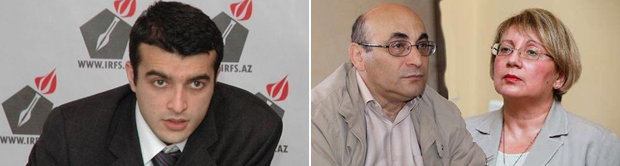
Rasul Jafarov, Arif Yunus and Leyla Yunus (Photos: Rasul Jafarov (© IRFS), Arif and Leyla Yunus (© HRHN))
60 NGOs from 13 Human Rights Houses call upon the Azerbaijani authorities, in their joint letter to President Ilham Aliyev, to immediately and unconditionally release Leyla Yunus, Arif Yunus and Rasul Jafarov, and lift all charges held against them. The NGOs also repeat their previous call to release Anar Mammadli and Bashir Suleymanli, and join calls for the release of Hasan Huseynli.
On 28 April 2014 Leyla Yunus, Director of the Institute for Peace and Democrac, and her husband historian Arif Yunus, were prevented from leaving the country at Baku’s airport. Leyla Yunus and her husband Arif Yunus were arrested on 30 July 2014. On that day, Leyla Yunus was sentenced to 3-months pre-trial detention, whilst her husband was placed under police guard and not allowed to leave Baku. The charges brought against Leyla Yunus are those of state treason (article 274 of the Criminal Code of the Republic of Azerbaijan), large-scale fraud (article 178.3.2), forgery (article 320), tax evasion (article 213), and illegal business (article 192). Arif Yunus was arrested on 5 August 2014 and also sentenced to 3-months pre-trial detention.
The NGOs state in their joint letter to President Aliyev of 5 August 2014 that they are in particular concerned about Leyla Yunus’ health whilst in detention. She suffers from diabetes and needs appropriate medication, as well as arrangements to eat at certain times, necessary to control the illness. We worry that the conditions in detention will have a detrimental effect on her health condition, as it appears that she is to date not provided with adequate health care.
In July 2014, the bank accounts of, amongst others, human rights defender Rasul Jafarov were frozen as part of a broader investigation into numerous NGO’s. On 25 July he was refused to leave the country. Rasul Jafarov was arrested on 2 August 2014, and sentenced to 3 months pre-trial detention on charges of tax evasion (article 213 of the Criminal Code of the Republic of Azerbaijan), illegal business (article 192) and abuse of authority (article 308.2).
On 14 July 2014, Hasan Huseynli, was sentenced to 6 years in prison. He was convicted on charges of armed hooliganism and unlawfully carrying a cold weapon.
The right to freedom of association is at the heart of the charges held against these human rights defenders. In essence they are deprived of their right to work in the defence of human rights. While registration of NGOs and grants to NGOs has become mandatory in Azerbaijan, authorities continue deny registration. Independent NGOs face continuous investigations and human rights defenders are being banned from travelling abroad, depending on their willingness to find agreements with the government, including agreements on their professional activities and their public statements.
Restrictions to laws affecting the right to freedom of association have been widely criticised since October 2011. Such legislation de facto criminalises human rights defenders in Azerbaijan, not for their wrong doing, but rather for the fact that working for an NGO, which does not have the blessing of the government, has become difficult in Azerbaijan. United Nations experts stated ahead of the Presidential elections that they “observed since 2011 a worrying trend of legislation which has narrowed considerably the space in which civil society and defenders operate in Azerbaijan.” The order given to the Human Rights House Azerbaijan in March 2011 to cease all its activities is a consequence of such policies.
The NGOs call upon the Azerbaijani authorities, in their joint letter to President Ilham Aliyev of 5 August 2014, to immediately and unconditionally release Leyla Yunus, Arif Yunus, Rasul Jafarov, and lift all charges held against them. The NGOs see this pre-trial detention of Leyla Yunus, Arif Yunus and Rasul Jafarov as a way to silence them. The NGOs also repeat their previous call to release Anar Mammadli and Bashir Suleymanli, and join calls for the release of Hasan Huseynli.
The NGOs further call upon the Azerbaijani authorities to take appropriate measures to put an end to the attacks, detention and harassment of human rights defenders, journalists and activists, and to take steps in order to foster a safe environment for them, in line with Azerbaijan’s international obligations and commitments, especially as the chair of the Committee of Ministers of the Council of Europe.
Signed by:
Human Rights House Azerbaijan (on behalf of the following NGOs):
- Association for the Protection of Women’s Rights
- Azerbaijan Lawyers Association
- Institute for Reporters’ Safety and Freedom
- Legal Education Society
- Media Rights Institute
- Society for Humanitarian Research
- Women Association for Rational Development
Barys Zvozskau Belarusian Human Rights House in exile, Vilnius (on behalf of the following NGOs):
- Belarusian Association of Journalists
- Belarusian Helsinki Committee
- City Public Association “Centar Supolnaść”
- Human Rights Centre “Viasna”
Human Rights House Belgrade (on behalf of the following NGOs):
- Belgrade Centre for Human Rights
Human Rights House Kiev (on behalf of the following NGOs):
- Association of Ukrainian Human Rights Monitors on Law-Enforcement
- Human Rights Information Centre
- Center for Civil Liberties
- Ukrainian Helsinki Human Rights Union
- Ukrainian Legal Aid Foundation
Human Rights House London (on behalf of the following NGOs):
- Article 19
- Index on Censorship
Human Rights House Sarajevo (on behalf of the following NGOs):
- Helsinki Committee for Human Rights in Bosnia and Herzegovina
Human Rights House Tbilisi (on behalf of the following NGOs):
- Article 42 of the Constitution
- Georgian Centre for Psychosocial and Medical Rehabilitation of Torture Victims
- Human Rights Centre
Human Rights House Oslo (on behalf of the following NGOs):
- Human Rights House Foundation
- Norwegian Burma Committee
- Norwegian Helsinki Committee
Human Rights House Voronezh (on behalf of the following NGOs):
- Charitable Foundation
- Civic Initiatives Development Centre
- Confederation of Free Labor
- For Ecological and Social Justice
- Free University
- Golos
- Interregional Trade Union of Literary Men
- Lawyers for labor rights
- Memorial
- Ms. Olga Gnezdilova
- Soldiers Mothers of Russia
- Voronezh Journalist Club
- Voronezh-Chernozemie
- Youth Human Rights Movement
Human Rights House Yerevan (on behalf of the following NGOs):
- Helsinki Citizens’ Assembly-Vanadzor
- Helsinki Association for Human Rights
- Journalists’ Club “Asparez”
- Public Information and Need of Knowledge NGO
- Shahkhatun
- Women’s Resource Center
Human Rights House Zagreb (on behalf of the following NGOs):
- APEO/UPIM Association for Promotion of Equal Opportunities for People with Disabilities
- B.a.B.e.
- CMS – Centre for Peace Studies
- Documenta – Centre for Dealing with the Past
- GOLJP – Civic Committee for Human Rights
- Svitanje – Association for Protection and Promotion of Mental Health
The Rafto House in Bergen, Norway (on behalf of the following NGOs):
The House of the Helsinki Foundation For Human Rights, Poland (on behalf of the following NGOs):
- Helsinki Foundation for Human Rights
Election Monitoring and Democracy Studies Center, Azerbaijan
Foundation “Multiethnic Resource Center for Civic Education Development”, Georgia
People in Need, Czech Republic
Public Movement Multinational, Georgia
Public Association for Assistance to Free Economy, Azerbaijan
Public Union of Democracy and Human Rights Resource Centre, Azerbaijan
This statement was originally posted on Aug 5, 2014 at http://humanrightshouse.org/Articles/20321.html
24 Jul 2014 | Hungary, Mapping Media Freedom, News, Politics and Society
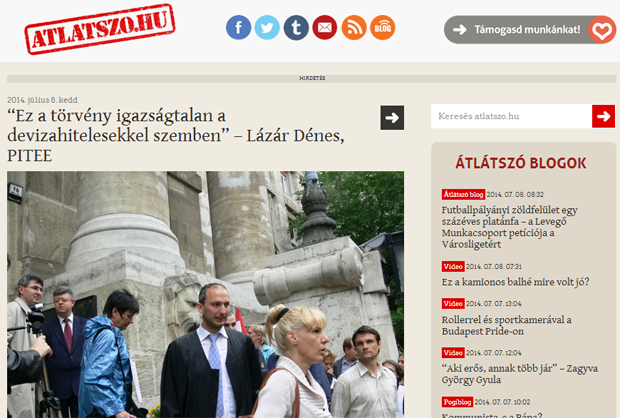
Hungarian NGOs are facing a rough summer: The Government Control Office (KEHI) has launched a series of investigations into grants they received from the Norway Financial Mechanism. Now the Council of Europe’s Commissioner for Human Rights, Nils Muižnieks, has written to János Lázár, Minister of the Prime Minister’s Office to express concern over the situation.
In the letter, Muižnieks told Lázár that he had been informed by several parties that audits were being conducted over the grants. A forthcoming report will further detail the monitoring that Muižnieks was conducting around media freedom in the country. For his part, Lázár has responded to the letter from the COE commissioner.
As Index reported on July 8, the government controls come after a long smear campaign with members of the Fidesz government accusing these NGOs to be proxies for “foreign interests”, and that Norway is using the program to exert direct political influence on Hungary.
“There is panic and uncertainty in the Hungarian civil society. In this respect, the controls are very effective, even if there will be no consequences,” says Tamas Bodoky, editor-in-chief of Atlatszo.hu, an investigative journalism outlet also targeted by the KEHI audit.
Atlatszo.hu decided not to comply with the government inspection, regarding it as unlawful. They say that KEHI is an agency overseeing government financial matters, and does not have the authority to investigate financing for NGOs. However, they have nothing to hide, so they published all relevant records concerning the use of funds on the website of their partner organisation, Asimov Foundation.
A number of NGOs followed Atlatszo’s example, but it is unclear what the repercussions of this decision might be. According to Bodoky, KEHI could freeze their bank accounts, suspend their VAT number, and fine them as well.
It is difficult to portray these NGOs as strongly opposing the Fidesz rule. Some of the organisations receiving grants from the Norway Financial Mechanism have been involved in anti-government protests, but others have fruitful cooperation with the government. The vast majority of grant recipients have no political involvement at all.
Bodoky believes the government controls are a small-time retaliation for the decision of the Norwegian government to suspend the payments from the EEA and Norway Grants. This fund represents the financial contribution of Norway, Iceland and Liechtenstein towards reducing economic and social disparities in the European Economic Area (EEA).
Hungary was set to receive 20 billion euros in the 2014-2020 period from this fund. However, the Hungarian government recently made important changes to the system by which EU and Norway development grants are administered. They did not consult with the donors. As a result the Norwegian government suspended the payments.
This measure did not affect the considerably smaller NGO Fund, operated by a Hungarian consortium of NGOs. The overall objective of this fund is to “strengthen civil society development and enhance contribution to social justice, democracy and sustainable development”.
The programme focuses on projects dealing with the human rights of minorities, good governance, combating racism and xenophobia, combating discrimination, social exclusion, gender inequalities and gender-based violence.
Some members of the NGOs administering the fund appear to have links to Politics Can Be Different (LMP), a small liberal party. Apparently this was the reason why State Secretary Janos Lazar, the “strong man” of the Fidesz government decided to write an open letter to the official representative of the Fund’s donors, Vidar Helgesen, Norway’s Minister of EEA and EU Affairs, accusing the Norway government of intervention into the internal affairs of Hungary.
Deputy State Secretary Nandor Csepreghy said in an interview that the Hungarian government would prefer Norway’s Civil Fund to provide financial support through the Hungarian government, whose “legitimacy comes from society and the voters”. Csepreghy believes that any other scheme can be interpreted as a direct involvement into Hungary’s internal political affairs.
Recent reports from mediafreedom.ushahidi.com:
Hungary: Companies owned by local council abrogate advertising contracts
Hungary: Investigative journalism group says it will not comply with government audit
Hungary: Officials target RTL Klub after critical reports
Hungary: NGO with close ties to Hungarian government will ‘monitor’ media attacks
Hungary: Blogger resigns after political pressure
This article was posted on July 8, 2014 at indexoncensorship.org
26 Jun 2014 | About Index, Campaigns, Statements, Ukraine
President Petro Poroshenko
11 Bankova street
01220 Kyiv
Ukraine
26 June 2014
Mr President,
We, the undersigned members and partners of the Human Rights House Network (HRHN), condemned in the strongest terms human rights violations which took place throughout Ukraine since 29 November 2013, and now call upon you to extend the mandate of the International Criminal Court investigations (taking into account events in Crimea and Eastern Ukraine) and to ratify the Rome Statute, in order to encourage such investigations, as an essential part of bringing peace to the country.
We welcome the repeated pledges of Ukrainian authorities to investigate all human rights violations committed since 29 November 2013 and hold those accountable, throughout the country and irrespective of which side the violator belongs to in the ongoing armed conflict in East Ukraine. The current situation of impunity must end.
The International Criminal Court is the only international body able to not only document grave human rights violations, amounting to core international crimes (war crimes, crimes against humanity, or genocide), but also investigate individuals responsible for such crimes. In order to restore peace and strengthen trust into State institutions, those responsible for such human rights violations have to be held accountable. We have for a long time called for a comprehensive reform of the judicial system in the country, which still remains to be initiated. Unfortunately, the national judicial system now shows its limits and in our view it is clear that it does not have the adequate knowledge, independence and resources to investigate all human rights violations since 29 November 2013 throughout the country.
Therefore, it is necessary to activate the international justice system, based on the complementarity principle, to guarantee that investigation into core international crimes committed by all parties in Ukraine, including by members of law enforcement and State agents, is credible and transparent, bringing those responsible to justice.
The Court’s jurisdiction should however not be limited in time, as it is now. On 17 April 2014, the Government of Ukraine indeed lodged a declaration under Article 12(3) of the Rome Statute accepting the jurisdiction of the ICC over crimes committed on its territory from 21 November 2013 to 22 February 2014.[3] We now call upon the Government to issue a declaration extending ICC jurisdiction from 21 November 2013 until the date of the entry into force of the Rome Statute for Ukraine.
We also call upon the authorities in Ukraine to accede to the Rome Statute as soon as possible. By doing this, Ukraine will make an important step to permanently depart from the culture of impunity that is prevailing.
In addition to the investigation into human rights violations, and action taken to end the use of violence in the country, Ukraine needs to undertake a massive reform of its legislation and practice in many fields. Ukraine’s law enforcement agencies have needed radical reform for a long time now: It is not about changing the names of institutions and units or about window-dressing, but about systemic changes, starting from the principles for establishing and structuring enforcement agencies, and ending with approaches to evaluating their performance.
We therefore support Ukraine’s efforts to propose a resolution at the United Nations Human Rights Council’s on-going session, although we deeply regret the draft resolution’s silence about the role of civil society in the country and the need for an investigation by the Court.
In Ukraine, human rights NGOs have proven their strong commitment to the rule of law and the respect of all human rights for all people, as well as their high level of professionalism and excellence. No country can build a sustainable future without full inclusion of civil society in decision-making, especially Ukraine in its present situation. Furthermore, States and leaders in all sectors of society must acknowledge publicly the important and legitimate role of human rights defenders in the promotion of human rights, democracy and rule of law, and avoid stigmatisation, as stated by the Human Rights Council resolution 22/6 of 21 March 2013.
Finally, we also welcome the reference in the draft resolution on Ukraine at the Human Rights Council to the extremely worrying human rights situation in Crimea and join Ukrainian authorities, the United Nations, the Organisation for Security and Cooperation in Europe, and other international voices, in condemning the enforcement of legislation of the Russian Federation on the territory of Crimea, at variance with the United Nations General Assembly resolution 68/262.
The role of civil society is essential in documenting human rights violations in Crimea and providing support to victims of such violations. A field mission has been launched by Ukrainian and Russian human rights defenders in co-operation, with which we expect full cooperation by all governmental agents in Ukraine.
On this background, we call upon you Mr President and the Government, with no further delay, to issue a declaration to extend the jurisdiction of the International Criminal Court from 21 November 2013 until the date of Ukraine’s accession to the Rome Statute either through appeal of the competent body of the Government or by adopting the Draft Law #4081a.
We further call upon you to:
- Take all necessary measures to support the work of human rights NGOs, journalists and bloggers and other media, including by investigating any threats, intimidation, harassment and violence against them, including arbitrary detentions, abductions, attacks and killings;
- Strongly and publicly acknowledge the important and legitimate role of human rights defenders in the promotion of human rights, democracy and the rule of law as an essential component of ensuring their protection; In line with United Nations Human Rights Council resolution 22/6 of 21 March 2013, paragraph 5
- Ensure that the reform process in the country, as well as all dialogue about the future of the country, is inclusive and transparent, giving space to civil society.
Sincerely,
Human Rights House Kyiv (on behalf of the following NGOs):
- Association of Ukrainian Human Rights Monitors on Law Enforcement (Association UMDPL)
- Centre for Civil Liberties
- Human Rights Information Center
- Institute of Mass Information
- Kharkiv Human Rights Protection Group
- La Strada Ukraine
- NGO “For Professional Journalism” – Svidomo
- Ukrainian Helsinki Human Rights Union
Education Human Rights House Chernihiv (on behalf of the following NGOs):
- Chernihiv Public Committee of Human Rights Protection
- Center of Humnistic Tehnologies “AHALAR”
- Center of Public Education “ALMENDA”
- Human Rights Center “Postup”
- Local Non-governmental Youth organizations М’АRТ
- Transcarpathian Public Center
- Ukrainian Helsinki Human Rights Union
Azerbaijan Human Rights House (on behalf of the following NGOs):
- Association for Protection of Women’s Rights – APWR
- Azerbaijan Human Rights Centre (AHRC)
- Institute for Peace and Democracy
- Human Rights Centre
- Legal Education Society
- Legal Protection and Awareness Society
- Media Rights Institute
- Public Union of Democracy Human Rights Resource Centre
- Women’s Association for Rational Development (WARD)
Barys Zvozskau Belarusian Human Rights House in exile, Vilnius
- Belarusian Association of Journalists
- Belarusian PEN Centre
- Belarusian Helsinki Committee
Human Rights House Belgrade (on behalf of the following NGOs):
- Belgrade Centre for Human Rights
- Helsinki Committee for Human Rights, Serbia
- Human Rights House Belgrade and Lawyers’ Committee for Human Rights –YUCOM
Human Rights House London (on behalf of the following NGOs):
- Index on Censorship
- Vivarta
Human Rights House Tbilisi (on behalf of the following NGOs):
- Article 42 of the Constitution
- Caucasian Centre for Human Rights and Conflict Studies (CAUCASIA)
- Georgian Centre for Psychosocial and Medical Rehabilitation of Torture Victims
- Media Institute
- Human Rights Center
- Union Sapari – Family Without Violence
Human Rights House Oslo (on behalf of the following NGOs):
- Human Rights House Foundation
- Norwegian Helsinki Committee
- Health and Human Rights Info
Human Rights House Voronezh (on behalf of the following NGOs):
- Civic Initiatives Development Centre
- Confederation of Free Labor
- For Ecological and Social Justice
- Free University
- Golos
- Interregional Trade Union of Literary Men
- Lawyers for labor rights
- Memorial
- Ms. Olga Gnezdilova
- Soldiers Mothers of Russia
- Voronezh Journalist Club
- Roronezh – Chernozemie
- Youth Human Rights Movement
Human Rights House Yerevan (on behalf of the following NGOs):
- Helsinki Citizens’ Assembly – Vanadzor
- Journalists’s Club Asparez
- Public Information and Need of Knowledge – PINK
Human Rights House Zagreb (on behalf of the following NGOs):
- APEO / UPIM Association for Promotion of Equal Opportunities for People with Disabilities
- B.a.B.e.
- CMS – Centre for Peace Studies
- Documenta – Centre for Dealing with the Past
- GOLJP – Civic Committee for Human Rights
- Svitanje – Association for Protection and Promotion of Mental Health
The Rafto House in Bergen – Norway (on behalf of the following NGOs):
The House of the Helsinki Foundation For Human Rights – Poland (on behalf of the following NGOs):
- Helsinki Foundation for Human Rights, Poland
Copies have been sent to:
- Mr Oleksandr Turchynov, Chairman of Verkhovna Rada
- Office of the Commissioner for Human Rights of the Council of Europe
- Private Office of the Secretary General of the Council of Europe
- Chairman of the Organisation for Security and Cooperation in Europe (OSCE)
- OSCE Special Monitoring Mission to Ukraine
- OSCE’s Office for Democratic Institutions and Human Rights
- United Nations Human Rights Monitoring Mission in Ukraine
- Delegation of the European Union in Ukraine
- Subcommittee on Human Rights of the European Parliament
- Diplomatic community in Kyiv, Brussels, Geneva and Strasbourg
- Various ministries of foreign affairs and parliamentary committees on foreign affairs
About the Human Rights House Network (www.humanrightshouse.org)
The Human Rights House Network (HRHN) unites 87 human rights NGOs joining forces in 18 independent Human Rights Houses in 13 countries in Western Balkans, Eastern Europe and South Caucasus, East and Horn of Africa, and Western Europe. HRHN’s mandate is to protect, empower and support human rights organisations locally and unite them in an international network of Human Rights Houses.
The Human Rights House Kyiv and the Education Human Rights House Chernihiv are members of HRHN. 10 independent Ukrainian human rights NGOs are members of both Human Rights Houses.
The Human Rights House Foundation (HRHF), based in Oslo (Norway) with an office in Geneva (Switzerland), is HRHN’s secretariat. HRHF is international partner of the South Caucasus Network of Human Rights Defenders and the emerging Balkan Network of Human Rights Defenders.
HRHF has consultative status with the United Nations and HRHN has participatory status with the Council of Europe.
