26 Nov 2013 | Campaigns, European Union, United Nations
In a joint letter to Baroness Catherine Ashton, High Representative for Foreign Affairs & Security Policy and Vice-President of the European Commission, Index on Censorship has joined 66 human rights NGOs from European Union member States, States from the European Partnership and States in cooperation with the European Union stress that the intent to reduce OHCHR’s budget is a signal in the wrong direction. The programme budget for the biennium 2014-2015 for 2014-2015 already decreases the budget of OHCHR by a net 4.8%, whilst the promotion and protection of human rights represents only 3% of the overall UN budget.
Keeping in mind that within the overall UN budget, the share allocated to the promotion and protection of human rights represents approximately 3%, the intent to reduce OHCHR’s budget is a signal in the wrong direction. Soon the Human Rights Council will celebrate its 10 years of existence – we believe that all States and group of States aiming at promoting human rights should ambition to raise that share to at least 10% to celebrate the 10 years of existence of the Council, which will be made impossible if the European Union continues to pressure for more and more “across the board” cuts in the UN’s human rights budget.
20 years after the Office was established, does the European Union really want to a force contributing to undermining the sustainability of OHCHR, hence weakening the voice for human rights within the UN system?
Azerbaijan Human Rights House (on behalf of the following NGOs):
Association for Protection of Womens’ Rights
Azerbaijan Lawyers Association
Human Rights Center of Azerbaijan
Institute for Peace and Democracy
Legal Education Society
Women’s Association for Rational Development
Media Rights Institute
Public Union of Democracy and Human Rights Resource Centre
Society for Humanitarian Research
Barys Zvozskau Belarusian Human Rights House in exile, Vilnius
Human Rights House Belgrade (on behalf of the following NGOs):
Belgrade Centre for Human Rights
Lawyers’ Committee for Human Rights
Helsinki Committee for Human Rights in Serbia
Policy Center
Human Rights House Kiev (on behalf of the following NGOs):
Association of Ukrainian Human Rights Monitors on Law Enforcement (Association UMDPL)
Center for Civil Liberties
Human Rights Information Center
Human Rights House Tbilisi (on behalf of the following NGOs):
Article 42 of the Constitution
Caucasian Centre for Human Rights and Conflict Studies
Georgian Centre for Psychosocial and Medical Rehabilitation of Torture Victims
Human Rights Centre
Media Centre
Union Sapari – Family without Violence
Human Rights House Oslo (on behalf of the following NGOs):
Human Rights House Foundation (HRHF)
Health and Human Rights Info
Norwegian Helsinki Committee
Human Rights House Voronezh (on behalf of the following NGOs):
Charitable Foundation
Civic Initiatives Development Centre
Confederation of Free Labor
For Ecological and Social Justice
Free University
Golos
Interregional Trade Union of Literary Men
Lawyers for labor rights
Memorial
Ms. Olga Gnezdilova
Soldiers Mothers of Russia
Voronezh Journalist Club
Voronezh-Chernozemie
Youth Human Rights Movement
Human Rights House Yerevan (on behalf of the following NGOs):
Armenian Helsinki Association
Helsinki Citizens’ Assembly – Vanadzor
Jurists against Torture
Guaranteeing Equal Opportunities
Shahkhatun
Socioscope
Women’s Resource Center
Human Rights House Zagreb (on behalf of the following NGOs):
Association for Promotion of Equal Opportunities for People with Disabilities
B.a.B.e. – Be active, Be emancipated
Centre for Peace Studies
Documenta – Centre for Dealing with the Past
GOLJP – Civic Committee for Human Rights
Svitanje – Association for Protection and Promotion of Mental Health
Russian Research Centre for Human Rights (on behalf of the following NGOs):
Human Rights Network Group
Independent Psychiatric Association of Russia
Moscow Centre for Prison Reform
Moscow Helsinki Group
Mother’s Right Foundation
Non-violence International
Right of the Child
Right to Live and Have Civil Dignity
Social Partnership FoundationUnion of the Committees of Soldiers’ Mothers of Russia
Helsinki Foundation for Human Rights, Poland
Human Rights Club, Azerbaijan
Rafto Foundation, Norway
Human Rights House Foundation (HRHF)
Index on Censorship
8 Nov 2013 | News, Russia
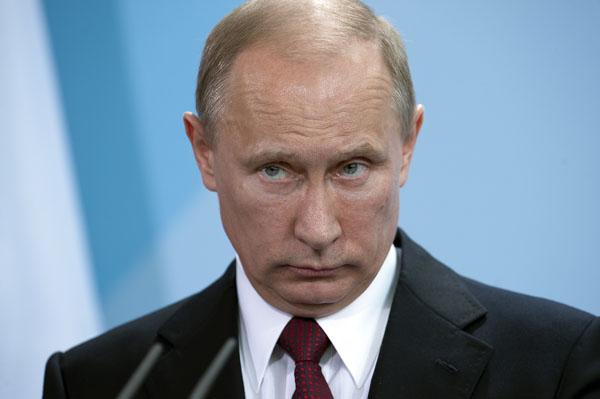
The United Nations got together yesterday to adopt a resolution calling for a world truce during the Winter Olympics kicking off in Sochi, Russia in exactly three months. This has become a tradition over the past 20 years — a symbolic gesture in the months leading up to the games. For the first time, however, it called upon the host country to “promote social inclusion without discrimination of any kind.”
Obviously a thinly veiled reference to the overtly anti-LGBT legislation Russia passed back in June. The vaguely worded ban on “gay propaganda” aimed at minors has sparked outrage across the world, with some activists calling for a boycott of the games.
But have no fear — Sochi Games chief Dmitry Chernyshenko, present at the UN, reminded us all that President Putin has repeated “three times” that there will be “no discrimination”.
THREE TIMES, YOU GUYS.
While you will forgive me for reserving my judgment on that particular guarantee for now, it is worth noting what was not mentioned in the resolution and what we were not given any assurance about. The right to freedom expression — or rather lack thereof — stands at the core of this issue. Since the law came into power, LGBT protesters have been attacked and arrested. Authorities have warned that spectators and athletes can be fined for “gay propaganda”, like displaying rainbow flags.
I don’t know about you, but to me that seems to fly in the face of the the universal human right to freedom of expression and assembly. But maybe it was simply an oversight, and this is next on the agenda. In which case, I’ve got a few suggestions on where to start.
For one, there are currently 28 Greenpeace activists and two journalists under arrest in Russia. They were staging a peaceful protest by a Gazprom oil rig on September 18, when their ship was boarded by Russian security forces. They are currently detained in a prison in St Petersburg. Initially held on piracy charges with a potential 15 year sentence, they have now been downgraded to hooliganism. This could still mean up to seven year in jail. Again, that’s for a peaceful protest.
Then there’s the case of the TV crew from the Norway’s Olympic broadcaster TV2. While filming a recent report in Sochi, they were taken into custody, interrogated, harassed and denied contact with the Norwegian embassy. The journalists were also told that they were now ‘blacklisted’. Not very encouraging to hear if you’re a critical foreign reporter heading to Sochi in February, never mind a member Russia’s perpetually repressed independent press.
And of course, you can’t talk about freedom of expression in Russia without mentioning Pussy Riot. Two members of the feminist punk group have been in prison since February 2012. The latest news was the apparent disappearance of Nadezhda Tolokonnikova as she was moved between prisons. This came after the Guardian published an open letter where she detailed the horrible conditions they were being held under. It soon emerged that she might be, like in some sort of Soviet nightmare, sent to Siberia.
One of the fundamental principles of the Olympics deals with “preserving human dignity”, and there is no doubt that freedom of expression is a pretty big part of that. Rather than listening to Putin’s empty promises, we should be measuring up Russia’s commitment to “human dignity” where it counts.
This article was originally posted on 7 Nov 2013 at PolicyMic.com
4 Nov 2013 | Bahrain, Middle East and North Africa, News
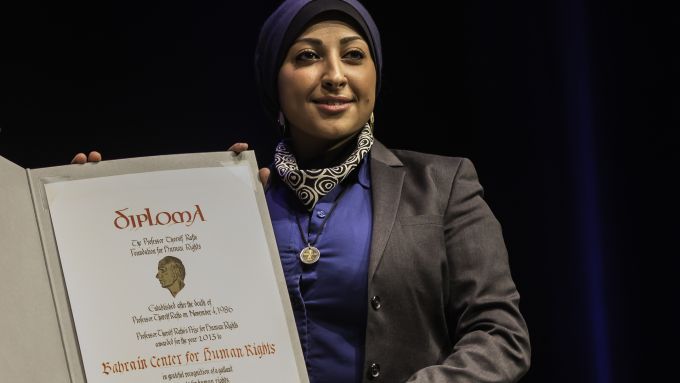
Maryam Alkhawaja accepts the Rafto Prize on behalf of the Bahrain Centre for Human Rights (Image: Lind and Lunde/Rafto Foundation)
The Bahrain Center for Human Rights (BCHR) was awarded the Rafto Prize for human rights at a ceremony in Bergen, Norway last night.
BCHR won for its peaceful fight for fundamental rights of freedom of expression and assembly in the Gulf kingdom, the award committee said.
Acting president of BCHR, Maryam Alkhawaja, was in Bergen to accept the prize. President Nabeel Rajab has been imprisoned since July 2012 for criticising authorities on Twitter. Marayam’s father and sister, Abdulhadi and Zainab, prominent human rights defenders in Bahrain, are also jailed for their opposition to the regime.
“The person who should be on this stage is not me but the people on the streets in Bahrain. They are the unnamed heroes,” Alkhawaja said in her acceptance speech.
She also read out a letter from Rajab: “Brutal violations are still continuing today against peaceful Bahrainis while the whole world continues to stay silent, especially Bahrain’s western allies. Our nation is a victim of being in an oil rich region and a victim of hypocrisies and double standards. Unfortunately, dictators of the gulf region succeeded in silencing governments of the free world in return for shortsighted economic and financial gains. Petrodollars have been able to silence global media and prevent them from revealing our people’s sufferings. We hope that with your support we can overcome this thick barrier as it has become so painful for our people to understand why the whole world deserves freedom and democracy except the small nations of oil rich countries in Gulf.”
The award committee echoed these sentiments: “This is a region where abuses too often are met with silence from western governments. Norwegian authorities have done nothing since expressing concerns in 2011,” said committee leader Martin Paulsen.
BCHR was established in 2002. It has played a vital part in Bahrain’s democracy uprising, now in its fourth year, in the face of the regime’s continued crackdown on opposition. BCHR won Index on Censorship’s Advocacy Award in 2012.
The Rafto Prize is awarded by the Norwegian Rafto Foundation. It is an increasingly influential human rights award, and a number of recipients have later gone on to win the Nobel Peace Prize.
10 Jul 2013 | Azerbaijan News, Politics and Society
From America to Azerbaijan, leaders have pledged themselves to a new era of openness and transparency. So why are whistleblowers and journalists still punished, asks Mike Harris
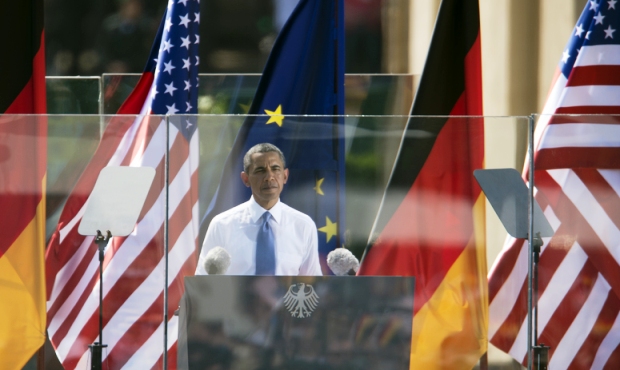
Is Barack Obama committed to transparency? (pic Gonçalo Silva/Demotix)
(more…)
