7 Nov 2015 | Awards, Awards year slider
[vc_row full_width=”stretch_row_content_no_spaces” css_animation=”fadeIn” css=”.vc_custom_1485788535593{padding-top: 250px !important;padding-bottom: 250px !important;background-image: url(https://www.indexoncensorship.org/wp-content/uploads/2016/10/2015-logo-1460×490-1.png?id=80257) !important;background-position: center !important;background-repeat: no-repeat !important;background-size: cover !important;}”][vc_column][/vc_column][/vc_row][vc_row css=”.vc_custom_1472525914065{margin-top: -150px !important;}”][vc_column][vc_row_inner equal_height=”yes” content_placement=”middle”][vc_column_inner el_class=”awards-inside-desc” width=”1/2″][vc_custom_heading text=”FREEDOM OF EXPRESSION AWARDS 2015″ use_theme_fonts=”yes”][vc_column_text]Index on Censorship’s Freedom of Expression Awards exist to celebrate individuals or groups who have had a significant impact fighting censorship anywhere in the world.
- Awards were offered in four categories: Arts, Campaigning, Digital Activism and Journalism
- Anyone who has had a demonstrable impact in tackling censorship is eligible
- Winners were honoured at a gala celebration in London at the Barbican Centre
- Winners joined Index’s Awards Fellowship programme and received dedicated training and support
[/vc_column_text][/vc_column_inner][vc_column_inner width=”1/2″][vc_video link=”https://www.youtube.com/watch?v=Fw_1o7IEisA”][/vc_column_inner][/vc_row_inner][/vc_column][/vc_row][vc_row equal_height=”yes” el_class=”awards-4grid” css=”.vc_custom_1472549004786{margin-top: 20px !important;margin-bottom: 20px !important;}”][vc_column width=”1/4″ css=”.vc_custom_1472461150656{background-color: #cb3000 !important;}”][vc_custom_heading text=”Arts” use_theme_fonts=”yes”][vc_column_text]for artists and arts producers whose work challenges repression and injustice and celebrates artistic free expression[/vc_column_text][/vc_column][vc_column width=”1/4″ css=”.vc_custom_1472461193991{background-color: #d98c00 !important;}”][vc_custom_heading text=”Campaigning” use_theme_fonts=”yes”][vc_column_text]for activists and campaigners who have had a marked impact in fighting censorship and promoting freedom of expression[/vc_column_text][/vc_column][vc_column width=”1/4″ css=”.vc_custom_1472461232330{background-color: #cb3000 !important;}”][vc_custom_heading text=”Digital Activism” use_theme_fonts=”yes”][vc_column_text]for innovative uses of technology to circumvent censorship and enable free and independent exchange of information[/vc_column_text][/vc_column][vc_column width=”1/4″ css=”.vc_custom_1472461222655{background-color: #d98c00 !important;}”][vc_custom_heading text=”Journalism” use_theme_fonts=”yes”][vc_column_text]for courageous, high-impact and determined journalism that exposes censorship and threats to free expression[/vc_column_text][/vc_column][/vc_row][vc_row el_class=”text_white” css=”.vc_custom_1472549018179{margin-top: 20px !important;margin-bottom: 20px !important;background-color: #cb3000 !important;}”][vc_column][vc_custom_heading text=”The Index Awards Fellowship” use_theme_fonts=”yes”][vc_column_text]In recognising individuals and organisations, often working in dangerous and difficult conditions, Index makes a commitment to them. Through a year-long fellowship we work with our awards winners – both during an intensive week in London, and the rest of the awarding year – to provide longer term, structured assistance to enhance the work they are already doing.[/vc_column_text][/vc_column][/vc_row][vc_row css=”.vc_custom_1472608310682{margin-top: 0px !important;margin-bottom: 20px !important;}”][vc_column][vc_custom_heading text=”FELLOWS” font_container=”tag:h1|text_align:center” use_theme_fonts=”yes” css=”.vc_custom_1472608304034{margin-top: 0px !important;}”][vc_column_text el_class=”container680″]
Through the Index Awards Fellowship we work with our winners – both during an intensive week in London and the rest of the awarding year – to provide longer term, structured support.
The goal is to help winners maximise their impact, broaden their support and ensure they can continue to excel at fighting free expression threats on the ground.
[/vc_column_text][awards_fellows years=”2015″][/vc_column][/vc_row][vc_row][vc_column][vc_custom_heading text=”JUDGING” font_container=”tag:h1|text_align:center” use_theme_fonts=”yes”][vc_row_inner el_class=”mw700″][vc_column_inner][vc_column_text]
Criteria – Anyone involved in tackling free expression threats – either through journalism, campaigning, the arts or using digital techniques – is eligible for nomination.
Any individual, group or NGO can nominate or self-nominate. There is no cost to apply.
Judges look for courage, creativity and resilience. We shortlist on the basis of those who are deemed to be making the greatest impact in tackling censorship in their chosen area, with a particular focus on topics that are little covered or tackled by others.
Nominees must have had a recognisable impact in the past 12 months.
Where a judge comes from a nominee’s country, or where there is any other potential conflict of interest, the judge will abstain from voting in that category.
Panel – Each year Index recruits an independent panel of judges – leading world voices with diverse expertise across campaigning, journalism, the arts and human rights.
The judges for 2015, chaired by Index on Censorship’s CEO Jodie Ginsberg were:
[/vc_column_text][/vc_column_inner][/vc_row_inner][vc_row_inner][vc_column_inner width=”1/3″][staff name=”Martha Lane Fox” title=” Businesswoman, philanthropist, and public servant” color=”#28a7cc” profile_image=”80235″]Martha Lane Fox co-founded Lastminute.com in the dotcom boom of the early 2000s and has subsequently served on public service digital projects. She is a board member of Twitter, mydeco.com, Marks & Spencer, and chairs the board of the digital skills charity, Go ON UK and was on the board of Channel 4 from 2007 to 2011. Lane Fox joined the House of Lords as a crossbencher on 26 March 2013, becoming its youngest female member. Lane Fox was also appointed as Chancellor of the Open University as of 12 March 2014.[/staff][/vc_column_inner][vc_column_inner width=”1/3″][staff name=”Elif Şafak” title=”Author, columnist, speaker and academic” color=”#28a7cc” profile_image=”80233″]Elif Şafak has published 15 books, 10 of which are novels. She writes fiction in both Turkish and English. Şafak blends Western and Eastern traditions of storytelling in stories of women, minorities, immigrants, subcultures, and youth. Her writing draws on diverse cultures and literary traditions, reflecting interests in history, philosophy, Sufism, oral culture, and cultural politics. Şafak also uses black humour. She was awarded the title of Chevalier de l’Ordre des Arts et des Lettres in 2010.[/staff][/vc_column_inner][vc_column_inner width=”1/3″][staff name=”Mariane Pearl” title=”Journalist and writer” color=”#28a7cc” profile_image=”80236″]Mariane Pearl is an award-winning journalist and writer who works in English, French and Spanish. She is currently the Managing Editor of Chime for Change global journalism platform that focuses on helping women and girls speak for themselves. She directed her pilot project “Women’s Voices Within” in Erbil, Iraq with Yazidi refugees. Mariane is the author of “A Mighty Heart: The Brave Life and Death of My Husband Daniel Pearl” (Scribner.) Her second book, “In Search of Hope” (Powerhouse) is a collection of profiles of extraordinary women around the world. Mariane Pearl is also a contributor to publications such as The New York Times, The Sunday Times, the Conde Nast traveler, Self Magazine and more.[/staff][/vc_column_inner][/vc_row_inner][vc_row_inner][vc_column_inner width=”1/3″][staff name=”Sir Keir Starmer, KCB, QC” title=”Politician and barrister” color=”#28a7cc” profile_image=”80234″]Sir Keir Starmer, KCB, QC is a British politician and barrister. Since the 2015 General Election, he has been the Labour Member of Parliament for Holborn and St Pancras. He was the Director of Public Prosecutions (DPP) and the Head of the Crown Prosecution Service from 2008 to 2013. He has prosecuted in numerous cases for the CPS during his career, while acting principally as a defence lawyer specialising in human rights issues.[/staff][/vc_column_inner][/vc_row_inner][/vc_column][/vc_row][vc_row full_width=”stretch_row_content_no_spaces” css=”.vc_custom_1473325605190{margin-top: 20px !important;margin-bottom: 20px !important;padding-top: 20px !important;padding-right: 15px !important;padding-bottom: 20px !important;padding-left: 15px !important;background-color: #f2f2f2 !important;}”][vc_column][vc_row_inner content_placement=”middle” el_class=”container container980″][vc_column_inner][awards_news_slider name=”NEWS” years=”2015″][/vc_column_inner][/vc_row_inner][/vc_column][/vc_row][vc_row css=”.vc_custom_1473325552363{margin-top: 0px !important;margin-bottom: 20px !important;padding-top: 0px !important;padding-right: 15px !important;padding-bottom: 0px !important;padding-left: 15px !important;}”][vc_column css=”.vc_custom_1473325567468{margin-top: 0px !important;margin-bottom: 0px !important;padding-top: 0px !important;padding-bottom: 0px !important;}”][awards_gallery_slider name=”GALLERY” images_url=”67151,67039,65101,65096,65066,65059,65054,65049,65047,65042,65040,65039,65038,65037,60907,65052,79360,79361,79362,79363,79364,79365,79366,79367,79368,79369,79370,79371,79372,79373,79374,79375,79376,79377,79378,79379,79380,79381,79382,79383,79384,79385,79386,79387,79388,79389,79390,79391,79392,79393,79394,79395,79396,79397,79398,79399,79400,79401,79402,79403,79404″][/vc_column][/vc_row]
30 Oct 2015 | mobile, News, United States
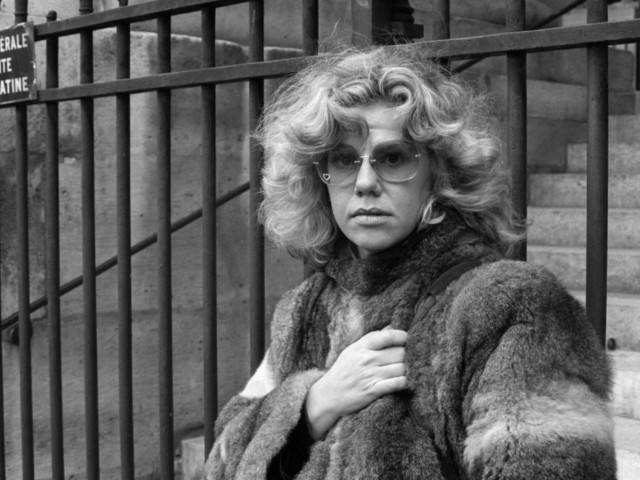
(Photo: Erica Jong)
There have always been sexual rebels.
In the 18th century, Mary Wollstonecraft and her daughter, Mary Shelley, were fiercely rebellious about sexuality. They also were great feminists. In the 20th century, Emma Goldman spoke for women who believed love should be free.
Our age tends to divide things by decades and generalise about them. So, it’s assumed that the 70s and the second wave of feminism introduced sexual freedom to women. This is absolutely not true. If you read The Group by Mary McCarthy (1963), Tropic of Cancer by Henry Miller (1934), or Ulysses by James Joyce (1922), you see that sexual rebels have always been with us.
What was different about [my 1973 novel] Fear of Flying was that it was a book that tried to reveal how women thought about sex in an age when most books about women didn’t show this. So, when the book came out both women and men were shocked. Some said: “Women don’t think like this!” and some said: “Thank God, somebody is talking about how women really think!” What was fascinating to me as an author was how contradictory the responses were.
I always wanted to write the books for women that did not exist. There is a huge gap between what we write about and what we think about. I wanted to rip the top of the head off a lusty woman and expose her fantasies to the light. Fantasies are important but they don’t necessarily have to become realities. The zipless fuck was a fantasy of perfect idealized sex with a stranger, but it is often impossible to fulfill. Many readers missed that.
Now I see woman writers writing about bondage and discipline, cruelty and submission, and I wonder whether that is fantasy too. I’ve never been much interested in submission, so I read these books as fairytale fantasies for women.
I think it’s important not to take literature literally. We turn to writers to document our dream lives. We turn to writers to show us what we are afraid to show ourselves. Many writers who become known for sexuality are not that different from you and me. They have a need to reveal the unconscious mind. If we take them literally, we miss the point.
The big change in sexual writing happened in the 1960’s when books like Lolita and Tropic of Cancer were liberated by the courts. The change in literature emerged from the change in the law. Male writers got very excited and produced books like John Updike’s Couples (1968) and Philip Roth’s Portnoy’s Complaint (1969). Suddenly it was possible to publish these very honest works. I wanted to show honesty from a woman’s point of view. I was not advocating a kind of behavior, but many people did not understand that.
In Fear of Dying, I have also been attempting to reveal something unrevealed before. An editor once told me there had never been a bestseller about a woman over 40. But as I watched women growing older, still feeling sexy, looking for a way to overcome mortality, I realised that we needed new books that showed how women had changed.
Like Fear of Flying, Fear of Dying is such a book.
Erica Jong is a novelist whose works include Fear of Flying and the newly-published Fear of Dying. (Her books are available on Amazon, iTunes, Waterstones or your local independent bookshop.)
This article was originally published on FeedYourNeedtoRead.com and is reposted here with permission.
|
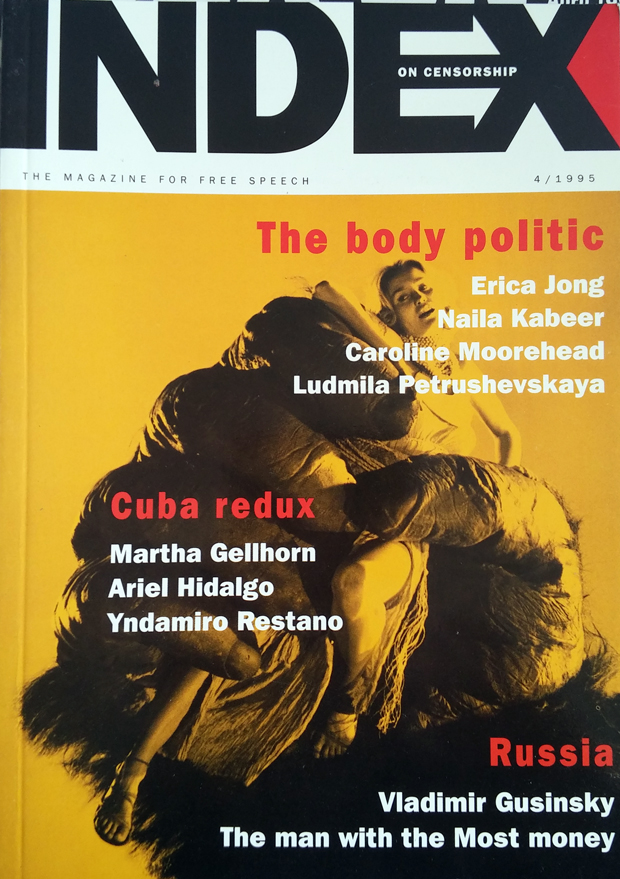
From the summer 1995 Index on Censorship magazine
Deliberately lewd
Erica Jong explains why pornography is to art as prudery is to the censors
Pornographic material has been present in the art and literature of every society in every historical period. What has changed from epoch to epoch – or even from one decade to another – is the ability of such material to flourish publicly and to be distributed legally. After nearly 100 years of agitating for freedom to publish, we find that the enemies of freedom have multiplied, rather than diminished.
Read the full article |
23 Oct 2015 | Academic Freedom, Counter Terrorism, Europe and Central Asia, mobile, News, United Kingdom
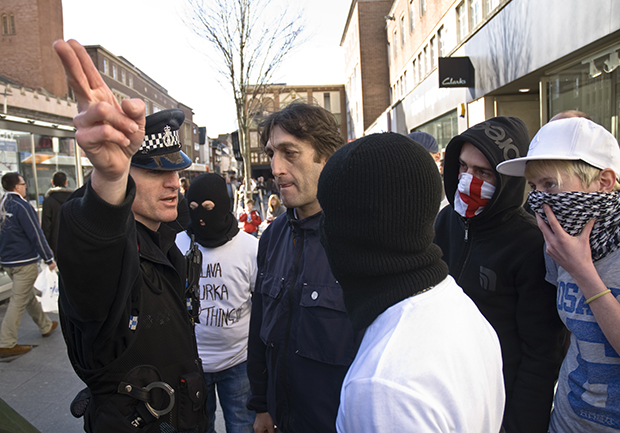
Police move on the English Defense League members in Exeter City Centre. Credit: Clive Chilvers / Shutterstock.com
There are a few techniques you can use to spot whether someone has slightly dodgy views on the world.
My favourite is the hand-chopping test. Imagine, if you will, that you find yourself debating on a panel with a media-friendly community activist. He was very jovial in the dressing room, knows all the right words about the European Convention on Human Rights and a little bit about the emancipation of women. All the nice things. But something seems a bit shady. You’ve heard he’s associated with some rather dubious types. Try this: ask if they think thieves should have their hands cut off. If they say: “What an odd question. Of course not!”, they’re probably fairly normal people, but they won’t be your friend because they reckon you’re probably Islamophobic. But if they start waffling about the “Sharia being properly implemented… in an Islamic State the Sharia would necessarily… something something scholars…” etc, you are in all likelihood sharing a stage with someone who’s a bit, well…
Well what, exactly? Dodgy, yes. The test has served to establish that much. But does it mean they’re probably going to join the Islamic State immediately after you’ve finished your panel debate? Or encourage others to do so?
Probably not. We don’t really know.
Take another example. You’re at a bus stop late at night when you overhear a middle-aged man next to you railing against refugees to a young woman. Is he simply an anti-immigrant little-Englander? What if he starts explaining that the current refugee crisis has been caused not by Assad or IS, or oppressive governments in say, Eritrea, but by the machinations of “Rothschild Zionists” who are determined to flood Europe with dark-skinned people in order to pollute the continent’s Aryan bloodstock?
The UK government would class the beliefs outlined above as “extreme”. Indeed, in its newly-outlined counter-extremism strategy, it focuses almost exclusively on Islamism and neo-Nazism, which might come as a relief to anarchists, deep greens, animal rights activists and physical-force Irish republicans.
I’m not about to debate the merits of the term “extremism” itself. Yes, “extreme” is by its nature a relative term, and things change over time: the Prussian secret police who spied on Karl Marx in London as he wrote Das Kapital surely would have identified him as an extremist, but could not have possibly imagined his ideas would become so very prominent in the corridors of mainstream academia a century later.
The ideas of extreme Islamists and the far right, it is probably reasonable to say, are far from the mainstream of British society. And violence is carried out in their name. These seem reasonable assertions.
The question then is whether the government should do something about their existence. And if so, what?
The new counter-extremism strategy does at least attempt to identify specifics of what extremism might be and also shows some actual knowledge of the identified problems as specific political projects rather than floating notions.
But it’s still not entirely clear whether the ultimate aim is to prevent acts of terrorism carried out by extremists or to prevent general wrongs.
It is of interest, for example, to note that violence against women and girls, including genital mutilation, is identified. But I’m not sure that the “root causes” can be linked simply to the forms of extremism mentioned in the strategy document.
There are other issues that will also raise concern for those interested in free expression.
In an age when stories about who can and cannot speak on university campuses have become a staple of discussion, the government’s assertion that it expects “student bodies such as the NUS to avoid providing a platform for extremist speakers” feels like yet another incursion onto the idea that universities should be free spaces.
The suggestion that “the government will challenge broadcasters whenever extremists have been given a platform to preach harmful messages without critical challenge” appears to be moving beyond the existing role of Ofcom in promoting balance on the airwaves.
This is underlined by the pledge to “legislate in this parliament to ensure Ofcom’s existing powers to immediately suspend TV services that broadcast unacceptable extremist material also extend to all radio services” and to “consider changes” to regulation around shows that appear on the web.
We ultimately return to the challenge of our jovial preacher on the panel debate or our bus-stop Streicher.
As individuals and as a society, what do we want to do with them? Convince them that they are wrong and that liberal democracy is the way to go? The government suggests it will “act with confidence, unapologetically defending our shared values and robustly confronting extremists”.
This is important, certainly, and is something that must be put into practice in places such as prisons where the path to radicalisation and possible violence is at its clearest.
But it’s crucial that is seen as an act rather than an idea: the crime is to plant the bomb or recruit, fundraise for violence in the name of the Islamic State, or attempt to foment race war longed for by Nazis. The crime cannot be simply to believe in the Islamic State or the race war. We come back (as we so frequently do) to John Stuart Mill’s harm principle: “The only purpose for which power can be rightfully exercised over any member of a civilized community, against his will, is to prevent harm to others.”
22 Oct 2015 | Angola, Mapping Media Freedom, News, Portugal
It all became perfectly clear in Miguel’s head when a high-ranking editor from his newspaper eagerly approached him one day with a story idea. It was August 2012, and the Angolan presidential elections were scheduled for the 31st.
“You’re going to write an article that will prove once and for all to the Portuguese audience that Angola is a true democracy and not dictatorship. We’ll show that it is the Portuguese who are the fascists here, not the Angolan,” the editor told him.
The assignment came as no surprise to Miguel, who was aware of the rumours that the cash-strapped newspaper he works for is one of the many Portuguese media outlets that have received cash infusions funded by Angolan investors. These investments come from individuals connected to Angolan President José Eduardo dos Santos, the man who enriched himself and his country’s tight-knit elite throughout his 36 years of power. While rich in resources — Angola figures among the world’s top producers of oil and diamonds — the country’s profits benefit very few. The most shocking example of that is the fact that this former Portuguese colony has the world’s highest mortality rate for infants and for children under the age of five.
Eventually, after informing his editor that he didn’t share the opinion that “Angola is a true democracy”, Miguel acquiesced and wrote the article on the condition that his byline would not appear.
Later that month, on 31 August 2012, dos Santos won the election with a controversial 71.84% of the votes.
“After that, I imposed on myself a kind of conscious negligence on everything relating to Angola. I stopped thinking about it, not just in order to keep my job, but also for mentality’s sake,” Miguel admits.
Ownership of Portuguese media outlets by Angolan oligarchs is a way for the dos Santos regime to hide the country’s negative side while promoting it before a foreign audience, experts say.
“They know better than anyone that the media can help them create the illusion that Angola is a good example when it comes to politics, the economy or even human rights,” says Portuguese MEP Ana Gomes, a member of the European Parliament’s Subcommittee on Human Rights and a close follower of the Angolan situation. “It grants good publicity and an idea of respectability to Angolan personalities who got all their money by stealing assets of the Angola state.”
Francisco Louçã, a former leader of the Portuguese Left Block political party and co-author of the book The Angolans Who Own Portugal, told Index on Censorship that “by owning strategic positions of the Portuguese media, these businessmen and businesswomen who are very close to the Angolan regime can manage and condition the information that reaches Portugal, which, from their perspective, is the perfect gateway for other European markets”.
It’s hard to find a media title in Portugal that isn’t owned in some way or another by Angolan oligarchs — and although Portugal has yet to see the effects of media transparency legislation that will make it mandatory for newspapers to reveal their shareholders beginning on 27 October, many news reports dating back to 2008 show that Angolan money is being invested in the Portuguese media.
In March 2014, António Mosquito, an Angolan businessman with close ties to the president, purchased a 27.5% stake in Controlinvest media group — including Diário de Notícias, the country’s oldest newspaper, and Jornal de Notícias, the second-most read. A few months after this deal, 160 workers were laid-off, including 64 journalists.
Then there’s Newshold, a media group owned by Angolan banker and businessman Álvaro Sobrinho. After buying the weekly Sol in 2008, Newshold announced the acquisition of the daily i in 2014. Newshold is also a shareholder in the two largest national media empires: 1.9% in Cofina, which includes Portugal’s highest circulation newspaper, Correio da Manhã; and 3.2% of Impresa, owner of television powerhouse SIC and the prestigious weekly Expresso.
In 2012, Newshold was also a frontrunner for the concession of RTP, the Portuguese public television network, after the government announced that it was willing to put it into the hands of private owners — a sale that was later dropped.
Then there is the case of Isabel do Santos, daughter of the Angolan president and Africa’s richest woman. Much of her $3.1 billion (£2.07 billion) net worth has been facilitated by her father’s decisions, which led to Forbes to dubbing her “daddy’s girl”. Not long after that piece was published, Isabel dos Santos bought the rights to produce a Portuguese-language version of Forbes which will be sold in Portugal and in Portuguese-speaking African countries.
Although Isabel dos Santos has no reported ownership of a Portuguese media outlet, she does co-own NOS, Portugal’s leading cable television company, in a joint-venture with the Portuguese telecom mogul Sonaecom — which is also the owner of the daily Público.
“Portugal is a vanity fair for the so-called Angolan elite,” says Angolan investigative journalist Rafael Marques de Morais, winner of the 2015 Index Journalism award for his work uncovering corruption in his country.
Whether they are the recipients of direct investments or not, all newspapers in Portugal are dependent on money from Angola’s elite in the form of advertising. With holdings in Portugal’s real estate, telecoms, construction and banking industries, Angolan investors can potentially influence coverage through contracts for ad space.
It isn’t always clear how the Angolan money is invested in Portugal’s media. For example, in the case of i, a newspaper that has struggled with financial issues, a February 2012 purchase of a 70% stake by printing-house owner Manuel Cruz was completed behind a reluctance to reveal the identity of the investors. “It’s a deal that is done through a foreign group, of which I’m a shareholder representative in Portugal,” Cruz was quoted as saying at the time.
However, inside the newsroom, journalists became alert to the possibility that that investment had roots in the Angolan oligarchy. “It became known through rumours, which were later proved to be true,” says António Rodrigues, a former editor of i’s foreign news desk. “It got pretty obvious even without an official confirmation. It’s impossible for the owner of a printing house to be able to afford to suddenly buy an unprofitable newspaper during an economic crisis. There had to be someone from Angola behind him.”
Rodrigues was right. But this was only to be fully brought to light in September 2014 when i and Sol moved into the same building.
In the meantime, while journalists were left to speculate on who their mysterious bosses were, news regarding Angola became a sensitive topic. “One had to be more careful and it was policy to ask the editors-in-chief for permission to publish anything related to Angola,” Rodrigues said.
After seven months working under the new owners, Rodrigues was laid off and the foreign news section was left without a permanent editor — such responsibilities were transferred to the masthead. This led to a gradual, yet steady loss of importance of the foreign news section in the paper. It didn’t take long until negative news concerning Angola nearly disappeared from i, Rodrigues said.
Other Portuguese news outlets appear to have limited their coverage of Angola. The ongoing hunger strike by Luaty Beirão — an Angolan-Portuguese rapper who began protesting on 21 September after being accused, along with 14 other activists, of preparing “crimes against [Angola’s] state security” — has been met with reluctance by some newspapers. i and Jornal de Notícias are yet to give more space to the subject than a brief item. And while it did write about new business opportunities for Isabel dos Santos, Diário de Notícias devoted only a little more than one column to the hunger strike when a demonstration for Beirão’s freedom took place in Lisbon to mark the 25th day of his protest.
On 27 October, Portugal will implement a media transparency law that will make it mandatory for newspapers to divulge their list of shareholders — TV and radio stations already follow this procedure. Until recently, similar drafts have been voted down by the centre-right governing coalition.
“Resistance by the media owners to laws of this kind is very high and some parties respect this clearly. The Angola regime is a sacred cow to some of them,” says Louçã.
“Finally we have such a law that will bring some light to this very dark issue. And I’m sure that if we follow the money trail, we’ll always find our way to very important personalities of the Angolan regime with high stakes in the Portuguese economy,” says Gomes.
However, Marques de Morais, a connoisseur of the ways of the Angolan oligarchy, is more skeptical of the results of this new law.
“If the regime of José Eduardo dos Santos has shown an ability to do something, it’s to hide their footsteps. There is always a way for them.”
This article was posted at indexoncensorship.org on 21 October 2015
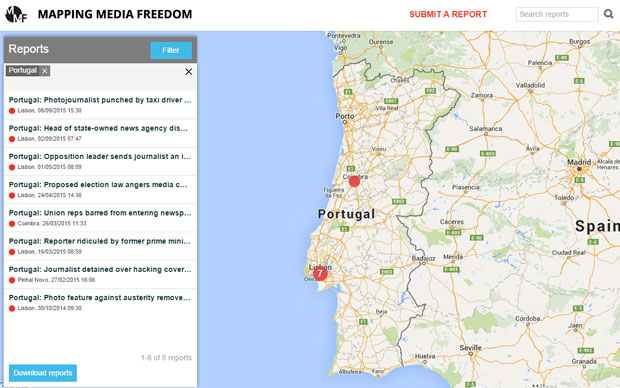
Mapping Media Freedom
Click on the bubbles to view reports or double-click to zoom in on specific regions. The full site can be accessed at https://mappingmediafreedom.org/
|