7 Nov 2014 | Europe and Central Asia, News, Turkey
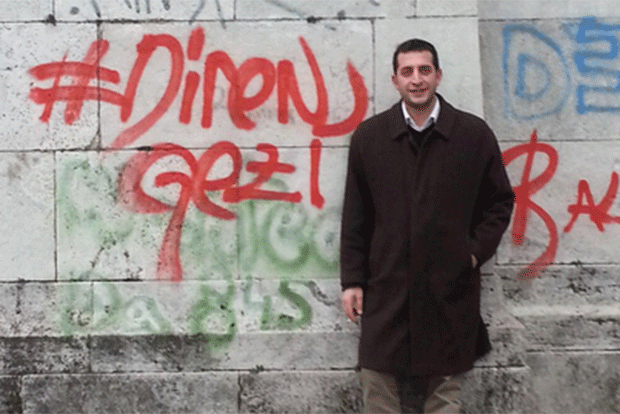
Kemal Göktaş (Photo: @kemalgoktas)
A Turkish journalist was charged on Tuesday for “insulting a public official“.
Kemal Göktaş, a reporter for Turkish paper Milliyet, faces up to two years and four months in prison for criticising the sentence of a police officer who beat a woman in custody. The victim called for eight years imprisonment, but the officer was handed down a one-year jail sentence.
Göktaş’s last article on the case appeared on Milliyet’s website on 6 October. He told Agos that his case is not only a violation of press freedom, but also a human rights violation. He is will testify on 14 November.
In 2009, Göktaş was acquitted of similar charges after publishing articles criticising “general surveillance permission“.
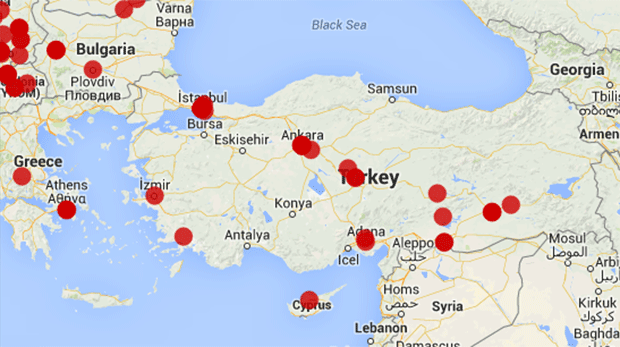
The incident was reported to mediafreedom.ushahihi.com, Index on Censorship’s media violations mapping project.
This article was originally posted on indexoncensorship.org
30 Oct 2014 | Europe and Central Asia, News, United Kingdom
![(Photo: Cindy (Flickr) [CC-BY-SA-2.0 (http://creativecommons.org/licenses/by-sa/2.0)], via Wikimedia Commons)](https://www.indexoncensorship.org/wp-content/uploads/2014/10/Happy_Halloween.jpg)
(Photo: Cindy (Flickr) [CC-BY-SA-2.0 (http://creativecommons.org/licenses/by-sa/2.0)], via Wikimedia Commons)
Paisley was, as usual, horrified by the world. That particular week he had one thing in mind: “Rock music is satanic,” Paisley told the assembled. “Let me repeat that, rock music is satanic, and those who have studied it have proved that conclusively.”
The reverend’s attention had been drawn back to rock music by the visit to Belfast of heavy metal singer Ozzy Osbourne. Osbourne had, Paisley intoned, been “sacked by another satanic organisation called ‘Black Sabbath'” for his drinking. And now this man was on Paisley’s territory.
“[It] is the intention of the devil to carry the battle for youthful minds, for youthful hearts and for youthful bodies. The citadel of man is his soul, and the battle is on in this city for the souls of the youth of our city.”
Paisley was a man capable of seeing demons everywhere but in himself, but he was not alone in his conviction that satan himself was acting through music and other media to destroy young minds (though he may have been alone in his later belief that line dancing induced lustfulness).
The mid 80s and early 90s were a time when many people seemed convinced that pop musicians were having weekly conference calls with beelzebub on how to corrupt and destroy the world’s youth. Osbourne’s fellow Brummie rockers Judas Priest found themselves accused of causing the suicides of two young fans by planting subliminal messages in their records.
(Meanwhile, in an atmosphere of moral panic, Tipper Gore and her comrades at the Parents Music Resource Center were diligently seeking out the rude bits on every record released and taking careful note, like schoolboys who’d found a discarded copy of Lady Chatterley’s Lover.
Pressure from the PMRC would lead to the “Parental Advisory: Explicit Lyrics” stickers put in the cover of every fun record released between 1985 and 1995, and contributed to the atmosphere where Miami Bass act 2 Live Crew found themselves in the dock for obscenity over their album As Nasty As They Wanna Be, the lewd content of which even the black and white stickers did not provide adequate warning for, it was claimed. Aptly, the song S&M on the 2 Live Crew album Move Somethin’, which preceded As Nasty As They Wanna Be, contained the lyric “I’m a disciple of Satan, with work to do”.)
One could argue that it’s a bit much to call your band Black Sabbath and then complain about being demonised. But it’s not just bat-biting metal bands that have faced accusations of evildoing.
William Friedkin’s The Exorcist, based on the novel of the same name, is one of the most Christian films ever made. Portraying the demonic possession of a young girl, what’s fascinating in watching The Exorcist now is how little of it is actually concerned with the “exorcism” itself. Huge chunks of the film are used in watching the priest Father Damien Karras explore every other avenue for the girls physical and mental state apart from possession. It is only in the last third of the film that the exorcist of the title appears, and the demon possessing the child is finally defeated. “You can have all the education and science you want,” The Exorcist suggests, “but only faith in God will save you from evil.”
This message would, you think, find favour with Christians. And yet Pastor Billy Graham, one of the UK’s most powerful preachers at the time of the film’s release in 1973, was appalled by The Exorcist. According to William Peter Blatty, who adapted the screenplay for The Exorcist from his own novel, Graham believed “’There [was] a power of evil in that film, in the fabric of the film itself.” Protestant evangelist Graham’s view of the film may not have been helped by it’s overt Roman Catholicism.
The Catholic church itself has recent form in perceiving satan at work. In 2003, then-cardinal and future pope Joseph Ratzinger reportedly denounced JK Rowling’s Harry Potter books as a “subtle seduction” which had “deeply unnoticed and direct effects in undermining the soul of Christianity before it can really grow properly”.
Later, in 2008, a Catholic academic put it rather more bluntly. Writing in the Vatican’s L’Osservatore Romano newspaper, Edoardo Rialti commented that: “Despite the values that we come across in the narration, at the base of this story, witchcraft is proposed as a positive ideal.
“The violent manipulation of things and people comes thanks to knowledge of the occult.”
Happily, like many an exhausted parent before it, the church eventually came to love the boy wizard and his Blytonian adventures. By the time the film of Harry Potter and the Half-Blood Prince was released, L’Osservatore Romano was full of praise, saying: “There is a clear line of demarcation between good and evil and [the film] makes clear that good is right. One understands as well that sometimes this requires hard work and sacrifice.”
By this time, again like many an exhausted parent, the Vatican had moved on to the new territory of the Twilight saga. One Monsignor Perazzolo of the Vatican’s Pontifical Council warned that the vampires v werewolves film’s occultery could create a “moral void more dangerous than any deviant message”. This, of course, was the same series that faced heavy criticism for creator Stephenie Meyer’s apparent Mormon undertone of sexual abstinence.
Satan and the occult trump all when hand wringing is to be done, with the sole exception of accusations of paedophilia (the history of real, dangerous and false allegations of paedophilia linked to satanic ritual in the UK is for a separate article). The very personification of evil is still a significant presence even in our secular lives. But he is invoked more often than not by those who wish to see his hand in simple things they do not like or do not understand.
This article was posted on 30 October 2014 at indexoncensorship.org
29 Oct 2014 | Europe and Central Asia, News, Serbia
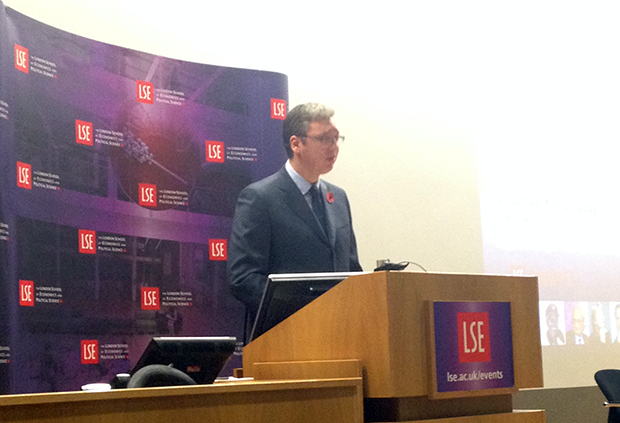
Serbian Prime Minister Aleksandar Vucic speaking at LSE (Photo: Milana Knezevic)
It wasn’t quite a remote controlled drone carrying a provocative political message, but Serbian Prime Minister Aleksandar Vucic’s Monday night lecture at the London School of Economics (LSE) came with its own controversial incident.
“What can you say about the total censorship of all opposition media”, Vucic was asked by a young woman in the audience just as the premier sat down for the question and answer portion of the event. She explained that she was representing Nikola Sandulovic, an opposition politician from the Serbian Republican Party, who was sitting beside her. Sandulovic said later he had travelled to London to confront Vucic.
Chaos ensued. Sandulovic claimed, among other things, that a police officer connected to Vucic had threatened to kill him and that he had evidence contained on a CD he held aloft. Vucic hit back that the Republican Party had only 0.01% of public support, and disputed Sandulovic’s assertion that he had been an adviser to former Serbian Prime Minister Zoran Djindjic, who was assassinated in 2003. Accusations flew across the room until LSE’s moderator James Ker-Lindsay finally managed regain control of the situation.
After the event, Sandulovic told Index he came to London because the media in Serbia ignore him and his party, apart from when government-friendly outlets attack him.
That press freedom was a popular topic on the night did not comes as a surprise. Serbia has seen a string of censorship incidents during Vucic’s time in power, as Index and many others have reported.
The prime minister himself brought up the press in his introductory lecture. He explained how his government has passed several new laws aimed at improving the media landscape, and complained that despite this, they are “scapegoated”. He directly addressed the recent controversial cancellation of a political talk show, Utisak Nedelje (Impressions of the Week), saying authorities have been subjected to a blame campaign for what was a commercial decision. Supporters of the show, including host Olja Beckovic, say it was down to political pressure.
In a joking reference to his infamous role under Slobodan Milosevic, he said he had been the “worst minister of information”. Curiously, he also used this former job as a counterargument to critics, arguing that his past had made it easy to blame him for any instance of censorship.
But this didn’t seem to stop the press-related questions, though none of the journalists present were chosen to ask one. Apart from the memorable Sandulovic intervention, an audience-member pointed out that Utisak Nedelje wasn’t the only show to have been taken off air in recent times.
If there was an overarching theme to the night, it was that it seemed to showcase different — some would say conflicting — sides of Vucic and his administration. He reminded the audience that Belgrade had recently organised a successful Pride parade, before adding that he didn’t want to attend. To have that choice, he argued, was a real mark of freedom.
There were, of course, questions about the football drone. While Vucic said he didn’t want to share his own views, he said UEFA (European football’s governing body) saw Serbia’s side of the story by awarding them the win, before pointing out that Serbia carries its share of the responsibility. The planned state visit from Albanian Prime Minister Edi Rama — the first in 68 years — will go ahead, he also confirmed, despite the post-drone postponement.
In response to questions about relations with Russia — just weeks after the Belgrade military parade where Vladimir Putin was the guest of honour — he said the two countries would continue to build their relationship, but that this would have no impact on Serbia’s ultimate goal of European Union accession.
Much has been made of Vucic’s apparent journey from Milosevic man to EU enthusiast. He seemed to reference this as he said he is “not perfect” and that he works “every single day” to change and better himself. But on Monday, he left more questions than answers about the direction he is taking Serbia in.
Mapping Media Violations in Europe: Serbia
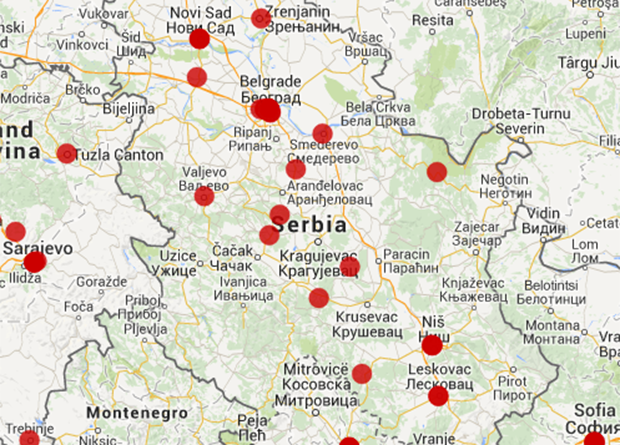
Five media outlets targeted with DDoS attacks
Protesters criticise cancellation of political talk shows
Deputy mayor fined for insulting journalist
Macedonian journalist released from extradition detention
Photographer injured by anti-pride parade protesters
This article was originally posted on 29 October at indexoncensorship.org
16 Oct 2014 | News, Politics and Society, Religion and Culture, United Kingdom
Thirty years ago this week a bomb exploded in the Grand Hotel, Brighton, where the then prime minister, Margaret Thatcher, and much of her cabinet were staying during Conservative party conference.
The bomb had been planted a month previously by IRA member Patrick Magee, with the intention of assassinating the prime minister. Thatcher escaped, but others did not. Five party members died. Others, including Margaret Tebbit, wife of Thatcher’s rottweiller Norman Tebbit, were left disabled.
The whereabouts of then-32-year old aspiring novelist Hilary Mantel at the time were not known, but we do now know that she herself was thinking about killing Thatcher as the IRA was planning the Grand bombing.
Last week, at the Royal Festival Hall, a solid concrete building that looks as if it could survive the combined explosive attentions of the IRA, Al Qaeda and a reanimated Fred Dibnah, Mantel discussed her own Thatcher assassination plot, which was published this year in the form of a short story that she had started over 3 decades ago.
“People have worked so hard to take offence at this story,” the Wolf Hall author pointed out, adding mischievously, “If only they would go through my extensive back catalogue it would keep them in fury for the rest of their lives.”
Mantel’s assassination fantasy is an enjoyable piece of suburban noir in which an IRA sniper attempts to use a Windsor woman’s window as a hide to take a shot at Thatcher. It’s interesting in that one finds the narrator and the gunman jockeying for position about their right to revile Thatcher as they do: who is more Irish? who is more Northern? Who is more affected by this terrible woman?
But ultimately it’s an almost Tales-Of-The-Unexpectedish story about extraordinary things happening to ordinary people.
Mrs Thatcher’s friend Lord Bell was horrified by Mantel’s story and her subsequent interview in The Guardian, where Mantel described seeing Thatcher leaving the hospital in 1983, saying that “if I wasn’t me, if I was someone else, she’d be dead”. Lord Bell angrily announced: “If somebody admits they want to assassinate somebody, surely the police should investigate. This is in unquestionably bad taste.”
The Daily Mail’s Stephen Glover was equally apoplectic: “Mantel’s contribution is peculiarly damaging because, while she appears so mild-mannered, her message is interpretable as a deadly one. If you don’t like your democratically elected leaders, who operate within the rule of law, you can always think about assassinating them.”
What Bell and Glover both seem to have failed to grasp here is the difference between thinking about something and doing it, or even the difference between thinking about doing something and plotting to do it.
Thinking about doing things one would not normally do is often known as “imagining”, and is quite crucial to the creative process. It’s an essential part of humanity that we can think beyond ourselves. It’s what allows us to empathise and sympathise; we may not be familiar with a specific set of circumstances, but we can, at least in part, imagine what it would be like to be placed in certain circumstances. I have never been homeless, but I can imagine that I wouldn’t like it. I can even imagine what might go through the head of someone I profoundly disagree with.
It was by sheer coincidence that the night before Mantel spoke at the Royal Festival Hall, Salman Rushdie received the PEN Pinter prize at the British Library.
While Mrs Thatcher was still prime minister, Rushdie’s imagination got him into rare trouble when he published the allegedly “blasphemous” Satanic Verses. Whether the allegation of blasphemy was correct or not, is, by the way, irrelevant. That suggestion would not validate the non-publication of a book, and certainly would not justify the murder contract put out by the supreme leader of Iran, Ayatollah Khomeini, in February 1989.
Rushdie’s western critics then often couched their criticisms in terms that emphasised their empathy with the “Muslim anger” which gave rise to protests across the world and eventually the Ayatollah’s incitement to murder; they understood, they implied. They too, had been hurt. Mrs Thatcher herself (characterised as “Mrs Torture” in the book) said: “We have known in our religion people doing things which are deeply offensive to some of us and we have felt it very much.”
The Archbishop of Canterbury, Robert Runcie, commented: “I well understand the devout Muslims’ reaction, wounded by what they hold most dear and would themselves die for.”
No mention of being able to well understand or even imagine what it might be like to be on the end of protests, to see your effigy burned in anger across the world.
In his speech at the British Library, Rushdie described one of the worst aspects of the onslaught against his imaginative work; the need to counteract the ignorant prescriptions of The Satanic Verses by those who wanted to have him censored and worse.
“Once the attack was fully underway,” said Rusdhie, “I felt obliged for a long time to fight back against the creation of that false version of The Satanic Verses by offering counter-explanations of my own. I loathed doing it, and often felt that by offering the almost line by line defence that seemed necessary I was damaging the kind of open, private reading of my novel for which, like every writer, I had hoped.”
After Rushdie spoke, a remarkable speech from International Writer of Courage winner Mazen Darwish was read out. Darwish, founder of the Syrian Centre for Media and Freedom of Expression, is currently in a regime jail in Damascus, faced with charges of “publicicing terrorism”. He somehow managed to smuggle a letter to London.
Addressing Rushdie directly, he offered a startling apology for the inaction of many people in the Middle East at the time of the fatwa, saying their indifference was tantamount to collusion to murder.
Drawing a line between the censorship of 1989 and the rise of the Islamic State in Syria today, Darwish lamented: “What a shame this much blood has had to be spilled for us to realise, finally, that we are digging our own graves when we allow thought to be crushed by accusations of unbelief, calling people infidels, and when we allow opinion to be countered with violence.”
Not, bear in mind, the extrapolations of a north London liberal, but a man in prison who knows acutely the price of standing up for the individual, for empathy, and for free expression. Words to bear in mind the next time we’re tempted to embark on a collective outrage against words and thoughts and imagination itself.
This article was posted on 16 October 2014 at indexoncensorship.org