29 Oct 2014 | Europe and Central Asia, News, Serbia
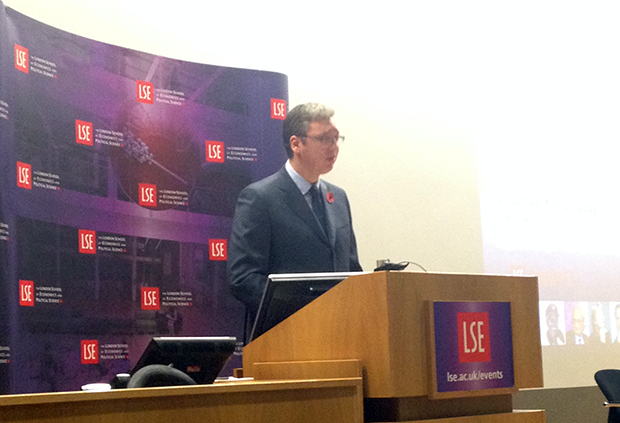
Serbian Prime Minister Aleksandar Vucic speaking at LSE (Photo: Milana Knezevic)
It wasn’t quite a remote controlled drone carrying a provocative political message, but Serbian Prime Minister Aleksandar Vucic’s Monday night lecture at the London School of Economics (LSE) came with its own controversial incident.
“What can you say about the total censorship of all opposition media”, Vucic was asked by a young woman in the audience just as the premier sat down for the question and answer portion of the event. She explained that she was representing Nikola Sandulovic, an opposition politician from the Serbian Republican Party, who was sitting beside her. Sandulovic said later he had travelled to London to confront Vucic.
Chaos ensued. Sandulovic claimed, among other things, that a police officer connected to Vucic had threatened to kill him and that he had evidence contained on a CD he held aloft. Vucic hit back that the Republican Party had only 0.01% of public support, and disputed Sandulovic’s assertion that he had been an adviser to former Serbian Prime Minister Zoran Djindjic, who was assassinated in 2003. Accusations flew across the room until LSE’s moderator James Ker-Lindsay finally managed regain control of the situation.
After the event, Sandulovic told Index he came to London because the media in Serbia ignore him and his party, apart from when government-friendly outlets attack him.
That press freedom was a popular topic on the night did not comes as a surprise. Serbia has seen a string of censorship incidents during Vucic’s time in power, as Index and many others have reported.
The prime minister himself brought up the press in his introductory lecture. He explained how his government has passed several new laws aimed at improving the media landscape, and complained that despite this, they are “scapegoated”. He directly addressed the recent controversial cancellation of a political talk show, Utisak Nedelje (Impressions of the Week), saying authorities have been subjected to a blame campaign for what was a commercial decision. Supporters of the show, including host Olja Beckovic, say it was down to political pressure.
In a joking reference to his infamous role under Slobodan Milosevic, he said he had been the “worst minister of information”. Curiously, he also used this former job as a counterargument to critics, arguing that his past had made it easy to blame him for any instance of censorship.
But this didn’t seem to stop the press-related questions, though none of the journalists present were chosen to ask one. Apart from the memorable Sandulovic intervention, an audience-member pointed out that Utisak Nedelje wasn’t the only show to have been taken off air in recent times.
If there was an overarching theme to the night, it was that it seemed to showcase different — some would say conflicting — sides of Vucic and his administration. He reminded the audience that Belgrade had recently organised a successful Pride parade, before adding that he didn’t want to attend. To have that choice, he argued, was a real mark of freedom.
There were, of course, questions about the football drone. While Vucic said he didn’t want to share his own views, he said UEFA (European football’s governing body) saw Serbia’s side of the story by awarding them the win, before pointing out that Serbia carries its share of the responsibility. The planned state visit from Albanian Prime Minister Edi Rama — the first in 68 years — will go ahead, he also confirmed, despite the post-drone postponement.
In response to questions about relations with Russia — just weeks after the Belgrade military parade where Vladimir Putin was the guest of honour — he said the two countries would continue to build their relationship, but that this would have no impact on Serbia’s ultimate goal of European Union accession.
Much has been made of Vucic’s apparent journey from Milosevic man to EU enthusiast. He seemed to reference this as he said he is “not perfect” and that he works “every single day” to change and better himself. But on Monday, he left more questions than answers about the direction he is taking Serbia in.
Mapping Media Violations in Europe: Serbia
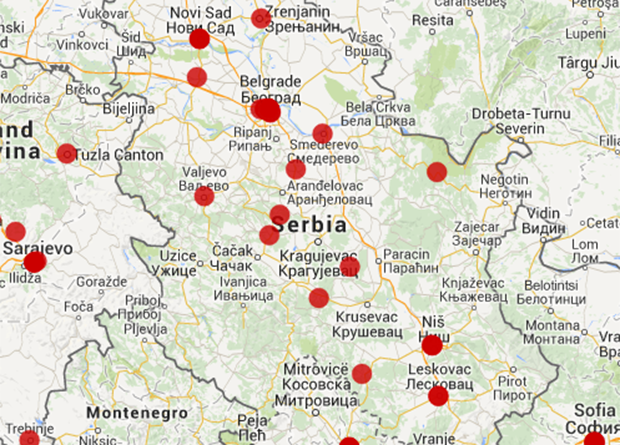
Five media outlets targeted with DDoS attacks
Protesters criticise cancellation of political talk shows
Deputy mayor fined for insulting journalist
Macedonian journalist released from extradition detention
Photographer injured by anti-pride parade protesters
This article was originally posted on 29 October at indexoncensorship.org
16 Oct 2014 | News, Politics and Society, Religion and Culture, United Kingdom
Thirty years ago this week a bomb exploded in the Grand Hotel, Brighton, where the then prime minister, Margaret Thatcher, and much of her cabinet were staying during Conservative party conference.
The bomb had been planted a month previously by IRA member Patrick Magee, with the intention of assassinating the prime minister. Thatcher escaped, but others did not. Five party members died. Others, including Margaret Tebbit, wife of Thatcher’s rottweiller Norman Tebbit, were left disabled.
The whereabouts of then-32-year old aspiring novelist Hilary Mantel at the time were not known, but we do now know that she herself was thinking about killing Thatcher as the IRA was planning the Grand bombing.
Last week, at the Royal Festival Hall, a solid concrete building that looks as if it could survive the combined explosive attentions of the IRA, Al Qaeda and a reanimated Fred Dibnah, Mantel discussed her own Thatcher assassination plot, which was published this year in the form of a short story that she had started over 3 decades ago.
“People have worked so hard to take offence at this story,” the Wolf Hall author pointed out, adding mischievously, “If only they would go through my extensive back catalogue it would keep them in fury for the rest of their lives.”
Mantel’s assassination fantasy is an enjoyable piece of suburban noir in which an IRA sniper attempts to use a Windsor woman’s window as a hide to take a shot at Thatcher. It’s interesting in that one finds the narrator and the gunman jockeying for position about their right to revile Thatcher as they do: who is more Irish? who is more Northern? Who is more affected by this terrible woman?
But ultimately it’s an almost Tales-Of-The-Unexpectedish story about extraordinary things happening to ordinary people.
Mrs Thatcher’s friend Lord Bell was horrified by Mantel’s story and her subsequent interview in The Guardian, where Mantel described seeing Thatcher leaving the hospital in 1983, saying that “if I wasn’t me, if I was someone else, she’d be dead”. Lord Bell angrily announced: “If somebody admits they want to assassinate somebody, surely the police should investigate. This is in unquestionably bad taste.”
The Daily Mail’s Stephen Glover was equally apoplectic: “Mantel’s contribution is peculiarly damaging because, while she appears so mild-mannered, her message is interpretable as a deadly one. If you don’t like your democratically elected leaders, who operate within the rule of law, you can always think about assassinating them.”
What Bell and Glover both seem to have failed to grasp here is the difference between thinking about something and doing it, or even the difference between thinking about doing something and plotting to do it.
Thinking about doing things one would not normally do is often known as “imagining”, and is quite crucial to the creative process. It’s an essential part of humanity that we can think beyond ourselves. It’s what allows us to empathise and sympathise; we may not be familiar with a specific set of circumstances, but we can, at least in part, imagine what it would be like to be placed in certain circumstances. I have never been homeless, but I can imagine that I wouldn’t like it. I can even imagine what might go through the head of someone I profoundly disagree with.
It was by sheer coincidence that the night before Mantel spoke at the Royal Festival Hall, Salman Rushdie received the PEN Pinter prize at the British Library.
While Mrs Thatcher was still prime minister, Rushdie’s imagination got him into rare trouble when he published the allegedly “blasphemous” Satanic Verses. Whether the allegation of blasphemy was correct or not, is, by the way, irrelevant. That suggestion would not validate the non-publication of a book, and certainly would not justify the murder contract put out by the supreme leader of Iran, Ayatollah Khomeini, in February 1989.
Rushdie’s western critics then often couched their criticisms in terms that emphasised their empathy with the “Muslim anger” which gave rise to protests across the world and eventually the Ayatollah’s incitement to murder; they understood, they implied. They too, had been hurt. Mrs Thatcher herself (characterised as “Mrs Torture” in the book) said: “We have known in our religion people doing things which are deeply offensive to some of us and we have felt it very much.”
The Archbishop of Canterbury, Robert Runcie, commented: “I well understand the devout Muslims’ reaction, wounded by what they hold most dear and would themselves die for.”
No mention of being able to well understand or even imagine what it might be like to be on the end of protests, to see your effigy burned in anger across the world.
In his speech at the British Library, Rushdie described one of the worst aspects of the onslaught against his imaginative work; the need to counteract the ignorant prescriptions of The Satanic Verses by those who wanted to have him censored and worse.
“Once the attack was fully underway,” said Rusdhie, “I felt obliged for a long time to fight back against the creation of that false version of The Satanic Verses by offering counter-explanations of my own. I loathed doing it, and often felt that by offering the almost line by line defence that seemed necessary I was damaging the kind of open, private reading of my novel for which, like every writer, I had hoped.”
After Rushdie spoke, a remarkable speech from International Writer of Courage winner Mazen Darwish was read out. Darwish, founder of the Syrian Centre for Media and Freedom of Expression, is currently in a regime jail in Damascus, faced with charges of “publicicing terrorism”. He somehow managed to smuggle a letter to London.
Addressing Rushdie directly, he offered a startling apology for the inaction of many people in the Middle East at the time of the fatwa, saying their indifference was tantamount to collusion to murder.
Drawing a line between the censorship of 1989 and the rise of the Islamic State in Syria today, Darwish lamented: “What a shame this much blood has had to be spilled for us to realise, finally, that we are digging our own graves when we allow thought to be crushed by accusations of unbelief, calling people infidels, and when we allow opinion to be countered with violence.”
Not, bear in mind, the extrapolations of a north London liberal, but a man in prison who knows acutely the price of standing up for the individual, for empathy, and for free expression. Words to bear in mind the next time we’re tempted to embark on a collective outrage against words and thoughts and imagination itself.
This article was posted on 16 October 2014 at indexoncensorship.org
2 Oct 2014 | Europe and Central Asia, News, United Kingdom
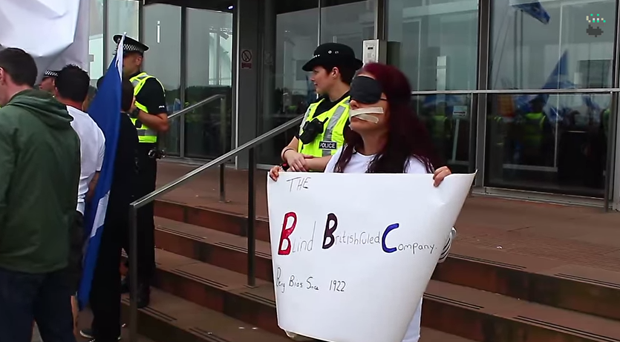
Supporters of Scottish independence protested against alleged BBC bias ahead of the referendum on 18 September (Image: Mishka Burr/YouTube/Creative Commons)
Benito Mussolini wrote romantic fiction. Of course he did. Maudlin sentimentality is at the very heart of fascism, which is why we should be keeping a closer eye on Mrs Brown’s Boys.
The Cardinal’s Mistress (or to give it its typically grandiose full title: Claudia Particella, Lamante del Cardinale, Grande Romanzo dei Tempi del Cardinale Emanuel Madruzzo) was written in the first decade of the 20th century, when the future dictator was still playing with socialism before he came up with his big idea. It was originally published as a serial in La Vita Trentina, the weekly supplement of socialist newspaper Il Popolo.
Reviewing an English translation of the work in 1928, Dorothy Parker, who admits to er, struggling with the book, dreamed of a scene “in which I tell Mussolini ‘And what’s more, you can’t even write a book that anyone could read. You old Duce you,’” before deadpanning, “You can see for yourself how flat that would leave him.”
It’s unclear whether or not Mussolini was left flat, or even read Parker’s New Yorker magazine review. But it’s possible to imagine that the negative review haunted him to the very end, that Il Duce spent his last days still pondering whether to write an angry letter to the New Yorker, pointing out that since Parker had admitted that she HADN’T EVEN FINISHED THE BOOK, it was a SERIOUS LAPSE of journalistic and critical standards to even run the review, and a sign of how a ONCE GREAT publication had been given over to cheap jibes and sarcasm instead of proper discussion of literary works [and so on, ad lamppostium].
One can imagine his supporters on Twitter, furiously @-ing the poor Parker: “Call yourself a journalist? #NewYorkerBias”, “MSM once again Misreprasents #IlDuce. #NoSurprise (@medialens)”, “So apparently this ‘Parker’ woman is actually a ROTHSCHILD? #BoycottNewYorker”, and so on and on and on and on and wearily on.
You know the kind of thing, because we see it every week now. The dull, thudding obsession with the idea that the media, or a section of the media is involved in some enormous conspiracy against you and your views, and subsequently the belief that that is the only reason not everyone shares your views.
The Scottish independence referendum was a case in point. Yes supporters became curiously obsessed with the BBC’s Nick Robinson and his apparent conservative sympathies. Now, Robinson, like many BBC hacks before him, (Andrew Marr? Socialist Organiser; Paul Mason? Workers’ Power; Jennie Bond? Class War), was politically active in his youth, rising to be president of the equal parts hilarious and horrendous Oxford University Conservative Association. This, plus a terse exchange between Robinson and Scottish Nationalist leader Alex Salmond over a media conference question Robinson felt Salmond had not answered properly, led to hundreds of nationalists converging on BBC Scotland’s headquarters claiming the BBC was biased against them and demanding, well, something.
This was bad enough, but they were egged on by Salmond himself, who said he thought there was “real public concern in terms of some of the nature and balance of the coverage”.
Calls for “balance” are almost always, in fact, calls for more-of-my-side and less-of-the-opposition. This was beautifully demonstrated by the number of complaints logged against the BBC in August about the most recent Israel-Palestine conflict. That month, 938 people complained that the BBC’s coverage was too favourable to the Palestinians, while 813 felt it the corporation was too favourable to the Israeli side. (Incidentally, in the same month over 350 people complained that the BBC had been too pro-independence in its broadcast of a Scottish referendum debate.)
The most embarrassing spectacle of the entire referendum came the days after the vote, when the nationalists had lost. The SNP sulkily decided they would bar right-wing, pro-union newspapers from the morning media conference. Salmond allegedly then tried to handpick which reporter from The Guardian would be allowed attend. The Guardian, doubly affronted by the ban on their press pack colleagues and Salmond’s demands upon it, rightly told Salmond they would skip the conference altogether.
The SNP are far from the only people to think they can demand good coverage and prevent dissent. Mark Ferguson, of the left-wing, trade-union-supported website Labour List, was recently informed that he would not be given a press pass for the Conservative party conference in Birmingham. It was only after other journalists raised their objections via Twitter that the Conservative party relented. It’s probably true to say that the Labour blogger’s coverage would not be the most pro-Tory, but that’s really not the point.
Meanwhile, in the wide world of sport, Newcastle United’s controversial owner owner Mike Ashley has decided that the Daily Telegraph’s Luke Edwards (and anyone else from the Telegraph, for that matter) will not be allowed near the club’s ground again, after Edwards reported rumours that Ashley may be seeking to sell the club.
There is an argument that Ashley generates enough bad publicity for himself without the assistance of apparently hostile journalists (Ashley recently caused confusion after telling a reporter with The i newspaper that club manager Alan Pardew would be “finished” and “dead” if Newcastle lost their next game), but that doesn’t make the move any less thin-skinned and censorious.
Football has form on this. Sir Alex Ferguson may have been the greatest manager of the modern era, but he was also so petty as to refuse to talk to the BBC for seven years after he objected to a documentary about his son aired by the national broadcaster.
Perhaps this tetchiness is what’s needed to get ahead, but it feels increasingly like a retreat from argument, and a retreat from the idea of open debate and a robust public sphere. We won’t accept arguments counter to our own, and if those arguments prove more popular than ours, it is not because ours may need rethinking. No, it is because the world is biased against us. We’re either being silenced by the metropolitan liberals, or censored by the public school Tory elites. Our public conversation is in danger of becoming a public whinge.
Correction 15:40, 2 October: An earlier version of this article stated that Paul Mason was in Workers’ Hammer.
This article was published on Thursday 2 October at indexoncensorship.org
25 Sep 2014 | News, Religion and Culture, United States
(Photo: Shutterstock)
For us jaded Europeans, the United States’ first amendment, with its simple pledge that the government will keep out of the business of religion and censorship, seems as stubbornly, oafishly American as Hulk Hogan. It’s a loud tourist with a bumbag, wasting his money in an Angus Steakhouse; it’s Burt Reynolds’ moustache; it’s Jane Russell’s specially-constructed brassiere; it’s brash and unsubtle and does not do nuance.
Which is why we’re so ready to accept the idea that a US court has decided that the first amendment concept of free speech trumps all, even sexual harassment. Especially if that court is in Texas, the bit, we imagine, that makes the rest of the United States look sophisticated.
“Texas court upholds right to take ‘upskirt’ pictures”, said the Guardian, while the Independent tweeted “You’re legally allowed to take upskirt pictures in Texas because it’s ‘freedom of expression’” (note the scare quotes).
The stories under the headlines concerned a ruling by the Texas Court of Criminal Appeals in a case concerning a man named Ronald Thompson.
Thompson had been caught taking pictures of children and women at a water park in San Antonio, focusing on what I believe is called the “bikini area”. Thompson reportedly tried to delete the photos as he was apprehended. He was indicted on 26 counts under Texas’ “improper photography or visual recording” law.
Thompson appealed the indictments on the grounds that the law was incompatible with the first amendment. The court agreed with him, leading to the headlines across the world. Most reports, including, it should be said, the American ones, went hard on the “upskirt” or “creepshot” angle, declaring it was now entirely legal to well, be a creep with a camera in Texas.
Is it really? Well, sort of, ish.
The judgement issued by the court is a genuinely fascinating read for anyone interested in free expression, far from the gun-toting, sexual harassment-ignoring, good ole boy decision it has been represented as. It involves discussion about what constitutes the public realm and the nature of consent. It goes into some detail as to whether the act of photography is in itself creative expression, and decides it is.
Some commentators, such as Salon’s Jenny Kutner have picked up on the wording in the judgment suggesting that “Protecting someone who appears in public from being the object of sexual thoughts seems to be the sort of ‘paternalistic interest in regulating the defendant’s mind’” as evidence of a court being more interested in a pervert’s right to perv than a woman’s right not to be harassed.
But it’s actually a point well worth making. Courts and governments cannot be involved in what people find sexually arousing in their imaginations; it’s only if actions cause harm to others that the law should intervene.
This is not, then, a ruling taken lightly. Rather it reviews very seriously a badly written law.
The law itself, section 21.15 of the Texas Penal Code, reads as follows:
(b) A person commits an offense if the person:
(1) photographs or by videotape or other electronic means records, broadcasts, or transmits a visual image of another at a location that is not a bathroom or private dressing room:
(A) without the other person’s consent; and
(B) with intent to arouse or gratify the sexual desire of any person;
The “bathroom or private dressing room” exclusion seems weird, but is only there because the next clause specifically refers to bathrooms and private dressing rooms, presumably drafted in light of some kind of Chuck Berry scenario (the guitar legend was accused of secretly taping people using bathrooms in his Missouri restaurant).
The problem is that this is far too broadly drawn as a law, but also weirdly specific. What it does not address at all is what might be a reasonable expectation of privacy in public: it is not a serious argument to suggest that one must always actively give consent to being photographed in public space. But it is reasonable to expect that no one should be taking upskirt pictures of you: the judgment acknowledges as much, specifically mentioning upskirt photographs as an “intolerable” breach of privacy.
The weird specificity comes with the “sexual desire” bit; why is this kind of thought worse than any other? Shouldn’t the focus be on the breach (or not) of privacy, rather than what thoughts the images might lead to? Apart from the argument over whether photography is an act of expression, it is this clause that raises free expression problem with the law: put simply, the human mind is capable of eroticising pretty much anything. Any kind of picture could “arouse or gratify the sexual desire of any person”. Once again, the focus is in fact taken away from the act of breaching privacy and towards the act of expression.
In spite of initial appearances, the Texans have done a good thing here. The state will now have to come up with a law that properly balances privacy and free expression, rather than giving just piecemeal thought to either concept.
First amendment cases often solicit astonished responses. But more often than not, a first amendment consideration isn’t just free expression rolling into town in its monstrous, burger chewing, gasoline drinking, Okie from Muskogee way. No. More often than not, the first amendment forces some real thought and analysis to take place in public life.
This article was posted on Thursday, September 25, 2014 at indexoncensorship.org