26 Jun 2014 | Azerbaijan, Azerbaijan News, News
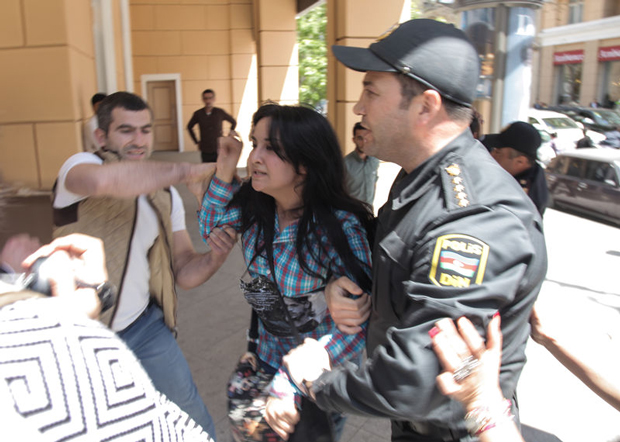
The Baku Court of Grave Crimes announced the verdict for the NIDA movement activists in May 2014. The human rights defenders Rashadat Akhundov, Zaur Gurbanly and Ilkin Rustamzadeh to 8 years’ imprisonment, Rashad Hasanov and Mamed Azizov – to 7.5 years. Protesters were detained and victimised by police. (Photo: Aziz Karimov / Demotix)
In a bleakly comic turn at the beginning of Ilham Aliyev’s address to the Parliamentary Assembly of the Council of Europe this week, Assembly president Anne Brasseur asked press photographers to leave the chamber and reminded those present that they were not permitted to vocalise their approval or disapproval during the Azerbaijani dictator’s stand. It appeared that Brasseur hadn’t quite meant what she said, as in the end photographers at the front of the room were merely required to move their tripods to ensure everyone in the room could see Aliyev as he spoke.
Aliyev’s speech was given to mark the Azerbaijan’s taking up of the chair of the Council of Europe’s Committee of Ministers last month. And what a speech it was!
The man who promises to “turn initiatives into reality” (still no idea) told of Azerbaijan’s enormous progress in all fields, not just oil fields. He spoke of the country’s “very positive atmosphere” and listed the country’s great freedoms: freedom of political activity, freedom of expression, freedom of media… Azerbaijan was proud of these freedoms, he said. Azerbaijan knew that an uncensored internet and independent newspapers were important for democracy.
It was a lovely speech, and also one that contained barely a word of truth beyond the conjunctions. Aliyev may as well have praised the nation’s Quidditch team for defeating Ravenclaw on penalties at the World Cup. He could have told us about his new motorcar, and his adventures with Ratty, Mole and Badger, and been more believable.
Watching Aliyev, the only time one got the sense he even believed what he was saying himself was when discussing the disputed territory of Nagorno-Karabakh, and even then he was only drily insisting that the regions “geographical toponyms” (place names?) were Azeri in origin: All Your Geographical Toponyms Are Belong To Us, so to speak.
The truth about Azerbaijan is quite different from the picture painted by its president this week. As Human Rights Watch pointed out ahead of the Council of Europe speech, “In the past two years, Azerbaijani authorities have brought or threatened unfounded criminal charges against at least 40 political activists, journalists, bloggers, and human rights defenders, most of whom are behind bars.” Search for Azerbaijan stories on Index, and you will find more details of those arrests and abuses.
And this isn’t exactly obscure knowledge. People know three things about Azerbaijan: it has a lot of gas and oil; it takes Eurovision very seriously; and it has a poor human rights record. After his speech, Aliyev was confronted by Michael McNamara of the CoE socialist group, who quoted Amnesty’s statistic that there are currently 19 political prisoners in Azerbaijan. Not so, said Aliyev. There are no political prisoners in Azerbaijan. The people who came up with these statistics were lying. There was a programme of “deliberate provocation” against Azerbaijan — though it was unspecified who was leading this programme.
Aliyev swore that this plot to undermine Azerbaijan would fail.
The Azerbaijani president is not alone in his capability for bare-faced falsehood. It’s a specific strain of Soviet and post-Soviet behaviour, learned from the Communist Party and the KGB. If the leader says something, it is true, no matter what the evidence to the contrary. There are no political prisoners in Azerbaijan, says Aliyev, and we encourage a free media because it is important to our democracy; Ukraine has been taken over by fascists, says Vladimir Putin, and Russia has no choice but to fight them. There is no point in putting on a play about depression in Belarus, an Alexander Lukashenko apparatchik tells the Belarus Free Theatre, because there is no such thing as depression in Belarus.
“So what?” you may say. “Politicians and institutions lie.” And you’d be right. But this is a form of lying that goes far beyond “I was perfectly within my rights to claim those expenses”/”I did not have sex with that woman”. Political lies in functioning democracies tend to have to do with cover ups of personal or institutional failings. In an authoritarian society, with power utterly concentrated to the leader and his cadre, there is no such thing as an isolated failure. As a result, every aspect of life must be spun. All triumphs belong to the leader, all criticisms are propaganda, all failures sabotage. When there is no balance of power, is there really an objective truth? When, for example, the dictator Lukashenko told a journalist that journalist Irina Khalip, under house arrest, could leave Belarus any time she wanted, was that actually true? Was it true the moment he said it? Did it become true after he said it? And did it remain true?
This state of things raises a question for those of us seeking to better the lot of people living under regimes such as Belarus and Azerbaijan: can we pounce on the moments when autocrats declare as fact something we know to be untrue, cling on until they actually make it true? Or does this merely confirm the idea that truth is whatever their whim makes it?
This article was posted on June 26, 2014 at indexoncensorship.org
20 Jun 2014 | News, Volume 43.02 Summer 2014
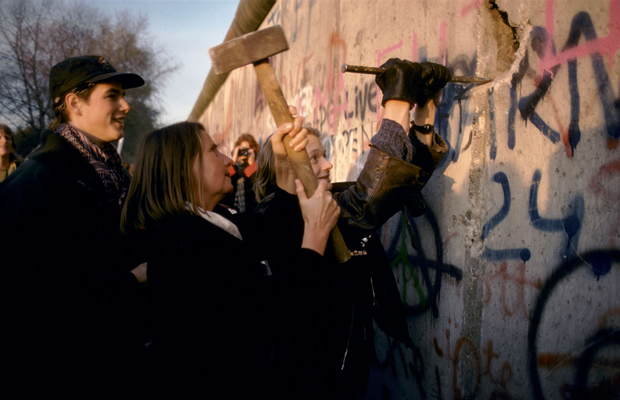
A woman chips away at the Berlin Wall, November 1989. Credit: Justin Leighton / Alamy
Our latest issue of Index on Censorship magazine includes a look at “Generation Wall” – the young people who grew up in a free eastern Europe. Tymoteusz Chajdas, 23, from Poland, is one of our contributors. Here, he looks back at what has changed and remembers his family’s excitement when packages arrived from an uncle in the West
The delivery of a package, the size of a small fridge, from abroad was rare in 1980s Poland. My family was fortunate enough to have this privilege. Every month, my two-year-old sister, Joanna, sat on the rubber flooring in the hallway of our two-bedroom apartment. She waited for a package from Jerzy, my uncle who lived in Cologne, West Germany.
The unpacking was always an occasion. But my parents have a particularly strong memory of the first time a package was delivered. When the postman arrived, Joanna opened the box and immediately started playing with the contents. “Balls. I’ve got so many! Come play with me!” It was the first time my sister had seen oranges.
This was the reality of that time. Poland became isolated from the rest of Europe when the Soviets erected the Berlin Wall in 1961. The ideals of liberty, freedom and democracy remained unattainable for an average Pole for the next 28 years. Some only experienced these ideals remotely by having family in the West, and occasionally receiving “samples” of what Western life was like.
Over on the eastern side of the wall, Poles couldn’t buy basic material goods easily, such as food or hygiene products. Large chunks of everyday life consisted of tedious searches and hours standing in long lines to buy essentials. Store shelves were frequently empty, and it seemed the only item always in stock was vinegar. Even if a product was available, it could only be purchased upon presentation of a ration card.
“Jerzy was devastated by this,” says my mother, Jadwiga, talking about her brother. In 1979, my uncle was invited by a friend for a three-week holiday in the Netherlands. After two weeks, Jerzy decided to stay on the other side of the wall. He applied for political asylum and never came back.
“He could stay there under one condition: he had to reject Polish citizenship,” she tells me. “So he did. Within two years he started sending us food and clothing.”
A few years later, another relative of ours emigrated to the United States. While the Berlin Wall divided Europe into two worlds,
Poles could not reveal any connections they had with the West. It was around this time my father started his career at the Silesian Police Department.
“We started to fear our own shadows,” says my mother, remembering that having family in the West was both a blessing and curse. Any association with capitalist Europe posed a threat to the authorities of communist Poland and was seen as political espionage and violation of the communist ideology. “[Your father] had to renounce family mem- bers living in the West if he wanted to stay employed,” says my mother. “Our phone was tapped so we had little contact with them.”
Despite this, my family still received packages. Only those who worked two jobs or were communist party members could afford to live comfortably, so my mother had to lie about her income to cover up for the extra goods we received from relatives abroad.
Less privileged Poles had little or no un- derstanding of what life looked like on the other side of the Iron Curtain. Jolanta Sudy, a high school teacher and family friend, re- members those times very well. She says the majority of Poles were victims of communist propaganda and were unaware of what was happening in their own country.
“As far as censorship is concerned, the Soviets presented the Eastern Bloc as an El Dorado where everything was perfect and no problems existed,” she says. The government spread its ideology through newspapers, magazines, books, films and theatre productions. Popular radio and tel- evision broadcasts were also censored and reinforced the views of the communist party.
Every year on 1 May, all Polish citizens were obliged to attend a street parade celebrating the International Worker’s Day. A register of attendance was kept.“It looked like a country fair or circus,” recalls Sudy. “Everyone was dressed up to show how joy- ful it was to live in Poland, how happy we were because of the socialist system. But the party stood above us with a whip.”
The elections worked similarly and at- tendance was also mandatory. Many saw them as an ironic spectacle organised by the authorities. The ballot paper featured only one name. “I always signed the register but I never put the card in the box,” says Sudy. “This was my battle with communism.”
Such oppression, constant fear and invigilation had a strong influence on the Poles. Some listened to Radio Free Europe, which broadcast unbiased news from Western countries.
In 1989 the situation changed drastically: the Berlin Wall was torn down.
“The store shelves filled up again with foreign goods,” says my mum. “Travel agents started organising vacations to other coun- tries. This was very difficult before then.”
Some Poles found the change shocking. Sudy says that, after the fall of the Berlin Wall, the amount of uncensored news was overwhelming. “It was hard to believe that we could have lived differently since the end of World War II.”
The overturn of the uniform culture of communist Poland gave birth to a cul- tural explosion which had skillfully been repressed by the Soviets. Free expression in the arts in Poland did not exist during the communist period, according to Kasia Gasinska, a 24-year-old graphic designer. Some Polish citizens listened to music from non-authorised radio stations but it was only “after the wall fell down that [Polish] art became liberated,” recalls Gasinska.
Gasinska says that Western music suddenly became available in Poland, and Poles set up new bands. “New music genres were introduced, such as rave or techno, which embodied the feeling of freedom shared by many at the time.”
The collapse of communism also brought with it one of the most powerful artistic forms – street art, says Gasinska. Many Poles made the journey to the remnants of the Berlin Wall where they could freely express themselves through graffiti.
This expanded as an artistic movement to major cities in Poland. Lodz, the third largest city and a post-industrial centre, became one of many hubs for street art, famous for its colourful murals and playful graffiti that covered many bleak estates.
olish cinema was liberated from communist propaganda as well. There were new movies that referred to the Polish romantic ideals of the previous epoch, as well as comedies and films that dealt with everyday life in the wake of the political transformation.
Today, the events that led to the dismantling of the Berlin Wall seem like a distant memory for many young Poles, myself included. I was born in 1990 and I only learnt about those times by listening to the stories my parents told. Some were scary, some funny. But mostly, they feel unreal, as does the idea of getting shot at for attempting to cross the western border.
Although the Berlin Wall was torn down 25 years ago, divisions can still be felt. An in- visible wall divides us into those who are too young to remember and those who suddenly woke up in a capitalist country. Some made up for the lost time and found themselves in the new system. Others still tend to talk about the good old communist times when the pace of life was less hectic.
But even these Poles wouldn’t deny that the Berlin Wall has become a symbol of an unrealistic system, gradual economic decline and political oppression. Today, its ruins remind me of the adversities many eastern Europeans had to go through to experience living in a free, democratic country. Few remember that, at the time, only hope kept the Poles dreaming of a better life.
My mother told me that when she was a child, she received a present from her friend who was leaving for West Germany. “It was a pair of knee-high socks with blue and red stripes at the top. Today, I would say they were unsightly,” she says. “But back then, I wore them every day. Every time I looked at them, I promised myself that it was going to be better one day.”
This article appears in the summer 2014 issue of Index on Censorship magazine. Get your copy of the issue by subscribing here or downloading the iPad app.
20 Jun 2014 | Egypt, News, Politics and Society
 It is still hot in the shade of the palm trees and stuccoed buildings on the American University in Cairo’s (AUC) downtown campus. Groups of refugees sit around on wicker chairs.
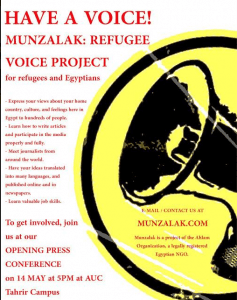
Everyone is here to learn about journalism. Munzalak is a new organization that aims to get refugees living in Egypt involved in the media and in command of their own voice. The name translates to “your comfortable place,” like a home from home – the one you were forced to leave.
Every weekend Munzalak hires out a room at AUC. Refugees are invited to come along and learn the basics of journalism for free. Aurora Ellis, a news editor for an international news agency, runs the workshops with aim of producing “articles that deal with refugee issues and with the refugee experience.”
The ultimate aim is to give refugees a space to voice their experiences. A blog on Munzalak’s website publishes pieces written by refugees (with the option of writing under a pseudonym) while training goes on and – organizers hope – more people join.
Similar initiatives have existed. The Refugee Voice was a newspaper based in Tel Aviv run by African asylum seekers and Israelis inside Israel and founded in April 2011, but is no longer published. Radar, a London-based NGO, also trains local populations in areas around the world (including Sierra Leone, Kenya and India) with the aim of connecting isolated communities.
“We’re being given the opportunity to write about our experiences…I can write about my experiences, and interview other refugees about theirs,” says Edward, a Sudanese refugee who arrived in Cairo earlier this year.
“We have several basic problems – in housing, security, education and health.” He quietly tells stories of life in Egypt; harassment and assault in the streets and pervasive racism (even, he says, from some people who are there to help). “We live a separated life. We are here by force only.”
Ultimately, Edward wants to write a history of the Nuba Mountains, the war-torn area straddling the border between Sudan and South Sudan, where he was born in over 25 years ago. Edward carries a notebook with ideas for this book – scribbled notes of a people and culture disappearing; histories of war and exodus. Edward sees his journalism as self-preservation, telling stories that other people don’t want to be told. He most admires Nuba Reports, a non-profit news source staffed by Sudanese reporters, which aims to break reporting black-spots while humanitarian crises and fighting continues on the ground.
Some activists working alongside refugees see initiatives like this as an important way to break the silence.
“Before June 30, refugees were always neglected in the national media. They were only included [the media] if they were being used as scapegoats,” says Saleh Mohamed from the Refugee Solidarity Movement (RSM) in Cairo. Famous examples include right-wing TV host Tawfik Okasha calling for Egyptians to arrest and attack Syrian and Palestinian refugees on sight. Syrians and Palestinians arrested by security forces have been routinely referred to as “terrorists” by the authorities, a narrative often repeated verbatim by pro-regime newspapers. “Now I think the media wants to keep refugees in the shadows and not talk with them,” Mohamed adds. “You never hear about refugees.”
But Munzalak is not without its risks and challenges. Staying independent but still being able to attract funding and support is one thing. Another is security.
Last Sunday 13 Syrians were sentenced to five years in prison after protesting in March 2012 against Bashar al-Assad. They were charged with illegal assembly and “threatening…security [forces] with danger,” something the defendants all denied, according to state-run newspaper Al-Ahram. A UNHCR official last year had told Syrian refugees to stay away from domestic politics – a warning that could feasibly include journalism as well.
Although historically repressive towards journalists during the rule of Hosni Mubarak, the Supreme Council of the Armed Forces (SCAF) and the Muslim Brotherhood’s Mohamed Morsi, Egypt’s media landscape has taken a significant nosedive since the July coup. Several journalists have been killed in the violence; Mayada Ashraf, a young reporter for Al-Dostour became the latest casualty after she was shot in the head during a protest, allegedly by a police sniper; while reporters remain behind bars and on trial for doing their job.
So is it a good idea to get refugees involved?
Mohamed says that street reporting and visibly working as journalists could put refugees – like Edward – “in danger.” Their legal ability to work also depends on what refugee status they have.
“But otherwise they can talk about themselves rather than waiting for journalists to approach them instead…They definitely need a voice.” But for some refugees, other priorities come first.
Jomana is a 20-year-old Syrian refugee and media studies undergraduate, originally from Aleppo. She visited Munzalak once and liked the idea, but is more concerned about getting a job and paying her way than talking about her experiences – which, like so many Syrian refugees in Egypt nowadays, are harsh. Of almost 184,000 refugees living in Egypt, according to mid-2013 figures from the United Nations Refugee Agency (UNHCR), around 130,000 of that number are Syrians.
“I don’t have enough money to continue my studies so I will have to leave,” she explains plainly. Jomana’s home was bombed out during the war and they fled the country with just their passports, arriving in Cairo over two years ago. Eventually her father went back to Aleppo to try and restart his old factory, but returned to find rubble. He came back to Cairo to economic uncertainty, incitement and political instability. “Other people are going back to Syria and dying there. Those that stay [here] aren’t dying from bombing or from fighting…but from hunger.”
Munzalak might help, but for some refugees, not in the most crucial of ways.
“It means I can express my opinion freely,” Jomana says, “but will I get paid for my opinion?”
This article was published on June 20, 2014 at indexoncensorship.org
19 Jun 2014 | Azerbaijan Statements, Campaigns, Digital Freedom, Digital Freedom Statements
The following is a transcript of a joint oral statement, led by ARTICLE 19 and supported by several IFEX members, that was read aloud today, 19 June 2014, at the 26th UN Human Rights Council session in Geneva:
Thank you Mr. President,
Two years ago this Council affirmed by consensus that “the same rights that people have offline must also be protected online, in particular freedom of expression”.
In 2014, the outcome document of Net-Mundial in Brazil recognised the vital role of the internet to achieve the full realisation of sustainable development goals. 31 UN Special Rapporteurs recently affirmed that guaranteeing the free-flow of information online ensures transparency and participation in decision-making, enhancing accountability and the effectiveness of development outcomes.
Development and social inclusion relies on the internet remaining a global resource, managed in the public interest as a democratic, free and pluralistic platform. States must promote and facilitate universal, equitable, affordable and high-quality Internet access for all people on the basis of human rights and net-neutrality, including during times of unrest.
The blocking of communications, such as the shutdown of social media in Malaysia, Turkey, and Venezuela is a violation of freedom of expression and must be condemned. Dissent online must be protected. We deplore the detention of Sombat Boonngamanong in Thailand, who faces up to 14 years imprisonment for using social media to urge peaceful resistance to the recent military coup in the form of a three-finger salute.
One year after the Snowden revelations, this Council must recognise that trust in the internet is conditional on respect for the rights to freedom of expression and privacy online, regardless of users’ nationality or location. Any mass (or dragnet) surveillance, which comprises collection, processing and interception of all forms of communication, is inherently disproportionate and a violation of fundamental human rights.
The targeted interception and collection of personal data must be conducted in accordance with international human rights law, as set out in the necessary and proportionate principles. Critical and intermediate infrastructure must not be tampered with for this end, nor should any system, protocol or standard be weakened to facilitate interception or decryption of data.
ARTICLE 19 urges the Human Rights Council to take action to comprehensively address these challenges.
Thank you.
Signed,
ActiveWatch – Media Monitoring Agency
Africa Freedom of Information Centre
Albanian Media Institute
Arabic Network for Human Rights Information
ARTICLE 19
Association of Caribbean Media Workers
Bahrain Center for Human Rights
Cairo Institute for Human Rights Studies
Cambodian Center for Human Rights
Canadian Journalists for Free Expression
Center for Independent Journalism – Romania
Center for Media Freedom and Responsibility
Egyptian Organization for Human Rights
Foro de Periodismo Argentino
Foundation for Press Freedom – FLIP
Freedom Forum
Human Rights Watch
Index on Censorship
Institute for the Studies on Free Flow of Information
International Press Institute
Maharat Foundation
Media, Entertainment and Arts Alliance
Media Institute of Southern Africa
Media Rights Agenda
National Union of Somali Journalists
Norwegian PEN
Pacific Islands News Association
Pakistan Press Foundation
PEN Canada
Privacy International
Reporters Without Borders
Southeast Asian Press Alliance
South East European Network for Professionalization of Media
West African Journalists Association
World Association of Community Radio Broadcasters – AMARC
Access
Alternative Informatics
Asian Forum for Human Rights and Development (FORUM-ASIA)
Association for Progressive Communications (APC)
Bangladesh Internet Governance Forum
Bangladesh NGOs Network for Radio and Communications (BNNRC)
Barys Zvozskau Belarusian Human Rights House
Big Brother Watch
Bir Duino (Kyrgyzstan)
Bits of Freedom
Bolo Bhi Pakistan
Bytes For All
Center for e-parliament Research
Centre for Internet & Society
Center for National and International Studies, Azerbaijan
Center for the Development of Democracy and Human Rights, Russia
Chaos Computer Club
CIVICUS: World Alliance for Citizen Participation
Digital Rights Foundation, Pakistan
Electronic Privacy Information Center
English Pen
European Centre for Not-for-Profit Law (ECNL)
Helsinki Citizens’ Assembly – Vanadzor
Human Rights Monitoring Institute, Lithuania
International Centre for Not-for-Profit Law (ICNL)
International Federation for Human Rights (FIDH)
Kazakhstan International Bureau for Human Rights and Rule of Law
Kenya Human Rights Commission
Liberty
OpenMedia.org
Open Net Korea
Open Rights Group
Panos Institute West Africa
Samuelson-Glushko Canadian Internet Policy & Public Interest Clinic (CIPPIC)
Simon Davies, publisher of “Privacy Surgeon”
Thai Netizen Network
Zimbabwe Human Rights Forum
