14 Apr 2014 | News, Russia
(Image: /Demotix)
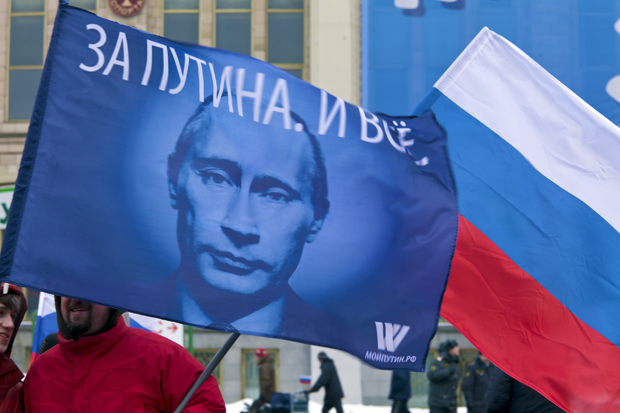
Censorship of anti-war sentiment in Russia now uses a mixture of state-sponsored media attacks, arms-length loyalists, crooked think tanks and legal strong-arming – but is it working?
Politonline, a website well-known for its support of Putin, has produced an article with the top twenty most “negative” news sources in Russia. Editors claim to have pioneered a methodology which can gauge “emotional sentiment and tone” in online articles. Politonline don’t elaborate on how the algorithm has been put together, or indeed the source data they used. However some of the keywords used have been published, including the words “annexation” and “support for Crimea.”
Meanwhile, a prominent academic has been publically slammed by a pro-Putin think tank, in a pro-Putin newspaper, after he compared Hitler’s strategy in Anschluss with the annexation of Crimea. Professer Andrei Zubov was also dismissed by his employers – the Moscow Institute for International Relations. The Institute for Democracy and Co-operation, the think tank who critiqued the article, included a list of American academics who had lost their jobs over their political views – although many had been fired for comments which were overtly racist, sexist, or incited hate.
The man who blew the whistle on Putin’s invasion in Crimea, Lev Shlosberg, has also been targeted by his opponents. Some of the masked paratroopers now in Crimea were originally based in his home region : Shlosberg helped alert the media when the invasion began. A legislator and newspaper editor, he has since been accused of being a “fifth columnist” and “traitor.” In an interview on the Russia 1 television channel, Putin’s press secretary Dmitri Peskov adopted a similar strategy when he smeared dissenters as “professional critics” and a “nano-fifth column.”
Alexey Navalny, a lawyer, blogger and pro-reform opposition politician has also faced penalties. A lengthy article he published on his blog regarding Crimea prompted authorities to accuse him of breaking the terms of his house arrest. Authorities then blocked access to the site, and warned citizens that anyone promoting his article online would be subject to unspecified sanctions.
Protesters brave enough to go on the streets are also being met with state-sponsored aggression. Tanya Lokshina, Russia Program Director and Senior Researcher at Human Rights Watch, told Index that “anti-war protesters have been subject to arbitrary detention, harassment, intimidation, and even physical attacks.”
Between February 21st and March 4th, the NGO allege that police detained well over a thousand peaceful protesters in Moscow alone. Courts ordered at least fifteen of them to serve ten days of administrative detention for alleged failure to obey police orders, and fined dozens of others for participating in unauthorized public gatherings. The majority are still awaiting administrative court hearings. Other cities have seen similar policing tactics and unfair judicial process.
“Many wondered what a post-Sochi crackdown might look like,” Hugh Williamson, Europe and Central Asia director at Human Rights Watch told Index. “These detentions, the crackdown under way on the media, and violent attacks against dissenters by unidentified assailants paint a stark picture of what is going on in Russia right now.”
So is all this working? In December, Putin’s popularity was at its lowest since 2000, according to a report on the Reuters website. Polling conducted by the Levada Agency showed that “61 percent of respondents voiced approval for Putin’s performance in November, down from 64 percent in October and the previous low this year of 62 percent, recorded in January.”
It’s also notable that before the Crimea crisis escalated, the Russian people were indifferent to Euromaidan. Another Levada poll showed that 63% of Russians didn’t sympathise with either Yanukovych or the protesters.
However a poll by VTsIOM, conducted in March after troops had moved into Crimea, showed that Putin’s approval ratings had leapt up. VtsIOM is state-run but according to Russian politics analyst Mark Adomanis, “remains one of the most widely respected polling outfits in Russia.”
Crimea has sent Putin’s poll numbers skyrocketing,” says Adomanis, who writes a column for Forbes about Russian politics and economics. “Levada currently has him at a little over 80%, his highest level since 2010.”
“Other agencies have shown a similar rebound in his numbers – pretty much everyone agrees that the poll numbers are the best in a long time.”
Adomanis also commented on the lack of media, political and academic freedom surrounding the Ukraine crisis.
“Even in democratic societies there’s always a concern that polling can be heavily influenced by the nature of media coverage. It’s definitely more of a concern in Russia, given the heavy-handedness with which the authorities manage the press
“You can’t totally separate the biased coverage from popular support, but I don’t think one can fully explain the other.”
So Putin’s strategy in Crimea has played out well politically. It’s hard to know what the polls would have been like had the press been able to fully criticise his actions, or had street protests been allowed to go on unhindered. It’s also likely that the long-term economic impact of the annexation will be great enough to push polls down again in the future. However, the tactics used by the authorities to keep dissent out of the public psyche appear well-rehearsed and difficult to counter. A quick review of any Russia Today bulletin, compared with multiple on the ground sources in Kiev, Crimea and eastern Ukraine, reveal that the Russian public are not getting the full picture about their leaders international transgressions.
This article was published on April 14, 2014 at indexoncensorship.org
11 Apr 2014 | Digital Freedom, News

(Illustration: Shutterstock)
State surveillance has been much publicised of late due to Snowden’s revelations, but allegations against the NSA and GCHQ are only one aspect of the international industry surrounding wholesale surveillance. Another growing concern is the emergence and growth of private sector surveillance firms selling intrusion software to governments and government agencies around the world.
Not restricted by territorial borders and globalised like every other tradable commodity, buyers and sellers pockmark the globe. Whether designed to support law enforcement or anti-terrorism programmes, intrusion software, enabling states to monitor, block, filter or collect online communication, is available for any government willing to spend the capital. Indeed, there is money to be made – according to Privacy International, the “UK market for cyber security is estimated to be worth approximately £2.8 billion.”
The table below, collated from a range of sources including Mother Jones, the Electronic Frontier Foundation, Bloomberg, Human Rights Watch, Citizen Lab, Privacy International and Huffington Post, shows the flow of intrusion software around the world.
| Surveillance Company |
Country of Origin |
Alleged Countries of Use |
| VASTech |
South Africa |
Libya (137) |
| Hacking Team |
Italy |
Azerbaijan (160), Egypt (159), Ethiopia (143), Kazakhstan (161), Malaysia (147), Nigeria (112), Oman (134), Saudi Arabia (164), Sudan (172), Turkey (154), Uzebekistan (166) |
| Elbit Systems |
Israel |
Israel (96) |
| Creative Software |
UK |
Iran (173) |
| Gamma TSE |
UK |
Indonesia (132) |
| Narus |
USA |
Egypt (159), Pakistan (158), Saudi Arabia (164) |
| Cisco |
USA |
China (175) |
| Cellusys Ltd |
Ireland |
Syria (177) |
| Adaptive Mobile Security Ltd |
Ireland |
Syria (177), Iran (173) |
| Blue Coat Systems |
USA |
Syria (177) |
| FinFisher GmbH |
Germany |
Egypt (159), Ethiopia (143) |
Note: The numbers alongside the alleged countries of use are the country’s ranking from 2014 Reporters without Borders World Press Freedom Index 2014.
While by no means complete, this list is indicative of three things. There is a clear divide, in terms of economic development, between the buyer and seller countries; many of the countries allegedly purchasing intrusion software are in the midst of, or emerging from, conflict or internal instability; and, with the exception of Israel, every buyer country ranks in the lower hundred of the latest World Press Freedom Index.
The alleged legitimacy of this software in terms of law enforcement ignores the potential to use these tools for strictly political ends. Human Rights Watch outlined in its recent report the case of Tadesse Kersmo, an Ethiopian dissident living in London. Due to his prominent position in opposition party, Ginbot 7 it was discovered that his personal computer had traces of FinFisher’s intrusion software, FinSpy, jeopardising the anonymity and safety of those in Ethiopia he has been communicating with. There is no official warrant out for his arrest and at the time of writing there is no known reason in terms of law enforcement or anti-terrorism legislation, outside of his prominence in an opposition party, for his surveillance. It is unclear whether this is part of an larger organised campaign against dissidents in both Ethiopia and the diaspora, but similar claims have been filed against the Ethiopian government on behalf of individuals in the US and Norway.
FinFisher GmbH states on its website that “they target individual suspects and can not be used for mass interception.” Without further interrogation into the end-use of its customers, there is nothing available to directly corroborate or question this statement. But to what extent are private firms responsible for the use of its software by its customers and how robustly can they monitor the end-use of its customers?
In the US Electronic Code of Federal Regulations, there is a piece of guidance entitled Know Your Customer. This outlines steps to be undertaken by firms to identify what the end-use of its products is. This is a proactive process, placing the responsibility firmly with the seller to clearly identify and act on abnormal circumstances, or ‘red flags’. The guidance clearly states that the seller has a “duty to check out the suspicious circumstances and inquire about the end-use, end-user, or ultimate country of destination.”
Hacking Team has sold software, most notably the Remote Control System (RCS) to a number of countries around the world (see above). Citizen Lab, based out of the University of Toronto, has identified 21 countries that have potentially used this software, including Egypt and Ethiopia. In its customer policy, Hacking Team outlines in detail the lengths it goes to verify the end-use and end-user of RCS. Mentioning the above guidelines, Hacking Team have put into practice an oversight process involving a board of external engineers and lawyers who can veto sales, research of human rights reports, as well as a process that can disable functionality if abuses come to light after the sale.
However, Hacking Team goes a long way to obscure the identity of countries using RCS. Labelled as untraceable, RCS has established a “Collection Infrastructure” that utilises a chain of proxies around the world that shields the user country from further scrutiny. The low levels of media freedom in the countries purportedly utilising RCS, the lack of transparency in terms of the oversight process including the make-up of the board and its research sources, as well as the reluctance of Hacking Team to identify the countries it has sold RCS to undermines the robustness of such due diligence. In the words of Citizen Lab: “we have encountered a number of cases where bait content and other material are suggestive of targeting for political advantage, rather than legitimate law enforcement operations.”
Many of the firms outline their adherence to the national laws of the country they sell software to when defending their practices. But without international guidelines and alongside the absence of domestic controls and legislation protecting the population against mass surveillance, intrusion software remains a useful, if expensive, tool for governments to realise and cement their control of the media and other fundamental freedoms.
Perhaps the best way of thinking of corporate responsibility in terms of intrusion software comes from Adds Jouejati of the Local Coordination Committees in Syria, “It’s like putting a gun in someone’s hand and saying ‘I can’t help the way the person uses it.’”
This article was posted on 11 April, 2014 at indexoncensorship.org
1 Apr 2014 | Digital Freedom, India, News

(Illustration: Shutterstock)
The social media experience which came across as a liberating tool for women, was often equated with a living room where one could voice opinions in public sphere. However, of late, a series of incidents have sounded a note of caution against the euphoria around social media. It has been compared to a street where women are abused, threatened, ogled at, rebuked, only virtually.
The situation plugs American academic Lawrence Lessig’s contention, “Cyberspace is something we build. Who knows how much of the real world is socially constructed? But, one thing is certain, cyberspace is socially constructed.”
While the online abuse faced by British activist Caroline Criado Perez, who led a successful campaign to have a woman on the £10 note first grabbed the news headlines, the scene in India isn’t too different. Even with a limited penetration of the internet, sexist abuse has become a tool to muzzle voices of independent women.
Things seem to have heated even more in the run up to poll season in India, where female Twitter users have increasingly become a subject of sexist abuse.
The abuse over political tweets isn’t a new phenomenon however; it has significantly gone up.
When Kavita Krishnan, feminist activist and political commentator recently opposed the induction of controversial chief of a right-wing outfit, who led an attack on women in a pub, she drew a barrage of abuse. Responses were replete with sexist comments and death threats. Additionally, there were many others who endorsed rape threats directed at her.
Krishnan, a Communist Party politbureau member, is also quick to point out that online abuse grows more vicious when she voices her political opinions. Threats directed at her have ranged from sexual assault to mutilation of genitals. Furthermore, anonymity granted to users on social media platforms has drawn threats directed at her mother too.
Female Twitter users are not always abused through words, morphed photographs with captions are also circulated by users online.
When actor, activist Gul Panag, who has been an assertive voice on Twitter recently threw herself into the political ring by contesting on a Common Man Party ticket, many users began posting her morphed photographs in lingerie with strategically placed accessories.
However, in an encouraging trend, trolls were soon outweighed by users who voiced support for her.
Female journalists, who express opinions on political issues, international affairs, among other topics considered anathema to the right wing, are also subjected to scathing Twitter attacks.
Sagarika Ghose, a senior Indian journalist who coined the term “Internet Hindus” writes, “As a television journalist, I get a daily dose of abuse on Twitter, an exercise in character-building endurance. Some examples: “Bitch, you deserve to be stripped and raped publicly.” “why u r not covering Assam riots?”, she writes.
Condescension is also evident in responses journalists receive which question their professional integrity. In Ghose’s case, the responses underlined how topics often considered anathema to the Hindu right, ended up pointing fingers at her journalistic integrity, accusing her of trivialising events.
With the poll bugle being sounded in country, female politicians active on Twitter have been subjected to scornful tweets, often threatening their family members. For instance, Priyanka Chaturvedi, a Congress party spokesperson tweeted, “Ladies you attack me is fine, bring on the love I say but don’t cross the crass line by dragging my parents/kids into this. Thanks. (sic)”
The reason for misogynistic abuse has little to do with what women talk about, rather it is the idea of a vocal and independent woman reclaiming online space which makes users abusive. Additionally, if a woman is vocal in opposing what may seem offensive to the right-wing, she becomes the target. Even opposing misogynistic values in seemingly innocuous statements draws in vicious abuse.
In December 2013, a researcher on caste and gender Arpita Phukan Biswas was subjected to rape threats when she protested against Indian singer Palash Sen’s misogynistic remarks at a cultural festival.
She initially let it go but as threats grew worse, she began tweeting about her harrowing experience and wrote a post on Facebook.
While many branded her Feminazi, others discussed how she should be made to shut up by rape and beating as she wasn’t having enough.
Politics, religion, feminism and sexuality are among the topics which strike more attention, deduces Anja Kovacs who heads the Internet Democracy Project, which recently did a study on women and verbal online abuse in India.
The study further notes that many online users expect women to be servile while others believe they have the right to discipline women through coercive measures resulting in blatant misogyny at play.
Kovacs rightly draws the metaphor of street for the internet.
“Internet is just like a street. Like women face sexual harassment on street, they do on the internet as well. Misogyny is evident in verbal online abuse on platforms like Twitter,” she says.
While sexism has been used as a tool to attack women on public spaces and muzzle their voices, it is time users come to each others’ rescue to reclaim spaces. Despite similarities between street and the internet, the weapons on the latter with both men and women are the same– the keyboard. The best way to counter avalanche of vicious sexist abuse is by witticism.
Kovacs believes setting up a strong online community of support is a way to counter abusive twitter users. “Being called ‘bitch, slut, whore’ is misogyny at play. And it cannot be eradicated and countered by legal measures”.
Similarly, a prolific Twitter user Vidyut Kale (@vidyut) makes it a point to never block anyone who trolls her. In fact, she believes in rolling up her sleeves and taking on the trolls. As a result, many trolls have ended up blocking her.
Perhaps, it is time we take a few steps back from the euphoria surrounding the liberating nature of the internet and critically examine social media spaces where virtual reality mirrors the real ugly one. There is a need to look at social media spaces as regions upholding patriarchal and misogynistic values and address challenges thereof.
This article was posted on April 1, 2014 at indexoncensorship.org
31 Mar 2014 | News, Russia
Punitive psychiatric treatment is returning to Russia. This is a throw back to Soviet times, with opposition activists condemned by a kangaroo court to bogus psychiatric treatment courses, with no chance of release until a doctor says so.
Mikhail Kosenko, 39, last week became the highest profile case when he lost his appeal case against enforced psychiatric treatment. As such he will be interned immediately at a state-owned medical facility in Moscow. At worst, his sentence could be for life, with no chance of parole, as his release depends on vaguely described criteria. His assessment will also be made by doctors whose political neutrality is not guaranteed.
In 2012, Kosenko was arrested by Moscow police after taking part in a peaceful protest against Putin in Bolotnoya Square. Charged with rioting, he spent much of the next twenty two months behind bars. When his sentence was read out in court last October, his sister Kseniya, told the BBC : “I have an awful feeling. There are really frightening stories about what goes on in these places.”
Kseniya describes her brother as “a very quiet, homely type of guy.” She confirms various inspecting doctors reporting that he’s very shy – “shunning any kind of violence.”
Kosenko did have a pre-existing psychiatric condition when he was arrested – slow on-set schizophrenia diagnosed in 2001. But after medication and good advice, the condition was very much under control. Kosenko had never shown any tendency to be violent, according to his doctors.
Tanya Lokshina, Russia Program Director and Senior Researcher at Human Rights Watch, opposes the ruling.
“Mikhail’s case simply reminds me of the Soviet Union,” Lokshina warns. She tells how punitive psychiatry was a tool that was rarely used, but always with devastating effect. “Back then the medications used were really heavy, they were designed to slow down movements and just keep you out of the way.”
It’s impossible know exactly what treatments are now in store for Kosenko. But whatever is to come, it will only end if Kosenko dies, renounces his politics, or wins a final case of appeal at the Supreme Court. This is his last chance, but it could be some time. Lokshina remembers that when Pussy Riot took an appeal case to the Supreme Court, they had to wait a year before their case was heard. In the meantime, Kosenko’s treatment will continue.
The only medical evaluation the court heard was conducted by the Serbsky Institute in Moscow. Their crebility was disputed by medical experts, including the head of Russia’s Independent Psychiatric Association, when they noted that the assessment had completely omitted any reference to Kosenko’s successful ten years of self-medication, with no history of violence. Serbsky Insitute is also owned and operated by the state. The judge threw out a petition to have a second medical assessment.
Lokshina tells me there have been a few cases recently – but this is by far the worst. Amnesty International call it “an abhorrent return to Soviet-era practices.” The weeping sister of Kosenko told the BBC she felt “physically sick” when she heard that her brother had been found guilty.
Putin is turning to medieval, desperate measures as he balances himself on a rattling economy, a tonne of debt and a country that is too big to govern. Those with the bitterest memories, like Ukraine, Poland and the Baltic states, fear a renewed bid to expand borders permanently, especially looking at adventures into Crimea.
But Putin is smarter. He must distract the population from a certain amount of oligarch asset-stripping and poor management, which has become epidemic under his reign. But he also must not overstretch or overspend. Enter the Roman strategy of “bread and circuses,” minus the bread.
Putin’s inaugural circus took place during the Georgia invasion in 2008, and according to Mark Adomanis remembering the war in Forbes magazine “bathed Russia in a warm patriotic glow.” Putin’s ratings took a generous bump as a result.
But Admonanis predicted, just two months ago, that Putin’s ratings would have dipped by the end of this year. The economy was weak and Sochi had been a slightly uncomfortable experience for anyone even remotely Russian.
Sadly Adomanis, nor anyone outside Putin’s inner circle, could not reasonably have predicted Putin’s subsequent gamble in Crimea.
The incursion has seen approval ratings leap from sixty five to eighty percent almost over-night. That is an extraordinary success.
Yet while Crimea has been a successful though highly irritating move, Putin’s political future is still at risk. The balance of world media commentary has been unapproving. The lies he is telling about dangerous neo-Nazi gangs have been proved as untruths, journalists have exposed the role of vicious nationalist thugs (on the Russian side), and Putin’s cheeky disregard for international law condemned. His domestic woes also go on regardless – senior officials within the Kremlin admit that the capital outflows and fall in the stockmarket are far greater than they had forecast. There certainly isn’t any capacity for “bread.”
Facing criticism at home and abroad – Putin turns to censorship and propaganda to secure himself domestically and reap political reward out of Crimea. Any oppositionist media has been bloodily censored. Reports of self-censorship are leaking out from the remaining clutch of titles.
There are three varieties of public criticism which particularly irk Putin. First, a human rights group can get hold of and successfully publicise a story (Kosenko). Second, a one-off event focuses the world on Russia (Sochi). The third is that Russian activists go out onto the streets (again Kosenko’s case, see also Pussy Riot).
In each scenario, Putin potentially loses. But he’s developed mitigation strategies. The first is to denounce foreign criticism as biased and baseless. The second is to claim it’s-a-great-big-Western-plot-we’re-the-victims-don’t-worry-Putin-here-will-rescue-you. The third is to allow some freedom of speech, but only as an opposition release valve. The fourth is to treat protesters like animals.
Street-marches are targeted by violent thugs, who act with suspicious impunity. But it’s the judiciary, and their shoddy self-discipline, who play the more important role. There were serious judicial errors in Kosenko’s case. Other victims have seen key witnesses prevented from giving testimony. Or biased “expert opinions.” Or paid goons threatening the families of the accused.
Putin’s actions abroad might bring back memories of Communist Russia, but Putin probably doesn’t see it this way. Putin needs the circuses of Georgia and Crimea, even if he can’t afford bread back home. He has also applied a blanket of censorship on the media.
Now Putin is turning to psychiatric institutions in a bid to remain in power.
This article was published on March 31, 2014 at indexoncensorship.org