7 Feb 2014 | News, United Kingdom

Journalist Jane Fae
Feminist writer Jane Fae says she has been stopped from opening a bank account for her new project – a history of the censorship of pornography.
Fae, a contributor to Index on Censorship, had agreed with NatWest bank to set up a business account to handle the incomes and outgoings for her new self-published book, Taming the Beast.
But according to a blog post today, Fae says the bank contacted her this morning (7 February) and reneged on the agreement.
Blogging at Faeinterrupted, the journalist, who has written for outlets from the Guardian to the Daily Mail (as well as this site) reported that she had gone through all the normal procedures with the bank and signed up for a new account. She goes on:
Then, this morning, out of the blue, the call. She had since run it past her boss…her manager.
Who was less impressed. “NatWest don’t do this sort of thing”, she explained.
“Er, what sort of thing? Publishing? Academic work?”
“No: the subject matter”.
I was incredulous. “You mean that NatWest will not sanction someone writing ABOUT a particular topic? Are there any other topics you’d rather people not write about in case, you know, in case it frightens the admin staff? Perhaps we had better not write about rape, or vioilence against women or…”.
Who knows.”
Fae is waiting for a proper explanation from NatWest.
A spokeswoman for the bank told Index the issue was being investigated
Index on Censorship will keep you up to date with developments.
UPDATE 07/01/14 16:05. A NatWest spokeswoman has been in touch with Index to tell us that the business manager of the branch in Stamford, Lincolnshire is arranging to meet Jane Fae next week. The bank says “the issue is not closed”.

7 Feb 2014 | Digital Freedom, India, News

(Image: Shutterstock)
Lord Chief Justice Campbell, while introducing The Obscene Publications Act 1857, described pornography as “poison more deadly than prussic acid, strychnine or arsenic” and insisted that the law was imperative to protect women, children and the feeble-minded.
The Indian Supreme Court’s observations and directions while hearing a petition in which online pornography is blamed for of the “epidemic” of rape and sexual violence is redolent of the pornophobia which had gripped the puritanical English legal system in the Victorian era. It is also a stark reminder of the befuddling and dangerous consequences of internet filters, as is being seen in the United Kingdom.
On 27 January, one of the defendants, the Internet Service Providers Association India (ISPAI) while stating that they would not indulge in voluntary censorship, posed a more challenging question — since there is no granular distinction to be made between “high art” and pornography, since temple sculptures can simultaneously be interpreted as both divine and obscene, how could they decide what to block and what to allow. On 28 January, all liberty-loving Indians were aghast at the Supreme Court’s intransigence on homosexual sex.
Taken together, these incidents portend to consequences more pernicious than just a chilling effect on free expression. As Lynda Nead contends, drawing a distinction between sublime and profane seeks to serve a social legitimising function which result in moral policing and violations of the rights of many.
Does pornography cause rape? Justice Douglas’ statement in Ginsberg — “Censors, of course, are propelled by their own neuroses” — and Ronald Dworkin’s reply to Katherine MacKinnon’s “breathtaking hyperbole” remain the most plausible answers to date, not a single study has been able to irrefutably prove correlation, let alone causation. However, Indian courts’ treatment of pornography has been ironic because exposure to obscene and sexually explicit material has been treated as a mitigating factor in rape sentencing. Reepik Ravinder and Phul Singh are two examples of rapists being regarded as victims of the “sex explosion” on celluloid. Not only that, a “ministry of psychic health and moral values” has also been directed to be established to nip this epidemic of vulgarity in the bud.
Justice Potter Stewart’s aphorism “I know it when I see it” holds true for any “definition” of pornography — even today. All we have got is a mystifying epithetic tautology — prurient, lewd, filthy, repulsive, which does no service to the clarity of judicial vision. It is easier to treat pornography as an accused, rather than an offence, because tropes and stereotypes make for poor and unjust legal definitions.
The plea to criminalise browser histories suffers from several grave elisions. For one, irrefutable evidence of correlation, let alone causation, between pornography and sexual violence or depravity is conspicuous by its absence. Though Delhi has a high rate of reported rapes, Google Trends data from 2013 shows more people in the apparently conservative bastions of Gujarat and West Bengal were searching for pornography online.
Most significantly, an obscurantist idyll defines the average consumer and purposes of online pornography. Evidence dispels the notion of only rapacious, lustful men devouring pornography. A 2008 survey reported one in five women watching and approving of porn. Forty-five percent of women who watched pornography also made their own porn videos, and stated how it had helped them being sexually inventive and more intimate with their partners. Another survey, deemed to be the most comprehensive, shows 60 percent women and 80 percent men admitting to accessing sexually explicit content online. Significantly, 30 percent of women respondents said that such content deals with sexual and reproductive health and romance, too. More significant is the response that usage of pornography improved couples’ sex lives.
Moreover, the upshots of dragnet internet filters are reasons for grave consternation. Google AdSense mistook an author’s memoir for pornography and blocked it. In reverse irony, smut sites got caught in an attempt to prevent bureaucrats from surfing sites related to the stock market. And since algorithms do not have a mind of their own, Christopher Hitchens’s polemic against Mother Teresa “The Missionary Position” might also lose its immunity.
India’s information technology law remains riddled with fuzzy definitions, and right now Google, stands indicted for defamation. A ban on internet pornography would further queer the pitch for intermediary liability, thereby delivering another blow to free speech.
Given the climate of legal homophobia, a reference to the aftermath of Canada’s ban on pornography becomes pertinent. There was a sustained persecution of bookstores stocking gay and lesbian literature, comics included, and 70 percent of prosecutions were of homosexual pornography. Besides, even if there were only opt-in filters, it would entail identifying one’s sexual preferences. And where demands for arresting homosexuals are raised on the flimsiest of pretexts, one would become a sitting duck for privacy breaches and criminal prosecution.
One can only wish these apprehensions, and not pornophobia, inform the Supreme Court’s decision.
This article was posted on February 7 2014 at indexoncensorship.org
6 Feb 2014 | News, Religion and Culture, Russia
Human Rights Watch released a video documenting the treatment of LGBT Russians on 3 February ahead of the opening of the Sochi Winter Olympics.
Drawing a screen around the realities of life for Russian gays and lesbians, Russian president Vladimir Putin and the organizers of the Sochi Winter Olympic games are presenting a decidedly friendly face to international visitors.
Even though Sochi’s mayor, Anatoly Pakhomov, would prefer to believe “there are no gays” in his city, the mayor of the Olympic village, Elena Isinbayeva, offered to make LGBT athletes to feel welcome — despite her earlier homophobic comments. The girl band Tatu, most popular during the early 2000s when they exploited homoeroticism in their live appearances and videos, will perform at the opening ceremonies.
The real Russia has turned ugly and brutish toward its LGBT citizens.
The recent spate of homophobic violence has its roots in a controversial law that bars the promotion of non-traditional relationships as being equal to traditional relationships. While the law’s backers say they are protecting children, the effect has been to silence the push for gay rights by threatening fines for “homosexual propaganda.”
While official Russia will be demonstrating what it sees as tolerance in Sochi, a court in the city of Nizhniy Tagil will issue a ruling on the case of Elena Klimova – a young journalist who created a group on Vkontakte – Russia’s answer to Facebook. Klimova’s group, Children 404, contains letters from young LGBT people, who have been subject to physical and psychological attacks. Their letters to each other, according to Klimova, have been helping them cope with the pressure and continuing struggle for their rights. Klimova’s efforts to ease the isolation of LGBT children has drawn the ire of United Russia’s Vitaly Milonov, a proponent of the gay propaganda law, who has sued Madonna and been exposed as a bigot by Stephen Fry.
Klimova has also been active in raising concerns about the plight of a teen girl in the Bryansk region who has been put under administrative control by a local juvenile commission. Her crime? The girl openly identified “herself as a person with non-traditional sexual orientation and promote[d] information which misinforms minors about social equality of traditional and non-traditional relationship”. She will be monitored as if she were a criminal.
According to the latest Levada-Centre research, some 43% of Russian citizens consider homosexuality a bad habit, 38% reckon LGBT people should be “cured”, 47% say LGBT and heterosexuals are not socially equal and 73% approve the state’s effort to prevent public professions of an LGBT orientation.
The Russian Orthodox Church has done a lot to maintain these numbers.
Patriarch Kirill has repeatedly condemned equal marriage, saying in late January that marriage is “between a man and a woman, based on love, aimed at having children”. Kirill asked law makers to reflect his belief in drafting laws. Moscow Patriarchate’s spokesman Vladimir Legoida called equal marriage and homosexuality a sin in an interview to RIA-Novosti – the former Russian state news agency. Not to be outdone, Ivan Okhlobystin, an actor and former priest, said “gays should be burnt in ovens”.
In the meantime, on 3 February, the regional court of Kamchatka sentenced three people to 9-12 years in prison for the murder of a gay acquaintance.
Homosexuality was decriminalized in Russia in 1993. In 1999 it finally was excluded from Russian official list of mental illnesses. The change in people’s mind is still yet to come.
This article was originally published on 6 February 2014 at indexoncensorship.org
5 Feb 2014 | News, Russia
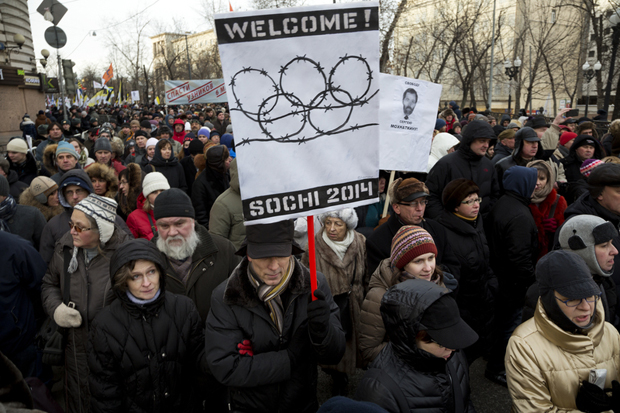
Several thousand protesters marched through central Moscow on 2 February 2014 to call for the release of 20 people who were arrested after clashes between police and demonstrators on 6th May of 2012. Photo: Nickolay Vinokurov / Demotix
Media will face increased restrictions in the build up to the Winter Games in Sochi as Russian president Vladimir Putin tries to rehabilitate a damaged domestic reputation, experts suggest.
Tighter controls on dissident media, more proactive use of state news outlets to mold public consensus, and obstacles to foreign reporters operating in the region can all be expected as the games begin on 7 February.
While Russian authorities have hailed the Games as a triumph, ongoing disputes over the payment of migrant workers, the environmental impact of Sochi’s intensive development, forced evictions of residents, intensive security measures, and Russia’s controversial gay propaganda law have all generated a domestic backlash that many believe is being deliberately ignored by state media. On 17 October, 2013, Roman Kuznetsov, a migrant worker from the Russian city of Orenburg who had helped build the Media Centre for the Sochi Olympic Games, sewed his lips shut with a needle and thread in protest against his employer’s failure to pay him several months of wages. He carried a sign that explained “Please help get reporters attention! I am not from around here”.
In an interview with select global media, Putin explained “I would like the participants, guests, journalists and all those who watch the Games on TV and learn about them from the mass media to see a new Russia, see its personality and its possibilities, take a fresh and unbiased look at the country”. Close restrictions recently imposed on press activity suggest otherwise. Only a small number of Olympic Events have been cleared for coverage by local journalists, including the arrival of IOC delegations and formal updates offered by federal officials. Access to government activities is granted only to the All-Russia State Television and Radio Broadcasting Company.
In a report produced by the Centre for the Protection of Journalists, a number of local journalists allege a more proactive media strategy in addition to direct censorship. Several reporters suggested that it was fairly common for media that receive funding to be directly censored by the administration. Local journalists also reported that the All-Russia State Television and Radio Broadcasting Company often stage interviews, and had been passing off closely scripted lines as dialogue with ordinary residents of Sochi. According to Russian Government website Zakupki, which details financial transactions at all levels of Russian government, the Sochi administration has distributed some 32,628.600 rubles (US$988,788) to 17 media organisations, including four television channels, six newspapers, one magazine, three radio stations, and one informational agency. It is not clear what form the funds took.
Aleksandr Valov, founder of BlogSochi, which seeks to document the impact of the Games on Sochi’s residents, explains “One begins to understand why Sochi media only talk about the government’s achievements and keep silent about the problems. The popular saying ‘He who pays the piper calls the tune’ comes to mind.”
International journalists covering Sochi have also been closely curtailed. Police from the Russian Republic of Adygea neighboring Sochi repeatedly stopped, detained, and threatened a two-person crew from Norway’s TV2- the country’s official broadcaster of the Olympic Games. At every stop and in detention, officials questioned the journalists aggressively about their work plans in Sochi and other areas, their sources, and in some cases about their personal lives, educational backgrounds, and religious beliefs. In several instances they denied the journalists contact with the Norwegian Embassy in Moscow. One official threatened to jail them both, the journalists told Human Rights Watch. Dutch photojournalist Rob Hornstra was denied a Russian visa in an apparent attempt to stop him from doing further work in the turbulent North Caucasus, and American journalist David Satter was forcibly expelled from the country in December.
Since beginning his first term as president in 2000, Vladimir Putin has carefully controlled his media presence, closing a number of independent media outlets and amalgamating others with state bodies, whilst tightly controlling the presence of foreign media. Professor Owen Johnson teaches at the School of Journalism at Indiana University, and has researched the role of media in Russia intensively. He offers a simple explanation for the recent expulsions ‘”While it would seem that this runs counter to other more positive actions by President Putin recently, this might be designed to make visiting journalists more cautious,” Johnson said. “Putin is less concerned about world public opinion than he is about his continued support in Russia.”
Domestic attitudes to Putin are changing fast, according to Mikhail Dmitriev, former director of Russia’s State Run Centre for Strategic Research. Over the past year discontent in the country at large has deepened and broadened, spreading across all social groups and ages. While support for Putin is stable in St. Petersburg and Moscow, where incomes remain high, fluctuating fortunes in Russia’s rural regions is starting to generate distrust. Dmitriev said the latest focus groups show that Putin is less associated with stability and more with uncertainty. His past achievements are becoming a distant memory, and his recent stunts, such as flying with cranes or diving for ancient amphorae, merely cause irritation.
The Sochi Games, Putin explained in a conference with journalists, will be an important global symbol of Russian achievement and resurgence. For Putin, well-managed domestic media coverage seems an important strategic component of his long term success and survival.
This article was originally posted on 5 February 2014 at indexoncensorship.org
