24 Jan 2014 | News, Pakistan, Religion and Culture
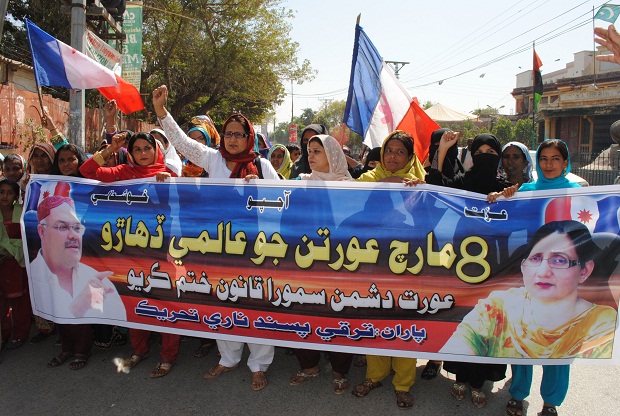
Hindu women protest in favour of Rinkle Kumari who was forced to convert to Islam in 2012 (Image: Rajput Yasir/Demotix)
December 21 will forever be etched on the memory of Sapna and her family. Belonging to a poor Hindu family, Sapna and her older sister Sabita were teachers in a neighbourhood school in Paharipura, Peshawar, the capital city of Khyber Pakhtunkhwa province. They were the sole breadwinners for the family after their father, who worked for Radio Pakistan, retired four years ago.
On that cold wintry day Sabita stayed after school to give extra tutoring while Sapna walked home alone. During her walk a car suddenly pulled up alongside her- out jumped a man who placed a cloth doused in an unknown chemical over her face. Sapna passed out.
When she regained consciousness she found herself in unfamiliar surroundings. A man, whom she had never seen before, asked her to marry him. But first Sapna would have to convert to Islam.
On her refusal, the man placed the intoxicant-doused cloth over her nose and she fainted once again. This routine carried on for 16 days.
Sapna narrated her account of the kidnapping to the judicial magistrate earlier this month after she was rescued.
“The police traced her through a phone call she made to us asking us to rescue her,” Ramesh Kumar, her brother-in-law told Index on Censorship during a phone interview. He, along with his wife, Sapna’s older sister, had accompanied the police and found her in a village in Bahawalpur, in Punjab province some 680 km from Peshawar.
“Unfortunately, the person who kidnapped her, Zahid Nawaz, got a tip-off and escaped,” said Kumar. Nawaz wasn’t a complete stranger to Sapna. Kumar believes that his sister’s kidnapper had managed to ensnare Sapna by calling her a few times before the snatching took place.
“When he learnt that she was a Hindu, he told her that he didn’t have a sister and looked on her as one,” he added.
Despite being the first case of its kind in the area Sapna’s kidnapping has spread fear among the Hindu community in Peshawar- since the day her sister was abducted Sabita has not been allowed to step out of her house.
However, the kidnapping of Hindu girls is nothing new in other parts of the country. According to Ramesh Kumar Vankwani, head of the Pakistan Hindu Council and a legislator: “We hear of three to four such cases every month from Sindh [province].”
More worrisome to the independent Human Rights Commission of Pakistan (HRCP) is the forced coercion of these Hindu girls to Islam before marriage takes place. The majority of these cases have been reported in the Sindh area with the HRCP calling it one of the “most outrageous human rights violations one has to deal with.”
I.A. Rehman, of the HRCP, blamed both the state and society for the escalation: “Both are getting more and more caught in the frenzy of religiosity, a process accelerated by the increase in Al-Qaeda/Taliban/Salafi influence on Pakistan’s Muslims.
“Hard-line Islam is supposed to liquidate non-Muslims and Shias and people belonging to other sects, such as Barelvis who enjoy music and visit shrines,” referring to the recent killings of devotees at a sufi shrine in Karachi earlier this month.
At the same time, he pointed out, the “zealots” among the society hoped to secure a “place in paradise” by converting non-Muslims to Islam. Hindus account for just over one per cent of the Pakistan’s population of 180 million.
Rehman deplored how the judiciary had been unable to intervene in such cases, noting how such lack of action reassures the culprits and depresses the communities of the victim.
Most religious minority members sitting in the assemblies are selected, as opposed to elected, and are therefore not the true representatives of their communities. Instead, they often toe the party line that has given them the ticket to their seat.
For their part, people like Vankwani say: “The main political parties pay lip service to our problems but have consistently failed to protect our lives or our rights,” arguing that until fair representation of minorities occurs in the assemblies their issues will never be resolved.
Amar Guriro, a journalist from a Hindu community, had a different take on the issue of coerced conversion. “There are cases where girls have converted of their own will or have eloped because, unless their parents can pay the heavy dowry that is demanded by the groom’s side, they cannot be married off,” he said.
Muslims have often been accused of preying on Hindu girls of marriageable age, forcing families to marry off their daughters at an earlier than desired time. “If they don’t there is a danger they may be kidnapped and asked to renounce their religion,” Guriro reported.
According to Amarnath Motumal, a lawyer with the HRCP, young Hindu girls may easily get “influenced” by their Muslim paramour: “In a country where even in schools Islam is the only religion taught and where religious freedom is negligible, young minds can easily be moulded.
“In Pakistan a Muslim woman cannot be married without the consent of the waali (her guardian — a father, uncle, or brother). Why didn’t the same hold true for the Hindu girl who had converted?”
Motumal has appeared in several cases of forced conversions. He told Index that during these hearings there is immense pressure on not just the young girls but also the judge as hundreds of protesting clergy can gather outside the courtroom. “The girls often do not have the courage to speak how or what they feel about the predicament they are in. And if the woman converted of her free will, why is she not allowed to meet with her parents?” he asked.
In 2012, the cases of Rinkle Kumari from Ghotki and Dr Lata Kumar in Karachi were taken up by the court after concerns arose in the media that they were forcefully converted to Islam.
Today, Motumal said, both women live with their respective Muslim husbands, but, he added: “They may be apparently happily married, but who knows what is going on in their hearts. They know what their fate will be if they have a change of heart and mind — they may be shunned by their own community and never find a match!
“Most believe themselves to have been polluted beyond redemption and prefer to stay with their abductors to returning home.”
This article was posted on 22 January 2014 at indexoncensorship.org
22 Jan 2014 | News, Politics and Society, Religion and Culture, Turkey
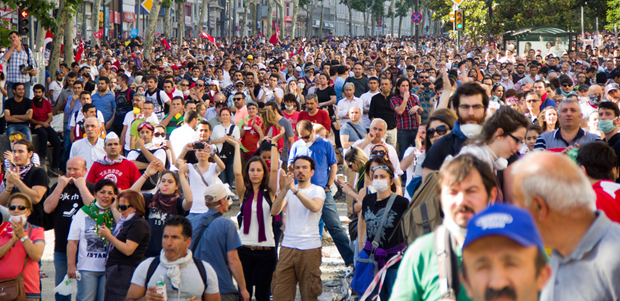
Thousands of protesters took to the streets of Istanbul on 1 June in the capital’s Taksim Square during demonstrations over plans to turn Gezi Park into a shopping mall. (Photo: Akin Aydinli / Demotix)
Author and playwright Meltem Arikan was amongst a small group of people who was accused by senior Turkish politicians and government sponsored media of being the architects of the May-June 2013 Gezi Park demonstrations. This was no idle threat, but a TV, newspaper and Twitter campaign designed to convince the Turkish people that the accused were responsible for the largest anti-government protest ever witnessed in Turkey. Forced to leave Turkey, she, and those closest to her, have come to live in UK and only now is she beginning to feel safe enough to tell her story.
What follows is Arikan’s personal account of the events.
For me everything starts on 27 May 2013.
Together with Memet Ali Alabora the director of my play Mi Minor, Pinar Ogun the lead actress and the play’s graphic designer Melin Edomwonyi, I went to KARVAK Awards Ceremony to receive our award for Best Play 2013 given by the Black Sea education, culture and environment protection foundation. As we made our way there, it didn’t seem possible that our lives were about to change completely. The ceremony started and the first award to be announced was a lifetime achievement award for the governor of Istanbul. The moment we heard this we stood up and left the venue, refusing to receive our award.
In Turkey, the governor is the highest state representative in the city, and has responsibility for and control over the police. At the time in Istanbul the frequent and excessive use of tear gas and heavy-handed police tactics to even the smallest gatherings — especially around Taksim — were causing real concern for us and many people. For example on 7 April, a peaceful demonstration of artists and cinema goers — including Greek film director Costa-Gavras — against the demolition of the Emek Theatre was dispersed with water cannons and tear gas.
We could not have accepted an award from an organisation that honoured the governor after all that was happening in the heart of our city.
We went straight home and read on Twitter that the trees at the Gezi Park, the only park in the area of the city called Taksim, were being destroyed to make way for a shopping mall. We started tweeting to make people aware of what was going on, that the trees needed protection. A small group of around 50 people went to the park to keep watch over the trees and stop them from being uprooted in the middle of the night. When the workmen drove into the park during the night ready to destroy the trees, the protesters asked if they had an official permit. They had no papers, so the workmen left the park. I followed everything on Twitter, retweeting the tweets and pictures that were coming out of the park. Looking at those pictures I was worried that, as with so many demonstrations, only a handful of people would turn up. So I kept retweeting moment by moment what was happening there all night.
Next Morning – 28 May
The digger came back in the morning at 8 am. By then there were 200 people in the park and, because of the growing numbers, the riot police used pepper spray and tear gas to clear it. At noon, pictures from Gezi Park were being shared on Twitter again, but this time they showed riot police using tear gas against peaceful protestors. The picture of the pepper-gassed woman in a red dress, that would later become an icon, was taken during this first police attack.
The attack had triggered more people to come to the park. We decided to join the protesters, to give our support to the trees and say “enough!” to the crazy number of shopping malls, which are poisoning our cities.
After the pepper gas attack the works in the park were restarted. This time the Istanbul MP, Sırrı Süreyya Önder, who is also a screenwriter and film director, stood with his arms wide open in front of a digger and asked for their permit. This stalled the destruction for the time being and the workmen left.
When we got to the park we could still smell the gas even though it was hours after the attack. Despite the stench, the joy and determination of the young protesters remained. By sunset nearly a thousand people had gathered. There were tents everywhere. It was clear that people living around Gezi Park supported the protests and they, too, wanted to save the trees, the treasured heart and lungs of Taksim Square. People were treating the damaged trees, and planting saplings in the holes left by the diggers. Women, men, strangers to one another, straight, gay, transsexual, young, old, little kids with their parents came together for the sake of the trees. Regardless of their differences they shared their feelings with one another. A table became a simple stage for people to speak from, prejudice gave way to the attempt to understand each other, music and dance took over from frustration. We wrote our thoughts on pieces of paper and hung them on the branches of the trees. Perhaps, in our country, where everyone had become “the other” to one another, for the first time, in that park, no one was “the other” anymore.
As the writer of the novel Hope is a Curse, it was wonderful for me to feel hope for the first time in years. Hope that, helped by new ways to exchange and share information, women and men can come together to lay claim to public space and freedom of speech, leaving the barriers of race, religion, sexual choices, language, ethnic roots and ideologies behind. Although we only planned to go to the park for an hour, after feeling the atmosphere there, I couldn’t leave. We all tweeted to spread the word that night. We chanted, danced, protested. It was as if something I had written years ago, was actually beginning to happen in front of me…
“Women!
We do not have to surrender to the beliefs that are imposed upon us.
The time has come for us to reclaim our stolen spirit.
We can sing the song of another culture without knowing its language.
Without knowing the steps, we can keep up with the rhythm.
The time has come for us to tune in to the music and the rhythm within ourselves.
Patriarchy will be scared, Patriarchy will resist. Patriarchy will accuse…
The time has come for us to reclaim our stolen spirit…
We will cover our ears and will burst out laughing at the accusations,
Women will dance and sing songs and laugh aloud.
In spite of everything, we will rise up in protest, propelled by our irrepressible laughter.
The new digital world will be shaped WITH women, not IN SPITE OF us”
29 May
The next day Prime Minister Recep Erdogan gave a speech and said that they will build a shopping mall no matter what the people say. After the prime minister’s speech more people came to Gezi Park.
I was there around 4 pm. This time there were thousands of people present, including supporter groups, political activists, environmentalists and even Turkish Airlines staff who were out on strike. People were coming to the park to give voice to the issues they were concerned about as well as to protect the trees.
It was like a festival. Even though it was much more crowded than the previous night, the atmosphere generated by such a large and diverse group of people was absolutely amazing. Could things change for real? This time, could we change things by singing songs, by dancing, by freely expressing ourselves all together? Could we actually protect this precious corner of nature from mad-made destruction? The leader of the opposition party visited the park that night. He promised to have two MPs stay there at all times. I left the park after midnight.
30 May
In the morning we heard that, at dawn around 5 am, the police had attacked people and the tents had been set on fire.
I was following everything on Twitter. Again, police had surrounded the park. Again, the Istanbul MP, Sırrı Süreyya, went to the park and again he stood up against the digger to stop the demolition. Again the police left the park. Once more, the protestors occupied the park. The tree watch went on.
Pinar and I didn’t get to the park until that night, because we had been in the studio all day shooting our TV programme Witch’s Cauldron. The early morning police raid had prompted crowds of people to come to the park. By the time we got there, there were more than 10,000 people gathered.
Some young people were tying pieces of colourful cloth to the branches of the trees to make wish trees just like in the old Shaman tradition. I was very moved to see young people picking up on this old tradition. More young trees were planted, more people were trying to heal the wounded trees. People were holding up banners and they were not just about Gezi Park. There were a lot of different issues addressed: protecting the environment, the demolition of the Emek Theatre, recent bombing and deaths in Antakya.
Speeches were made, poems were read and songs were sung on the small stage in the middle of the park. Yet again we chanted and danced until dawn.
31 May
We saw the riot police getting ready just as we were heading out of the square at 4 am. There were two MPs on duty from opposition party. We spoke to them. They said they could do nothing to stop the police attack.
As the sun rose, pressure in the park was rising. Protesters who were already awake warned those still sleeping in tents.
At 4:30 am, as we were on our way to a café down the road, the riot police moved in. At this point there were about 3,000 people in the park. Police used massive quantities of gas against the peaceful protestors. Trying to escape the storm of tear gas people got trapped on an old stone staircase in the park, which collapsed crushing dozens of protestors. Many people were badly affected by the excessive amount of gas, and many others were injured by tear gas capsules thrown directly at them.
It was, and still is, very difficult for me to tell the story of what happened that morning. Inside a café, on the first floor, even though the doors were shut, none of us was able to breathe without choking. I couldn’t make sense of the scene I was witnessing. What was this place? Where was I? What had happened to the songs, tents, banners and dances? The hope I had seen in the eyes of the young people, the wish notes on the trees, the voices of people united? What had triggered the violence? What had happened to turn all this into a war zone?
By 7 am Gezi Park was empty; everybody had fled. The police closed the park. Small numbers of people started to regroup in neighbourhoods around Taksim. We walked to Cihangir Street nearby. Sitting in a café it was hard to breathe and hard to believe how we had been abused. During the gas attack we had been separated from our friends, and now we were trying to get news about them. Had they been injured, arrested? Everyone was following the Twitter feeds, reading them out loud so that all of us could hear as reports coming out of Taksim Square told of the growing number of injured. The roads were closed, the police were everywhere and we were not able to leave the café. There was no media coverage of this brutality. Twitter was the only source of information and I was trying to follow every second of the feeds. I was furious and also felt completely disillusioned. A voice inside me was screaming “HOPE IS A CURSE! I TOLD YOU!”
At 10 am protesters who had now gathered outside Gezi Park made a statement to the press condemning the police brutality. After the press statement people tried to enter the park, and police once again fired tear gas. A couple of protestors, including the well-known journalist Ahmet Şık, were shot in the head with tear gas capsules. The police started to chase people in the streets but they were met with passive resistance – protesters stood still, some with their arms held up, some sitting on the ground. At 1 pm another statement was made — this time at Taksim Square. Then we heard that police once again had attacked.
We ran to help, but people had already dispersed. On the way back police were firing tear gas everywhere. A gas capsule fell next to my feet, I felt like I would never be able to breathe again. We washed our faces immediately with a mixture of water and Rennie tablets to neutralise the burning of the gas, and hid in an apartment building. I tried to come to grips with the reality of what was happening in front of my burning eyes. I could hear the sirens from outside and the screams of the people running. The same words going around in my head: Why all this violence and brutality? Why this hatred – who was it for? Once again I was witnessing how brutal male domination can be when people come together and say NO!
A young woman was hit by a capsule on her head, which left her in a coma for 30 days. She is still fighting for her life.
That day “Taksim Dayanışması” (Taksim Solidarity) the platform of nearly a hundred NGOs, political parties, and trade unions, that started the campaign against the planned shopping mall in Gezi Park called people to come together at Gezi Park at 7 pm. That day millions of tweets called for a gathering at Gezi Park.
All the time that Taksim was in chaos, there was nothing about what was happening in the mainstream media. Even more absurdly, one of the main news channels was showing a documentary about penguins while thousands of people were being attacked in the centre of Istanbul. This inspired a wave of satirical graffiti around the city – penguins in gas masks with slogans of defiance. We couldn’t go home because all the roads were closed and every minute more and more people appeared on the streets with goggles, helmets and plastic bottles filled with Rennie and water to protect each other from the effects of the gas.
Hearing the sounds of helicopters mixing with the sirens of the ambulances I felt completely disorientated. I closed my eyes and opened them… People falling on the ground in pain barely visible through the gas… I closed my eyes and opened them again to look for the helicopters I could only hear… I closed my eyes and opened them… A street dog lying on the ground… I closed my eyes and tears flowed in to my mouth tasting of pepper. My lips formed the word ENOUGH!
“I have seen how violence was created, when Patriarchy became merciless.
It was so cruel that I was frightened…
When the lives of those given by women were slaughtered by Patriarchy …
I saw nothingness…
The lives of those given by women were turning into fear and violence…
When we silently screamed ‘enough’, the cruelty of violence is so dense…
Enough, I feel shame.
Enough, I am a woman, violence was not born of me…”
On the night of 31st of May hundreds of thousands of people tried to reach Taksim Square on foot. We spent an hour on the street and then went to our friend’s home nearby. We could smell the gas inside the house and hear the ambulances, helicopters and people banging pots and pans in support of the protests from the windows of their houses. Then the first clashes between police and the protestors started; they carried on all night. We didn’t sleep at all.
1 June
In the morning Taksim was like a battlefield. The square was still surrounded by the police, and the protestors were still in the streets. Any one attempting to enter the square was forced back by the police.
Around 5:20 am, thousands of people started to march from the Asian side of Istanbul and crossed the Bosporus Bridge on foot to reach Taksim. They were joined by a big rally which had been planned months before to take place on 1 June on the Asian side. The government gave them permission and the police blockade was lifted. Hundreds of thousands of people entered Taksim Square. It was peaceful there but we heard about outbreaks of violence elsewhere because protests had spread to many parts of Istanbul and all around Turkey.
A group of high-profile artists, actors, directors, writers came together to appeal directly to the governor to stop the excessive use of police force, which they felt was responsible for the escalating violence. They couldn’t contact him so they sent out a call to fellow artists to join them in Cihangir Park to make a filmed appeal from the demonstration. I was there, too. When we entered the square there were nearly a million people and it was almost impossible to move through the crowds. Memet Ali Alabora, president of the actors union, spoke for the artists, addressing the governor and calling for peace; his speech was filmed and broadcast live as part of the first TV coverage of the demonstration.
Soon after the statement was made, I managed to get back to my house. I had no idea that I was to become a prisoner in my own home. From that moment until the day, two months later, when I decided to leave the country for good, I would only go outside once, for an hour, to the local shops.
At night clashes between police and protestors became increasingly brutal. That was when everything started to be broadcast internationally.
After the broadcasts went out all around the world the government, in an attempt to explain away what was happening, claimed that it was a conspiracy, a plot sponsored by foreign countries designed to bring us down. The only way the government could make sense of it was to find to someone to blame it on and to punish those responsible.
4 June
As the police violence increased more and more people left their houses and went out onto the streets. The more police brutality there was, the more people gathered in solidarity. The more thuggish the behavior of the police the more protestors responded with humour and satire – graffiti started to appear on the walls.
During the demonstrations the government had tried to control the flow of information, but they had failed to understand the significance of social media. They learned a valuable lesson — censoring the media had not prevented the people from finding out what was going on. In fact it had the opposite effect. It spawned thousands of new social media users, who understood — some for the first time — what young people have known all their lives, that new media has transformed the way we share and access information and ideas.
This change in perception was more threatening to the authorities than any weapon and signals the transition from the analogue to digital world order. In Gezi Park there was no leader, everything started and developed spontaneously. The majority of the protesters were from the new digital generation, who connect with the world, using technological tools to access the free flow of information and to express themselves freely.
As the Turkish prime minister said: Twitter has become a troublemaker.
Instead of listening to us — to the citizens — the prime minister, like an authoritarian father, tried to silence us, gave orders to the police to attack and harm us — seven young people and a police officer died, 4,329 people were injured some lost their eyes, others their arms, a few still in hospital — all because of the excessive police violence.
Instead of trying to understand what we were feeling, he told us he didn’t care. For thousands of years patriarchy has perpetrated violence by ignoring its conscience. Our prime minister said Obey Me. Arrogant, ignorant, oppressive, persistent and irreconcilable as always. Here were the age-old violent tactics of male domination used against men and women whose crime was to come together to protect nature from needless destruction.
The world thinks Turkey is a third world country, but in Gezi Park the demonstrators supported modern secular universal values. They didn’t say we are hungry or we want a job. Instead they said, “We respect nature and defend the lives of the trees. We want to exist as who we are, we want religious, sexual and cultural freedom. We don’t want racial, ethnic or political discrimination. We want free flow of information, we want free expression.”
Read Index’s interview with Arikan: A conversation with Meltem Arikan, Turkish playwright and author (7 January 2014)
This article was posted on 22 January 2014 at indexoncensorship.org
15 Jan 2014 | Europe and Central Asia, European Union, Index Reports, News, Politics and Society
This article is part of a series based on our report, Time to Step Up: The EU and freedom of expression
Beyond its near neighbourhood, the EU works to promote freedom of expression in the wider world. To promote freedom of expression and other human rights, the EU has 30 ongoing human rights dialogues with supranational bodies, but also large economic powers such as China.
The EU and freedom of expression in China
The focus of the EU’s relationship with China has been primarily on economic development and trade cooperation. Within China some commentators believe that the tough public noises made by the institutions of the EU to the Chinese government raising concerns over human rights violations are a cynical ploy so that EU nations can continue to put financial interests first as they invest and develop trade with the country. It is certainly the case that the member states place different levels of importance on human rights in their bilateral relationships with China than they do in their relations with Italy, Portugal, Romania and Latvia. With China, member states are often slow to push the importance of human rights in their dialogue with the country. The institutions of the European Union, on the other hand, have formalised a human rights dialogue with China, albeit with little in the way of tangible results.
The EU has a Strategic Partnership with China. This partnership includes a political dialogue on human rights and freedom of the media on a reciprocal basis.[1] It is difficult to see how effective this dialogue is and whether in its present form it should continue. The EU-China human rights dialogue, now 14 years old, has delivered no tangible results.The EU-China Country Strategic Paper (CSP) 2007-2013 on the European Commission’s strategy, budget and priorities for spending aid in China only refers broadly to “human rights”. Neither human rights nor access to freedom of expression are EU priorities in the latest Multiannual Indicative Programme and no money is allocated to programmes to promote freedom of expression in China. The CSP also contains concerning statements such as the following:
“Despite these restrictions [to human rights], most people in China now enjoy greater freedom than at any other time in the past century, and their opportunities in society have increased in many ways.”[2]
Even though the dialogues have not been effective, the institutions of the EU have become more vocal on human rights violations in China in recent years. For instance, it included human rights defenders, including Ai Weiwei, at the EU Nobel Prize event in Beijing. The Chinese foreign ministry responded by throwing an early New Year’s banquet the same evening to reduce the number of attendees to the EU event. When Ai Weiwei was arrested in 2011, the High Representative for Foreign Affairs Catherine Ashton issued a statement in which she expressed her concerns at the deterioration of the human rights situation in China and called for the unconditional release of all political prisoners detained for exercising their right to freedom of expression.[3] The European Parliament has also recently been vocal in supporting human rights in China. In December 2012, it adopted a resolution in which MEPs denounced the repression of “the exercise of the rights to freedom of expression, association and assembly, press freedom and the right to join a trade union” in China. They criticised new laws that facilitate “the control and censorship of the internet by Chinese authorities”, concluding that “there is therefore no longer any real limit on censorship or persecution”. Broadly, within human rights groups there are concerns that the situation regarding human rights in China is less on the agenda at international bodies such as the Human Rights Council[4] than it should be for a country with nearly 20% of the world’s population, feeding a perception that China seems “untouchable”. In a report on China and the International Human Rights System, Chatham House quotes a senior European diplomat in Geneva, who argues “no one would dare” table a resolution on China at the HRC with another diplomat, adding the Chinese government has “managed to dissuade states from action – now people don’t even raise it”. A small number of diplomats have expressed the view that more should be done to increase the focus on China in the Council, especially given the perceived ineffectiveness of the bilateral human rights dialogues. While EU member states have shied away from direct condemnation of China, they have raised freedom of expression abuses during HRC General Debates.
The Common Foreign and Security Policy and human rights dialogues
The EU’s Common Foreign and Security Policy (CFSP) is the agreed foreign policy of the European Union. The Maastricht Treaty of 1993 allowed the EU to develop this policy, which is mandated through Article 21 of the Treaty of the European Union to protect the security of the EU, promote peace, international security and co-operation and to consolidate democracy, the rule of law and respect for human rights and fundamental freedom. Unlike most EU policies, the CFSP is subject to unanimous consensus, with majority voting only applying to the implementation of policies already agreed by all member states. As member states still value their own independent foreign policies, the CFSP remains relatively weak, and so a policy that effectively and unanimously protects and promotes rights is at best still a work in progress. The policies that are agreed as part of the Common Foreign and Security Policy therefore be useful in protecting and defending human rights if implemented with support. There are two key parts of the CFSP strategy to promote freedom of expression, the External Action Service guidelines on freedom of expression and the human rights dialogues. The latter has been of variable effectiveness, and so civil society has higher hopes for the effectiveness of the former.
The External Action Service freedom of expression guidelines
As part of its 2012 Action Plan on Human Rights and Democracy, the EU is working on new guidelines for online and offline freedom of expression, due by the end of 2013. These guidelines could provide the basis for more active external policies and perhaps encourage a more strategic approach to the promotion of human rights in light of the criticism made of the human rights dialogues.
The guidelines will be of particular use when the EU makes human rights impact assessments of third countries and in determining conditionality on trade and aid with non-EU states. A draft of the guidelines has been published, but as these guidelines will be a Common Foreign and Security Policy document, there will be no full and open consultation for civil society to comment on the draft. This is unfortunate and somewhat ironic given the guidelines’ focus on free expression. The Council should open this process to wider debate and discussion.
The draft guidelines place too much emphasis on the rights of the media and not enough emphasis on the role of ordinary citizens and their ability to exercise the right to free speech. It is important the guidelines deal with a number of pressing international threats to freedom of expression, including state surveillance, the impact of criminal defamation, restrictions on the registration of associations and public protest and impunity against human right defenders. Although externally facing, the freedom of expression guidelines may also be useful in indirectly establishing benchmarks for internal EU policies. It would clearly undermine the impact of the guidelines on third parties if the domestic policies of EU member states contradict the EU’s external guidelines.
Human rights dialogues
Another one of the key processes for the EU to raise concerns over states’ infringement of the right to freedom of expression as part of the CFSP are the human rights dialogues. The guidelines on the dialogues make explicit reference to the promotion of freedom of expression. The EU runs 30 human rights dialogues across the globe, with the key dialogues taking place in China (as above), Kazakhstan, Kyrgyzstan, Tajikistan, Turkmenistan, Uzbekistan, Georgia and Belarus. It also has a dialogues with the African Union, all enlargement candidate countries (Croatia, the former Yugoslav republic of Macedonia and Turkey), as well as consultations with Canada, Japan, New Zealand, the United States and Russia. The dialogue with Iran was suspended in 2006. Beyond this, there are also “local dialogues” at a lower level, with the Heads of EU missions, with Cambodia, Bangladesh, Egypt, India, Israel, Jordan, Laos, Lebanon, Morocco, Pakistan, the Palestinian Authority, Sri Lanka, Tunisia and Vietnam. In November 2008, the Council decided to initiate and enhance the EU human rights dialogues with a number of Latin American countries.
It is argued that because too many of the dialogues are held behind closed doors, with little civil society participation with only low-level EU officials, it has allowed the dialogues to lose their importance as a tool. Others contend that the dialogues allow the leaders of EU member states and Commissioners to silo human rights solely into the dialogues, giving them the opportunity to engage with authoritarian regimes on trade without raising specific human rights objections.
While in China and Central Asia the EU’s human rights dialogues have had little impact, elsewhere the dialogues are more welcome. The EU and Brazil established a Strategic Partnership in 2007. Within this framework, a Joint Action Plan (JAP) covering the period 2012-2014 was endorsed by the EU and Brazil, in which they both committed to “promoting human rights and democracy and upholding international justice”. To this end, Brazil and the EU hold regular human rights consultations that assess the main challenges concerning respect for human rights, democratic principles and the rule of law; advance human rights and democracy policy priorities and identify and coordinate policy positions on relevant issues in international fora. While at present, freedom of expression has not been prioritised as a key human rights challenge in this dialogue, the dialogues are seen by both partners as of mutual benefit. It is notable that in the EU-Brazil dialogue both partners come to the dialogues with different human rights concerns, but as democracies. With criticism of the effectiveness and openness of the dialogues, the EU should look again at how the dialogues fit into the overall strategy of the Union and its member states in the promotion of human rights with third countries and assess whether the dialogues can be improved.
[1] It covers both press freedom for the Chinese media in Europe and also press freedom for European media in China.
[2] China Strategy Paper 2007-2013, Annexes, ‘the political situation’, p. 11
[3] “I urge China to release all of those who have been detained for exercising their universally recognised right to freedom of expression.”
[4] Interview with European diplomat, February 2013.
10 Jan 2014 | Digital Freedom, Europe and Central Asia, European Union, News

(Illustration: Shutterstock)
This article is part of a series based on our report, Time to Step Up: The EU and freedom of expression
The EU has made a number of positive contributions to digital freedom: it plays a positive part in the global debate on internet governance; the EU’s No-Disconnect Strategy, its freedom of expression guidelines and its export controls on surveillance equipment have all be useful contributions to the digital freedom debate, offering practical measures to better protect freedom of expression. Comparatively, some of the EU’s member states are amongst the world’s best for protecting online freedom. The World Wide Web Foundation places Sweden at the top of its 2012 Index of internet growth, utility and impact, with the UK, Finland, Norway and Ireland also in the top 10. Freedom House ranks all EU member states as “free”, and an EU member state, Estonia, ranks number one globally in the organisation’s annual survey, “Freedom in the World”. But these indices merely represent a snapshot of the situation and even those states ranked as free fail to fully uphold their freedom of expression obligations, online as well as offline.
As the recent revelations by whistleblower Edward Snowden have exposed, although EU member states may in public be committed to a free and open internet, in secret, national governments have been involved in a significant amount of surveillance that breaches international human rights norms, as well as these governments’ own legal commitments. It is also the case that across the EU, other issues continue to chill freedom of expression, including the removal or takedown of legitimate content.
The EU’s position on digital freedom is analysed in more detail in Index on Censorship’s policy paper “Is the EU heading in the right direction on digital freedom?” The paper points out that the EU still lacks a coherent overarching strategy and set of principles for promoting and defending freedom of expression in the digital sphere.
Surveillance
Recent revelations by former US National Security Agency (NSA) whistleblower Edward Snowden into the NSA’s PRISM programme have also exposed that mass state surveillance by EU governments is practised within the EU, including in the UK and France.
Mass or blanket surveillance contravenes Article 8 (the right to respect for private and family life) and Article 10 (the right to freedom of expression) of the European Convention on Human Rights. In its jurisprudence, the European Court of Human Rights has repeatedly stated that surveillance, if conducted without adequate judicial oversight and with no effective safeguards against abuse, will never be compatible with the European Convention.[1]
This state surveillance also breaches pledges EU member states have made as part of the EU’s new cybersecurity strategy, which was agreed in February 2013 and addresses mass state surveillance. The Commission stated that cybersecurity is predominantly the responsibility of member states, an approach some have argued gives member states the green light for increased government surveillance. Because the strategy explicitly states that “increased global connectivity should not be accompanied by censorship or mass surveillance”, member states were called upon to address their adherence to this principle at the European Council meeting on 24th October 2013. The Council was asked to address revelations that external government surveillance efforts, such as the US National Security Agency’s Prism programme, undermining EU citizens’ rights to privacy and free expression. While the Council did discuss surveillance, as yet there has been no common EU position on these issues.
At the same time, the EU has also played a role in laying the foundations for increased surveillance of EU citizens. In 2002, the EU e-Privacy Directive introduced the possibility for member states to pass laws mandating the retention of communications data for security purposes. In 2006, the EU amended the e-Privacy Directive by enacting the Data Retention Directive (Directive 2006/24/EC), which obliges member states to require communications providers to retain communications data for a period of between six months and two years, which could result in member states collecting a pool of data without specifying the reasons for such practice. A number of individual member states, including Germany, Romania and the Czech Republic, have consulted the European Convention on Human Rights and their constitutions and have found that the mass retention of individual data through the Data Retention Directive to be illegal.
While some EU member states are accused of colluding in mass population surveillance, others have some of the strongest protections anywhere globally to protect their citizens against surveillance. Two EU member states, Luxembourg and the Czech Republic, require that individuals who are placed under secret surveillance to be notified. Other EU member states have expanded their use of state surveillance, in particular Austria, the UK and Bulgaria. Citizens of Poland are subject to more phone tapping and surveillance than any other citizens in the European Union; the European Commission has claimed the police and secret services accessed as many as 1,300,000 phone bills in 2010 without any oversight either by the courts or the public prosecutor.
Internet governance
At a global level the EU has argued for no top-down state control of internet governance. There are efforts by a number of states including Russia, China and Iran to increase state control of the internet through the International Telecommunication Union (ITU). The debate on global internet governance came to a head at the Dubai World Conference on International Telecommunications (WCIT) summit at the end of 2012 which brought together 193 member states. At the WCIT, a number of influential emerging democratic powers aligned with a top-down approach with increased state intervention in the governance of the internet. On the other side, EU member states, India and the US argued the internet should remain governed by an open and collaborative multistakeholder approach. The EU’s influence could be seen through the common position adopted by the member states. The European Commission as a non-voting WCIT observer produced a common position for member states that opposed any new treaty on internet governance under the UN’s auspices. The position ruled out any attempts to make the ITU recommendations binding and would only back technology neutral proposals – but made no mention of free expression. The absence of this right is of concern as other rights including privacy (which was mentioned) do not always align with free speech. After negotiations behind closed doors, all 27 EU member states and another 28 countries including the US abstained from signing the final treaty. That states with significant populations and rising influence in their regions did not back the EU and leant towards more top-down control of the internet should be of significant concern for the EU.
Intermediate liability, takedown and filtering
European laws on intermediate liability, takedown and filtering are overly vague in defining what constitutes valid and legitimate takedown requests, which can lead to legal uncertainty for both web operators and users. Removal of content without a court order can be problematic as it places the content host in the position of judge and jury over content and inevitably leads to censorship of free expression by private actors. EU directorate DG MARKT[2] is currently looking into the results of a public consultation into how takedown requests affect freedom of expression, among other issues. It is expected that the directorate will outline a directive or communication on the criteria takedown requests must meet and the evidence threshold required, while also clarifying how “expeditiously” intermediaries must act to avoid liability. A policy that clarifies companies’ legal responsibilities when presented with takedown requests should help better protect online content from takedown where there is no legal basis for the complaint.
The EU must take steps to protect web operators from vexatious claims from individuals over content that is not illegal. Across the EU, the governments of member states are increasingly using takedown requests. Google has seen a doubling of requests from the governments of Germany, Hungary, Poland and Portugal from 2010-2012; a 45% increase from Belgium and double-digit growth in the Netherlands, Spain and the UK. Governments are taking content down for dubious reasons that may infringe Article 10 rights of the ECHR. In 2010, a number of takedown requests were made in response to ‘”government criticism” and four in response to “religious offence”. A significant 8% of takedown requests were in response to defamation offences. With regard to defamation charges, it must be noted that the public interest is not protected equally across all EU countries (see Defamation above).
Although corporate takedown is more prevalent than state takedown, particularly in the number of individual URLs affected, the outcome of the DG MARKT consultation must be to address both vexatious state and corporate takedown requests. The new communication or directive must be clearer than the EU e-Commerce directive has been with respect to the responsibility of member states. While creating a legal framework that was intended to protect internet intermediaries, the EU e-Commerce directive has failed to be entirely effective in a number of high-profile cases. EU member states use filters to prevent the distribution of child pornography with questionable effectiveness. However, filters have not been used by states to block other content after a Court of Justice of the European Union ruling stated EU law did not allow states to require internet service providers to install filtering systems to prevent the illegal distribution of content. The Court made it clear at the time that such filtering would require ISPs to monitor internet traffic, an infringement under EU law. This has granted European citizens strong protections against systematic web filtering on behalf of states. There continue to be legal attempts to force internet intermediaries to block content that is already in the public domain. In a recent case, brought by the Spanish Data Protection authority on behalf of a complainant, the authority demanded that the search engine Google remove results that pointed to an auction note for a reposessed home due to social security debts. The claimant insisted that referring to his past debts infringed on his right to privacy and asked for the search results to be removed. In June 2013, the Advocate General of the European Court of Justice decided Google did not need to comply to the request to block “legal and legitimate information that has entered the public domain” and that it is not required to remove information posted by third parties. Google has estimated that there are 180 cases similar to this one in Spain alone. A final decision in the case is expected before the end of this year, which could have profound implications for intermediate liability.
[1] In Liberty v. UK (58243/00) the ECHR stated: “95. In its case-law on secret measures of surveillance, the Court has developed the following minimum safeguards that should be set out in statute law in order to avoid abuses of power: the nature of the offences which may give rise to an interception order; a definition of the categories of people liable to have their telephones tapped; a limit on the duration of telephone tapping; the procedure to be followed for examining, using and storing the data obtained; the precautions to be taken when communicating the data to other parties; and the circumstances in which recordings may or must be erased or the tapes destroyed”; A. v. France (application no. 14838/89), 23.11.1993: found a violation of Article 8 after a recording was carried out without following a judicial procedure and which had not been ordered by an investigating judge; Drakšas v. Lithuania, 31.07.2012, found a violation of Article 13 (right to an effective remedy) on account of the absence of a judicial review of the applicant’s surveillance after 17 September 2003.
[2] The Internal Market and Services Directorate General
