Russia: We know what you blocked this summer
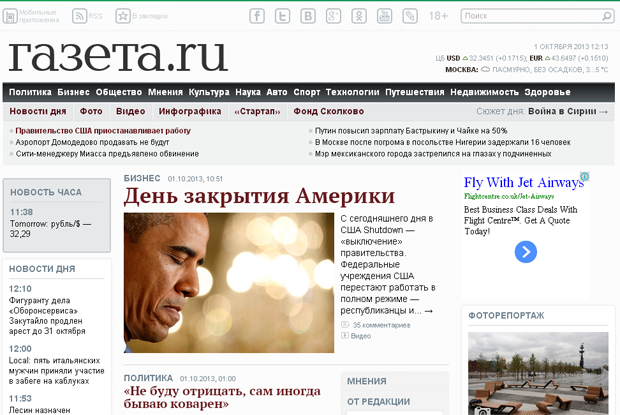
gazeta.ru was just one of the sites blocked by a Russian court.
The major news in internet censorship in summer 2013 in Russia is a new law on copyright covering film, television and video productions. Under the legislation, a website hosting allegedly illegal content can be blocked without a court judgment if the owner of the site fails to remove the content after receiving a warning from the state regulator Roskomnadzor.
The measure was strongly criticised by human rights activists, experts and internet companies, but the State Duma approved the “anti-piracy” law on 21 June and it entered into force on 1 August. The first victim was a torrent-tracker site, added to the Register of Pirate Resources on 22 August. Since then dozens of websites have been banned or blocked and distrubution of many movies online has been prohibited by courts.
Site-blocking has also been used against the mainstream media: in June internet users in the Ulyanovsk region discovered that their access to the websites of 14 popular publications, including the online newspaper gazeta.ru and the tabloid daily Komsomolskaya Pravda, was barred. The local prosecutor blocked the websites after a ruling by a district court that articles on bribery they had published “undermined the authority of the government”. Remarkably, the court failed to inform the newspapers of the decision.
Extremism
Chuvash ISP fined for distributing extremist materials
On 3 June the Chuvash Republic prosecutor reported that the Novocheboksarsk city court had found the head of a local ISP guilty of failing to block access to websites posting extremist materials and had sentenced him to a fine of 2,000 rubles. The verdict has not yet entered into force.
ISP fined in Moscow
On 4 June it was reported that the arbitration court of the Moscow region had sentenced the ISP Tefo to a fine of 30,000 rubles for failing to block access to websites featuring extremist materials. The company appealed the decision, but the appeal court confirmed the verdict.
Chechnya prosecutor seeks to block Belyi Bukvar
On 4 June the Chechnya Republic prosecutor announced that a writ had been served against the ISPs Vainakh Telecom, Elektrosviaz Federal State Unitary Enterprise in the Chechen Republic, Chechenskaya Sotovaya Svyaz, Mig, the Caucasus branch of Megafon and the local branches of VimpelCom and MTS. The prosecutor demanded that the ISPs block access to a website hosting the far-right tract The White Primer (Belyi Bukvar), which is on the Federal List of Extremist Materials.
Krasnodar prosecutor moves against Islamist website
On 5 June 2013, the Krasnodar regional prosecutor said that the Islamist website www. islamdin.biz, which is on the Federal List of Extremist Materials, was publicly accessible. The Starominskiy district prosecutor served a writ demanding that the ISP Beeline block access to the site.
Moscow prosecutor requests blockion on anti-Islam video
On 5 June it was reported that the Presnenskaya prosecutor in Moscow had served a writ in the Basmanny district court against the ISP Taskom. The prosecutor demanded a block on access to a website featuring the anti-Islamic video The Innocence of Muslims, which is on the Federal List of Extremist Materials.
Komi Republic ISP yields to bailiffs
On 6 June it was reported that the Syktyvkar city court had approved the demand of the city prosecutor for a block on access to the websites www. islamdin.biz, www.3a русb.livejornal.com and www.pat-livejornal.com. The court ordered the ISP Parma-Inform to block them, but the company did not immediately comply. The bailiff service notified it that enforcement proceedings were being initiated, and warned of possible criminal liability for non-compliance with the court’s decision. Subsequently, the ISP blocked the websites.
Courts order ISPs to block Falun Gong and Scientology
On 13 June the Krasnodar regional prosecutor said that the Leninsky district court and the Oktyabrsky district court had approved the city prosecutor’s demands that eight ISPs – Astarta, Kubintersvyaz, Prestizh-internet, Kuban State University, VimpelCom, Megafon, MTS, and Kubtelecom – block access to sites publishing materials by the Chinese sect Falun Gong and Scientology tracts. The offending texts were Zhuan Falun by Li Hongzhi, Report into Allegations of Organ Harvesting of Falun Gong Practitioners in China by David Matas and David Kilgour and PTS/SP Course Lectures by L Ron Hubbard, all of which had been previously legally recognised as extremist.
Novokyibishevsk prosecutor moves on websites
On 13 June the Samara regional prosecutor announced that the Novokyibishevsk city prosecutor had served 20 writs against the ISPs Progress-IT, TesKomVolga, MIRS and NeksTellSamara demanding blocks on access to websites hosting material included in the Federal List of Extremist Materials. The Novokuibyshev city court has approved eight of the writs.
Mussolini books lands ISP in trouble
On 17 June the Ivanovo regional prosecutor said that the Rodnikovsky district prosecutor had demanded that the ISP Irtek block access to two websites hosting the texts of Benito Mussolini’s Memoirs 1942-1943 and The Doctrine of Fascism.
ISPs warned over access to extremist materials
On 18 June the Jewish Autonomous regional prosecutor announced that it had demanded that the Khabarovsk branch of MTS and the Birobidzhan branch of VimpelCom block access to websites hosting extremist materials.
Kemerovo blocks websites
On 18 June it was reported that a court had approved the demand of the Zavodskoy district prosecutor that an ISP block access to websites hosting texts included in the Federal List of Extremist Materials.
Blagoveshchensk denies access to extremism
On 20 June the Blagoveshchensk city court approved the demand of the district prosecutor that the Amur branch of Rostelecom block a site hosting the article “The Mujahideen statement upon arrival of new bandit groups – FSB and MVD – to Dagestan”, which is on the Federal List of Extremist Materials.
Samara prosecutors demand block
On 21 June the Samara regional prosecutor announced that the Zheleznodorozhny district prosecutor had served 26 court writs against the ISPs Intertelekom.ru, Avantel, and Samara Lan, demanding that they block access to websites hosting fascist propaganda and materials aimed at inciting religious and racial hatred.
Saratov ISP ordered to block websites
On 24 June the Saratov regional prosecutor said that a court had approved the demand of the Leninsky district prosecutor that the regional branch of the ISP Rostelecom block access to websites with extremist content.
Surgut prosecutors move against NBP website
On 24 June the Khanty-Mansiysk Autonomous District prosecutor said that the Surgut city prosecutor had served a writ against the local branches of the ISPs VimpelCom and Megafon demanding blocks on access to the sites of extremist organisations including the Slavic Union and the National Bolshevik Party.
Mari El prosecutor gets sites barred
On 1 July the Mari-El Republican prosecutor said that the Volzhsk city court had approved a demand from the Volzhsky inter-district prosecutor that the ISP Intercom block access to sites hosting the text of the booklet Rasovaia Gigiena i Demograficheskaia Politika v Natsional-sotsialisticheskoi Germanii (Racial Hygiene and Population Policy in National-Socialist Germany) and the Islamist tracts The Concept of Hizb-ut-Tahrir and Kniga Edinobozhiia (The Book of Monotheism). The prosecutor also sought to block websites promoting drug use.
Moscow ISP pre-empts court ban
On 26 June the Lytkarino city prosecutor in Moscow announced that it had served a writ against the ISP Velcom-L, demanding a block on access to a website hosting extremist materials. The ISP complied without waiting for a court decision. The case was closed.
Penza websites reined in
On 26 June the Penza regional prosecutor said that the Oktyabrsky district court in Penza had approved the district prosecutor’s demand that local ISPs block access to websites hosting extremist materials including Krysoliudi by Orei Volot and Mein Kampf by Adolf Hitler; both of which are on the Federal List of Extremist Materials.
Smolensk prosecutors issue warning
On 27 June the Smolensk regional prosecutor said that the district prosecutors of the Zadneprovsky and Promyshlennyi districts and the inter-district prosecutors of Gagarinskaya and Safonovskaya had issued 12 warnings to ISPs of violations of the law on combating extremism. The ISPs that received the warnings were the local branches of MTS and Rostelecom, SmolenskSvyazStroy, MAN-Set, and the Russian Post (Pochta Rossii).
Jewish Autonomous Region blocks access
On 2 July the prosecutor of the Jewish Autonomous Region said that the regional offices of MTS and Beeline had blocked access to extremist materials after the ISPs were sent warnings.
Novgorod court orders block
On 11 July the Novgorod regional prosecutor said that the Novgorod district court had approved a prosecutor’s demand that the ISPs Maxim +, Novline, Rostelecom and Alfakom block access to a Jehovah’s Witnesses website and to a site hosting the anti-Islamic video Innocence of Muslims, which is on the Federal List of Extremist Materials. The ISPs have complied with the court decision.
Chukotka prosecutor blocks access
On 12 July the prosecutor of Chukotka Autonomous District said that the district attorney had demanded that the management of the ISP Arctic Region Communications block access to extremist materials. The ISP complied.
Bratsk prosecutors acts against extremism
On July 15 the Irkutsk regional prosecutor said that the Padunsky district prosecutor in Bratsk had demanded that an ISP block access to websites included on the Federal List of Extremist Materials.
Samara blocks book site
On 15 July the Kirov district court approved the demand of the Samara regional prosecutor that access be blocked to a website hosting the book Allu Butami Ochishchenie Serdtsa i Tela ot Griazi Mnogobozhiia i Neveriia (Purification of the Heart and the Body from the Dirt of Polytheism and Atheism) by Ahmad ibn Hajar. The book is on the Federal List of Extremist Materials.
Chukotka prosecutor targets post office
On 17 July the prosecutor of Chukotka Autonomous District demanded that the Lavrenty post office cease allowing access to sites included in the Federal List of Extremist Materials, among them sites inciting ethnic and religious hatred. Access to these sites was blocked and the Lavrenty postmaster was reprimanded.
Pyatigorsk says Islamist site is extremist
On 16 July Pyatigorsk city court approved a demand by the city prosecutor to classify the Islamist website firdauz.ucoz.net, which had published the banned video lecture Chuzhie (Aliens) by Sheikh Khalid Yasin, as extremist.
Primorye blocks extremist material
On 18 July the Primorye regional prosecutor said that the director of Fokino-Telecom had been told to eliminate violations of the law on combating extremism. The ISP blocked access to several websites and the ISP’s managers face disciplinary charges.
Leningrad moves against messages
On 19 July the Leningrad regional prosecutor said that the Sosnovy Bor town prosecutor had demanded that the ISP Infosentr block extremist materials. The prosecutor said that the local network sbor.claim, housed on the Infosentr’s server news.sbor.net, contained user messages aimed at inciting national and racial hatred and violence. The management of Infosentr removed the offending materials from the server.
Krasnodar ISPs receive warnings
On 8 August it was reported that the central administrative district prosecutor in Krasnodar had issued warnings to the ISPs Virtual, Komlink, Postavshchik Kommercheskoi Informatsii and Real Comm, which had all allowed access to a video message by the Chechen Islamist Doku Umarov. The message was indicted for public incitement to terrorist activities including disruption of the 2014 Olympic Games in Sochi.
ISP told to limit access in Moscow
On 26 August it was announced that the Pavlovsky Posad town court had approved the town prosecutor’s demand that the ISP Elektranet block access to extremist websites and remove the offending sites from its servers. The court ruling has not yet entered into force.
Extremist websites blocked in Chechnya
On 29 August the Chechnya Republican prosecutor said that the Leninsky district court of Grozny had endorsed five demands that ISPs block access to websites hosting extremist materials.
Saratov prosecutor demands access block
On 30 August the Saratov regional prosecutor announced that the Kirovsky district prosecutor had served a writ in order to include the website, which contains a book included in the Federal List of Extremist Materials, on the Register of Banned Domain Names.
ISP loses appeal in Sverdlovsk
On 30 August it was announced that an ISP from Kamensk-Uralsky had lost its appeal against a court decision demanding that it block access to websites containing extremist materials. The company had argued that ISPs should not be responsible for content monitoring, but was instructed to block access to the offending sites.
Ulyanovsk prosecutor seeks bans
On 20 August it was reported that the Inzensky district prosecutor had served a writ demanding that the Ulyanovsk regional branch of Rostelecom block access to websites hosting extremist materials, including kcblog.info, koransunnah.wordpress.com and masteroff.org.
Students ‘must be protected’ in Voronezh
On 14 August it was reported that the Kamensky district bailiffs’ office in Voronezh had demanded that the administration of a district school comply with a court order blocking student access to extremist sites within five days. The school complied and enforcement proceedings were closed.
Altai Republic bans 10 sites
On 14 August the Gorno-Altaysk city court reviewed two demands by the Altai Republic prosecutor that two ISPs block access to 10 websites with extremist content. During the review it was established that the ISP E-Telecom had voluntarily complied with the demand and blocked the websites. The ISP ONGNET agreed to comply with the request at the time of the court proceedings.
Tambov prosecutors demand blocks
On 6 August the Tambov regional prosecutor said that the Michurinsk town prosecutor had demanded that the ISP Yugo-Vostok TransTeleKom block access to extremist materials.
Networking service hit because of 2011 post
On 7-8 August, internet users in several regions were unable to access the popular social networking site LiveJournal.com. Beeline, a major mobile operator and ISP, temporarily blocked the site in Moscow, Nizhny Novgorod and Yekaterinburg because of a post about miendorss, published in 2011. The intention was to block only a page, but an error led to blocking the entire site.
Extremist book publishers targeted in Ulyanovsk
On 8 August it was reported that the Ulyanovsk district prosecutor had served a writ demanding that the regional branch of Rostelecom block access to extremist materials on the websites bookz.ru, svoboda.ru, tvoyhram.ru, e-reading-lib.com and blagievesti.ru. The sites were found to contain the books Krasnaia Kabbala (The Red Kabbalah), Rasovaia Gigiena i Demograficheskaia Politika v Natsional-sotsialisticheskoi Germanii (Racial Hygiene and Population Policy in National-Socialist Germany), Udar Russkikh Bogov (The Strike of Russian Gods), Glavnaia Spetsial’naia Operatsiia Vperedi (The Main Special Operation Is Ahead), and Spravochnik Russkogo Cheloveka (The Russian’s Handbook).
Drugs
Langepas prosecutor demands drug restrictions
On 10 June the Khanty-Mansi Autonomous district prosecutor said that the Langepas city prosecutor had served a writ demanding that the ISP Rostelecom block websites posting information about the use and manufacture of illegal drugs.
Togliatti prosecutors block drug sites
On 20 June the Samara regional prosecutor said that the Avtozavodsky district prosecutor in Togliatti had served 54 writs against the ISPs AIST, Infolada, Infopak, Letkom-2, Togliatti Telecom and Aido Telecom, demanding that they block websites promoting the use and production of illegal drugs. Thirteen of these writs have been acted upon.
Bashkortostan move on ‘smoking blends’
On 22 July it was announced that the Ishimbay district prosecutor had served a writ against the ISP Bashinformsvyaz, demanding that access to 40 sites that promote the use of ‘smoking mixtures’ be blocked.
Moscow ISP told to clean up
On 28 August it was announced that the city prosecutor of Pavlovsky Posad in the Moscow region had demanded that the ISP Elektranet block sites hosting information about drug manufacture. The city court approved the prosecutor’s demand in full.
Roscomnadzor bans singer’s website
On 8 August it was reported that the state regulator Roscomnadzor had added the webpage of Buryat singer Dasha Baskakova to the Register of Banned Websites on the request of drug enforcement agencies. The singer has been unable to obtain any explanation for adding her site to the register.
Bribery and corruption
Ulyanovsk prosecutors seek bans
On 14 June it was reported that the Zasviyazhskiy district prosecutor of Ulyanovsk had served a writ demanding that the ISPs DARS-IP and Telekom.ru. block the websites 7ba.ru, babyplan.ru, daslife, bbcont, Volgograd, which contain information on how to give bribes.
Gazeta.ru blocked in Ulyanovsk and Nizhny Novgorod
In the second half of June 2013, internet users in the Ulyanovsk region discovered that their access to the websites of 14 popular publications, including gazeta.ru and Komsomolskaya Pravda, had been blocked. The local prosecutor had blocked the websites in accordance with a decision of the Leninsky district court, which ruled that material on bribery previously featured in these publications “undermined the authority of the government”. The court failed to inform the newspapers about the decision. On 26 June the ISP restored access to the materials on the website. The prosecutor explained that the block on access related to specific materials published at gazeta.ru, and not to the entire site. The Dzerzhinsk city prosecutor in the Nizhny Novgorod region also requested that the ISP block gazeta.ru materials.
ISPs pre-empt prosecutor in Ivanovo
On 12 July it was announced that the Teykovskaya inter-district prosecutor had served six writs demanding that Ivanovo ISPs block websites on techniques of bribing officials. The ISPs complied with the writs without waiting for the court’s decision.
Prosecutor withdraws in Nizhny Novgorod
On 24 July it was reported that the Kulebaki town prosecutor in Nizhny Novgorod had gone to court demanding that the regional branch of Rostelecom block access to a page of the social network livejournal.com which discussed ways of soliciting bribes. The prosecutor subsequently withdrew because the defendant lacked the technical capacity for blocking access to the page without blocking the entire site.
Ufa nixes bribery sites
On 23 July it was announced that the Ishimbay district prosecutor in Ufa had served writs against the ISPs Bashinformsvyaz and Ufanet, demanding that they block access to websites hosting information on ways to give a bribe. The court approved the prosecutor’s demands.
Tyumen court bans corruption tips
On 26 August the Tyumen regional prosecutor said that the Tsentralnyi district court in Tyumen had endorsed a prosecutor’s demand to block access to five websites hosting information on techniques of bribery.
Reader’s letter from 2009 prompts ban
On 29 August it became clear why the Frunze district prosecutor in St Petersburg had agreed to block access to the gazety.ru website – a letter by a woman reader entitled “I can teach you how to give a bribe”. Several other sites had reprinted the text, so the prosecutor demanded a block on access to these site as well: the advice section of www.daslife.ru, a social network for mature individuals; maxpark.com, a women’s community website; www.girls-only.org; the smart-phone portal www.7ba.ru; the business website bc1.ru; and a pregnancy-planning portal, babyplan.ru. The Frunze district prosecutor said that that the managers of these websites should face criminal responsibility “for their effects on the mind and will of the actor (cultivating an intention to commit a crime) in the form of advice, guidance, or providing information”.
Samara court moves against bribery advice
On 9 August it was reported that the Samarsky district court had approved six writs from the district prosecutor demanding blocks on access to websites providing information on how to commit crimes of corruption. The names of the websites in question were not reported.
Pyramid schemes shut down in Volgograd
On 12 August the Volgograd regional prosecutor said that the Tsentralny district prosecutor had served 44 writs in local courts against ISPs demanding blocks on access to websites advertising a pyramid scheme, the Group of Social Solidarity: the Knights (Gruppa sotsial’noi solidarnosti: Vitiazi).
Krasnodar prosecutor aims at anti-draft info
On 14 August the Krasnodar regional prosecutor said that the prosecutor of its central administrative district had served eight writs against ISPs to block access to websites hosting information on the ways to evade military service.
Samara prosecutor bars corruption sites
On 8 August the Samara regional prosecutor said that a district court in Samara had approved six writs from the district prosecutor blocking access to websites hosting information on how to commit corruption offences.
Gambling
Nyagan court orders ban
On 14 June it was reported that a court had approved a writ from the Nyagan town prosecutor demanding that the ISP Rostelecom block access to gambling websites.
Bryansk gambling sites blocked
On 19 June the Bryansk regional prosecutor said that the Soviet district court had approved a writ from the Fokinsky district prosecutor demanding that the ISP Mobilnye TeleSystemy block access to seven gambling websites.
Stavropol court demands block
On 21 June it was reported that the Leninsky district court had approved a writ from the Stavropol district prosecutor, demanding that ISPs block access to 80 sites involved in illegal gambling activities.
Pyramid-scheme sites targeted in Ulyanovsk
On 26 June it was reported that a court had approved a writ from the Leninsky district prosecutor demanding that the ISP ER-Telekom Holdingblock block access to six websites run by the MMM pyramid scheme.
Online casinos barred in Stavropol
On 27 June it was reported that the Leninsky district court had approved a writ from the Stavropol city prosecutor demanding that the ISP VimpelCom block access to 80 gambling websites.
Ivanovo prosecutor demands pyramid scheme ban
On 28 June the Ivanovo regional prosecutor said that the Teikovsky Inter-district prosecutor had served 20 court orders blocking the MMM and MMM-2012 pyramid scheme websites.
Samara gambling sites blocked
On 15 July the Samara regional prosecutor announced that the Kirovsky district court of Samara had approved five writs from the Samara district prosecutor demanding blocks on gambling websites.
Magadan bailiffs act against ISP
On 18 July it was announced that the Susumansky district bailiffs department had initiated enforcement proceedings against the ISP Hitek, which had been ordered to block subscribers’ access to the website www.win-win-casino.com within five days of a court decision coming into force. The ISP blocked access to the site.
Samara blocks 210 online casinos
On 19 August the Samara regional prosecutor said that the Oktyabrsky district court of Samara had approved 210 writs from the district prosecutor blocking access to gambling websites. Six additional writs are pending.
Casino ban bill introduced in State Duma
On 19 July a bill allowing blocks on access to online casinos was introduced in the State Duma. The initiative came from Moscow Duma deputies. The bill suggests “the decision with respect to information that allows to take part in gambling activities via telecommunication networks, such as the internet” as a basis for inclusion on the Register of Banned Websites.
Omsk bailiffs ordered in on ISP
On 21 August it was reported that the Leninsky district court in Omsk had asked bailiffs to enforce a court decision ordering an ISP to block access to online casinos. The ISP complied with the request within five days. The name of the ISP was not specified.
Moscow ISPs ordered to block casinos
On August 7 the Moscow city prosecutor reported that the Kuntsevskiy district court had approved a writ from the district prosecutor demanding that the ISPs Velnet, SITS and SmarTel block access to gambling websites.
Perm court institutes ban
On 1 August it was reported that the Leninsky district court of Perm had approved a writ from the Kosinski district prosecutor demanding that the regional branch of Rostelecom block access to the MMM- 2011 pyramid scheme website. The court’s decision has not yet entered into force.
Ulyanovsk court blocks online casino
On 8 July it was reported that the Ulyanovsk regional prosecutor had served a writ against the regional branch of Rostelecom demanding it block access to the gambling website slotico.com. The court approved the writ.
Arkhangelsk ISP accedes to demands
On 26 July it was reported that the ISP ATK had on the request of the city prosecutor blocked access to online casinos and the MMM- 2013 pyramid scheme website. The ISP acted before court approval of the prosecutor’s demand.
Explosives manufacturing
Chechnya prosecutor demands explosives ban
On 4 June the Chechnya Republic prosecutor was reported to have served writs against the ISPs Vainakh Telecom, Elektrosviaz, Chechenskaya Sotovaya Svyaz and Mig, the Caucasus branch of Megafon, and the local branches of VimpelCom and MTS, demanding that they block access to two websites featuring information on manufacturing explosives at home.
Samara court blocks explosives site
On 4 June the Kirov district court of Samara approved the district prosecutor’s writ blocking access to a website hosting information on manufacturing improvised explosive devices.
Pyatigorsk bans weapons information
On 22 June it was announced that the Pyatigorsk city court had approved a writ from the city prosecutor demanding that the ISP KMVtelekom block access to websites hosting information on manufacturing weapons.
Chechnya prosecutor moves against ISPs
On 24 June it was reported that the Chechnya prosecutor had served a writ in the Leninsky district court in Grozny against the ISPs Vainakh Telecom, Elektrosviaz, Chechenskaya Sotovaya Svyaz and Mig, the Caucasus branch of Megafon, and the local branches of VimpelCom and MTS, demanding a block on access to a website hosting information on manufacturing explosives.
Pyatigorsk court blocks arms websites
On 26 June it was announced that the Pyatigorsk city court had ordered the ISP KMVtelekom to block access to websites advertising the sale of weapons and providing information on manufacturing of explosives and weapons.
Chechnya prosecutor demands action on explosives info
On 25 June the Chechen Republic prosecutor said that the Gudermessky district prosecutor had served two writs against the ISP Gumsnet demanding that it block access to a website hosting information on manufacturing explosives.
Trans-Baikal prosecutor gives ISP ultimatum
On 28 June the Trans-Baikal regional prosecutor issued a writ against the ISP ChitaTechEnergo, demanding it block access to several websites hosting information on manufacturing explosives.
Explosives sites identified in Omsk
On 19 July it was reported that the Omsk central district prosecutor had served writs against the ISPs T-Service, Media Group and Kompleksnye Komputernye Sistemy demanding that they block three websites hosting information on ways to give a bribe and home manufacturing of explosives.
TransBaikal court blocks access to bomb website
On 7 August the Transbaikal regional prosecutor said that on August 7 the Chita central district court had approved a writ from the regional prosecutor demanding that the regional branch of the ISP Rostelecom block access to a website hosting information on manufacturing of explosives. The ISP had refused to comply voluntarily with the prosecutor’s demand.
Mordovia prosecutor seeks ban
On 30 July the Mordovia Republic prosecutor said that the Ruzaevsky inter-district prosecutor had served a writ against the ISP Rostelecom demanding it block access to two websites hosting information on manufacturing explosives.
Grozny court orders explosives block
On 9 July the Leninsky district court of Grozny approved six writs from the Chechnya Republic prosecutor demanding blocks on access to websites hosting information on improvised explosive devices.
Piracy
VKontakte deletes audio files
On 14 June it was reported that the administration of the social network VKontakte had started deleting its music content in anticipation of the anti-piracy bill being considered by the State Duma. Users who download audio files personally, rather than copying them from another person, received messages from the network administration demanding that they remove any material that infringed on copyright.
New copyright and piracy law comes into force
On 21 June the State Duma passed a new law on protection of copyright in film, television and video productions. Any website hosting allegedly illegal content can now be blocked without waiting for a court judgment if the owner of the site fails to remove the identified material after a warning from the regulator Roskomnadzor.
On 1 August the “anti-piracy” law entered into force. On the first day, the Moscow city court rejected three writs. Seichas, a media distribution company, demanded a block on access to five films found on the Turbofilm.tv and Rutor.org websites, and additional blocks on access to movies posted by users of the social network VKontakte.
The writs were rejected on the grounds that the applicants had failed to indicate the persons against whom they sought action and had not supplied other documentation.
Roscomnadzor opened a website for complaints about piracy, NAP.RKN.GOV.RU, on 1 August.
First entry appears on piracy register
On 22 August it was announced that Roscomnadzor had added the address of the torrent tracker Opensharing.org to its Register of Pirate Resources, stating that the owners of the site had “failed to remove within the stipulated statutory period the technical ability to download the following 10 films, the rights to which were claimed by the company Direktsiia Kino: Vysotsky; Spasibo; Chto Zhivoi; Diversant; Konets Voiny; Dve Sud’by; Novaia Zhizn; Desantura; Nikto Krome Nas; Admiral; Ischeznuvshie; Leto Volkov; Kanikuly Strogogo Rezhima; Liubov Pod Prikrytiem; and Podsadnoi.
Prosecutors demand block on gazety.ru in St Petersburg
On 23 August Fontanka.ru said that the St Petersburg city prosecutor had demanded a block on the online newspaper gazety.ru for publishing an article allegedly promoting corruption in 2009.
Another site added to piracy list
On 27 August it was announced that the state regulator Roscomnadzor had added rutor.org to the Register of Banned Websites. The website opensharing.org had previously been included on the register, then taken off the list after removing its illegal content, and then added again after it was established that its distribution of pirated materials had been resumed.
Moscow court bans sharing of online movies
On 13 August the Moscow city court upheld the claim of the company Direktsiia Kino demanding the termination of access to the following movies: Vysotsky; Spasibo; Chto Zhivoi; Diversant; Konets Voiny; Dve Sud’by; Novaia Zhizn; Desantura; Nikto Krome Nas; Admiral; Kanikuly Strogogo Rezhima; Liubov Pod Prikrytiem; Trudno Byt’ Macho; Podsadnoi; Belaia Noch; and Nezhnaia Noch. The defendant website was not identified.
On 31 August the Moscow city court handed down three decisions on appeals from Central Partnership Sales House. The court ordered termination of distribution online of pirated copies the films Legenda No 17 (the name of the film was misspelled in the text of the verdict), Legenda o Kruge, Marafon, Pyat’ Nevest, O Chem Molchat Devushki and Likvidatsiia on the sites rutor.org and nnm-club.ru.
Moscow court upholds copyright on TV series
On 8 August it was announced that the Moscow city court had upheld a request from the media distribution company Seichas for a block on access to the TV series Interny, Sasha, Tania, HB and Univer Novaia Obshaga. The court ordered the website rutor.org to block access to the series and the website Turbofilm.tv to block access to Komputershchiki TV series.
TV company demands block
On 15 August the Moscow city court upheld the claim of Pimanov and Partners against a website that had made three seasons of the series Aleksandrovsky Sad and Zhukov available online. The plaintiff demanded a block on access to the offending website. The unnamed site was given 15 days to confirm its right to distribute the material.
Moscow court bars pirate series
On 16 August it was announced that the Moscow city court had upheld a demand from the All-Russian State Television and Radio Broadcasting Company that the website rutor.org block access to the TV series Institut Blagorodnykh Devits.
Move against piracy approved
On 16 August the Moscow city court upheld four claims by media companies NTV-Profit and Novyi Disk-trei seeking to block internet access to the TV series Vor, Dve Luny Tri Solntsa, Umirat Legko, Mama, Russkii Bunt, Poklonnnik, Kliuchi ot Smerti, Den’ Rozhdeniya Burzhuia and Krutye Povoroty.
Court backs anti-piracy action
On 8 August it was reported that the Moscow city court had approved the media distribution company Seichas’s demand for a ban on the websites rutor.org and turbofilm.tv making available online the TV series Interny, Sasha, Tania, Univer Novaia Obshaga and The IT Crowd.
Education and public spaces
Saratov schools penalised over filters
On 10 June it was reported that the Turkovsky district prosecutor in Saratov had demanded that 10 schools improve their internet filtering to prevent students accessing extremist materials. Eighteen officials face disciplinary actions.
Novgorod prosecutor acts on explosives
On 21 June the Novgorod regional prosecutor said that the Batetsky district prosecutor had demanded that the chairman of the district’s education committee block access to websites hosting information on manufacturing explosives from the computers in Gorodnia village secondary school. Access to the offending websites has been blocked.
ISP blocks sites before court decision
After an inspection in March 2013 revealed that computers at Dubnenskaya and Voskresenskaya schools in the Dubnensky district in Tula provided access to online pornography and to the text of Hitler’s Mein Kampf, the Dubnensky district prosecutor demanded that access to these sites be blocked. On 25 June, the case was dismissed due to the fact that the ISP Rostelecom had blocked the websites prior to the start of the proceedings.
Chapaevsk school told to block websites
On 26 June it was announced that the Chapaevsk city court in Samara had approved the city prosecutor’s demand that the principal of School No 8 in Chapaevsk install content filters on its computers after the prosecutor found that students had access to extremist and pornographic websites and to the VKontakte and Odnoklassniki social networks.
Sverdlovsk schools warned on filtering
On 27 June the Sverdlovsk regional prosecutor said that the Chkalovsky district prosecutor had found that the computers of Yekaterinburg Gymnasium No 39 allowed access to extremist materials, despite being equipped with content filters. The school principal was issued a warning.
Yaroslavl prosecutor demands shield for children
On 28 June it was reported that the Kirov district prosecutor in Yaroslavl had demanded that schools No 42 and No 43 cease allowing access from their computers to websites hosting extremist and pornographic materials.
Stavropol students ‘must be protected’
On 18 July the Stavropol regional prosecutor said that the Budennovskaya inter-district prosecutor had issued eight demands that schools block access to websites hosting extremist materials, pornography and promotion of drug abuse. The schools have complied and the responsible parties face disciplinary charges.
Schools told to shield children from drugs
On 25 July it was reported that the Monastyrshchinsky district prosecutor in Nizhny Novgorod had served 12 court writs demanding that secondary schools block access to websites hosting recipes for making illegal drugs. All 12 writs were approved.
Chapaevsk limits access to gambling sites
On 25 July the Samara regional prosecutor said that the Leninsky district court in Samara had approved 16 writs from the Chapaevsk prosecutor demanding a block on access to websites that facilitate online gambling.
Novgorod blocks school computers
On 31 July the Novgorod regional prosecutor said that the Batetsky district prosecutor had demanded that the chairman of the district board of education block access to websites giving advice on bribery from school computers in the villages of Gorodnia and Batetsky. The sites were blocked.
Saratov prosecutor acts on ‘smoking blends’
On 2 August the Saratov regional prosecutor said that Aleksandrovo-Gaisky district prosecutor had demanded that the principal of Secondary School No 3 in the village of Aleksandrov-Gai block access websites with information on illegal drugs.
Gaming hall ‘allowed access to extremist material’
On 17 July the Volgograd regional prosecutor said that the Kamyshinsk city prosecutor had served a writ against the proprietor of the local gaming hall Ramdos, Tsereus, demanding a block on access to websites hosting extremist materials. The gaming hall has been shut down for breaches of fire regulations.
Belgorod ISPs face clampdown
On 29 August it was reported that the Belgorod regional office of the state regulator Roscomnadzor had reported the ISPs Rosinterkom, Svyazinform, Radius and Optiktelekom for failing to block access to materials on the Register of Banned Websites. The case will now go to the Belgorod arbitration court for consideration.
Kazan ISP warned of violations
On 22 August it was announced that Roscomnadzor office in the Tatarstan Republic had compiled a record of alleged failures by the ISP SKS-AiTiTelekom to block access to websites and pages included in the Register of Banned Websites.
Pornography
Porn site blocked in Mordovia
On 16 July the Mordovia Republic prosecutor said that the Ruzaevskaya inter-district prosecutor had served a writ against the Mordovian branch of Rostelecom, seeking to block access to a porn website. The Leninsky district court in Saransk endorsed the writ.
This article was originally posted at indexoncensorship.org on 1 Oct 2013