29 Oct 2012 | Digital Freedom, India
Following outrage from India’s civil society and media, it appears the country’s government has backed away from its proposal to create a UN body to govern the internet. The controversial plan, which was made without consulting civil society, angered local stakeholders, including academics, media, and industry associations. Civil society expressed fear that a 50-member UN body, many of whom would seek to control the internet for their own political ends, would restrict the very free and dynamic nature of the internet. The proposal envisaged “50 member States chosen on the basis of equitable geographic representation” that would meet annually in Geneva as the UN Committee for Internet-Related Policies (UN-CIRP).
Rajeev Chandrasekhar, Indian parlimentarian and critic of the proposal, said: “CIRP seems like a solution in search of a problem”. At present, ICANN (Internet Corporation for Assigned Names and Numbers), a non-profit with ties to the US State Department, serves as the platform for internet governance, using an organisational structure that allows input from the wider internet community and not just governments of the world.

Sachin Pilot, India’s Minister of State for Telecom
However at the 4-5 October Conference on Cyberspace in Budapest, the Minister of State for Telecom, Sachin Pilot, indicated that India was moving away from the “control of the internet by government or inter-governmental bodies”, and moving instead towards enhanced dialogue. Pilot has now confirmed the change to Index, saying that the Indian government has now decided to “nuance” its former position.
![]() The sudden move can be explained by India’s decision to now develop its own stance, claiming that it was initially just supporting proposals made at the India, Brazil and South Africa seminar (IBSA) on Global Internet Governance in Brazil in September 2011. However, there are indicators that the country might have played an active role in pushing for the new body.
The sudden move can be explained by India’s decision to now develop its own stance, claiming that it was initially just supporting proposals made at the India, Brazil and South Africa seminar (IBSA) on Global Internet Governance in Brazil in September 2011. However, there are indicators that the country might have played an active role in pushing for the new body.
The government representatives present at the IBSA seminar drafted a set of recommendations focused on institutional improvement, which pushed for the UN to establish a body “in order to prevent fragmentation of the internet, avoid disjointed policymaking, increase participation and ensure stability and smooth functioning of the internet”. The proposal was to be tabled until the IBSA Summit on 18 October 2011, but according to a Daily Mail report, Indian bureaucrats publicly discussed the proposal at the 2011 Internet Governance Forum (IGF) in Kenya, saying that the move “was criticised across the board by all countries and scared away both Brazil and South Africa.” The report also alleges that the Indian government only consulted one NGO — IT for Change — in drafting the proposal presented in Brazil, despite repeated offers from other participants to pay for members of the country’s third sector to participate in the seminar. India’s proposed UN-CIRP was slammed for moving away from multi-stakeholderism and instead opting for government-led regulation.
Whatever the truth behind the Indian government’s motives in proposing UN-CIRP, its new and more “nuanced” position is a welcome move. It remains to be seen if India will maintain its new stance at the upcoming IGF, which will be held from 6-9 November in Baku, Azerbaijan.
Mahima Kaul is a journalist based in New Delhi. She focuses on questions of digital freedom and inclusion
29 Oct 2012 | Africa, Sub-Saharan Africa
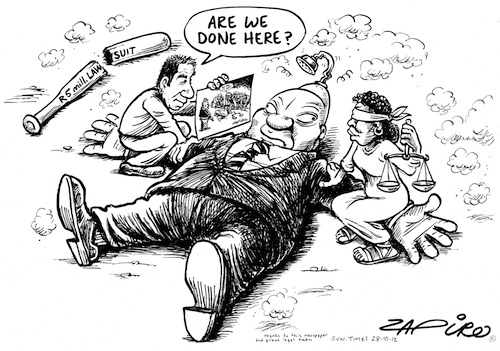
South Africa’s president Jacob Zuma dropped his defamation lawsuit against the country’s most prominent newspaper cartoonist, Zapiro, over the weekend [28 October].
The suit centred on a 2008 cartoon in the Sunday Times, the highest-circulation local weekend newspaper, depicting Zuma unzipping his pants to rape a woman held down by other politicians. Zapiro, whose real name is Jonathan Shapiro, identified the figure of the woman as symbolising “Lady Justice”.
At the time, the cartoon drew mixed responses, given racist attitudes towards black male sexuality and the cartoon’s use of rape as “metaphor” in a country with a high incidence of rape (studies show between 25 to 40 per cent of South African women will experience at least one sexual assault in their lifetime).
In 2006, Zuma was charged with and acquitted of rape.
His office explained this weekend’s unexpected withdrawal of the case as based on a concern over its chilling effect on freedom of expression. “The President (…) would like to avoid setting a legal precedent that may have the effect of limiting the public exercise of free speech,” Zuma’s spokesperson, Mac Maharaj, said in a statement.
Maharaj indicated that the president regarded the case as a “diversion”, as he wishes to provide leadership in the face of more urgent matters such as “the global economic meltdown and frustrations by the people on the ground”.
Zapiro celebrated with the cartoon below:
© 2012 Zapiro (All Rights Reserved) Printed/Used with permission from www.zapiro.com
Christi van der Westhuizen is Index on Censorship’s new South African correspondent
27 Oct 2012 | Africa, South Africa, Sub-Saharan Africa
Rural people travelled hundreds of kilometres to voice their objections at South Africa’s parliament about a new bill that threatens to impose a separate and unequal legal system on them — just to hear that their submissions are being blocked.
The Traditional Courts Bill uses apartheid-era Bantustan jurisdictions to reinstate a legal system that deprives black rural South Africans from citizen’s rights enjoyed by their urban counterparts. Some 22 million people are affected – almost half of the country’s population.

Women are not usually allowed to speak in traditional courts – male relatives talk on their behalf
The bill empowers traditional leaders, who are unelected and predominantly male, to act as judicial officers in disputes. Penalties can be imposed that range from banishment to hard labour.
Critics have pointed out that the bill continues a colonial practice that violates the principle of the separation of powers by concentrating executive, legislative and judicial functions in the hands of traditional chiefs.
Chiefs dispense executive governmental functions, including allocating land and access to water. Customary law is understood as “living law” developed by communities and is therefore not written down. The bill will allow chiefs inordinate say when applying customary law while also appointing them as presiding officers in such legal matters.
Rural women are particularly adversely affected because they are usually not allowed to speak in traditional courts, and therefore cannot defend themselves. Instead of entrenching women’s right to speak this bill exacerbates this situation by allowing others to speak on women’s behalf. In practice these “others” will be male family members – frequently the same people who have in interest in depriving a woman of her house or land after her husband’s death.
Traditional leaders have been using their influence in the ruling African National Congress (ANC) to drive the bill. The drafters from the department of justice and constitutional development consulted only traditional leaders in the drafting process, and not those most affected – rural people.
South Africa’s constitution obliges its parliament to hear the public’s views about legislation. Parliament held public hearings across the country in April and May this year where many rural people resoundingly rejected the bill.
The hearings were flawed, as traditional leaders arrived with large entourages and tried to prevent community members, especially women, from speaking in some cases. There have been suggestions that many rural people were not informed of the hearings while those who attended were frequently misinformed about the implications of the bill.
The public hearings culminated in September in Cape Town, the seat of the South African parliament. Again, rural women and men travelled from far-flung areas to tell the select committee on security and constitutional development how the bill would exacerbate current power abuses by traditional leaders.
The committee received almost 70 written submissions while more than 20 oral submissions were heard over a four-day period. The vast majority of the submissions demanded the scrapping of the bill and the drafting of a completely new bill
However, it emerged on Wednesday (24 October) that the committee has decided to only consider the submissions made by two government departments and the South African Human Rights Commission (SAHRC), a constitutional watchdog body.
The committee chairperson, Tjetha Mofokeng (ANC), told committee members that he had instructed justice department officials to compile a “working document” for them. On his instruction, the document was limited to summaries of the submissions from the justice department, the department of women, children and people with disabilities and the SAHRC.
Mofokeng, supported by ANC committee members, questioned “the relevance” of the 60-plus submissions by non-state representatives.
Opposition party parliamentarians objected, pointing out that the overwhelmingly negative response from rural participants has to be taken into account.
Dennis Bloem from the Congress of the People (COPE) argued:
Chair, I want to put it clearly, it will be an insult to all the other organisations that have made inputs here to say that it is not relevant. We have spent taxpayer’s money to have a whole week of public hearings to listen to what the people have said. That is the essence and the reason for having public hearings.
The Alliance for Rural Democracy, a group of 30 civil society organisations including the 50,000 member-strong Rural Women’s Movement, called Mofokeng’s actions “brazen” and “deeply insulting”. The alliance called on parliament to clarify its position on the unconstitutional stance taken in the committee, which amounts to silencing citizens’ voices.
Christi van der Westhuizen is Index on Censorship’s new South African correspondent
22 Oct 2012 | Mexico
Last August, Manuel Berumen, a university professor, received the shock of his life after kissing his wife as they strolled with their four-year-old son in a public plaza in Leon, Guanajuato. A woman complained about the “indecency” and he ended up in jail. Berumen was victim of Guanajuato’s anti-obscenity laws, which ban kissing in public. The law was introduced in 2009 under mayor Eduardo Romero Hicks, of the conservative right win National Action Party, (PAN).
Berumen had demanded justice for wrong imprisonment and urged that the police officers who arrested him be punished. But now, a local inquiry body, called the Honor and Justice Committee has exonerated the police officers who arrested Berumen and said they were only protecting local law.
(more…)



