
“Freedom to express yourself is what it means to be an artist”
Artist Ai Weiwei has been missing for 40 days, Leah Borromeo reports from the opening of his new show
Chinese artist Ai Weiwei was detained on 03 April 2011 by the authorities at Beijing Capital Airport preparing to board a scheduled flight to Hong Kong. He has yet to be charged and the state has not yet confirmed his whereabouts.
A major survey show of his work has opened at London’s Lisson Gallery joining his first public installation at Somerset House — “Circle of Animals”. As one of the leading cultural figures of his generation, Ai is a political artist in work and in deed. With work that juxtaposes the antiquity and craft of Chinese culture with modern techniques and multimedia platforms, his work has a voice that resonates through histories.
From a junkyard assemblage of domestic doors made from pristine slabs of marble to Han Dynasty vases covered in bold industrial paint to a marble CCTV camera pointed into the streets of London, the Lisson’s compilation of Weiwei’s work from the past six years shows the activism in his art and the artistry in his activism.
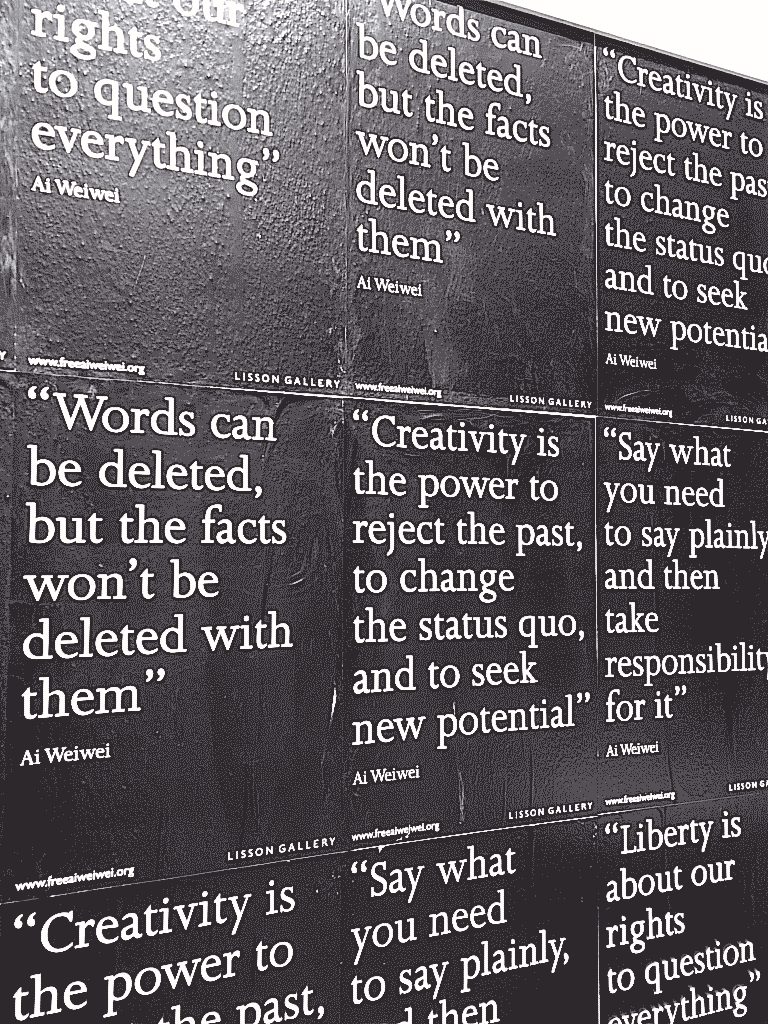 Wheatpasted on the walls outside the gallery are words from Ai himself:
“Liberty is about our rights to question everything.”
“Say what you need to say plainly and take responsibility for it.”
“Creativity is the power to reject the past, to change the status quo and to seek new potential.”
“Words can be deleted, but the facts won’t be deleted with them.”
The Lisson’s founder and director Nicholas Logsdail argues that Weiwei’s work “has become politicised because of his position. The genius lies in politically gentle forms that are open to interpretation — only when you look into what constitutes the work can you see he’s rebaptised antiquity with a message.”
In the days of the Young British Artists, established galleries like the Lisson and larger institutions like Tate and the Guggenheim were depoliticised. Should political art be shown it was obfuscated beneath layers of visual rhetoric or in historical retrospectives where the immediacy of the message passed its dateline. Thanks to Ai Weiwei and his disappearance at the hands of his own state, an art world already politicised by funding cuts is speaking out. We’ve all become agit-prop. Tate Modern stencilled “Free Ai Weiwei” across the top of its building. Anish Kapoor dedicated his Leviathan sculpture in Paris to Ai Weiwei. Bob and Roberta Smith held a reading of names to remind people that dozens of other artists, writers, and supporters of free expression have either been detained or gone missing at the hands of the Chinese. The Guggenheim has launched an online petition for his release and the Lisson is inviting all visitors to its show to be photographed with a “Free Ai Weiwei” placard that will be broadcast on the internet. There is no scope to be subtle when freedom is at stake.
Greg Hilty, the Lisson’s curatorial director, said that after Weiwei’s disappearance there was “no question” of whether to continue with the show. “Ai Weiwei consistently places himself at great risk for his art. We are showing that his art and activism goes beyond China. He’s an example for social criticism and free expression around the world. To Weiwei, there are no sacred cows.”
Logsdail says: “If you don’t support Ai Weiwei, you’re mental. Freedom to express yourself is what it means to be an artist.”
Believing in total transparency, truth and openness in a society obsessed with micromanaging the lives of its 1.3billion inhabitants is a problem for Ai Weiwei. China’s schizophrenic relationship with maintaining repressive regime structures whilst successfully engaging with a free market economy are themes that Weiwei’s work show. A compulsive communicator, his Twitter account logged the artist’s candid thoughts and movements. His belief is that if you have nothing to hide, you have nothing to spy on.
A documentary about Ai by Alison Klayman asks “Can an artist change China?”. Not just an artist, this artist. An artist that photographed himself flashing his middle finger at Tiananmen Square. An artist whose studio was trashed by Chinese authorities and beaten when he investigated the deaths of schoolchildren in post-earthquake Sichuan. An artist with a voice and a worldwide audience that China is scared of.
Ai Weiwei is not a revolutionary. He is an artist who shows us what it is to be human by example. He is the bridge between China’s past and its future.
WikiLeaks not so simple to replicate after all
The Wall Street Journal last Thursday announced with great fanfare a WikiLeaks clone of its own, an ostensibly secure online drop box for anonymously leaked documents called SafeHouse. The unveiling offered confirmation that US mainstream media outlets – although they have often publicly scorned WikiLeaks – must surely be wishing they had thought of the idea on their own. (more…)
Jailed lawyer awarded PEN prize
Nasrin Sotoudeh, 47, writer, lawyer, and women and children’s rights activist, has been awarded PEN’s Barbara Goldsmith Freedom to Write Award.
The award honours international literary figures who have been persecuted or imprisoned for exercising or defending the right to freedom of expression. Sotoudeh is currently in Tehran’s Evin Prison, serving an 11 year sentence for outspoken advocacy in defence of her clients, she was arrested after the June 2009 presidential elections. Sotoudeh gave interviews to the media and human rights organisations about her client’s cases, the charges against her include spreading lies about the regime, acting against national security, and cooperating with the Center for the Defenders of Human Rights. She has been banned from practicing law and traveling outside the country for 20 years, a term that begins after her release from prison.
“From the start, Nasrin Sotoudeh has insisted on voicing the unspoken realities of post-revolutionary Iran,” Freedom to Write Program Director Larry Siems said.
The struggles of women, the experiences of minors swept up in Iran’s judicial system, the aspirations of writers, journalists and ordinary Iranians to engage in free and open debate about their country’s future — Nasrin has risked her own freedom to make sure these are acknowledged in Iran. That they have been acknowledged by sending her to prison speaks volumes about the Iranian leadership; that she is a hero and an inspiration to millions of her countrymen says even more about the Iranian people.
Nasrin Sotoudeh began her activism in 1991 as the only female writer for the Nationalist-religious publication Daricheh Goftegoo. One of her first projects was to prepare a series of interviews, reports, and articles on Iranian women to mark International Women’s Day, all of which her editor refused to run. After completing her Master’s Degree in International Law at Shahid Behshti University, Sotoudeh passed the bar exam in 1995 but was not permitted to practice law for another eight years. She therefore concentrated on journalism instead, writing for several reformist newspapers, including Jame’e. When she was finally granted a law license in 2003, she specialised in women’s and children’s rights while continuing to write articles addressing these issues, which she also discussed in a recent letter to her daughter.
“Nasrin Sotoudeh not only embodies the spirit of the PEN/Barbara Goldsmith Freedom to Write Award, but also the spirit of this remarkable year,” said Kwame Anthony Appiah, president of PEN American Center. “As a writer, as an activist, and as a lawyer she has dedicated herself to a simple and powerful idea: the principle that the rights guaranteed by law are absolute and shared equally by all. At a moment when women and men around the world are standing together peacefully to reclaim this most basic truth, she is in one of the world’s most infamous prisons, to the great shame of the Iranian government. In honoring her with this award, we stand with the millions of Iranians she has stood up for and inspired, and we urge individuals and governments around the world to join us in pressing for her immediate release.”
The Freedom to Write Award is an extension of PEN’s advocacy on behalf of the more than 900 writers and journalists who are currently threatened or in prison. Forty-five women and men have received the award since 1987; 32 of the 36 honorees who were in prison at the time they were honored were subsequently released.