23 Oct 2013 | News, Pakistan, Religion and Culture
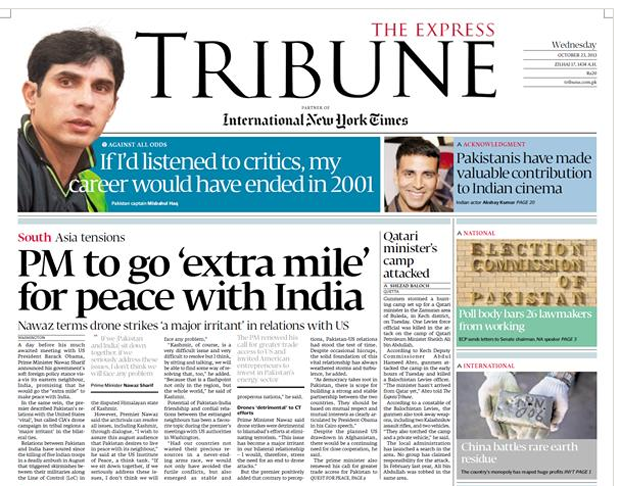
It’s been over two weeks now that Rana Tanveer, a reporter in Lahore at the English daily, Express Tribune, has not gone to work.
Early this month, he received a one-page letter, in the Urdu language, terming him an apostate and accusing him of writing in favour of Ahmadis and Christians.
“It warned me to stop writing ‘against’ Islam and seek ‘forgiveness’ from God,” he said over the phone from his home in the Punjab province.
It further warned him that if he did not desist, he would be killed — since that is the punishment of a person declared an apostate.
“I can’t work like this; no reporter can, if he cannot roam about freely,” said Tanveer.
Initially, he did not take the letter too seriously, but a week after he received the letter, he felt he was being followed on a motorbike. “It’s a scary experience,” he conceded, adding: “I made a few turns just to be sure that this was not a figment of my imagination, but the man on the motorbike persisted. I knew then that this was no joke and I had to do something.”
His seniors at work advised him to at least file a complaint with the police, which he did, but he did not name anyone “due to security reasons”.
“My editor told me to keep a low profile and not to report on minority issues for a while, and if I had to, it would go without by byline,” said the journalist.
Farahnaz Zahidi, features editor in the same paper as Tanveer’s feels very strongly about one’s byline being taken away. “As a journalist, perhaps the biggest satisfaction in this otherwise perilous and often under-paid profession is one’s by-line; it also lends credibility.”
However, she added, by shooting the messenger, society loses out. “The right to information is threatened when media persons threatened.”
Tanveer finds a plethora of minority rights abuses strewn around his city but says few journalists feel inclined to take up these issues.
“Mine seems to be a lone battle,” he said. “I am often scorned by my colleagues for reporting ‘chooras’ (derogatory term used for Christians, also among the poorest sections of society and consigned to menial janitorial jobs) and ‘Qadianis’ (also a derogatory name for those belonging to the Ahmadi faith, declared non-Muslims by state in 1974),” he said.
But it’s not indifference to these rights issue alone that keeps journalists from reporting on them. Senior journalist and communication expert, Babar Ayaz, says it is also quite dangerous to write about “the victimisation of Ahmadis, Christians or Hindus”.
Nevertheless, he added: “Journalists have to write what is right. Threats and killings are hazards of this job living in an increasingly intolerant society.”
He remembered when he wrote a piece on the attack on the massacre of Ahmadis in Lahore [in May 2010], he received a couple “abusive phone calls”. He also received some angry messages on a chapter in his book titled: What’s Wrong With Pakistan? The book, which was published in August criticises Islamic laws in Pakistan.
“But we are small fry,” said Ayaz. “When Nawaz Sharif expressed condolence on the killings of ‘our Ahmadis bhais [brothers]’ some mullahs said that by calling them ‘bhai’ he had committed a sin. The extremists have no logic but they have muscle power,” he added.
According to Aamer Mahmood, who heads the press section of the Ahmadiyya Jammat, and is in regular touch with several journalists: “The fear among them is palpable. While many empathise with us for the way our rights are trampled, they say their hands are tied. Some are scared of the wrath of the extremists; others fear they will lose their jobs.”
“It is indeed becoming more dangerous to write on these issues, in any language,” agreed Kamila Hyat, a rights activist and former editor of English daily The News. “I believe that while sections of the English language press remain relatively liberal, more and more are succumbing to the bias and intolerance we see everywhere,” she pointed out.
“The manner in which the ‘agenda’ for news is set, notably by the electronic media, also shoves minority issues to the sidelines, and intolerant mindsets exist everywhere — even among the educated,” she said.
With seven journalists having lost their lives since January this year, according to the 2013 Impunity Index report by the Committee to Protect Journalists (CJP), just last year, Pakistan which was ranked tenth, has moved two spots up at eighth position for the worst place for the press. Further, it has been declared more dangerous than Russia, Brazil, Nigeria and India.
According to the CJP, 28 Pakistani journalists have been murdered since 1992 in connection with their work, 27 of whom were killed with impunity. The deaths of 24 additional killed during the same period cannot be confirmed as “targeted.”
“Doing journalism in Pakistan is not easy, which is ranked the third most dangerous country for reporting after Syria and Egypt,” observes Mazhar Abbas, former secretary general of the Pakistan Federal Union of Journalists, a formidable voice fighting for the rights of journalists. While journalists continue reporting despite threats particularly those working in the Federally Administered Tribal Area (FATA), Balochistan and even in the southern port city of Karachi, Abbas said, reporters from the Punjab province seemed comparatively safer.
But not anymore, it seems.
Abbas said every threat should be taken seriously. “The letter to Tanveer could be an individual act or from a group. The government and administration need to probe this matter and find out about the person who sent this letter in the first place. Journalists reporting on sensitive issues should do so responsibly; their reports should be factually correct with minimum expression that can lead to stoking up controversy.”
This article was originally posted on 23 Oct 2013 at indexoncensorship.org
22 Oct 2013 | News, Pakistan, Religion and Culture
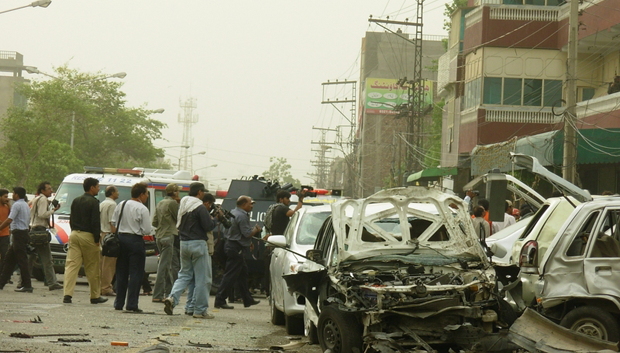
In May 2010, terrorists attacked two mosques belonging to the Ahmadi community. Ninety-four people were killed and more than 120 were injured. (Photo: Aown Ali / Demotix)
As the Muslim festival of Eid ul Adha drew to a close last week, it left a bad taste in the mouth of several Pakistanis when they heard that those belonging to the Ahmadi community were stopped from performing the ritual of animal sacrifice because they are “non-Muslims”.
According to a news report by Express Tribune, police raided a house of an Ahmadi man in Lahore, Punjab, and took him into custody. Police released him only after Ahmadi community elders intervened, giving written assurances that the man will not perform a sacrifice.
“We have slid towards the deep,” said rights activist and filmmaker Feryal Gauhar, quoting Chilean poet Pablo Neruda, blaming the government for not taking action.
“The spiral is rapidly spinning out of control. We are reduced to being passive bystanders to the tragedy that is being played out by forces of obscurantism,” she said.
“I think it’s deplorable and yet another instance of official persecution of the Ahmadis,” said Zohra Yusuf. But she said it was unclear under which law the police took action. “This indicates that intolerance has seeped into the police force, particularly in the Punjab,” she said.
The spokesperson of the Ahmadiyya Jammat in Pakistan, Saleemuddin (who uses his first name) said: “The police should not have given into the pressure of a few hardliners; this only strengthens them further.”
While only two cases surfaced this year, last year, too, a couple of cases were reported. Many fear if not nipped in the bud, this could set precedence for the coming years.
To Pakistani journalist and rights activist Beena Sarwar the episode is reminiscent of Nazi Germany and the persecution the Jews faced. “It goes against the basic tenets of humanity and justice, and the Islamic principle of ‘to you your faith and to me, mine’.”
“Pakistan must, for its own sake, take a firm stand against any such vigilantism and witch-hunting and intrusion into citizens’ personal lives and faith,” Sarwar said.
Every year, Muslims from all over the world gather in Mecca, Saudi Arabia, and perform Haj, between the 8th to the 12th day of the Islamic month of Zil Haj. Among a series of rituals performed that date to the time of Prophet Abraham, is the sacrifice of animals — usually a goat or a sheep (although cows and camels are also slaughtered) and the meat is distributed among relatives and the less fortunate.
“Offering animal sacrifices, particularly on the blessed days of Eid-ul-Adha, is a quintessential Muslim practice that all Muslims deeply cherish. For police to strip Ahmadis of this precious right is a callous and cruel act,” responded Amjad Mahmood Khan, president, Ahmadiyya Muslim Lawyers Association, which is based in the United States, through an email exchange.
“Yes, it is a ritual performed by Muslims, and Ahamdis are not Muslims,” Qari Shabbir Ahmed Usmani, a cleric who lives in Chenab Nagar, Punjab, where 95 percent of its population belong to the Ahmadi faith.
While the Ahmadis, consider themselves Muslims, they believe that Mirza Ghulam Ahmad, a 19th century cleric, “was the messiah promised by God” which is unacceptable to all other Muslim sects.
In 1974, the state of Pakistan declared Ahmadis to be non-Muslims. According to Pakistan’s constitution, they cannot call themselves Muslims, are banned from referring to their places of worship as mosques and cannot sing hymns in praise of the Prophet Muhammad. There are between 2-5 million Ahamdis living in the country.
But Usman, who heads the International Kahtme Naboowat Momin, one of the several religious movements in Pakistan, that aims to protect the sanctity of Prophet Muhammad is not in favour of the banning Ahmadis from performing the sacrifice. “In Chenab Nagar, no Ahmadi was stopped carrying out the sacrifice,” he said.
This was confirmed by Aamer Mahmood, in charge of the press section of the Ahmadiyya Jammat, who lives in Chenab Nagar.
But strong armed tactics to scare the Ahmadis is not restricted to Punjab alone. In September, four Ahmadis were killed in Karachi for their faith, said Mahmood.
In addition, he said, over 60 Khatme-Naboowat Conferences were held on or around September 7 (the day Ahmadis were declared non-Muslims) across Pakistan. Mahmood said a hate campaign forms an integral part of the conferences. The followers are incited to kill Ahmadis as part of Muslim edict.
“Earlier a handful would be held, but this time there was a record number which shows state collusion in stoking anti-Ahmadi sentiment.” he said.
“They are lying,” said Usmani. “We are against every form of violence; they are badmouthing Islam. In fact, had that been the case, do you think there would have been a single Ahmadi still alive in Pakistan?” he said during a phone interview.
“I have before me scores of published press statements and edicts by various Khatme Naboowat leaders from various Urdu newspapers to kill us or openly threatening us to leave Pakistan,” Mahmood countered.
He said he has pamphlets listing the names and addresses of Ahmadi families alongside messages inciting murder.
According to Khan: “The extreme views of a certain militant segment of Pakistan have permeated state institutions and law enforcement. Until and unless the state of Pakistan recognizes that it is only Allah’s place to judge whether someone is a true and righteous Muslim, it will continue down a perilous path towards lawlessness and injustice.”
Gauhar said sadly: “Mohammad Ali Jinnah [the country’s founder] would not own this Pakistan.”
Meanwhile, in the United States, a Congressional-appointed bipartisan federal body yesterday urged President Obama to raise concerns about the “dire religious freedom situation” in Pakistan during their meeting.
“Given that President Obama and Sharif reportedly will be discussing how best to counter violent extremism, we urge the US to incorporate concern about freedom of religion into these conversations,” said Robert George, Chairman of the US Commission of International Religious Freedom.
“To successfully counter violent extremism, Pakistan must have a holistic approach that ensures that perpetrators of violence are jailed, and addresses laws that foster vigilante violence, such as the blasphemy law and anti-Ahmadi laws.
“For the sake of his country, the Prime Minister should be pressed to take concrete action,” George said.
Based on findings of United States Commission on International Religious Freedom (USCIRF), Pakistan represents one of the worst situations in the world for religious freedom, he noted.
“The violence extremists perpetuate threatens all Pakistanis, including Shias, Christians, Ahmadis, and Hindus, as well as those members of the Sunni majority who dare to challenge extremists,” he said.
This article was originally posted on 22 Oct 2013 at indexoncensorship.org
15 Oct 2013 | Digital Freedom, News, Pakistan
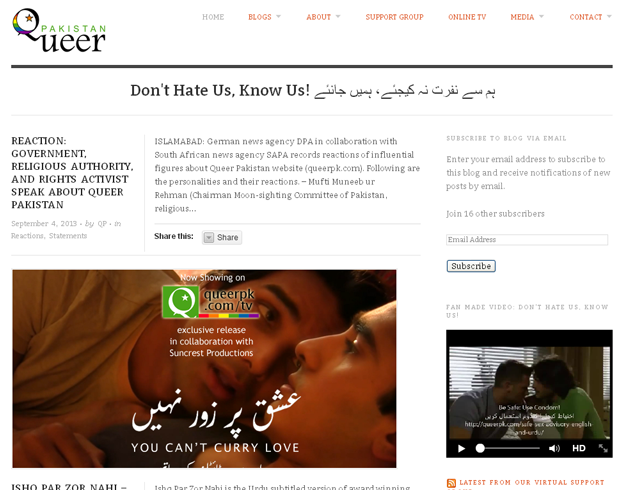
Pakistan’s move to ban access to a gay website reflects the conservative society’s inability to accept a “larger world view”, activists say.
“Freedom of speech remains in peril and online privacy and security is almost nonexistent in the country making dissidents worry for their and their families’ safety”, Nighat Dad, a lawyer working with the Digital Rights Foundation in Pakistan, said.
Dad was referring to last month’s blocking of a gay website www.queerpk.com by the Pakistan Telecommunication Authority for being “against Islam”.
But for others belonging to the LGBTQ community, the ban has not come as a big surprise.
“They banned YouTube, you think Queerpk would count at all?” said banker Imran, requesting only his first name to be used.
“It was quite expected and shows how immature this society is and how our government is keen on pandering to the idiocies of the worst among us”, said Ali (also preferring to use just his first name).
Kashif Khan, a gay university teacher, considers the website ban “just the tip of the iceberg” of a certain “mindset” that holds sway within the Pakistani society.
“We, as minorities, are not the only one affected by this heightened sense of self righteousness and religiosity which stems from this complete inability to entertain and appreciate any world view other than our own,” he said.
Further, he points out: “The closing of the mind and quashing of this spirit of inquiry is probably because a lot of beliefs that we have held sacred might not stand the test of rationality and empirical evidence.”
But Ali, for one, does not think it was a great idea for a group of LGBTQ community to try and create a space a space for themselves in public domain.
“Gay people here do not want a gay rights movement because this society isn’t the kind of society in which a gay rights movement can take place,” he said.
For too long, the LGBTQ community has remained invisible. They continue to enjoy both peace and relative freedom, but many fear that the moment they try to rock the boat and start demanding their rights, they may invite the attention of the religious extremist elements within society -much to their detriment.
Even the Pakistani law refuses to take a tolerant view of their existence. Article 377 of the Pakistan Penal Code prescribes up to 10 years in jail and a fine for those caught engaged in homosexual activity. Consenting sex between a man and a woman outside of marriage is criminalised and punishment awarded.
On the other hand, safeguarding citizens’ privacy is enshrined in Pakistan’s constitution, which calls “privacy rights” inviolable.
It is for that very reason Shahzad Ahmad, country director of Bytes For All, Pakistan, says that the Pakistani society “first acknowledge and recognise that the LGBTQ community exists”. It is also important, he said, to give more space to such portals where the gay community can discuss their issues in a “mature, understandable and engaging way”.
Even for Queerpk team the ban was not unexpected “given the backlash the website had received online and ‘reporting’ to PTA”. The team was prepared with a Plan B. “We mirrored the website onto a new domain, routing all traffic to the new website,” the website’s spokesperson (who didn’t want his name to be made public) wrote in an email exchange.
In addition, the website ban has not affected the netizens visiting the website in any way: “It hasn’t! If anything, it has brought together several thousand more users, hundreds of whom have written to us in appreciation and support, many of whom were not connected to any support online or offline. So for all reasons, the blockade has worked in our favour,” the spokesperson added.
When it comes to freedom of expression, Pakistan is not the most generous of countries. Freedom House’s annual report Freedom on the Net 2013 put Pakistan among the top ten countries where internet and digital media freedom is curbed.
“The recent ban of Pakistani gay websites is a clear sign that the new government is following what the past governments have been doing in Pakistan,” Dad said.
According to Ahmad the government’s “moral policing policy” curbs alternate and progressive discourse was the reason behind the blockade of Queerpk. This is not the first time that gay websites have been targeted, he explains: “I remember, another LGBTQ social networking website ManJam was banned in Pakistan and that ban still exists for Pakistani users.”
Currently there are over a dozen dating and social networking websites aimed at the Pakistani LGBTQ community. But the case of QueerpK is different, say experts, because it was more than a networking website. “Many important and relevant issues were being discussed on the website and an alternate discourse on sexual minorities’ rights was, for the first time, discussed in a very mature manner in a conservative society like Pakistan,” said Ahmad.
“With the government’s internet censorship policies over last few years it is quite evident that this new medium for communication for LGBTQ community won’t last long,” he added.
For that reason, BFA feels compelled to work with different international organisations in support of Queerpk to voice its concern against the ban. “We have also raised this issue at different forums and are also planning to raise it at the Internet Governance Forum,” Shahzad told Index.
This article was originally posted on 15 Oct 2013 at indexoncensorship.org
7 Oct 2013 | Digital Freedom, News, Pakistan

The government of Sindh province warned last week it would block Skype, Whatsapp and Viber Tango.
Dr Asha Bedar, a clinical psychologist, looks at the news of a proposed three-month blockade of Skype and WhatsApp in Karachi, with much trepidation. Having recently moved to this southern port city of an estimated 20 million, these apps are almost like a lifeline.
“Like so many others, my family and friends are scattered around the globe. It’s these Skype, Whatsapp etc., that help bridge the distance. We are constantly in touch and able to share our joys and sorrows, ” she said.
The ban on internet chat and telephony apps including Skype, WhatsApp and Viber Tango is to help curb militancy, Sindh province information minister, Sharjeel Memon, said at a news conference last week.
Pakistan’s commercial hub, Karachi, has witnessed much violence in recent years. According to the Citizens-Police Liaison Committee, the city witnessed 2,124 murders last year and 2,058 in the last nine months.
Memon said terrorists had switched from cell phones to these networks which were difficult to trace.
However, the news opened a floodgate of criticism and derision from all strata of society.
“What next? Motorbikes, cars, cell phones, since the terrorists use all of these as well!” wrote Saroop Ijaz, a Lahore based lawyer in the Express Tribune.
Matters only got worse after 25-year old Bilawal Bhutto Zardari, co-chairperson of Sindh province’s ruling Pakistan People’s Party, tweeted: “Dear Burgers [referring derisively to westernized young people] Sorry abt Skype/Viber/Whtsapp. Excuse us while we catch some terrorists and save some lives. SMS for 3 months. Sincerely BBZ”.
“Our right to communicate shouldn’t be a victim to national security,” pointed out Sana Saleem of co-founder Bolo Bhi, a group that campaigns for freedom of speech.
Pakistan is among the bottom ten countries in the annual report — Freedom on the Net 2013 — by the Freedom House, an independent watchdog based in Washington D.C. The report measures internet and digital media freedom in 60 countries. It said Pakistan blocks objectionable content, monitors internet users, lacks adequate connectivity in rural areas and has not done enough to protect users from accusations of blasphemy.
The ban if imposed, even if temporary, can only reflect Pakistan as one of the most restrictive nations in the world for internet use.
The Pakistan Telecommunications Authority has a history of clampdowns. It has banned more than 4,000 websites for what it considers objectionable material, including YouTube, which was blocked last year after a U.S. citizen posted a film was deemed blasphemous by Muslims around the world. In 2011, in a particularly ill-thought-out move it announced censoring text messages containing swear words. In 2010, after a decision by the Lahore High Court, Facebook was blocked as a reaction to the ‘Everybody Draw Muhammad’ page that was seen as offensive to the prophet and in 2009, then interior minister had announced a ban on jokes ridiculing the President Asif Ali Zardari and warned that the Federal Investigation Agency would trace electronically transmitted jokes under the Cyber Crimes Act.
While Saleem says the impending ban reflected a “flawed counterterrorism policy”, sports reporter Faizan Lakahani, working for private television channel, Geo, feels it only showcases that the government “is just not competent in nailing down terrorists”.
Bans to restrict citizen’s freedom were not only futile but counter-productive. The government should use technology to trace out terrorists, instead, Lakahani said.
“The ban on cellular phones in the past has led to disabling of car security and home security systems,” added Saleem. “For every blockage there are dozens of ways to circumvent them. It would be a huge challenge and technology-wise nearly impossible to do a province specific ban.”
But for many like Bedar, the ban could significantly affect work.
“I work from home regularly and keep in touch with my clients. At times due to distance I even do therapy sessions on Skype. In addition, I regularly take up international assignments for which we often hold meetings and discussions via Skype. The ban could potentially affect both my work and efficiency,” she said.
Saleem , who uses Skype regularly for work, would also be affected. “I also use Whatsapp for work. Currently I’m working on short documentary stories on migrant workers and refugees in two different regions. I’ve Whatsapp’ed groups for people I’ve interviewed to keep in touch and to keep them posted once I’m back in Pakistan,” she said.
Many believe it wouldn’t be totally unfounded if the excuse to implement the ban was shaped by the telecommunications companies themselves, as these apps were threatening their revenues. Saleem agrees: “The telecom sector has been widely impacted because of these ad hoc measures”.
The ban has not been put into force because final authority rests with the central government in Islamabad. Interior Minister Chaudhry Nisar Ali Khan had already sounded out his reservations.
“The state has often backtracked from such announcements in the past after public outrage”, Saleem said.
This article was originally published on 7 Oct 2013 at indexoncensorship.org
