10 Jan 2014 | Asia and Pacific, News, Pakistan
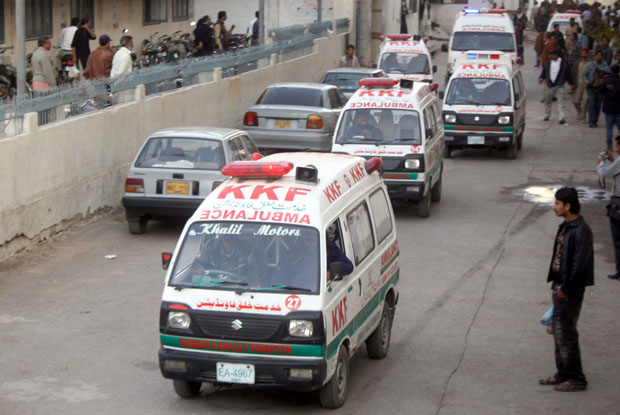
The ambulances transporting the bodies of the six young men killed in Gadap Town on the outskirts of Karachi (Image: Ppiimages/Demotix)
In a fresh wave of violence that gripped the southern port city of Karachi at the turn of the new year, six young devotees of Sufi saint Ayub Shah in Gadap Town, on the outskirts of the city, were killed on January 7. Their bodies were found by the caretaker the following morning in a mud-house close to the shrine.
A note left near the dead, allegedly by the Tehrik Taliban Pakistan (TTP), stated that a similar fate awaited anyone visiting the shrine. The police told AFP the note said: “Stop visiting shrines!”
Sufism, strongly practiced in Pakistan’s Sindh province, is opposed by the Taliban who follow the Wahabi and Salafist school of Islam.
The brutal killings have reinforced the long-standing fear among the people of Karachi that the militant group which infiltrated the city a few years ago has now not only consolidated itself, but is also imposing its belief system.
“The part of Karachi where this incident took place is a known stronghold of the Taliban,” explained Imtiaz Ali, correspondent for Dawn newspaper. He said Wall Street journalist Daniel Pearl’s body was also found in Gadap. Taliban commander Mullah Abdul Ghani Baradar, also one of the four men who founded the Taliban movement in Afghanistan in 1994, was arrested from there in 2010. Gadap has often been in the news during anti-polio campaigns which have had to be suspended in recent years after attacks on vaccinators and health workers.
Just a month back, 25-year-old Bilawal Bhutto Zardari, son of former prime minister Benazir Bhutto, had warned of the Talibanisation of Pakistan. “They are surrendering our culture, our history, our identity and our religion based on a lie cloaked in an imported, fictionalised version of Islam,” he said at an event announcing a two-week cultural festival to take place in February.
While Karachi is no stranger to violence, Ambreen Agha, research assistant at New Delhi’s Institute for Conflict Management, agreed with Zardari. This particular incident, she said, should definitely ring alarm bells for Pakistan’s security apparatus as it indicated the “deeper penetration” of Pakistani Taliban in the city.
“The TTP’s upward mobility should be taken as a serious threat for the concerned agencies,” she said, warning that the gradual trickling down of the “Talibanised ideology” posed a potent threat to the establishment.
It also puts a big question mark on the targeted “operation” carried out by security forces and law enforcement agencies in the city, which have been ongoing since September. Touted as a success by the government, Sindh governor Ishratul Ibad last week voiced his satisfaction, saying there was a “significant decrease” in target killings and kidnappings for ransom.
Labelling the operation nothing but “buffoonery and horseplay”, Agha, however, pointed out: “The tact with which the outfit [Taliban] carries out its activities and the pattern that they follow in the metropolitan city suggests something more than what meets the eye.” She added: “TTP’s operational success suggests implicit collusion with the gangsters and their political patrons.”
“The claims of success by the Rangers [paramilitary force] should be questioned,” said Zohra Yusuf, the chairperson of the independent Human Rights Commission of Pakistan.
Naeem Sadiq’s, a citizen of Karachi, says the militant attacks “are a result of the armed private militias, so faithfully encouraged by the government’s own ‘proliferation of weapons’ policy.” He believes the only way to prevent incidents like Gaddap, is to cleanse the city of weapons and has filed a petition in the Supreme Court of Pakistan calling for this. “De-weaoponise all individuals and groups – starting with the world’s most militant parliament with its 69,473 prohibited bore weapons!” he said.
This article was posted on 10 Jan 2014 at indexoncensorship.org
9 Jan 2014 | Asia and Pacific, Digital Freedom, News, Pakistan
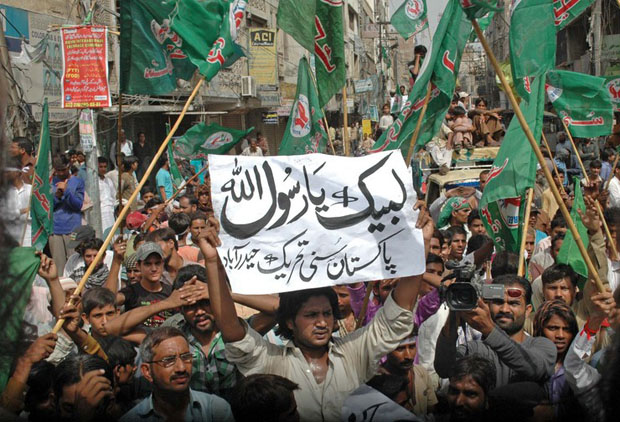
Protest in Hyderabad, Pakistan against the film Innocence of Muslims, which got YouTube blocked in the country (Image: Rajput Yasir/Demotix)
The last year saw Pakistan successfully transferring power from one democratically elected government to another. A norm in many countries worldwide, this was a milestone for Pakistani citizens. However, while a peaceful transition is welcome, there have been few changes in policy making and inclusion of citizens and civil society in due process when it comes to the country’s deteriorating state of cyberspace, digital security and surveillance issues.
Last year proved to be a bumpy ride too for Pakistan. From one ban to another broken promise, the Pakistani internet community really didn’t have much to be happy about. YouTube was first blocked by the previous government in September 2012 after a blasphemous movie named “The Innocence of Muslims” was uploaded, and remained blocked as of 31 December 2013.
In January, a Pakistan daily reported that the Pakistan Telecommunication Authority (PTA) and the Ministry of Information Technology (MoIT) were planning to install a regulatory system, reportedly imported from China, to monitor websites, online content and also internet filtration. Throughout the year, officials tried to systemize online content filtering mechanism, especially getting a boost after the YouTube fiasco.
A further blow came when Vimeo, another video sharing site, was found to be inaccessible in the country. In May, a band released a satirical song criticising military generals. The lyrics made fun of the army hitting out at their intolerance and corruption: When pockets are full/all the strings are theirs to pull/If it’s one of them you give a naughty look to/very soon you will disappear from view. The video was uploaded on Vimeo and went viral, and in turn led to the site being blocked.
On 2 June, a plethora of users found Tumblr inaccessible in some regions of Baluchistan and Sindh. That same month, an extensive report by Citizen Lab found the Pakistani government to be using the technology from Canadian company Netsweeper, along with DNS tampering, for political and social filtering.
Another ban appeared to have been imposed when Viber users started complaining about not being able to make calls. Viber is an app that supports text messaging and Voice-over Internet Protocol (VoIP) for making free internet calls. Tribune Pakistan recorded complains from around the country including from Karachi, Hyderabad, Multan, Rawalpindi, Faisalabad, and Gujranwala.
Freedom House released its annual “Freedom on the Net” Pakistan country report in October. Among the 60 researched countries, the report placed Pakistan in bottom 10 for its privacy and surveillance concerns. According to this report, at least three cybercafés and mobile phone stores were attacked by religious extremist on moral grounds — something the Pakistani government has yet to fight against.
November brought quite depressing news when a young boy was accused of blasphemy for allegedly sharing objectionable content on Facebook. This was the first time social media was used as a evidence and set a dangerous precedent in a country without any cyber laws. November also saw the Internet Movies Database (IMDb) blocked in the country after Internet Service Providers (ISPs) received a directive from the state. Following online outcry against the ban, it was reversed after only a couple of days.
This was soon followed by Pakistan’s very first case of selective blocking, where the government managed to target specific pages rather than entire platforms. On 25 November, 2013, users across the country reported the inaccessibility of Baloch movie “The Line of Freedom”. The government has time and again tried to use any and all sorts of means to curb dissidents’ views, especially those from the Baluchistan province. While IMDb, Vimeo and other sites remained accessible, the pages of the aforementioned movie were blocked.
Instead of removing the ban on YouTube after having a successful test case of selective blocking, the Pakistani government is currently in talks with Google, Inc. to localise YouTube in the country. This will empower the government to more frequently and easily ban any material that it deems unfit for the nation without ever taking citizens’ views into account.
If anything, the year 2013 only brought despair and hopelessness to Pakistan’s growing number of internet users. From one step to another, the new democratically-elected government is using draconian censorship and surveillance means and systems, affecting the rich exuberance of the country’s online community.
This article was originally posted on 8 Jan 2014 at indexoncensorship.org
23 Dec 2013 | News, Pakistan, Religion and Culture
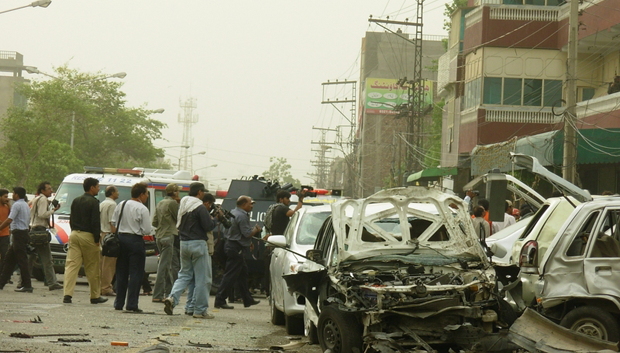
In May 2010, terrorists attacked two mosques belonging to the Ahmadi community. Ninety-four people were killes and more than 120 were injured. (Photo: Aown Ali / Demotix)
“It was staged and pre-planned,” said Shahid Attaullah, referring to the arrest of a homeopath Dr Masood Ahmed on charges of blasphemy.
Narrating the details of the events preceding the arrest of a 72-year old doctor, who is also a British national, Attaullah, the spokesperson for the Ahmaddiya Jamaat, said: “Two men posing as patients, came to his clinic in the Anarkali, an older part of Lahore, on November 25. After a few minutes they started discussing religion. Supposedly the doctor responded to their questions about Islam and then they left. Within minutes, a mob gathered around the clinic. A complaint was lodged and the police arrested him for preaching. He is in lock-up and his bail denied.”
According to news reports, the doctor was arrested for ‘posing’ as a Muslim.
Ahmadis consider themselves Muslims but in 1974, the government promulgated an ordinance, declaring them non-Muslims. According to Pakistan’s constitution, this community cannot call themselves Muslims; are banned from referring to their places of worship as mosques and cannot recite the Kalima, which is the first tenet of Islam, whereby a Muslim proclaims that he is a Muslim. The Ahmadis are banned from even singing hymns in praise of Prophet Muhammad. Of late there have been incidents where they have been harassed for keeping Muslim names.
Attaullah sees this to be a long-drawn case now that a first information report (FIR) has been lodged. “It is now gone into the court.” Last year 20 trumped up charges were registered, while this year as many as 33 people have so far been booked including the doctor.
According to Attaullah while there are some judges who are themselves prejudiced towards the community, those who are not are pressured by religious hardliners.
“There was a case where the judge of the Lahore High Court refused to take decision and sent the application back to the lower court. This is quite unprecedented. Two months ago in another case, after the judge granted bail to the accused, a group of clerics went to the judge’s chamber. I don’t know what transpired inside, but a little later, the judge changed the written order stating ‘no bail’”.
This does not surprise Zohra Yusuf, the chairperson of the independent Human Rights Commission of Pakistan. “I can understand the judge’s predicament because a lot of power has been ceded to the clerics and most people buckle under their threats,” she said.
Since 1984, 299 people belonging to the community have been charged under the blasphemy law, 764 booked for displaying the Kalima; 38 for the Azan (calling to prayer); 447 ‘posing’ as Muslims; 93 for offering prayers, 770 for preaching and hundreds others for many such offences.
Little wonder then that Attaullah says: “There is always the sword of Damocles hanging over all of us and the mental anguish is permanent”.
“Many of our youngsters are migrating to other countries,” he said. “They do not see a future in Pakistan and the elderly members don’t want to leave the country they think is theirs,” he pointed out the social quandary they find themselves in.
The religious apartheid has become overt with the oppressors having declared an all out war. “In the last few years, I find the persecution has escalated and the attacks on us are pre-meditated and carried out in a planned manner,” said Attaullah. He further added: “And they always pick on the weaker elements of our community.”
In addition, said Yusuf: “The persecution of Ahmadis knows no bounds and, regrettably, there’s not enough condemnation from society or the media.”
According to Attaullah, the space for Ahmadis in Pakistan is getting narrower by the day.
Talking about the doctor’s arrest, he said: “The complainants had filmed the unsuspecting man reading aloud the translation of a verse from the Quran through the hidden camera.”
A Lahore-based journalist, requesting his name be withheld, (as he has received threats by an Islamic group for covering faith-based issues) has seen the video clip: “It was clear the doctor was trapped into saying what he said, but he was not preaching,” he said.
Further, said the journalist: “Ahmadis don’t talk about religion publicly and never to strangers; these people must be known to him and from the video it seemed they were asking him questions and he was responding to them.”
Attaullah, said they regularly circulate directives telling their people not to participate in any religious discussions with anyone and if the opposite sides wants to pull them in, they should simply disclose they are Ahmadis and the law does not allow them to speak on Islam.
This article was posted on 23 Dec 2013 at indexoncensorship.org
This article was updated to correct an error. Ahmadis were declared non-Muslims in 1974, not 1984 as previously stated.
18 Dec 2013 | Uncategorized

Who would’ve thought the news earlier this month of YouTube being finally made accessible in Pakistan, albeit as a local search engine, would open a floodgate of criticism?
Minster of State for Information Technology and Telecommunications, Anusha Rehman certainly did not. She probably thought she had done a good turn — wooed many young digital rights activists who had long been demanding unblocking of the website and calmed others who had demanded blocking of objectionable content from it.
“Instead of installing costly filtration mechanisms, Google will easily be able to block blasphemous content on the request of the Pakistan government,” Rehman told the Senate’s Standing Committee on Information and Technology. “Saudi Arabia and Malaysia have also reached a similar arrangement with Google,” she added.
But Farieha Aziz, director at Bolo Bhi, a not-for-profit geared towards advocacy, policy and research in the areas of gender rights, government transparency, internet access, digital security and privacy, dismissed the news out right saying: “There is no arrangement between the company and the government, unlike the perception the government is projecting.”
“I don’t want a localised version. Remember what became of Disney in India with everything getting dubbed in Hindi! I would definitely prefer the original version,” said a resolute 12-year old Khadeja Ebrahim, a YouTube buff. “I love YouTube, my entire school loves YouTube and we hate the people who have blocked it,” she added vehemently.
Yasser Latif Hamdani, who had filed a case for unblocking the website, on behalf of digital rights campaigners Bytes For All is not too happy with the news. His concern is mainly constitutional.
“It is a matter of principle. I do not think it is alright that the government can decide what I should be able to view,” he said. To him this was a clear violation of Article 19, 19-A and 17 of the Constitution of Pakistan. “Therefore, I do not consider it a great service,” he concluded.
The young lawyer uses the popular video-sharing website to listen to debates on law, politics, constitution, philosophy and history. He accesses YouTube through virtual private networks(VPNs), but complains “the experience is just not the same”.
Nighat Dad, of the Digital Rights Foundation doesn’t find the move “encouraging” either and given “how different vague provisions of different laws and constitution have been misused in blocking the content on internet” in the Pakistan” is, in fact, quite wary. She warns: “I see a huge wave of internet blocking and censorship coming our way.”
“If it happens, it will be bad news!” pointed out Shahzad Ahmad, country director of B4A.
Simply put, said Ahmad, it means legalising censorship of digital content on this platform. “YouTube may then become like Facebook. You will only be able to see that content which authorities will allow us to see,” he explained.
Presenting a doomsday-like scenario, he further said: “A new war will erupt among religious factions and the stronger ones may demand a ban on the others. Human rights movement will suffer hugely, political expression will become much more difficult and alternate discourse will die.”
Many say this will put a stop to hate speech, a major issue stoking religious sects and minorities, in Pakistan, especially on social media.
Ahmad disagreed. “Banning hate speech will not end till perpetrators and banned outfits are taken to task. If you expect that banning their Facebook/Youtube or Twitter will solve the problem, then the answer is a no, a big no!” he said emphatically.
The blocking of YouTube in Pakistan, began last year on 17 September after the website refused to remove the blasphemous 14-minute video clip “Innocence of Muslim”.
The video had led to violent protests and demonstrations across the Muslim world, killing over 50 people.
Ahmad said the decision to block YouTube had nothing to do with upholding religious values or blocking blasphemous content. He suspects it had “political” underpinnings to it.
“The authorities have used this incident to strengthen censorship and filtering in Pakistan, and spent millions of dollars, a useless wastage of the public’s hard earned tax money, as nothing can be blocked on the Internet. Citizens have already resorted to VPNs and circumvention tools.
That is true. Over the past one year, hundreds of die-hard users of this website have relied on proxy servers to work around the ban.
“I just came back from China- and while Facebook and YouTube were banned everywhere, you can access them in Shanghai Freezone especially the Pudong district of Shanghai,” said Hamdani. “So even authoritarian regimes understand the futility of such censorship,” he added.
These proxy servers are passed on word of mouth and go viral within moments, but expire every few weeks. Then the process of passing the information starts all over again. “You can imagine our desperation,” pointed out Ebrahim.
But while she and her school friends are mostly using the website for downloading songs or cheat videos for games, there are hundreds who depended on it for their bread and butter.
“I can give you scores of examples of small traders, who marketed and “networked” for expanding their businesses on this free platform because they could not afford to advertise through the mainstream media. The Virtual University, an online learning institute, had uploaded thousands of lectures for its students to access; all that came to a halt. These lectures benefitted not just Pakistani students but millions of those living abroad. Now they have set up their own servers, and which I suspect must have been a huge investment” said Dad.
Toffee TV.com produces songs, stories and activities for children in the Urdu language. They went live on July 2011 and banked on YouTube to take it further and the latter did. It met with enormous success at schools, in homes and even among speech therapists, but saw a huge slump in its business. Before the ban was imposed, TOFFEE was uploading two new video programmes per week with 100,000 new visitors a month and serving five times those many repeat visitors.
The minister for IT said that the Pakistan Telecommunication Authority has been tasked with drafting an ordinance that would provide intermediary liability protection to Google/YouTube, thereby not holding the company responsible for what users choose to upload to the platform.
Bolo Bhi is quite disturbed by this news. “Why is PTA, a regulatory authority that deals with enforcement and not policy making, being asked to draft the ordinance?” it asked in a press statement. It also asked what became of the expensive filtering equipment that the government had acquired for its telecommunication networks.
