20 Jul 2017 | Campaigns, Campaigns -- Featured, Media Freedom, media freedom featured, Statements
[vc_row][vc_column][vc_column_text]Dear Mr. Désir
Index on Censorship welcomes your appointment as the Representative on Freedom of the Media by the OSCE member states. We would like to extend our congratulations to you.
Like you, we agree wholeheartedly that the role of RFoM is important. In fact it is more important today than when the office was founded 1997. Since then, the media has faced pressures from a changing financial environment and — in some nations — government interference.
Through its project Mapping Media Freedom, Index on Censorship monitors press freedom violations in 42 OSCE member states. In just the last three years, there have been 3,302 verified incidents. Sadly, the number of reports we investigate is increasing. Journalists are coming under pressure from the left and the right of the political spectrum, from governments and non-state actors, from organised crime and private citizens. These multidimensional threats demand a consistent and robust response that crosses international boundaries.
We ask that, on assuming your responsibilities, you urgently consider the following as your priorities:
- Focusing attention on how the independence of the public media in OSCE member states such as Poland and Hungary is being undermined
- Calling attention to a continent-wide drift toward tighter regulation of the media — whether online or off — in OSCE nations such as France, the UK and Germany
- Raising awareness of widespread interference with the professional duties of journalists through legal obstacles and demands for accreditation, most acutely in OSCE members Belarus, Russia and Azerbaijan
- Building on the record of the RFOM office by being a vocal and visible advocate for journalists
- Continuing a determined and consistent approach to cases of impunity
- Resisting ill-guided attempts to use legislation to further curtail the marketplace of ideas in the member states
- Call out use of terror legislation to silence media by member states
- Mount a sustained campaign against criminal defamation laws in member states
Index on Censorship stands ready to partner with you to protect the media’s right to report and the public’s right to information.[/vc_column_text][/vc_column][/vc_row][vc_row][vc_column][vc_column_text]
Mapping Media Freedom
Click on the bubbles to view reports or double-click to zoom in on specific regions. The full site can be accessed at https://mappingmediafreedom.org/[/vc_column_text][/vc_column][/vc_row]
18 Jul 2017 | Campaigns -- Featured, Poland, Statements
[vc_row][vc_column][vc_column_text]18 July 2017
Dear Defence Minister Macierewicz,
Reporters Without Borders (RSF), the European Centre for Press and Media Freedom (ECPMF), the European Federation of Journalists (EFJ), Freedom House, the Global Editors Network (GEN), Index on Censorship, the International Press Institute (IPI) and the South East Europe Media Organisation (SEEMO) are very concerned about the criminal proceedings you have brought through the military bureau of the Polish prosecutor-general’s office against the investigative journalist Tomasz Piatek in connection with a book he has written.
You accuse this journalist of “using force or threats against a public official” and “public insults or humiliation of a constitutional body” – charges that could result in a three-year jail sentence.
In our view, there are absolutely no grounds for prosecuting a civilian before a military court in connection with his writings.
[/vc_column_text][vc_row_inner][vc_column_inner width=”1/4″][vc_icon icon_fontawesome=”fa fa-times-circle” color=”black” background_style=”rounded” size=”xl” align=”right”][/vc_column_inner][vc_column_inner width=”3/4″][vc_column_text]
There are absolutely no grounds for prosecuting a civilian before a military court in connection with his writings.
[/vc_column_text][/vc_column_inner][/vc_row_inner][vc_column_text]The organisations signing this letter urge you to abandon these proceedings against this journalist.
We understand that Tomasz Piatek is an investigative journalist of recognised standing and that the book is based on 18 months of research and reporting.
As a prominent representative of the Polish state, using the prerogatives of your position to suppress criticism that has been levelled against you undermines the rule of law and helps to project a very damaging picture of respect for media freedom in your country. Like all other citizens, government ministers have other means at their disposal if they want to dispute allegations they regard as erroneous.
This latest attempt to intimidate a journalist seems to be part of a broader two-year-old offensive against freedoms in Poland that could be aggravated by the controversial proposed reform of the judicial system
We thank you in advance for the attention you give to our letter.
Sincerely,
Lutz Kinkel, General Director of European Centre for Press and Media Freedom (ECPMF)
Ricardo Gutiérrez,the EFJ General Secretary
Nate Schenkkan, Nations in Transit Project Director at Freedom House
Peter Bale, President of the Global Editors Network (GEN)
Melody Patry, Head of Advocacy, Index on Censorship
Scott Griffen, Director of Press Freedom Programmes at the International Press Institute (IPI)
Pauline Adès-Mével, Head of the EU-Balkan desk of Reporters Without Borders (RSF)
Oliver Vujovic, Secretary General of South East Europe Media Organisation (SEEMO)[/vc_column_text][/vc_column][/vc_row][vc_row][vc_column][vc_basic_grid post_type=”post” max_items=”12″ style=”load-more” items_per_page=”4″ element_width=”6″ grid_id=”vc_gid:1500386462977-62faa9b6-2b3f-9″ taxonomies=”6632″][/vc_column][/vc_row]
11 Jul 2017 | Azerbaijan, Azerbaijan Statements, Campaigns, Campaigns -- Featured, Statements
President of France, Mr. Emmanuel Macron
L’Élysée
55 Rue du Faubourg Saint-Honoré
75008 Paris, France
Ministry of Europe and Foreign Affairs of France
37, Quai d’Orsay
75351 Paris, France
Embassy of France to Azerbaijan
9, rue Rassoul Rza
AZ 1000, Baku, Azerbaijan
Subject: Support for political prisoners in Azerbaijan
11 July 2017
Dear President Macron,
We are writing to you on behalf of the undersigned organisations to draw your attention to the repressive free speech situation in Azerbaijan and to request your support to ensure the release of those imprisoned on politically motivated grounds in this country. In particular, we urge you to use your administration’s influence and leverage to help ensure the implementation of the ruling issued by the European Court of Human Rights (ECtHR) on the case of political opposition activist Ilgar Mammadov. He remains in prison, although the Court concluded that he was detained in retaliation for his criticism of the government. The persistent non-execution of the ruling in his case by the Azerbaijani authorities is undermining the credibility of the human rights protection regime established by the Council of Europe and sets a dangerous precedent for all those wrongfully prosecuted in Azerbaijan who turn to the Court in search of justice.
In view of France’s role as a leading European state and host country for the ECtHR and other Council of Europe bodies, as well as its well-developed cooperation with Azerbaijan in trade and other areas, your engagement on this issue would be particularly important. We welcome the moral, value-based and human rights oriented leadership that you have embraced for your presidency and are confident that you will vigorously pursue human rights in relations with Azerbaijan’s government on the basis of the common standards set out in the European Convention on Human Rights.
In the last few years, Azerbaijan’s government has carried out a relentless crackdown on alternative voices in the country. Legislation seriously restricting the operation of NGOs has been enforced, independent media subjected to pressure, the political opposition has been marginalised and human rights defenders, journalists and political opposition activists have been arrested, convicted and imprisoned on politically motivated charges.
While some of those imprisoned on such grounds have been released as a result of international pressure, new arrests continue to take place. For example, well-known blogger Mehman Huseynov was arrested and sentenced to two years in prison on defamation charges in March this year after speaking out about police ill-treatment. Journalist Aziz Orujov and opposition member Gozel Bayramli were arrested on other spurious charges in May, while in the same month journalist Afgan Mukhtarli was abducted in Georgia only to resurface in Azerbaijani custody. Many government critics imprisoned in previous years also remain behind bars, including Ilgar Mammadov.
Ilgar Mammadov, who chaired the political opposition REAL party and served as director of the Council of Europe School of Political Studies in Azerbaijan, was detained in February 2013 after monitoring and reporting on street protests in the town of Ismayilli, which resulted in clashes with the police. He was groundlessly accused of instigating these clashes and sentenced to seven years in prison on trumped-up charges of organising mass riots and using violence against police. In a judgment issued in May 2014, the ECtHR found that Ilgar Mammadov’s arrest and detention violated his rights to liberty and security, judicial review of his detention and to be presumed innocent under the European Convention on Human Rights. The court also found that Azerbaijan’s government had imposed restrictions on his rights for purposes other than those permitted, in violation of its obligations under the Convention. The court concluded that Mammadov was detained on political rather than legal grounds for the purpose of punishing and silencing him for his criticism of the government.
It has now been more than three years since the ECtHR adopted its judgement in this case, but the Azerbaijani authorities have consistently failed to implement it, although Azerbaijan is legally bound to comply with ECtHR rulings as a party to the European Convention on Human Rights. The Azerbaijani authorities have ignored repeated calls by other Council of Europe bodies, including its Committee of Ministers – which supervises the implementation of court rulings, its Secretary General and its Human Rights Commissioner to execute the judgment on Mammadov’s case. In November 2016, Azerbaijan’s Supreme Court rejected an appeal submitted by Mammadov on the basis of the ECtHR ruling and upheld his seven- year prison sentence. As a result, he continues to be unlawfully imprisoned.
To date the case of Ilgar Mammadov is the only one where the relevant authorities have failed to implement an ECtHR ruling that has found that the detention of an individual violates the right to liberty and security under the European Convention on Human Rights. As emphasized in a joint statement issued by 44 members of the Civic Solidarity Platform and the Sport for Rights Coalition in May 2017, the non-implementation of the ECtHR’s judgment on this case has developed into a test of the legitimacy of the Council of Europe as the guardian of human rights and the rule of law in the region. Thus, this case is no longer only about the unlawful deprivation of liberty of Ilgar Mammadov. On the contrary, it has become a case that risks weakening the effectiveness of the entire human rights protection regime established by the Council of Europe, as well as eroding confidence in this regime among people in Azerbaijan and other member states who turn to the ECtHR when their rights are being trampled upon by their governments.
We urge you to do all in your power to help prevent this dangerous outcome and to ensure the implementation of the ECtHR judgment in the case of Ilgar Mammadov, as well as the release of him and others arbitrarily detained on politically motivated grounds in Azerbaijan. To this end, we urge you in particular to:
- Support the civil society appeal to the Committee of Ministers of the Council of Europe to refer the case of Ilgar Mammadov back to the ECtHR on the grounds of non-execution of the judgment under article 46.4 of the European Convention on Human Rights, which sets out a mechanism in cases where parties to the convention refuse to abide by a final
- Issue a public statement on the importance of the execution of ECtHR judgments in view of the integrity and credibility of the human rights protection regime established by the Council of Europe, giving particular attention to the failure by the Azerbaijani authorities to date to implement the ruling on the case of Ilgar Mammadov and the wider implications of
- Prominently raise the case of Ilgar Mammadov and others who have been deprived of their liberty in retaliation for their exercise of fundamental freedoms in Azerbaijan, including Mehman Huseynov, Aziz Orujov, Gozel Bayramli and Afgan Mukhtarli in relations with the Azerbaijani authorities and use all available means of leverage to press for their
- Invite representatives of Azerbaijani civil society to a meeting to demonstrate support with them and to discuss the challenges they face and ways in which your administration can help address these challenges and promote improved respect for the standards protecting fundamental freedoms set out in the European Convention on Human
We thank you for your consideration of the issues raised in this letter and would be happy to provide additional information should you so request.
Sincerely,
- Association UMDPL (Ukraine)
- Bir Duino (Kyrgyzstan)
- Canadian Journalist for Free Expression (Canada)
- Center for Civil Liberties (Ukraine)
- Center for Participation and Development (Georgia)
- Centre for the Development of Democracy and Human Rights (Russia)
- Crude Accountability (USA)
- Eastern Partnership Civil Society Forum
- Fair Trails (UK)
- Freedom Files (Poland/Russia)
- Freedom Now (USA)
- German-Russian Exchange (DRA – Germany)
- Helsinki Committee for Human Rights (Serbia)
- Helsinki Foundation for Human Rights (Poland)
- Human Rights Matter (Germany)
- Human Rights Watch (USA)
- Index on Censorship (UK)
- International Partnership for Human Rights (Belgium)
- Kazakhstan International Bureau for Human Rights and the Rule (Kazakhstan)
- Legal Policy Research Center (Kazakhstan)
- Legal Transformation Center (Belarus)
- Libereco – Partnership for Human Rights (Germany/Switzerland)
- Moscow Helsinki Group (Russia)
- Norwegian Helsinki Committee (Norway)
- PEN America (USA)
- People in Need (Czech Republic)
- Public Association “Dignity” (Kazakhstan)
- Public Verdict Foundation (Russia)
- Regional Center for Strategic Studies (Azerbaijan)
- The Barys Zvozskau Belarusian Human Rights House (Belarus)
- The Kosova Rehabilitation Centre for Torture Victims (Kosovo)
- Truth Hounds (Ukraine)
- World Organisation against Torture (OMCT)
Human rights defenders from Azerbaijan who have signed the letter:
- Akif Gurbanov, Institute for Democratic Initiatives
- Alasgar Mammadli, lawyer
- Anar Mammadli, Election Monitoring and Democracy Training Center
- Annagi Hajibayli, Azerbaijan Lawyers Association
- Asabali Mustafayev, lawyer
- Bashir Suleymanli, Civil Rights Institute
- Intiqam Aliyev, Legal Education Society
- Khadija Ismayilova, human rights defender, investigative journalist
- Latafat Malikova, Regional Human Rights and Education Public Union
- Rasul Jafarov, Human Rights Club
- Samir Kazimli, human rights defender
- Xalid Bagirov, human rights defender, lawyer
- Zohrab Ismayıl, Public Association for Assistance to Free Economy
22 May 2017 | Azerbaijan, Azerbaijan Statements, Campaigns -- Featured, Digital Freedom, Europe and Central Asia, Statements
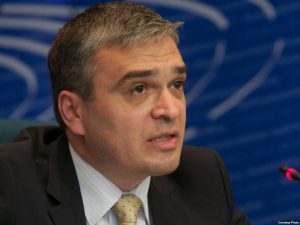
Ilgar Mammadov
Today three years have passed since the European Court of Human Rights (ECtHR) delivered its judgment on the case of political prisoner Ilgar Mammadov, concluding that the Azerbaijani authorities had detained him to punish him for his criticism of the government. In spite of this ruling, and repeated calls for his release by Council of Europe bodies in follow-up to the ruling, the Azerbaijani authorities have persistently refused to execute the decision of the Court and free Ilgar Mammadov. In view of this, we, members of the Civic Solidarity Platform and the Sports for Rights Coalition, call on the Committee of Ministers of the Council of Europe to refer the case back to the ECtHR on the grounds of non-execution of the judgment. This is crucial to ensure justice for this wrongly imprisoned government critic, who has already spent more than four years behind bars, as well as to safeguard the legitimacy of the Council of Europe as the guardian of human rights and the rule of law in the region.
Ilgar Mammadov, chair of the political opposition REAL party, was a well-known opponent of the regime when he was arbitrarily detained in February 2013. He attempted to stand in the 2013 presidential elections, gathering the required 40 000 signatures in support of his candidacy, which the Central Election Commission ruled as invalid.[i] He was also outspoken in his criticism of the policies of the authorities on his blog and in the media. Ilgar Mammadov was detained after monitoring and reporting on street protests in the town of Ismayilli in January 2013, which resulted in clashes with the police. He did not participate in these protests, but travelled to the region after they took place to observe developments and revealed the role of individuals with ties to the authorities in initiating the clashes. In spite of the lack of evidence llgar Mammadov was accused of instigating the Ismayilli clashes and on 17 March 2014, he was sentenced to seven years in prison on trumped-up charges of “organizing mass riots” and using “violence against police officers”. His sentence was upheld on appeal.
In a judgment issued on 22 May 2014, the ECtHR found that Ilgar Mammadov’s arrest and detention violated numerous provisions of the European Convention on Human Rights, including Articles 5.1, 5.4 and 6.2 on the right to liberty and security, the right to judicial review of one’s detention and the principle of presumption of innocence, as well as article 18 that limits the applicability of restrictions on rights. The Court concluded that Ilgar Mammadov had been detained without any evidence to reasonably suspect him of having committed a crime and that the actual purpose of his detention was to silence and punish him for criticizing the government and publishing information it was trying to hide.[ii]
In its follow-up to the ECtHR’s ruling, the Committee of Ministers of the Council of Europe — the body responsible for supervising the execution of ECtHR judgements — has repeatedly called on the Azerbaijani authorities to release Ilgar Mammadov. The Committee has examined this case as a matter of priority in its review of the execution of ECtHR judgments by Council of Europe member states and adopted a number of decisions and interim resolutions on it.[iii]
Other Council of Europe bodies, including the organization’s Secretary General, its Human Rights Commissioner and the President of its Parliamentary Assembly have also repeatedly called for Ilgar Mammadov to be released. However, the Azerbaijani authorities have flagrantly ignored these calls and refused to implement the ECtHR’s judgment and release Mammadov.
In view of the continued failure of the Azerbaijani authorities to implement the ECtHR’s decision on Ilgar Mammadov’s case, the Council of Europe’s Secretary General Thorbjørn Jagland launched an official inquiry into Azerbaijan’s implementation of the European Convention on Human Rights in December 2015.[iv]Under Article 52 of the Convention, the Secretary General may initiate an inquiry into how the domestic law of member states ensures the effective implementation of the Convention. This was the first time that Secretary General Jagland had taken such a measure and his initiative was welcome and important.
However, in November 2016, Azerbaijan’s Supreme Court nevertheless rejected an appeal submitted by Ilgar Mammadov on the basis of the ECtHR ruling and upheld his seven-year prison sentence. Thus, Ilgar Mammadov remains behind bars for no other reason than speaking out critically about those in power. This continued defiance by the Azerbaijani authorities leads us to conclude that further action is urgently required.
Therefore, we call on the Committee of Ministers to refer the case back to the ECtHR under Article 46.1 of the European Convention on Human Rights, which obliges the parties to the Convention to abide by the final judgment of the Court in any case to which they are parties. The Convention authorizes the Committee to take action to this end. Article 46.4 states: “If the Committee of Ministers considers that a High Contracting Party refuses to abide by a final judgment in a case to which it is a party, it may, after serving formal notice on that Party and by decision adopted by a majority vote of two-thirds of the representatives entitled to sit on the committee, refer to the Court the question whether that Party has failed to fulfil its obligation under paragraph 1.”
Ilgar Mammadov v. Azerbaijan has become a test case of the legitimacy of the Council of Europe. When commenting on the Supreme Court’s failure to uphold Azerbaijan’s obligation to execute the ECtHR judgment last year, Secretary General Jagland stated: “Azerbaijan’s flagrant disrespect of the European Convention on Human Rights undermines the entire scope of our cooperation” [and] “affects the 46 Member States of the Council of Europe who have a collective responsibility for the implementation of the Convention”.[v]
By resorting to the ultimate mechanism for addressing non-compliance of judgments set out by the European Convention on Human Rights, the Committee of Ministers can take resolute action to safeguard the Council of Europe’s integrity and ensure that the Azerbaijani authorities finally abide by their obligations under the Convention, implement the ECtHR ruling and free Ilgar Mammadov.
Signed by the following members of the Civic Solidarity Platform and the Sport for Rights Coalition:
1. Association of Ukrainian Human Rights Monitors on Law Enforcement (UMDPL, Ukraine)
2. Barys Zvozskau Belarusian Human Rights House
3. Bir Duino-Kyrgyzstan
4. Bulgarian Helsinki Committee
5. Center for Civil Liberties (Ukraine)
6. Center for Participation and Development (Georgia)
7. Center for Regional Strategic Studies (Azerbaijan)
8. Center for the Development of Democracy and Human Rights (Russia)
9. Civil Rights Defenders (Sweden)
10. Committee Against Torture (Russia)
11. Crude Accountability (USA)
12. Fair Trials (UK)
13. International Federation for Human Rights (FIDH, France)
14. Freedom Files (Poland)
15. Freedom House (USA)
16. Freedom Now (USA)
17. Helsinki Foundation for Human Rights (Poland)
18. Human Rights Center of Azerbaijan
19. Human Rights Club (Azerbaijan)
20. Human Rights Monitoring Institute (Lithuania)
21. Humanrights.ch (Switzerland)
22. IDP Women Association “Consent” (Georgia)
23. Index on Censorship (UK)
24. Institute for Reporters Freedom and Safety (Azerbaijan)
25. Institute Respublica (Ukraine)
26. International Partnership for Human Rights (IPHR, Belgium)
27. Kazakhstan International Bureau for Human Rights and the Rule of Law
28. Kosova Rehabilitation Centre for Torture Victims
29. Libereco – Partnership for Human Rights (Germany)
30. Moscow Helsinki Group (Russia)
31. Netherlands Helsinki Committee
32. Norwegian Helsinki Committee
33. Notabene (Tajikistan)
34. PEN America (USA)
35. PEN International
36. Promo LEX Association (Moldova)
37. Public Alternative (Ukraine)
38. Public Association “Dignity” (Kazakhstan)
39. Public Verdict Foundation (Russia)
40. Swedish OSCE Network: signed in personal capacity by Olof Kleberg and Anki Wetterhall
41. Truth Hounds (Ukraine)
42. Ukrainian Helsinki Human Rights Union
43. Women of the Don (Russia)
44. World Organisation Against Torture (OMCT) (Switzerland)
[i] In several rulings against Azerbaijan, the ECtHR has found that the practices of the Central Election Commission with respect to the validation of signatures violate Article 3 of Protocol No. 1 to the European Convention on Human Rights, which protects the right to free elections.
[ii] The judgment is available at: http://hudoc.echr.coe.int/eng?i=001-144124
[iii] The most recent decision on this case adopted by the Committee of Ministers is available at: https://rm.coe.int/16806c4554
[iv] See press release at: http://bit.ly/2q8CRNI
[v] His statement is available at: https://www.coe.int/en/web/portal/-/azerbaijan-statement-by-secretary-general-jagland-on-the-decision-of-the-supreme-court-today-rejecting-the-appeal-by-ilgar-mammadov
