19 May 2017 | Digital Freedom, Europe and Central Asia, Mapping Media Freedom, News
[vc_row][vc_column][vc_column_text]
Each week, Index on Censorship’s Mapping Media Freedom project verifies threats, violations and limitations faced by the media throughout the European Union and neighbouring countries. Here are five recent reports that give us cause for concern.
15 May 2017 – The editor-in-chief of Cumhuriyet’s website, Oğuz Güven, was arrested on charges of spreading propaganda on behalf of a terrorist organisation.
The journalist was detained on 12 May when a headline used in the online version of the newspaper about a prosecutor who died in a car crash upset government supporters.
Cumhuriyet reported that Güven was taken to the İstanbul Police Department located on Vatan Street after his detention.
Also read: Turkey: International coalition slams Cumhuriyet arrests and media closures
15 May 2017 – Ukrainian President Petro Poroshenko signed a National Security and Defence Council decree that bans a number of Russian media and social media sites, including VKontakte and Odnoklassniki, along with search engine Yandex and email service Mail.ru.
The sanctions also apply to antivirus providers Kaspersky Lab and DrWeb. Ukrainian internet service providers will be forced to block access to these sites for three years.
According to Radio Liberty, economic sanctions have also been imposed against major Russian television stations TV Center, RBC, RTR, NTV-Plus, Zvezda, TNT, REN and OTR.
Sanctions have also been imposed against 1,228 individuals how are both citizens of Ukraine, Russia and other countries. According to Detector media, the sanction list includes 13 foreign journalists who are now prohibited from entering the territory of Ukraine for one year.
The list includes five journalists who are citizens of European countries: Magdalena Tasheva (Bulgaria), Novorossia News, Agency blogger David Berezitskyy (Poland), NTV television reporter Maxim Byerozin (Germany), Novorossia News Agency journalist and blogger David Hudzhets (Poland), head of Unified Information and Analytical Center Eurasia inform Vladimir Bukarskyy (citizen of Moldova).
Also the sanction list includes seven: Russian citizens: news agency Ruptly journalist Daniel Anisimov, First Channel CEO of the international network Alexey Efimov, Red Star media holding president Alex Pimanov, Izvestia newspaper editor-in-chief Alexander Potapov, Expert magazine editor-in-chief Valery Fadeev, Rossiyskaya Gazeta newspaper editor-in-chief Vladislav Fronin, Vzhlyad.ru online news outlet editor-in-chief Alex Sharavskyy.
Ukrainian citizen Olena Berezovska, who lives in Moscow and manages the Internet news outlet Ukraina.ru created by RT, is also on the sanction list. The ban is a continuation of government policies to block the activities of Russian companies in Ukraine after the annexation of Crimea and Russia’s military support of separatist groups in the Donbass region.
15 May, 2017 – Investigative crime reporter Håkan Slagbrand was assaulted in his home by an unknown man in the early morning. The assailant, who wore overalls, claimed to be a painter and spoke in English.
“I think this could be connected to some of my work from a while back on financial crime,” Slagbrand said.
He sustained injuries to his face during the assault. By the time police arrived, the assailant had vanished. Slagbrand had previously had a firebomb thrown at his car.
13 May, 2017- Prominent journalist Arbana Xharra has been assaulted by unknown individuals in a parking lot close to her apartment in the capital Pristina.
Xharra was beaten severely and brought to the hospital where she’s in stable condition, according to the police.
A few days before the attack, Xharra had announced that she was resigning from her work in journalism and joining the largest political party in the country, the PDK. She was the editor-in-chief of Zeri, the biggest newspaper in Kosovo. She is well-known for her investigative reporting on corruption and religious extremism.
12 May, 2017 – Chechen interior minister Ruslan Alkhanov told Interfax that the ministry will sue Novaya Gazeta after police checks the newspaper’s allegations on the detainment of gay people in the republic.
Akhanov said the allegation by Novaya Gazeta that more than 160 men were detained, 50 of which were killed (Novaya Gazeta only reported on three killings), “does not have any grounds and is fictitious”. He said no complaints of harassment were submitted to the police and hotline.
[/vc_column_text][/vc_column][/vc_row][vc_row][vc_column][vc_column_text]
Mapping Media Freedom
Click on the bubbles to view reports or double-click to zoom in on specific regions. The full site can be accessed at https://mappingmediafreedom.org/[/vc_column_text][/vc_column][/vc_row][vc_row][vc_column][vc_basic_grid post_type=”post” max_items=”4″ element_width=”6″ grid_id=”vc_gid:1495188040093-d2601eaf-7081-4″ taxonomies=”6564″][/vc_column][/vc_row]
15 May 2017 | Campaigns -- Featured, Denmark, Digital Freedom, Statements
[vc_row][vc_column][vc_column_text]We the undersigned respectfully urge the Danish Parliament to vote in favour of bill L 170 repealing the blasphemy ban in section 140 of the Danish criminal code, punishing “Any person who, in public, ridicules or insults the dogmas or worship of any lawfully existing religious community”.
Denmark is recognised as a global leader when it comes to the protection of human rights and freedom of expression. However, Denmark’s blasphemy ban is manifestly inconsistent with the Danish tradition for frank and open debate and puts Denmark in the same category as illiberal states where blasphemy laws are being used to silence dissent and persecute minorities. The recent decision to charge a man – who had burned the Quran – for violating section 140 for the first time since 1971, demonstrates that the blasphemy ban is not merely of symbolic value. It represents a significant retrograde step in the protection of freedom of expression in Denmark.
The Danish blasphemy ban is incompatible with both freedom of expression and equality before the law. There is no compelling reason why the feelings of religious believers should receive special protection against offence. In a vibrant and pluralistic democracy, all issues must be open to even harsh and scathing debate, criticism and satire. While the burning of holy books may be grossly offensive to religious believers it is nonetheless a peaceful form of symbolic expression that must be protected by free speech.
Numerous Danes have offended the religious feelings of both Christians and Muslims without being charged under section 140. This includes a film detailing the supposed erotic life of Jesus Christ, the burning of the Bible on national TV and the publication of cartoons depicting the prophet Muhammed. The Cartoon affair landed Denmark in a storm of controversy and years of ongoing terrorist threats against journalists, editors and cartoonists. When terror struck in February 2015 the venue was a public debate on blasphemy and free speech.
In this environment, Denmark must maintain that in a liberal democracy, laws protect those who offend from threats, not those who threaten from being offended.
Retaining the blasphemy ban is also incompatible with Denmark’s human rights obligations. In April 2017 Council of Europe Secretary General Thorbjørn Jagtland emphasised that “blasphemy should not be deemed a criminal offence as the freedom of conscience forms part of freedom of expression”. This position is shared by the UN’s Human Rights Committee and the EU Guidelines on freedom of expression and religion.
Since 2014, The Netherlands, Norway, Iceland and Malta have all abolished blasphemy bans. By going against this trend Denmark will undermine the crucial European and international efforts to repeal blasphemy bans globally.
This has real consequences for human beings, religious and secular, around the globe. In countries like Pakistan, Mauretania, Iran, Indonesia and Russia blasphemy bans are being used against minorities as well as political and religious dissenters. Denmark’s blasphemy ban can be used to legitimise such laws. In 2016 the UN Special Rapporteur on Freedom of Religion or Belief pointed out that “During a conference held in Jeddah (Saudi Arabia) [in 2015], the Danish blasphemy provision was cited by one presenter as an example allegedly indicating an emerging international customary law on “combating defamation of religions”.
Blasphemy laws often serve to legitimise violence and terror. In Pakistan, Nigeria and Bangladesh free-thinkers, political activists, members of religious minorities and atheists have been killed by extremists. In a world where freedom of expression is in retreat and extremism on the rise, democracies like Denmark must forcefully demonstrate that inclusive, pluralistic and tolerant societies are built on the right to think, believe and speak freely. By voting to repeal the blasphemy ban Denmark will send a clear signal that it stands in solidarity with the victims and not the enforcers of blasphemy laws.
Jacob Mchangama, Executive director, Justitia
Steven Pinker, Professor Harvard University
Ahmedur Rashid Chowdhury, Exiled editor of Shuddhashar, 2016 winner International Writer of Courage Award
Pascal Bruckner, Author
Ayaan Hirsi Ali, Human Rights Activist Founder of AHA Foundation,
Dr. Elham Manea, academic and human rights advocate (Switzerland)
Sultana Kamal, Chairperson, Centre for Social Activism Bangladesh
Deeyah Khan, CEO @Fuuse & founder @sister_hood_mag.
Fatou Sow, Women Living Under Muslim Laws
Elisabeth Dabinter, Author
William Nygaard, Publisher
Flemming Rose, Author and journalist
Jodie Ginsberg, CEO, Index on Censorship
Kenan Malik, Author of From Fatwa to Jihad
Thomas Hughes, Executive Director Article 19
Suzanne Nossel, executive director of PEN America
Pragna Patel – Director of Southall Black Sisters
Leena Krohn, Finnish writer
Jeanne Favret-Saada, Honorary Professor of Anthropology, Ecole Pratique des Hautes Etudes,
Maryam Namazie, Spokesperson, Council of Ex-Muslims of Britain
Fariborz Pooya, Host of Bread and Roses TV
Frederik Stjernfelt, Professor, University of Aalborg in Copenhagen
Marieme Helie Lucas, Secularism Is A Women’s Issue
Michael De Dora, Director of Government Affairs, Center for Inquiry
Robyn Blumner, President & CEO, Center for Inquiry
Nina Sankari, Kazimierz Lyszczynski Foundation (Poland).
Sonja Biserko, Founder and president of the Helsinki Committee for Human Rights in Serbia
James Lindsay, Author
Malhar Mali, Publisher and editor, Areo Magazine
Julie Lenarz – Executive Director, Human Security Centre, London
Terry Sanderson President, National Secular Society
Greg Lukianoff, CEO and President, FIRE
Thomas Cushman, Professor Wellesley College
Nadine Strossen, John Marshall Harlan II Professor of Law, New York Law School
Simon Cottee, the Freedom Project, Wellesley College
Paul Cliteur, professor of Jurisprudence at Leiden University
Lino Veljak, University of Zagreb, Croatia
Lalia Ducos, Women’s Initiative for Citizenship and Universals Rights , WICUR
Lepa Mladjenovic, LC, Belgrade
Elsa Antonioni, Casa per non subire violenza, Bologna
Bobana Macanovic, Autonomos Women’s Center, Director, Belgrade
Harsh Kapoor, Editor, South Asia Citzens Web
Mehdi Mozaffari, Professor Em., Aarhus University, Denmark
Øystein Rian, Historian, Professor Emeritus University of Oslo
Kjetil Jakobsen, Professor Nord University
Scott Griffen, Director of Press Freedom Programmes International Press Institute (IPI)
Henryk Broder, Journalist
David Rand, President, Libres penseurs athées — Atheist Freethinkers
Tom Herrenberg, Lecturer University of Leiden
Simone Castagno, Coordinamento Liguria Rainbow
Laura Caille, Secretary General Libres
Mariannes Andy Heintz, writer
Bernice Dubois, Conseil Européen des Fédérations WIZO
Ivan Hare, QC[/vc_column_text][/vc_column][/vc_row][vc_row][vc_column][vc_basic_grid post_type=”post” max_items=”12″ style=”load-more” items_per_page=”4″ element_width=”6″ grid_id=”vc_gid:1495443304735-e4b217b9-25e4-0″ taxonomies=”88, 53″][/vc_column][/vc_row]
12 May 2017 | Events
[vc_row][vc_column][vc_column_text]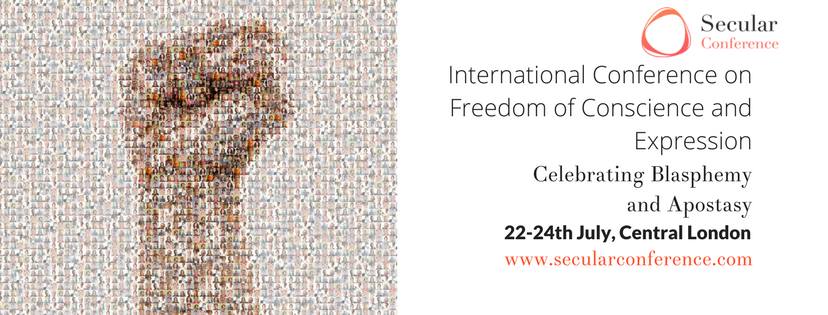
Join notable free-thinkers from around the world for a weekend of discussions and debates on freedom of conscience and expression in the 21st century at a spectacular venue in central London during 22-23 July 2017.
On 24 July, an activist strategy meeting will be followed by body-painting in support of ex-Muslims, which will be open to the public.
The two-day conference will discuss censorship and blasphemy laws, freedom of and from religion, apostasy, the limits of religion’s role in society, LGBT and women’s rights, atheism, secular values and more.
Speakers from countries or the Diaspora as diverse as Afghanistan, Algeria, Bangladesh, Canada, Egypt, France, India, Iran, Iraq, Iraqi Kurdistan, Ireland, Lebanon, Malaysia, Morocco, Nigeria, Norway, Pakistan, Palestinian Territories, Poland, Saudi Arabia, Sudan, Sweden, Switzerland, Syria, Turkey, Tunisia, UK, Ukraine, US and Yemen will gather in London to defend freedom of conscience and expression and argue that freedoms are not western but universal.
The conference will highlight the voices of people on the frontlines of resistance – many of them persecuted and exiled – as well as address challenges faced by activists and freethinkers, elaborate on the links between democratic politics and free expression and conscience, promote secular and rights-based alternatives, and establish priorities for collective action.
Art and culture will be integral to the event as will lively debate with the dauntless use of the free word.
Full schedule: http://www.secularconference.com/agenda-2017/
Confirmed Distinguished Speakers:
A C Grayling, Philosopher
Aliaa Magda Elmahdy, Egyptian Feminist Activist
Alya Al-Sultani, British-Iraqi Vocalist and Composer
Ani Zonneveld, Founder and President of Muslims for Progressive Values
Annie Laurie Gaylor and Dan Barker, Co-Presidents of the Freedom From Religion Foundation
Armin Navabi, Founder of Atheist Republic
Asher Fainman, President of Goldsmiths Atheist Society
Benjamin David, Editor-in-Chief of Conatus News
Bonya Ahmed, Activist, Writer and Blogger at Mukto-Mona
Cemal Knudsen Yucel, Co-Founder and Chair of Ex-Muslims of Norway
Chris Moos, Secular Activist
Damon Conlan and Neil Edwards, Magicians
Dave Silverman, President of American Atheists
Deeyah Khan, Filmmaker
Djemila Benhabib, Author and Activist
Elham Manea, Yemeni-born Author and Human Rights Campaigner
Fariborz Pooya, Bread and Roses TV Presenter and Editor
Fauzia Ilyas, Founder of Atheist & Agnostic Alliance Pakistan
Gina Khan, One Law for All Spokesperson
Gita Sahgal, Director of Centre for Secular Space
Gona Saed, Co-Founder of Kurdistan Secular Centre
Gurpreet Kaur Bhatti, Award-winning Playwright
Halima Begum, Ex-Muslim Feminist Researcher and Blogger
Hassan Radwan, Agnostic Muslim Khutbahs blog
Houzan Mahmoud, Culture Project Co-Founder
Imad Iddine Habib, Founder of Council of Ex-Muslims of Morocco
Inna Shevchenko, FEMEN Leader
Iram Ramzan, Journalist and Founder of Sedaa
Ismail Mohamed, Egyptian Atheist and Founder of Black Ducks Talk Show
Jane Donnelly and Michael Nugent, Atheist Ireland’s Human Rights Officer and Chairperson
Jodie Ginsberg, CEO of Index on Censorship
Karima Bennoune, UN Special Rapporteur in the Field of Cultural Rights
Karrar D. Al Asfoor, Co-founder of Atheist Alliance Middle East and North Africa
Kate Smurthwaite, Comedian
Kenan Malik, Author and Broadcaster
London Humanist Choir
Maajid Nawaz, Founding Chairman of Quilliam Foundation
Marieme Helie Lucas, Algerian Sociologist and Founder of Secularism is a Women’s Issue
Mario Ramadan, Co-Founder of Freethought Lebanon
Maryam Namazie, Iranian-born Rights Activist, Writer and Conference Organiser
Nadia El Fani, Tunisian Filmmaker
Nasreen Rehman, Co-Founder and Chair of British Muslims for Secular Democracy
Nina Sankari, Polish Atheist Activist
Noura Embabi, Muslim-ish President
Peter Tatchell, Human Rights Campaigner
Pragna Patel, Director of Southall Black Sisters
Rana Ahmad, Head of the RDF Arab Atheist Community
Rayhana Sultan, ExMuslimBecause
Richard Dawkins, Author and Scientist (subject to availability)
Sadia Hameed, Spokesperson of the Council of Ex-Muslims of Britain
Sanal Edamaruku, Founder and President of Rationalist International
Sarah Haider, Co-Founder of Ex-Muslims of North America
Sarah Peace, Nigerian Artist and Director of Fireproof Library
Savin Bapir Tardy, Counselling Psychologist for The Iranian and Kurdish Women’s Rights Organisation
Shabana Rehman, Performance Artist and Human and Animal Rights Advocate
Shelley Segal, Singer/Songwriter
Tasneem Khalil, Swedish-Bangladeshi Journalist and Editor of Independent World Report
Teresa Gimenez Barbat, MEP, Group of the Alliance of Liberals and Democrats for Europe and Euromind
Victoria Gugenheim, Award-winning Body Artist
Waleed Al Husseini, Palestinian Writer and Founder of Council of Ex-Muslims of France
Yasmine Mohammed, Confessions of an ExMuslim
Yasmin Rehman, Women’s Rights Campaigner
Zehra Pala, President of Atheism Association of Turkey
Zineb El Rhazoui, Moroccan-born Columnist for Charlie Hebdo
Speaker biographies available here: http://www.secularconference.com/speakers-2017/
For more information, contact Maryam Namazie, [email protected].uk.
The conference is sponsored by: Alliance of Liberals and Democrats for Europe; Atheist International Alliance; Bread and Roses TV; Center for Inquiry; Centre for Secular Space; Council of Ex-Muslims of Britain; Culture Project; Euromind; Equal Rights Now; Fitnah; Freedom from Religion Foundation; National Secular Society; One Law for All; Richard Dawkins Foundation for Reason and Science; Southall Black Sisters; and Secularism is a Women’s Issue.[/vc_column_text][/vc_column][/vc_row][vc_row][vc_column][vc_column_text]
When: 22-24 July
Where: Central London
Tickets: From £65 via Secular Conference No tickets will be sold at the door.
[/vc_column_text][/vc_column][/vc_row]
27 Apr 2017 | Digital Freedom, News, Turkey Uncensored, Volume 46.01 Spring 2017
[vc_row][vc_column][vc_column_text]
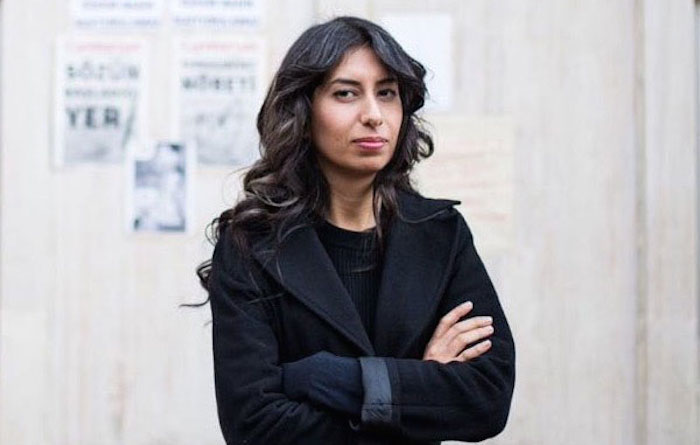
Cumhuriyet reporter Canan Coşkun
Credit: Antonin Weber
[/vc_column_text][/vc_column][/vc_row][vc_row][vc_column][vc_custom_heading text=”Canan Coşkun, a journalist at daily newspaper Cumhuriyet who faces two upcoming trials for her reporting, talks about her attitude to the dangers of life as a reporter in Turkey, in the Spring 2017 issue of Index on Censorship magazine” google_fonts=”font_family:Libre%20Baskerville%3Aregular%2Citalic%2C700|font_style:400%20italic%3A400%3Aitalic”][/vc_column][/vc_row][vc_row][vc_column][vc_column_text]
Every two to three weeks recently, I have seen off a colleague leaving the courthouse for prison or snatched a few moments with a deeply missed, and now detained, workmate in the shadow of the authorities. But we aren’t afraid of this dungeon darkness because we journalists are only doing our jobs.
I have been a court reporter for Cumhuriyet since 2013, so I spend the large majority of my working life in the courts. We all have moments we cannot forget from our working lives. For me, one such day was 5 November 2016, the day when 10 of our writers and managers were arrested. I was waiting for the court’s decision right behind the barrier in the court building, and the moment I heard the decision I felt a flush of pride for our 10 writers and managers, followed by anger and deep depression for my friends.
I felt proud because the fact that they had been arrested for their journalism had been mentioned in the court’s decision. In listing examples of our reporting as the reason for the arrests, the judge took the government’s insistence that “they were not arrested for their journalism” and threw it out of the window. I felt anger and sadness because we were sending our friends off to an indefinite spell of captivity. The police would not even allow us to say goodbye to our colleagues who were only 30 or 40 metres away behind a barrier. But among the many feelings I had, fear was not one of them. When the attacks on journalism are on this scale, fear becomes a luxury.
After our 10 colleagues were arrested, many journalists from around Europe began visiting our newspaper’s offices. Our foreign counterparts wanted to hear about what had happened and how we felt, and they all had the same question: “Are you afraid?” From November onwards, arrests of journalists have continued at a regular pace. But just as on that day, my answer to that question today is short and sweet: “No!”
We are not afraid, because we are doing our work and we are concerned only with our work. We are not afraid, because we too feel as if we have been in Silivri prison with our colleagues for these long months. We are not afraid, because very little difference remains between being in and out of prison. We are not afraid, because the heads of our jailed colleagues are held high. We are not afraid, because Fethullah Gülen, the exiled cleric accused by the government of being behind last year’s failed coup attempt, was not once our “partner in crime”. We are not afraid, because the Cumhuriyet that governments of every era have tried to silence has only reported, is only reporting and will only report.
[/vc_column_text][/vc_column][/vc_row][vc_row][vc_column width=”1/4″][vc_icon icon_fontawesome=”fa fa-quote-left” color=”custom” align=”right” custom_color=”#dd3333″][/vc_column][vc_column width=”3/4″][vc_custom_heading text=”When the attacks on journalism are on this scale, fear becomes a luxury” google_fonts=”font_family:Libre%20Baskerville%3Aregular%2Citalic%2C700|font_style:400%20italic%3A400%3Aitalic”][/vc_column][/vc_row][vc_row][vc_column][vc_column_text]
Ahmet Şık, a reporter at my newspaper, has been under formal arrest since December 2016. Back in 2011, along with former military chief of staff İlker Başbuğ and many soldiers, police, journalists and academics, he spent more than a year in prison in relation to the “Ergenekon” case. The accusation was that they were attempting to overthrow the government.
Şık is currently under arrest accused of conspiring with the Gülen movement. But Turkey’s justice system is such that the case in which Şık was arrested in 2011 still continues, and this gave us a chance to see him in court on 15 February. I waited outside the courtroom doors and when they opened all I saw inside was a face smiling with hope: he was able to see his friends for the first time in months. Although Şık is a much more experienced journalist than I am, his desk in the office was close to mine and I missed him.
At that hearing, he summarised today’s fight to carry out journalism under the state of emergency, saying: “The story of those who think they have power, and who use this power to persecute journalists is as long as journalism itself.”
Last December, six journalists, including some of my friends, were held for 24 days in an inquiry into the hacking of minister Berat Albayrak’s emails. (Albayrak is President Recep Tayyip Erdogan’s son-in-law.) Three of these journalists were later formally arrested by the courts. During this time, detained journalist Mahir Kanaat became a father, but he was unable to see his child. Fellow detainee Tunca Öğreten was not given the right to send and receive letters, or see anyone except his close relatives. He had to propose to his girlfriend via his lawyers.
Recently, I listened to one of these journalists relate a memory from his time in court. Having had their faith in justice shaken, they instead turned to superstition in the courtroom in a bid to be set free. Metin Yoksu, a freed journalist, said three of them had sat close to the courtroom exit and had replaced their shoelaces – which had been taken from them – with laces they had made from bits of water bottles. The result: those who were freed were those who had sat near the exit door.
Trust in Turkey’s justice system has fallen so far that we now rely on our superstitions. How depressing.
[/vc_column_text][/vc_column][/vc_row][vc_row][vc_column][vc_column_text]
This article is part of the spring 2017 issue of Index on Censorship magazine. You can read about all of the other content in the magazine here.
Journalist Canan Coşkun is a court reporter at Cumhuriyet. She is currently charged with defaming Turkishness, the Republic of Turkey and the state’s bodies and institutions in one of her articles. Her article covered the story of a truck full of weapons hidden under onions. The second charge is that she depicted the police who combat terrorism as a target, for a story about Turkish Kurds being arrested.
Turkey Uncensored is an Index on Censorship project to publish a series of articles from censored Turkish writers, artists and translators.
Translated by John Butler
[/vc_column_text][/vc_column][/vc_row][vc_row][vc_column][vc_custom_heading text=”From the Archives”][vc_row_inner][vc_column_inner width=”1/3″][vc_single_image image=”80569″ img_size=”213×289″ alignment=”center” onclick=”custom_link” link=”http://journals.sagepub.com/doi/pdf/10.1177/0306422016657010″][vc_custom_heading text=”We are journalists, not terrorists” font_container=”tag:p|font_size:24|text_align:left” link=”url:http%3A%2F%2Fjournals.sagepub.com%2Fdoi%2Fpdf%2F10.1177%2F0306422016657010|||”][vc_column_text]June 2016
Valeria Costa-Kostritsky looks at a developing trend where journalists are being accused of terrorism and arrested for reporting the news.[/vc_column_text][/vc_column_inner][vc_column_inner width=”1/3″][vc_single_image image=”89086″ img_size=”213×289″ alignment=”center” onclick=”custom_link” link=”http://journals.sagepub.com/doi/pdf/10.1177/0306422013489932″][vc_custom_heading text=”Turkey’s media: a polluted landscape
” font_container=”tag:p|font_size:24|text_align:left” link=”url:http%3A%2F%2Fjournals.sagepub.com%2Fdoi%2Fpdf%2F10.1177%2F0306422013489932|||”][vc_column_text]July 2013
As protests continue in Istanbul, journalist Yavuz Baydar calls for the media to resist government pressure to filter the news.[/vc_column_text][/vc_column_inner][vc_column_inner width=”1/3″][vc_single_image image=”80569″ img_size=”213×289″ alignment=”center” onclick=”custom_link” link=”http://journals.sagepub.com/doi/pdf/10.1177/0306422016657030″][vc_custom_heading text=”Scoops and troops: Turkey’s future ” font_container=”tag:p|font_size:24|text_align:left” link=”url:http%3A%2F%2Fjournals.sagepub.com%2Fdoi%2Fpdf%2F10.1177%2F0306422016657030|||”][vc_column_text]June 2016
Writers from acclaimed independent newspaper Radikal on its closure and the shape of Turkish investigative journalism today.[/vc_column_text][/vc_column_inner][/vc_row_inner][vc_separator][/vc_column][/vc_row][vc_row][vc_column width=”1/3″][vc_custom_heading text=”The Big Squeeze” font_container=”tag:p|font_size:24|text_align:left” link=”url:https%3A%2F%2Fwww.indexoncensorship.org%2Fmagazine|||”][vc_column_text]The spring 2017 issue of Index on Censorship magazine looks at multi-directional squeezes on freedom of speech around the world.
Also in the issue: newly translated fiction from Karim Miské, columns from Spitting Image creator Roger Law and former UK attorney general Dominic Grieve, and a special focus on Poland.[/vc_column_text][/vc_column][vc_column width=”1/3″][vc_single_image image=”88788″ img_size=”medium” alignment=”center” onclick=”custom_link” link=”https://www.indexoncensorship.org/magazine”][/vc_column][vc_column width=”1/3″][vc_custom_heading text=”Subscribe” font_container=”tag:p|font_size:24|text_align:left” link=”url:https%3A%2F%2Fwww.indexoncensorship.org%2Fsubscribe%2F|||”][vc_column_text]In print, online. In your mailbox, on your iPad.
Subscription options from £18 or just £1.49 in the App Store for a digital issue.
Every subscriber helps support Index on Censorship’s projects around the world.
 SUBSCRIBE NOW[/vc_column_text][/vc_column][/vc_row]
