6 Aug 2014 | Azerbaijan Statements, News, Statements
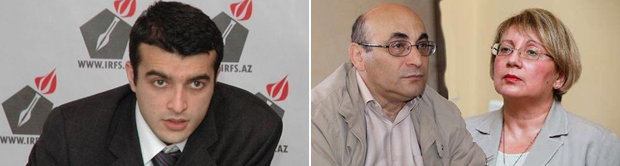
Rasul Jafarov, Arif Yunus and Leyla Yunus (Photos: Rasul Jafarov (© IRFS), Arif and Leyla Yunus (© HRHN))
60 NGOs from 13 Human Rights Houses call upon the Azerbaijani authorities, in their joint letter to President Ilham Aliyev, to immediately and unconditionally release Leyla Yunus, Arif Yunus and Rasul Jafarov, and lift all charges held against them. The NGOs also repeat their previous call to release Anar Mammadli and Bashir Suleymanli, and join calls for the release of Hasan Huseynli.
On 28 April 2014 Leyla Yunus, Director of the Institute for Peace and Democrac, and her husband historian Arif Yunus, were prevented from leaving the country at Baku’s airport. Leyla Yunus and her husband Arif Yunus were arrested on 30 July 2014. On that day, Leyla Yunus was sentenced to 3-months pre-trial detention, whilst her husband was placed under police guard and not allowed to leave Baku. The charges brought against Leyla Yunus are those of state treason (article 274 of the Criminal Code of the Republic of Azerbaijan), large-scale fraud (article 178.3.2), forgery (article 320), tax evasion (article 213), and illegal business (article 192). Arif Yunus was arrested on 5 August 2014 and also sentenced to 3-months pre-trial detention.
The NGOs state in their joint letter to President Aliyev of 5 August 2014 that they are in particular concerned about Leyla Yunus’ health whilst in detention. She suffers from diabetes and needs appropriate medication, as well as arrangements to eat at certain times, necessary to control the illness. We worry that the conditions in detention will have a detrimental effect on her health condition, as it appears that she is to date not provided with adequate health care.
In July 2014, the bank accounts of, amongst others, human rights defender Rasul Jafarov were frozen as part of a broader investigation into numerous NGO’s. On 25 July he was refused to leave the country. Rasul Jafarov was arrested on 2 August 2014, and sentenced to 3 months pre-trial detention on charges of tax evasion (article 213 of the Criminal Code of the Republic of Azerbaijan), illegal business (article 192) and abuse of authority (article 308.2).
On 14 July 2014, Hasan Huseynli, was sentenced to 6 years in prison. He was convicted on charges of armed hooliganism and unlawfully carrying a cold weapon.
The right to freedom of association is at the heart of the charges held against these human rights defenders. In essence they are deprived of their right to work in the defence of human rights. While registration of NGOs and grants to NGOs has become mandatory in Azerbaijan, authorities continue deny registration. Independent NGOs face continuous investigations and human rights defenders are being banned from travelling abroad, depending on their willingness to find agreements with the government, including agreements on their professional activities and their public statements.
Restrictions to laws affecting the right to freedom of association have been widely criticised since October 2011. Such legislation de facto criminalises human rights defenders in Azerbaijan, not for their wrong doing, but rather for the fact that working for an NGO, which does not have the blessing of the government, has become difficult in Azerbaijan. United Nations experts stated ahead of the Presidential elections that they “observed since 2011 a worrying trend of legislation which has narrowed considerably the space in which civil society and defenders operate in Azerbaijan.” The order given to the Human Rights House Azerbaijan in March 2011 to cease all its activities is a consequence of such policies.
The NGOs call upon the Azerbaijani authorities, in their joint letter to President Ilham Aliyev of 5 August 2014, to immediately and unconditionally release Leyla Yunus, Arif Yunus, Rasul Jafarov, and lift all charges held against them. The NGOs see this pre-trial detention of Leyla Yunus, Arif Yunus and Rasul Jafarov as a way to silence them. The NGOs also repeat their previous call to release Anar Mammadli and Bashir Suleymanli, and join calls for the release of Hasan Huseynli.
The NGOs further call upon the Azerbaijani authorities to take appropriate measures to put an end to the attacks, detention and harassment of human rights defenders, journalists and activists, and to take steps in order to foster a safe environment for them, in line with Azerbaijan’s international obligations and commitments, especially as the chair of the Committee of Ministers of the Council of Europe.
Signed by:
Human Rights House Azerbaijan (on behalf of the following NGOs):
- Association for the Protection of Women’s Rights
- Azerbaijan Lawyers Association
- Institute for Reporters’ Safety and Freedom
- Legal Education Society
- Media Rights Institute
- Society for Humanitarian Research
- Women Association for Rational Development
Barys Zvozskau Belarusian Human Rights House in exile, Vilnius (on behalf of the following NGOs):
- Belarusian Association of Journalists
- Belarusian Helsinki Committee
- City Public Association “Centar Supolnaść”
- Human Rights Centre “Viasna”
Human Rights House Belgrade (on behalf of the following NGOs):
- Belgrade Centre for Human Rights
Human Rights House Kiev (on behalf of the following NGOs):
- Association of Ukrainian Human Rights Monitors on Law-Enforcement
- Human Rights Information Centre
- Center for Civil Liberties
- Ukrainian Helsinki Human Rights Union
- Ukrainian Legal Aid Foundation
Human Rights House London (on behalf of the following NGOs):
- Article 19
- Index on Censorship
Human Rights House Sarajevo (on behalf of the following NGOs):
- Helsinki Committee for Human Rights in Bosnia and Herzegovina
Human Rights House Tbilisi (on behalf of the following NGOs):
- Article 42 of the Constitution
- Georgian Centre for Psychosocial and Medical Rehabilitation of Torture Victims
- Human Rights Centre
Human Rights House Oslo (on behalf of the following NGOs):
- Human Rights House Foundation
- Norwegian Burma Committee
- Norwegian Helsinki Committee
Human Rights House Voronezh (on behalf of the following NGOs):
- Charitable Foundation
- Civic Initiatives Development Centre
- Confederation of Free Labor
- For Ecological and Social Justice
- Free University
- Golos
- Interregional Trade Union of Literary Men
- Lawyers for labor rights
- Memorial
- Ms. Olga Gnezdilova
- Soldiers Mothers of Russia
- Voronezh Journalist Club
- Voronezh-Chernozemie
- Youth Human Rights Movement
Human Rights House Yerevan (on behalf of the following NGOs):
- Helsinki Citizens’ Assembly-Vanadzor
- Helsinki Association for Human Rights
- Journalists’ Club “Asparez”
- Public Information and Need of Knowledge NGO
- Shahkhatun
- Women’s Resource Center
Human Rights House Zagreb (on behalf of the following NGOs):
- APEO/UPIM Association for Promotion of Equal Opportunities for People with Disabilities
- B.a.B.e.
- CMS – Centre for Peace Studies
- Documenta – Centre for Dealing with the Past
- GOLJP – Civic Committee for Human Rights
- Svitanje – Association for Protection and Promotion of Mental Health
The Rafto House in Bergen, Norway (on behalf of the following NGOs):
The House of the Helsinki Foundation For Human Rights, Poland (on behalf of the following NGOs):
- Helsinki Foundation for Human Rights
Election Monitoring and Democracy Studies Center, Azerbaijan
Foundation “Multiethnic Resource Center for Civic Education Development”, Georgia
People in Need, Czech Republic
Public Movement Multinational, Georgia
Public Association for Assistance to Free Economy, Azerbaijan
Public Union of Democracy and Human Rights Resource Centre, Azerbaijan
This statement was originally posted on Aug 5, 2014 at http://humanrightshouse.org/Articles/20321.html
26 Jun 2014 | About Index, Campaigns, Statements, Ukraine
President Petro Poroshenko
11 Bankova street
01220 Kyiv
Ukraine
26 June 2014
Mr President,
We, the undersigned members and partners of the Human Rights House Network (HRHN), condemned in the strongest terms human rights violations which took place throughout Ukraine since 29 November 2013, and now call upon you to extend the mandate of the International Criminal Court investigations (taking into account events in Crimea and Eastern Ukraine) and to ratify the Rome Statute, in order to encourage such investigations, as an essential part of bringing peace to the country.
We welcome the repeated pledges of Ukrainian authorities to investigate all human rights violations committed since 29 November 2013 and hold those accountable, throughout the country and irrespective of which side the violator belongs to in the ongoing armed conflict in East Ukraine. The current situation of impunity must end.
The International Criminal Court is the only international body able to not only document grave human rights violations, amounting to core international crimes (war crimes, crimes against humanity, or genocide), but also investigate individuals responsible for such crimes. In order to restore peace and strengthen trust into State institutions, those responsible for such human rights violations have to be held accountable. We have for a long time called for a comprehensive reform of the judicial system in the country, which still remains to be initiated. Unfortunately, the national judicial system now shows its limits and in our view it is clear that it does not have the adequate knowledge, independence and resources to investigate all human rights violations since 29 November 2013 throughout the country.
Therefore, it is necessary to activate the international justice system, based on the complementarity principle, to guarantee that investigation into core international crimes committed by all parties in Ukraine, including by members of law enforcement and State agents, is credible and transparent, bringing those responsible to justice.
The Court’s jurisdiction should however not be limited in time, as it is now. On 17 April 2014, the Government of Ukraine indeed lodged a declaration under Article 12(3) of the Rome Statute accepting the jurisdiction of the ICC over crimes committed on its territory from 21 November 2013 to 22 February 2014.[3] We now call upon the Government to issue a declaration extending ICC jurisdiction from 21 November 2013 until the date of the entry into force of the Rome Statute for Ukraine.
We also call upon the authorities in Ukraine to accede to the Rome Statute as soon as possible. By doing this, Ukraine will make an important step to permanently depart from the culture of impunity that is prevailing.
In addition to the investigation into human rights violations, and action taken to end the use of violence in the country, Ukraine needs to undertake a massive reform of its legislation and practice in many fields. Ukraine’s law enforcement agencies have needed radical reform for a long time now: It is not about changing the names of institutions and units or about window-dressing, but about systemic changes, starting from the principles for establishing and structuring enforcement agencies, and ending with approaches to evaluating their performance.
We therefore support Ukraine’s efforts to propose a resolution at the United Nations Human Rights Council’s on-going session, although we deeply regret the draft resolution’s silence about the role of civil society in the country and the need for an investigation by the Court.
In Ukraine, human rights NGOs have proven their strong commitment to the rule of law and the respect of all human rights for all people, as well as their high level of professionalism and excellence. No country can build a sustainable future without full inclusion of civil society in decision-making, especially Ukraine in its present situation. Furthermore, States and leaders in all sectors of society must acknowledge publicly the important and legitimate role of human rights defenders in the promotion of human rights, democracy and rule of law, and avoid stigmatisation, as stated by the Human Rights Council resolution 22/6 of 21 March 2013.
Finally, we also welcome the reference in the draft resolution on Ukraine at the Human Rights Council to the extremely worrying human rights situation in Crimea and join Ukrainian authorities, the United Nations, the Organisation for Security and Cooperation in Europe, and other international voices, in condemning the enforcement of legislation of the Russian Federation on the territory of Crimea, at variance with the United Nations General Assembly resolution 68/262.
The role of civil society is essential in documenting human rights violations in Crimea and providing support to victims of such violations. A field mission has been launched by Ukrainian and Russian human rights defenders in co-operation, with which we expect full cooperation by all governmental agents in Ukraine.
On this background, we call upon you Mr President and the Government, with no further delay, to issue a declaration to extend the jurisdiction of the International Criminal Court from 21 November 2013 until the date of Ukraine’s accession to the Rome Statute either through appeal of the competent body of the Government or by adopting the Draft Law #4081a.
We further call upon you to:
- Take all necessary measures to support the work of human rights NGOs, journalists and bloggers and other media, including by investigating any threats, intimidation, harassment and violence against them, including arbitrary detentions, abductions, attacks and killings;
- Strongly and publicly acknowledge the important and legitimate role of human rights defenders in the promotion of human rights, democracy and the rule of law as an essential component of ensuring their protection; In line with United Nations Human Rights Council resolution 22/6 of 21 March 2013, paragraph 5
- Ensure that the reform process in the country, as well as all dialogue about the future of the country, is inclusive and transparent, giving space to civil society.
Sincerely,
Human Rights House Kyiv (on behalf of the following NGOs):
- Association of Ukrainian Human Rights Monitors on Law Enforcement (Association UMDPL)
- Centre for Civil Liberties
- Human Rights Information Center
- Institute of Mass Information
- Kharkiv Human Rights Protection Group
- La Strada Ukraine
- NGO “For Professional Journalism” – Svidomo
- Ukrainian Helsinki Human Rights Union
Education Human Rights House Chernihiv (on behalf of the following NGOs):
- Chernihiv Public Committee of Human Rights Protection
- Center of Humnistic Tehnologies “AHALAR”
- Center of Public Education “ALMENDA”
- Human Rights Center “Postup”
- Local Non-governmental Youth organizations М’АRТ
- Transcarpathian Public Center
- Ukrainian Helsinki Human Rights Union
Azerbaijan Human Rights House (on behalf of the following NGOs):
- Association for Protection of Women’s Rights – APWR
- Azerbaijan Human Rights Centre (AHRC)
- Institute for Peace and Democracy
- Human Rights Centre
- Legal Education Society
- Legal Protection and Awareness Society
- Media Rights Institute
- Public Union of Democracy Human Rights Resource Centre
- Women’s Association for Rational Development (WARD)
Barys Zvozskau Belarusian Human Rights House in exile, Vilnius
- Belarusian Association of Journalists
- Belarusian PEN Centre
- Belarusian Helsinki Committee
Human Rights House Belgrade (on behalf of the following NGOs):
- Belgrade Centre for Human Rights
- Helsinki Committee for Human Rights, Serbia
- Human Rights House Belgrade and Lawyers’ Committee for Human Rights –YUCOM
Human Rights House London (on behalf of the following NGOs):
- Index on Censorship
- Vivarta
Human Rights House Tbilisi (on behalf of the following NGOs):
- Article 42 of the Constitution
- Caucasian Centre for Human Rights and Conflict Studies (CAUCASIA)
- Georgian Centre for Psychosocial and Medical Rehabilitation of Torture Victims
- Media Institute
- Human Rights Center
- Union Sapari – Family Without Violence
Human Rights House Oslo (on behalf of the following NGOs):
- Human Rights House Foundation
- Norwegian Helsinki Committee
- Health and Human Rights Info
Human Rights House Voronezh (on behalf of the following NGOs):
- Civic Initiatives Development Centre
- Confederation of Free Labor
- For Ecological and Social Justice
- Free University
- Golos
- Interregional Trade Union of Literary Men
- Lawyers for labor rights
- Memorial
- Ms. Olga Gnezdilova
- Soldiers Mothers of Russia
- Voronezh Journalist Club
- Roronezh – Chernozemie
- Youth Human Rights Movement
Human Rights House Yerevan (on behalf of the following NGOs):
- Helsinki Citizens’ Assembly – Vanadzor
- Journalists’s Club Asparez
- Public Information and Need of Knowledge – PINK
Human Rights House Zagreb (on behalf of the following NGOs):
- APEO / UPIM Association for Promotion of Equal Opportunities for People with Disabilities
- B.a.B.e.
- CMS – Centre for Peace Studies
- Documenta – Centre for Dealing with the Past
- GOLJP – Civic Committee for Human Rights
- Svitanje – Association for Protection and Promotion of Mental Health
The Rafto House in Bergen – Norway (on behalf of the following NGOs):
The House of the Helsinki Foundation For Human Rights – Poland (on behalf of the following NGOs):
- Helsinki Foundation for Human Rights, Poland
Copies have been sent to:
- Mr Oleksandr Turchynov, Chairman of Verkhovna Rada
- Office of the Commissioner for Human Rights of the Council of Europe
- Private Office of the Secretary General of the Council of Europe
- Chairman of the Organisation for Security and Cooperation in Europe (OSCE)
- OSCE Special Monitoring Mission to Ukraine
- OSCE’s Office for Democratic Institutions and Human Rights
- United Nations Human Rights Monitoring Mission in Ukraine
- Delegation of the European Union in Ukraine
- Subcommittee on Human Rights of the European Parliament
- Diplomatic community in Kyiv, Brussels, Geneva and Strasbourg
- Various ministries of foreign affairs and parliamentary committees on foreign affairs
About the Human Rights House Network (www.humanrightshouse.org)
The Human Rights House Network (HRHN) unites 87 human rights NGOs joining forces in 18 independent Human Rights Houses in 13 countries in Western Balkans, Eastern Europe and South Caucasus, East and Horn of Africa, and Western Europe. HRHN’s mandate is to protect, empower and support human rights organisations locally and unite them in an international network of Human Rights Houses.
The Human Rights House Kyiv and the Education Human Rights House Chernihiv are members of HRHN. 10 independent Ukrainian human rights NGOs are members of both Human Rights Houses.
The Human Rights House Foundation (HRHF), based in Oslo (Norway) with an office in Geneva (Switzerland), is HRHN’s secretariat. HRHF is international partner of the South Caucasus Network of Human Rights Defenders and the emerging Balkan Network of Human Rights Defenders.
HRHF has consultative status with the United Nations and HRHN has participatory status with the Council of Europe.
24 Jun 2014 | News, Politics and Society
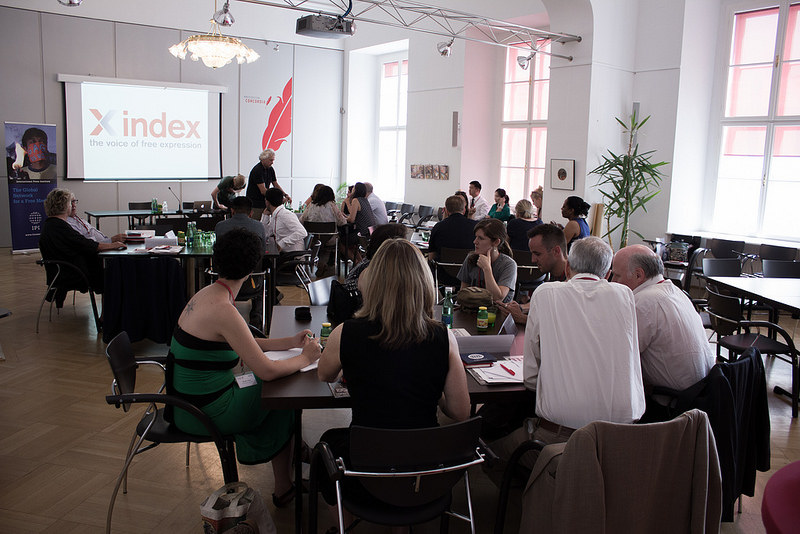
Index speaks at the IAPC meet 2014, Vienna
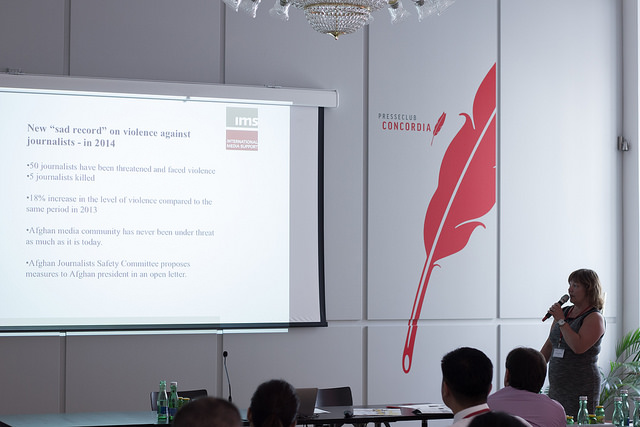
There has been an 18% rise in violence towards journalists compared to the same period last year, International Media Support, an organisation that works in many of the world’s biggest danger zones, told an international journalism conference.
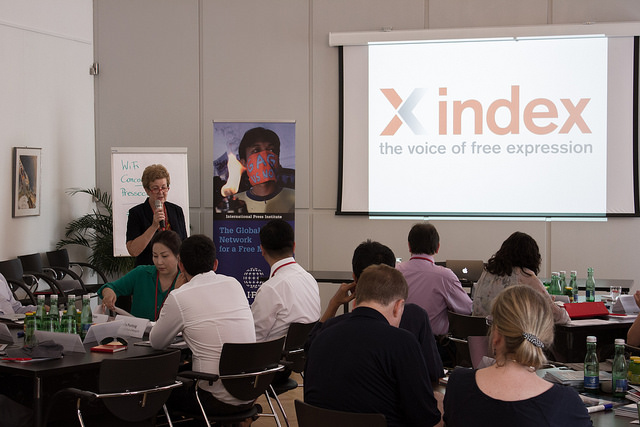
News from Egypt – as three journalists from Al-Jazeera are sentenced to seven years in prison – demonstrates the huge threats that journalists can face. The subject was covered in detail at this year’s International Association of Press Clubs annual conference in Vienna, which Index on Censorship attended this month.
“Some countries we just can’t work in,” said John Barker from Media Legal Defence Initiative, who help represent journalists facing legal charges for reporting and presented on their work. “Every time we work in Vietnam, for example, the lawyers are arrested. In many places, we can’t transfer money to them.” Nonetheless, they are currently working on 102 cases in 39 countries.
Other topics for discussion included:
- The increasing number of freelancers working in danger zones – and with little training
- How to protect fixers, translators and local journalists
- Possible methods for funding legal representation (Crowdfunding worked as a recent experiment in Ethiopia, said MLDI)
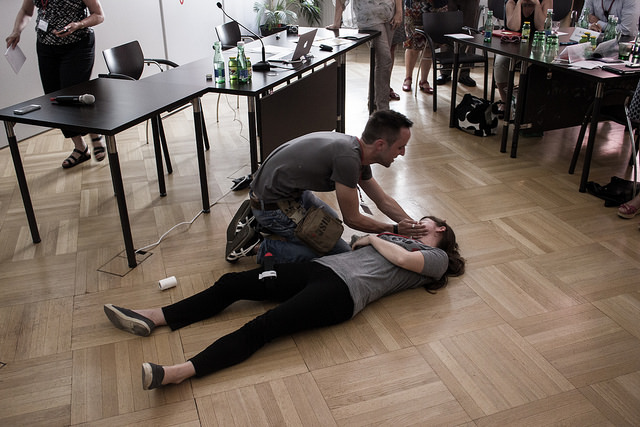
The event was hosted by Austria’s PresseClub Concordia – said to be the oldest press club in the world (founded in 1859 – reformed in 1946, after having its assets seized by Nazis). It was attended by press clubs from around the world, including Poland, Belarus, Syria, the Czech Republic, the US, India, Ukraine, Mongolia, Germany, and Switzerland. Other NGOs – alongside Index, International Media Support and Media Legal Defence Initiative – included the International Press Institute and RISC (Reporters Instructed in Saving Colleagues).
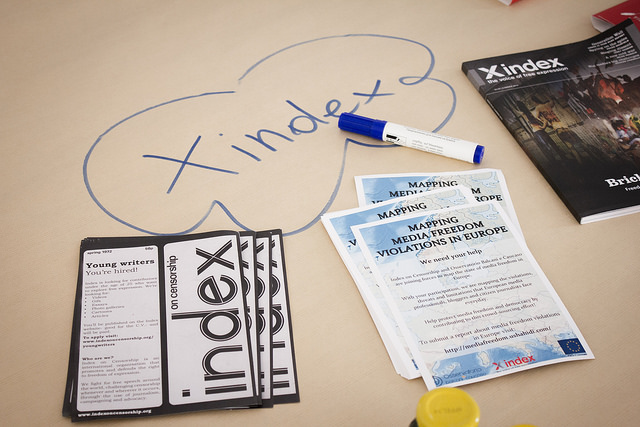
Index was invited to present on the work the organisation is doing around the world, which included sharing the stories of our Freedom of Expression Awards winners and nominees, and news of our current work, including a crowdsourcing project to map media freedom violations across the EU. Plus we also shared stories from our quarterly magazine – including a report on violent threats to journalists in Tanzania and how news stories are getting out of Syria via citizen reports.
Index also hosted round-table discussion on censorship, which provoked an impassioned debate. One of the most interesting topics covered was on contracts that some journalists are being made to sign on what they can and can’t write. We heard of cases in Mongolia and Germany. We also discussed self-censorship and censorship by complying to advertisers’ will. One attendee from the Berlin Press Club said: “There is no censorship in Germany, but journalists feel like they have scissors in their heads. You have to self-censor before you write.” This is an area that we are researching, so please get in touch if you have experiences and examples.
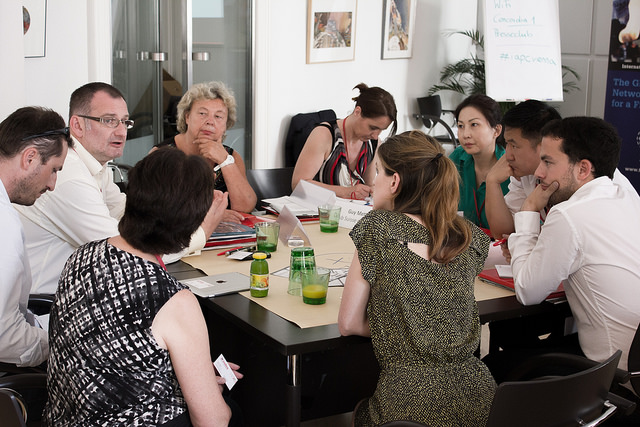
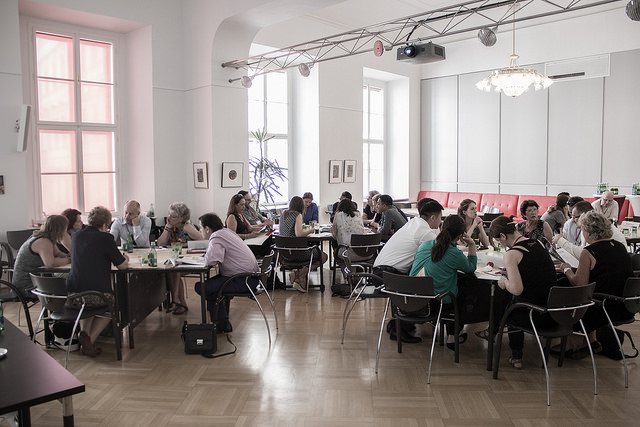
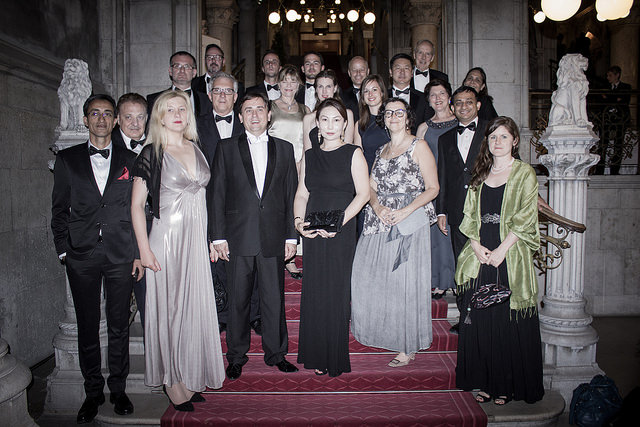
The meeting also visited a new exhibition on censorship during WW1 and ended with the Concordia Press Club’s annual ball, which is a key fundraiser for the club and attended by over 2,000 guests. See photos from the event below.
This article was posted on June 24, 2014 at indexoncensorship.org
20 Jun 2014 | News, Volume 43.02 Summer 2014
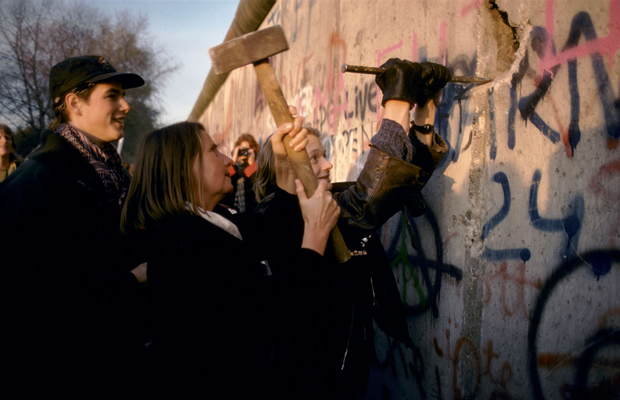
A woman chips away at the Berlin Wall, November 1989. Credit: Justin Leighton / Alamy
Our latest issue of Index on Censorship magazine includes a look at “Generation Wall” – the young people who grew up in a free eastern Europe. Tymoteusz Chajdas, 23, from Poland, is one of our contributors. Here, he looks back at what has changed and remembers his family’s excitement when packages arrived from an uncle in the West
The delivery of a package, the size of a small fridge, from abroad was rare in 1980s Poland. My family was fortunate enough to have this privilege. Every month, my two-year-old sister, Joanna, sat on the rubber flooring in the hallway of our two-bedroom apartment. She waited for a package from Jerzy, my uncle who lived in Cologne, West Germany.
The unpacking was always an occasion. But my parents have a particularly strong memory of the first time a package was delivered. When the postman arrived, Joanna opened the box and immediately started playing with the contents. “Balls. I’ve got so many! Come play with me!” It was the first time my sister had seen oranges.
This was the reality of that time. Poland became isolated from the rest of Europe when the Soviets erected the Berlin Wall in 1961. The ideals of liberty, freedom and democracy remained unattainable for an average Pole for the next 28 years. Some only experienced these ideals remotely by having family in the West, and occasionally receiving “samples” of what Western life was like.
Over on the eastern side of the wall, Poles couldn’t buy basic material goods easily, such as food or hygiene products. Large chunks of everyday life consisted of tedious searches and hours standing in long lines to buy essentials. Store shelves were frequently empty, and it seemed the only item always in stock was vinegar. Even if a product was available, it could only be purchased upon presentation of a ration card.
“Jerzy was devastated by this,” says my mother, Jadwiga, talking about her brother. In 1979, my uncle was invited by a friend for a three-week holiday in the Netherlands. After two weeks, Jerzy decided to stay on the other side of the wall. He applied for political asylum and never came back.
“He could stay there under one condition: he had to reject Polish citizenship,” she tells me. “So he did. Within two years he started sending us food and clothing.”
A few years later, another relative of ours emigrated to the United States. While the Berlin Wall divided Europe into two worlds,
Poles could not reveal any connections they had with the West. It was around this time my father started his career at the Silesian Police Department.
“We started to fear our own shadows,” says my mother, remembering that having family in the West was both a blessing and curse. Any association with capitalist Europe posed a threat to the authorities of communist Poland and was seen as political espionage and violation of the communist ideology. “[Your father] had to renounce family mem- bers living in the West if he wanted to stay employed,” says my mother. “Our phone was tapped so we had little contact with them.”
Despite this, my family still received packages. Only those who worked two jobs or were communist party members could afford to live comfortably, so my mother had to lie about her income to cover up for the extra goods we received from relatives abroad.
Less privileged Poles had little or no un- derstanding of what life looked like on the other side of the Iron Curtain. Jolanta Sudy, a high school teacher and family friend, re- members those times very well. She says the majority of Poles were victims of communist propaganda and were unaware of what was happening in their own country.
“As far as censorship is concerned, the Soviets presented the Eastern Bloc as an El Dorado where everything was perfect and no problems existed,” she says. The government spread its ideology through newspapers, magazines, books, films and theatre productions. Popular radio and tel- evision broadcasts were also censored and reinforced the views of the communist party.
Every year on 1 May, all Polish citizens were obliged to attend a street parade celebrating the International Worker’s Day. A register of attendance was kept.“It looked like a country fair or circus,” recalls Sudy. “Everyone was dressed up to show how joy- ful it was to live in Poland, how happy we were because of the socialist system. But the party stood above us with a whip.”
The elections worked similarly and at- tendance was also mandatory. Many saw them as an ironic spectacle organised by the authorities. The ballot paper featured only one name. “I always signed the register but I never put the card in the box,” says Sudy. “This was my battle with communism.”
Such oppression, constant fear and invigilation had a strong influence on the Poles. Some listened to Radio Free Europe, which broadcast unbiased news from Western countries.
In 1989 the situation changed drastically: the Berlin Wall was torn down.
“The store shelves filled up again with foreign goods,” says my mum. “Travel agents started organising vacations to other coun- tries. This was very difficult before then.”
Some Poles found the change shocking. Sudy says that, after the fall of the Berlin Wall, the amount of uncensored news was overwhelming. “It was hard to believe that we could have lived differently since the end of World War II.”
The overturn of the uniform culture of communist Poland gave birth to a cul- tural explosion which had skillfully been repressed by the Soviets. Free expression in the arts in Poland did not exist during the communist period, according to Kasia Gasinska, a 24-year-old graphic designer. Some Polish citizens listened to music from non-authorised radio stations but it was only “after the wall fell down that [Polish] art became liberated,” recalls Gasinska.
Gasinska says that Western music suddenly became available in Poland, and Poles set up new bands. “New music genres were introduced, such as rave or techno, which embodied the feeling of freedom shared by many at the time.”
The collapse of communism also brought with it one of the most powerful artistic forms – street art, says Gasinska. Many Poles made the journey to the remnants of the Berlin Wall where they could freely express themselves through graffiti.
This expanded as an artistic movement to major cities in Poland. Lodz, the third largest city and a post-industrial centre, became one of many hubs for street art, famous for its colourful murals and playful graffiti that covered many bleak estates.
olish cinema was liberated from communist propaganda as well. There were new movies that referred to the Polish romantic ideals of the previous epoch, as well as comedies and films that dealt with everyday life in the wake of the political transformation.
Today, the events that led to the dismantling of the Berlin Wall seem like a distant memory for many young Poles, myself included. I was born in 1990 and I only learnt about those times by listening to the stories my parents told. Some were scary, some funny. But mostly, they feel unreal, as does the idea of getting shot at for attempting to cross the western border.
Although the Berlin Wall was torn down 25 years ago, divisions can still be felt. An in- visible wall divides us into those who are too young to remember and those who suddenly woke up in a capitalist country. Some made up for the lost time and found themselves in the new system. Others still tend to talk about the good old communist times when the pace of life was less hectic.
But even these Poles wouldn’t deny that the Berlin Wall has become a symbol of an unrealistic system, gradual economic decline and political oppression. Today, its ruins remind me of the adversities many eastern Europeans had to go through to experience living in a free, democratic country. Few remember that, at the time, only hope kept the Poles dreaming of a better life.
My mother told me that when she was a child, she received a present from her friend who was leaving for West Germany. “It was a pair of knee-high socks with blue and red stripes at the top. Today, I would say they were unsightly,” she says. “But back then, I wore them every day. Every time I looked at them, I promised myself that it was going to be better one day.”
This article appears in the summer 2014 issue of Index on Censorship magazine. Get your copy of the issue by subscribing here or downloading the iPad app.
