31 Jan 2023 | Burma, FEATURED: Katie Dancey-Downs, News
This year’s planned elections in Myanmar were always going to be controversial. Then, last week, the military junta that runs the country announced new laws which will create yet more hurdles for democracy. Political parties must re-register within 60 days and sign up at least 100,000 members. Those that the military-controlled government deems to be connected with terrorist groups or to be unlawful will not be allowed to form.
Two years on from the 2021 military coup, Burmese journalist Wai Moe remembers seeing military fighters in the city of Yangon.
“Many of my friends, they did not believe there would be a coup, but I already believed this,” he told Index.
On the morning of 1 February 2021, the phone rang. A friend told Moe that the country’s leader, Aung San Suu Kyi, had been arrested. That night, he remembers the military announcement that due to the emergency situation, power was being given to the commander-in-chief, General Min Aung Hlaing.
“I learnt about the coup… I was very afraid,” Moe said. “I thought, ‘They’re going to arrest me.’”
He wasn’t arrested that day, but when in April he was offered the opportunity to flee the country on a chartered plane, he took it.
Moe is now in exile from Myanmar for the second time in his life. The first occasion came after his release from a five-year-stint as a political prisoner in the mid-1990s. He said he had been part of an underground organisation that secretly studied politics and history.
He still speaks to people in Myanmar, some of whom he describes as going back to normal life after the recent lifting of the curfew. They visit bars and nightclubs. “Day by day, they are in control,” he said of the military, believing the curfew lift to be a sign of this.
The changing face of the protest movement
“When the coup occurred, what initially came out of that was a large-scale protest resistance,” Dan Anlezark, the deputy head of investigations at Myanmar Witness, told Index. This Burmese-led organisation formed in March 2021 in response to events that unfolded following the coup. The group identifies and verifies potential human rights abuses to promote accountability in Myanmar, often using videos and testimonies posted on Facebook and other digital platforms.
Following the protests came violent crackdowns.
Student Thu Thu Zin marched at the front of a small anti-coup protest in Mandalay on 27 July 2021, taking one end of the red Mya Taung Strike Front flag and chanting. According to the evidence verified by Myanmar Witness, the 25-year-old was shot and killed. There was nothing to suggest Zin or the protesters had been violent. Zin’s body was removed, sand used to conceal the blood and her body placed into the back of a truck and taken away. Her family found out about her death when they saw photos of her body on social media. The report concludes that the shooting can, with reasonable certainty, be attributed to the military.
“She became quite symbolic of the protest movement at the start, of that resistance and how forcefully it was met,” Anlezark said.
Since that time, the landscape has changed.
“Once the protesters saw exactly how much force they were being met with, those protests died down. If you’re being met with a gun, and you know that they’re willing to use it, it’s not the most effective means of resistance,” he said. Any protests that are still happening tend to be smaller and reactions to specific events.
Now there is an armed struggle for democracy, as a network of civilian groups, named the People’s Defence Force, clashes with the military. Meanwhile, military junta vehicle convoys are intentionally burning down villages at an alarming rate, according to evidence seen by Myanmar Witness.
Putting the horror of this situation into context, Anlezark explained that they have been examining evidence of burned bodies, found shackled.
“The why is always hard to answer,” he said. “It does look to be that the villages have a link to say PDF [People’s Defence Force] operations or there’s a PDF base nearby, or it’s seen in the eyes of the SAC [State Administration Council] as a means of potential intimidation. Or just to scare the living daylights out of people.”
Erin Michalak has a background in forensic science and now works largely with the arms team at Myanmar Witness. She explained that an increase in unguided airstrikes comes hand-in-hand with the SAC having more aircrafts available to them. Air assets have been transferred from countries including Russia. For some areas in Myanmar, access through ground troops has proven difficult, but airstrikes have made these places potential targets.
“Commentary that I see and that I hear is that the air strikes are almost a symptom of the SAC knowing that they’re not winning or that they’re not progressing how they would like in a ground war,” Anlezark said.
The vanishing Myanmar media
“On 8 March, they banned all the private publications,” Moe told Index, explaining that any continuing news outlets became state controlled. After five publications initially had their licences revoked, the rest fell victim shortly after.
Some citizens turned to foreign radio, like the BBC and Radio Free Asia, and accessed international news through VPNs, Moe explained. Facebook was banned in the early days of the coup, but it is still used extensively to share information, as is the messaging app Telegram.
“If they [media] were pro-democracy or anti-regime, it was shut down or there was a sense that there was going to be something negative that occurred,” Michalak said. “And there are reports and claims of journalists being detained and imprisoned within Myanmar — these are harder to verify.”
In addition, she described evidence of some prisons acting without proper court systems and performing their own sentencing.
“It’s really hard to get an understanding of what’s truly going on here,” she said. “But there is evidence that there has been a negative effect on journalism and freedom of speech within the country.”
In January this year, the military junta released hundreds of political prisoners in celebration of Myanmar’s 75th anniversary of independence. While welcome news to those released, thousands remain behind bars, including former leader and Nobel Peace Prize winner Aung San Suu Kyi, who will likely spend the rest of her life in prison and Htien Lin, an artist and Index contributor who was arrested last August.
“It did appear to be very political, with international viewership noticing that they were releasing these prisoners,” Michalak said.
She described how most of the sentences were connected to freedom of speech and expressing disagreement with the regime. Holding high-profile figures for longer would have been difficult for the military, she said.
Myanmar’s military administration has claimed it will run a general election in August 2023, coinciding with the end of the state of emergency.
“We will be very closely monitoring that to identify voter coercion, disenfranchisement, fraud and violence, which is almost certainly going to occur against protesters and people trying to cast a democratic vote,” Anlezark said.
Moe does not see how any proposed elections could be free and fair.
“There is no space for media, no space for press freedom,” he said. “They are only looking for legitimacy.”
In the run up, the military is conducting a nationwide census, and the reasons for it are unclear. The information in the hands of the junta, Anlezark said, could become a targeting list. It might show who is still in the country, who should be and who might have disappeared to join the network of armed civilian groups who have training camps in the jungle. Daily allegations on Facebook claim that census officials are going from town to town and checking their lists. Myanmar Witness is monitoring and collecting the information.
As to the future of the country, from which he is again exiled, Moe said: “We have to find a way out of the crisis.”
27 Jan 2023 | FEATURED: Martin Bright, Index Arts, News, Russia, Ukraine, Uzbekistan, Uzbekistan
The title of the play Crimea, 5am refers to the time in the morning the authorities choose to raid the homes of activists in the Russian-occupied territory. It is a time of fear and horror for the Crimean Tatars whose voices make up the text of this verbatim play, taken from the testimonies of the men now held in Putin’s prisons and the families waiting at home for them.
Crimea 5am brings to life one of the lesser-known aspects of the brutal war in Ukraine, which began not in February 2022 but in March 2014. It draws on the oral history of the suppression of the Tatar Muslim minority, who returned to the peninsula in the 1990s following independence after years of exile from their homeland.
Much of what we know of life in Crimea since 2014 has come from activists turned citizen journalists. This is one of the reasons the Russian authorities have cracked down so hard on Tatars, characterizing them either as political extremists or Islamist terrorists linked to the group Hizb-ut-Tahrir.
Two examples from the play show how ordinary Tatars went from being activists, to journalists to dissidents in the face of Russian repression.
Tymur Ibrahimov, 38, moved back to Crimea from Uzbeksitan at the age of six in 1991 after the death of his father. In the play, his wife Diliara, explains his transformation from computer repairman to enemy of the state: “It used to be different, until 2014, you know, back then he would make home videos, he would take pictures of nature, like, of the bees and butterflies on flowers, just like that. It all changed in 2015 and he began making footage of what was going on in Crimea. That is, all the searches, court hearings, “Crimean Solidarity” meetings.” For the crime of recording the resistance of his people Tymur was sentenced to 17 years in prison.
Narminan Memedeminov, 39, also moved back to Crimea from Uzbekistan in 1991. After graduating in economics he became involved in human rights activism and media coordinator for the Crimean Solidarity movement. “Here’s an example: I went and took a video of somebody helping out a prisoner’s family, like, basic stuff, they would take the child to the hospital, help them hang the wallpaper, fix the plumbing, send off the parcels to the detention centre and so on… And in the end, everybody involved was at risk: those who took videos, those who helped, those who did anything at all.”
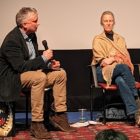
Index editor at large Martin Bright (left) taking part in a post-play discussion.
The stories have been brought together by two Ukrainian writers, Natalia Vorozhbyt and Anastasiia Kosodii and the project is backed by the Ukrainian Institute and the Ukrainian Ministry of Foreign Affairs as a way of bringing the situation to international attention. I had the privilege of watching a reading of of the play at the Kiln Theatre, Kilburn in London last week with professional actors alongside non-professional activists and supporters. Directed by Josephine Burton and produced by Dash Arts, the play focuses on the domestic lives of the families of the Tatar political prisoners and particularly the women.
Burton told Index that until the 2022 Russian invasion of Ukraine, Crimea has drifted from international attention. “Helped by a media blackout, we forgot that the peninsula has been occupied by Russians for almost nine years now and its Tatar community oppressed,” she said. “Determined to fight this silence, the community has relentlessly documented this oppression – filming and uploading searches, arrests and court cases of its people by the Russian Security Forces. And for this act, these “Citizen Journalists” have been arrested themselves and given insanely long sentences, some for up to 20 years in penal colonies.”
Crimea 5am focuses on the everyday lives of Tatar dissidents, drawn from many hours of recordings with the families of 11 political prisoners. “It builds a beautiful and powerful portrait of a community, ripped apart by this tragedy, but also woven with stories of love and resilience through the prism of the wives left behind. It is this mix of tenderness and humour alongside the unfathomable darkness which enables its impact. We the audience become invested in their lives and feel the impact of their tragedy deeply.”
Dash Arts is looking for further opportunities to perform Crimea 5am: https://www.dasharts.org.uk/
25 Jan 2023 | FEATURED: Jemimah Steinfield, News
In the aftermath of her murder in 2017, the family of Maltese journalist Daphne Caruana Galizia found themselves embroiled in a nasty battle with a London law firm. Dubbed a “one-woman Wikileaks” for her exposures of corruption among Malta’s elite Caruana Galizia had faced 42 civil libel cases and five criminal libel cases while alive. These cases passed posthumously to her family. One of them came from a company that had headquarters in London, meaning they could bring legal action there.
“It was like falling further into a pit,” her son Matthew told me over the phone from Malta. “I never imagined I’d be battling these [legal threats]. Everything that could happen to make the situation worse did happen,” he said.
The UK’s libel laws are notoriously open to abuse (as was reported by openDemocracy yesterday) – and London law firms have been at the beck and call of the powerful worldwide. Cases like Caruana Galizia’s have a name – SLAPPs. An acronym for “strategic lawsuits against public participation”, these heavy-handed legal actions seek to intimidate and deter journalists. Their purpose is not to address genuine grievances but to drain targets of as much time, money and energy as possible in an effort to silence them – and to dissuade other journalists from similar investigations.
The laws are also known to be claimant-friendly, especially those in England and Wales where the burden of proof required from a publisher is enormous, often impossible, effectively meaning the accused is guilty until proven innocent. It’s this quirk, combined with exorbitant fees for both parties, which has made London a SLAPPs breeding ground. A 2020 survey of reporters across 41 countries found the UK was the source of 31% of legal threats against journalists. The USA, by contrast, accounted for 11%, and all EU countries combined for 24%.
But the loopholes in UK law might be closing, finally starving firms that have grown fat on oligarchs’ money. A set of reforms were announced last summer that seek to limit the impact of SLAPPs. The reforms are twofold: first, stop cases before they get to court through a series of tests. Do they go against activity in the public interest, for example? If so, throw them out. Next, cap fees for those cases that do make it through.
Half a year on we are still waiting for reforms that, frankly, can’t come fast enough. SLAPPs have long cast a dark shadow over the UK’s media and publishing landscape. 2022 alone saw the climax of big legal actions against Guardian and Observer journalist Carole Cadwalladr, who was taken to court by multimillionaire Brexit backer Arron Banks as a result of a comment she made on a TEDTalk in Canada, FT journalist Tom Burgis, author of Kleptopia: How Dirty Money is Conquering the World, which led to defamation charges by Kazakh mining giant ENRC, and former Reuters journalist Catherine Belton, who was sued over a number of matters in her book Putin’s People: How the KGB took back Russia and then took on the west, by multiple Russian billionaires, including Roman Abramovich.
Neither Burgis’ nor Belton’s cases made it to a full trial. Burgis’ was dismissed by a judge, while Belton settled after revisions were made to her book. Cadwalladr was less lucky. A trial at London’s High Court took place. At the time she said she feared losing her home and bankruptcy. She managed to crowdfund nearly £600,000 to cover costs, and the judgement ruled in her favour in June (although Banks has since been granted permission to appeal).
Yet even these victories are Pyrrhic ones. In a testimony given in the UK’s House of Commons after his case was dropped, Burgis said: “There is money that will not be got back that could have been spent on other books.”
He added:
“There is always a danger, as I know from conversations with colleagues, that you become an expensive and problematic journalist. In an era when the newspaper business model remains broke and oligarchs are amassing more and more wealth, this inequality of arms is extraordinary.”
Out of the spotlight plenty more battle away, ones with far less funding and backing. Journalists at Swedish business and finance publication Realtid, for example, were recently sued in London in connection with their investigation into the financing of energy projects involving a Swedish businessman. Faced with the prospect of financial ruin, just last week, on 13 January, it was announced that they had settled out of court, on condition that they published an apology.
It’s not just the personal toll on these journalists that is deeply concerning; it’s the industry-wide cost. Fear of legal threats is as damning as the threats themselves. Like the guillotine in revolutionary France, it hovers overhead. Do you meet with the whistleblower whose story might land you a Pulitzer, but also might land you in court? I’ve spoken to editors at desks who have become too scared to touch certain topics; a single strongly-worded letter from a minted London law firm is all it takes to spike an article. A top journalist in the UK, now in his 60s who has reported all over the world, told me that he’s never operated in a more fearful media environment than this. Covering your back is exhausting and the risk of humiliation high too. It demands nerves of steel and a sizeable chunk of liability insurance to boot. Young journalists, small media outfits and freelancers are basically counted out.
How many stories have never seen the light and what information are British readers being deprived of? Speaking at a House of Lords Committee back in April, Thomas Jarvis, legal director at Harper Collins, said the publisher regularly avoids publishing information in books in the UK that would be included in international editions because “the risk of publication in the UK is far greater”. This came from the publisher behind both Belton and Burgis’ books, with a proven record to take risks.
Burgis told me that he feels “incredibly lucky to have been backed so bravely” by his publishers. At the same time he’s angry about “all the information of vital public interest that gets suppressed because there is often today such inequality of arms between journalists (incredibly poor) and the powerful (increasingly rich).”
There’s now a real opportunity for change. The war in Ukraine catapulted SLAPPs to the forefront. With some cases being brought by oligarchs and kleptocrats with links to Putin, there has never been a less fashionable time to be a claimant. The UK also has a new head of state and a new prime minister. What better way to show their commitment to democracy than by closing the legal loopholes.
The tide has been turning against SLAPPs for some time. In early 2021, the UK Anti-SLAPP Coalition emerged, made up of NGOs, individual campaigners and lawyers, co-founded and led by Index. It helped pave the wave for the proposed legislation. Through the coalition’s efforts and a changing international landscape British MPs have started to take SLAPPs seriously. So why not push this legislation across the finish line? Today it stubbornly remains just a proposal, rather than a reality. And, speaking to Gill Phillips, director of editorial legal services at the Guardian, she confirmed some of my fears if it does get passed – namely the devil will be in the detail – and the detail has yet to be finessed. No “definition” of public interest, for example, has been provided. Nor is there a clear definition of what constitutes a SLAPP. This might appear like semantics, but in the case of Cadwalladr the judge didn’t deem the case as SLAPP, a judgment that perplexed many.
Still, all those involved in the Coalition welcomed the proposals when they were first mooted, as did Matthew Caruana Galizia.
“What the government is doing is putting a flag up a pole” he said. He thinks the proposals are good and if passed will improve the situation. He adds though that “we can go further”.
“I say ‘we’ not as a UK citizen – I’m a citizen of Malta – but ‘we’ because ‘we’ all suffer as a result of what the British courts allow. They’ve become a platform to stop investigative journalism.”
Let’s dismantle this platform in 2023. It’s high time to end the trial of media freedom.
25 Jan 2023 | Australia, Austria, Bahrain, Belarus, Belgium, Botswana, Burma, China, Cuba, Czech Republic, Denmark, Equatorial Guinea, Eritrea, Estonia, Ethiopia, Finland, Germany, Greece, Index Index, Ireland, Laos, Latvia, Lithuania, Moldova, Netherlands, News, Nicaragua, North Korea, Norway, Portugal, Romania, Russia, Saudi Arabia, South Africa, South Sudan, Swaziland, Switzerland, Syria, Turkmenistan, United Arab Emirates, United States, Yemen
A major new global ranking index tracking the state of free expression published today (Wednesday, 25 January) by Index on Censorship sees the UK ranked as only “partially open” in every key area measured.
In the overall rankings, the UK fell below countries including Australia, Israel, Costa Rica, Chile, Jamaica and Japan. European neighbours such as Austria, Belgium, France, Germany and Denmark also all rank higher than the UK.
The Index Index, developed by Index on Censorship and experts in machine learning and journalism at Liverpool John Moores University (LJMU), uses innovative machine learning techniques to map the free expression landscape across the globe, giving a country-by-country view of the state of free expression across academic, digital and media/press freedoms.
Key findings include:
-
The countries with the highest ranking (“open”) on the overall Index are clustered around western Europe and Australasia – Australia, Austria, Belgium, Costa Rica, Denmark, Estonia, Finland, Germany, Ireland, Latvia, Lithuania, Netherlands, New Zealand, Norway, Portugal, Sweden and Switzerland.
-
The UK and USA join countries such as Botswana, Czechia, Greece, Moldova, Panama, Romania, South Africa and Tunisia ranked as “partially open”.
-
The poorest performing countries across all metrics, ranked as “closed”, are Bahrain, Belarus, Burma/Myanmar, China, Cuba, Equatorial Guinea, Eritrea, Eswatini, Laos, Nicaragua, North Korea, Saudi Arabia, South Sudan, Syria, Turkmenistan, United Arab Emirates and Yemen.
-
Countries such as China, Russia, Saudi Arabia and United Arab Emirates performed poorly in the Index Index but are embedded in key international mechanisms including G20 and the UN Security Council.
Ruth Anderson, Index on Censorship CEO, said:
“The launch of the new Index Index is a landmark moment in how we track freedom of expression in key areas across the world. Index on Censorship and the team at Liverpool John Moores University have developed a rankings system that provides a unique insight into the freedom of expression landscape in every country for which data is available.
“The findings of the pilot project are illuminating, surprising and concerning in equal measure. The United Kingdom ranking may well raise some eyebrows, though is not entirely unexpected. Index on Censorship’s recent work on issues as diverse as Chinese Communist Party influence in the art world through to the chilling effect of the UK Government’s Online Safety Bill all point to backward steps for a country that has long viewed itself as a bastion of freedom of expression.
“On a global scale, the Index Index shines a light once again on those countries such as China, Russia, Saudi Arabia and United Arab Emirates with considerable influence on international bodies and mechanisms – but with barely any protections for freedom of expression across the digital, academic and media spheres.”
Nik Williams, Index on Censorship policy and campaigns officer, said:
“With global threats to free expression growing, developing an accurate country-by-country view of threats to academic, digital and media freedom is the first necessary step towards identifying what needs to change. With gaps in current data sets, it is hoped that future ‘Index Index’ rankings will have further country-level data that can be verified and shared with partners and policy-makers.
“As the ‘Index Index’ grows and develops beyond this pilot year, it will not only map threats to free expression but also where we need to focus our efforts to ensure that academics, artists, writers, journalists, campaigners and civil society do not suffer in silence.”
Steve Harrison, LJMU senior lecturer in journalism, said:
“Journalists need credible and authoritative sources of information to counter the glut of dis-information and downright untruths which we’re being bombarded with these days. The Index Index is one such source, and LJMU is proud to have played our part in developing it.
“We hope it becomes a useful tool for journalists investigating censorship, as well as a learning resource for students. Journalism has been defined as providing information someone, somewhere wants suppressed – the Index Index goes some way to living up to that definition.”
