17 Jan 2020 | Global Journalist, media freedom featured, News, Turkey
[vc_row][vc_column][vc_column_text]This article is part of Index on Censorship partner Global Journalist’s Project Exile series, which has published interviews with exiled journalists from around the world.[/vc_column_text][vc_custom_heading text=”“I try to live isolated to protect myself. “”][vc_separator][/vc_column][/vc_row][vc_row][vc_column][vc_column_text]
Zubyede Sari
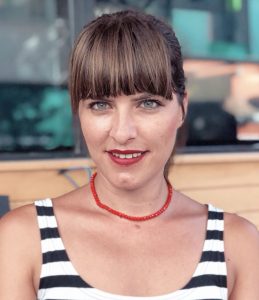
When she got her start in the news business in 2009, Turkish journalist Zübeyde Sari couldn’t have imagined her chosen profession would cause her to have to leave her homeland.
At that time, Turkey’s then-prime minister Recep Tayyip Erdogan was making peace overtures to Kurdish separatists, the Arab Spring that triggered civil war in neighbouring Syria was still more than a year away, and Turkish journalists and opposition parties had significant latitude to criticise Erdogan and the ruling AKP party.
After graduating from university in the southern port town of Mersin, Sari later moved east to the mainly Kurdish city of Diyarbakir, about 60 miles (97km) from the Syrian border. There she became a correspondent for BBC Turkish and the pro-Kurdish IMC TV, eventually covering the Syrian civil war as well as Turkey’s conflict with the PKK, a Kurdish militia.
Yet Turkey was becoming a more restrictive place for journalists. Censorship increased after massive protests in 2013 in Istanbul’s Gezi Park. Gezi Park. In 2016, a failed military coup against President Erdogan triggered a ferocious crackdown on dissidents. More than 150,000 civil servants, police officers and academics were fired from government jobs for suspected disloyalty, according to a tally from the website Turkeypurge.com. Over 300 journalists were arrested and 189 media outlets shut down. IMC TV was raided by police and shutdown mid-broadcast.
Sari survived the initial purges, but in late 2018 she was forced to flee to Germany. “I had to leave in just one night,” she says. “They put my face on all the front pages of the magazines, accusing me of being part of a broadcast television network connected to the Kurdish movement. The next day, I would have woken up with the police knocking at my front door.”
Soon after leaving, she published an article for the site SuperHaber.tv detailing collaboration between the ruling AKP party and Turkish security in the construction of hidden prisons for political dissidents. Now 36, she lives in Berlin, Germany and works for Özgürüz [We Are Free], an online Turkish news portal founded by the well-known exiled journalist Can Dündar.
Sari, who still fears threatened by the many pro-Erdogan Turkish immigrants in Germany, spoke with Global Journalist’s Arianna Suardi. Below, an edited version of their interview:
Global Journalist: Why exactly were you targeted?
Sari: It’s complicated, but I think the Turkish government chose to target me because I’m reporting the truth about the political situation in Turkey. I talk about corruption and the lack of freedom of expression, and of course Erdogan’s party doesn’t like it. I also have friends who are Kurdish and [minority] Alevis and that’s probably why I’ve been accused of being one of them.
GJ: How was it to leave in just one night?
Sari: I’m still under the impact of that feeling. You basically leave your life behind with a small suitcase. It was November 2018, in one night I packed all the things I could and in the early morning I went to the airport and I took the first plane to Berlin.
I feel I don’t belong in this place. Leaving your country is a problem, but settling down in another one isn’t easy either.
GJ: Is life in Germany different than you imagined?
Sari: I’m working for Özgürüz. I can do my profession and I’ve been supported by [press freedom group] Reporters Without Borders. But it’s still very difficult here, more than I imagined. That’s why I started getting therapy. One important aspect is that I don’t speak German. I’m basically restarting my life from the beginning.
GJ: When do you think it will be possible to go back to Turkey?
Sari: I’ve packed my luggage everyday hoping to go back, and I’m still doing it. The problem is the climate of freedom of expression – in Turkey it’s terrible. You need press cards from the government to be a journalist. The government has full control over press card distribution. All the media outlets in Turkey are controlled by Erdogan, and if you’re not part of them you’re considered a terrorist or a traitor.
GJ: Now that you’re in Germany, do you feel free to express yourself or do you still feel pressure?
Sari: No, I can’t express myself. No one has actually threatened me so far, but I just try to hide myself as a form of protection. Sometimes I have the feeling that [Turkish] people in Germany do not really understand what is happening in Turkey, and that is the reason why they sympathise with Erdogan.
I prefer ignoring them rather than get into trouble…I try to avoid every private and personal conversation because I’m scared. It’s not easy, but when, for example, I have to take a taxi, I don’t reveal my identity nor my views about politics. Just yesterday, I was in a taxi and I lied about my profession, I said I was an accountant because I didn’t feel safe. I lie all the time, and I try to live isolated to protect myself.[/vc_column_text][/vc_column][/vc_row][vc_row][vc_column width=”1/2″][vc_video link=”https://youtu.be/6BIZ7b0m-08″][/vc_column][vc_column width=”1/2″][vc_column_text]Index on Censorship partner Global Journalist is a website that features global press freedom and international news stories as well as a weekly radio program that airs on KBIA, mid-Missouri’s NPR affiliate, and partner stations in six other states. The website and radio show are produced jointly by professional staff and student journalists at the University of Missouri’s School of Journalism, the oldest school of journalism in the United States.[/vc_column_text][/vc_column][/vc_row][vc_row][vc_column][vc_custom_heading text=”Don’t lose your voice. Stay informed.”][vc_separator color=”black”][/vc_column][/vc_row][vc_row][vc_column width=”1/2″][vc_column_text]Index on Censorship is a nonprofit that campaigns for and defends free expression worldwide. We publish work by censored writers and artists, promote debate, and monitor threats to free speech. We believe that everyone should be free to express themselves without fear of harm or persecution – no matter what their views.
Join our mailing list (or follow us on Twitter or Facebook). We’ll send you our weekly newsletter, our monthly events update and periodic updates about our activities defending free speech. We won’t share, sell or transfer your personal information to anyone outside Index.[/vc_column_text][/vc_column][vc_column width=”1/2″][gravityform id=”20″ title=”false” description=”false” ajax=”false”][/vc_column][/vc_row][vc_row][vc_column][three_column_post title=”Global Journalist / Project Exile” full_width_heading=”true” category_id=”22142″][/vc_column][/vc_row]
16 Jan 2020 | News
[vc_row][vc_column][vc_single_image image=”111830″ img_size=”full” add_caption=”yes”][vc_column_text]“When I talk about what’s happening in Saudi Arabia, I liken it to a really abusive relationship. First they [the state] gaslight you, they try to convince you that you’re not being abused, that this actually is for your own protection, for your best interests. Then when that doesn’t work out, then they beat you up and… when you escape from them they hunt you down and kill you,” said Safa Al Ahmad, award-winning Saudi Arabian journalist, at the launch of the winter 2019 issue of Index on Censorship magazine.
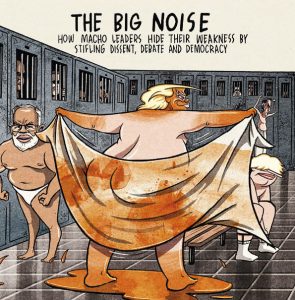
The issue is on the techniques that macho leaders around the world are using to stifle dissent, democracy and discussion, and how people are fighting back. From Brazilian President Jair Bolsonaro ranting against and disparaging media to Hungary’s Prime Minister Viktor Orbán using a rhetoric of family values to deny the LGBT community and others the same rights as “traditional” nuclear families, the magazine takes a global view.
Al Ahmad was joined for a panel discussion, held at Google HQ in London, with bestselling Chinese novelist Xiaolu Guo, Hungarian activist Dóra Papp and satirist and author Rob Sears. The panel was chaired by Rachael Jolley, editor-in-chief of Index on Censorship magazine.
Each panellist was invited to discuss a world leader. Al Ahmad opened with her striking analogy of abusive relationships to discuss Crown Prince of Saudi Arabia Mohammed bin Salman. She highlighted that her analogy was not an exaggeration, citing women’s rights campaigners who have ended up dead or in prison. “I think the feminist movement in Saudi must have been the most frightening for the state,” she said, explaining the lengths the state has gone to in order to silence women.
Al Ahmad also remarked on the absolutist relationship the Saudi state has with the media: “We [Saudi Arabia] have inventing the rulebook on shutting down dissent of any sort, so the state owns all the media. There is no independent media whatsoever to shut buyout – they already own it.”
Papp observed that Orbán has not locked up or killed dissenters “yet”, but that he is at the stage of attempting to create a sense of discord amongst Hungarians, thereby preventing unified protest. She said: “What this kind of leadership from Orbán is really pro in is… making the nation believe that they have to stay divided in order to protect their own identities and their own values.”
Family values is part of the rhetoric of Orbán’s government, which “concludes in a list of disadvantages for LGBT groups, for single mothers, for anyone who is thinking outside the box”. Papp, a successful campaigner, said that we need to be really cautious and not let this narrative divide people.
Guo, discussing China’s president Xi Jinping, spoke about the importance of a dominating personality in a “strongman” leader in order to control the narrative of a country. She said of Xi: “He has an extremely tough way of dealing with internal turmoil but also a very interesting and mysterious way of dealing with international conflict.” She also commented that tension between Xi and US President Donald Trump seems to be bringing about a cold war that “we thought had disappeared 20 years ago”.
A discussion about macho men would not be complete without a dissection of the presidency of Trump, which Sears did by observing how Trump stifles free expression, not by killing journalists, but by setting the media agenda. Sears highlighted two of Trump’s oratory traits: “One is that he is basically impossible to ignore and the other is that he is basically impossible to engage with.”
He explains that Trump’s repeated use of outrageous, implausible (think “build the wall” and “lock her up”) but clear images forces the media to report on them. He said: “You [journalists] can’t help but respond to them and make them the focus of attention, meaning that it’s tricky for other topics to make it into the highest levels of conversation.”
“I’m sure every politician finds the right language for that purpose. UK Prime Minister Boris Johnson cleary does and some of the other leaders we’ve talked about do as well… I don’t know if they are deliberate methods… but I do think that it’s been extremely effective against a decent, fruitful public debate in the states and worldwide.”
Click here to read more about the current magazine
Listen to Rachael Jolley and deputy editor of the magazine, Jemimah Steinfeld, discuss the current issue on Resonance radio here [/vc_column_text][/vc_column][/vc_row][vc_row][vc_column][/vc_column][/vc_row]
3 Jan 2020 | Magazine, News, Volume 48.04 Winter 2019
[vc_row][vc_column][vc_video link=”https://www.youtube.com/watch?v=s-bKFo30o2o”][/vc_column][/vc_row][vc_row][vc_column][vc_column_text]What does it mean to be a man? That has been the subject of many a song and is also the subject of the winter 2019 issue of Index on Censorship magazine, where we consider how leaders are using concepts of masculinity for their political gain and our free speech loss. While you’re reading the mag, have a listen to your playlist which features artists from Bob Dylan to Taylor Swift, who are all singing, one way or another, about the problems with macho men.
Enjoy the songs below. Hopefully the outspoken lyrics of women like Lily Allen and Shania Twain will leave you feeling more empowered than despondent.[/vc_column_text][/vc_column][/vc_row][vc_row][vc_column][vc_column_text]
When US President Donald Trump tweeted that he is “so great looking and smart”, Carly Simon’s classic take down of an unnamed man sprung to mind. Ditto every time we see Russian President Vladimir Putin’s appearing topless on a horse. But what are these mega egos doing to our rights? Editor-in-chief Rachael Jolley spoke to New York Times lawyer David E. McCraw about the state of media freedom in the USA under Trump.
“Macho, macho man! I want to be a macho man!” Is this what the current pack of male leaders listen to every morning? And do they also add their own words, like dominant, aggressive and infallible? For a more complete list of what they are like, how they are destroying our freedoms and how you can be a macho man too, read Rob Sears guide for the modern despot.
Brandon Flowers told NME in 2017 that the then-newly released single The Man depicted his attitude towards masculinity when The Killers started out, an attitude he now regrets. With lyrics including “don’t try to teach me, I got nothing to learn”, it’s easy to see why Flowers is glad to have grown out of such youthful notions. Unfortunately, the men who dominate world politics don’t seem to have matured out of their eagerness to be “The Man” and all that that implies. Case in point China’s Xi Jinping.
Irish rock band Thin Lizzy had a hit in 1976 with The Boys are Back in Town, a joyful ode to, well, boys being back in town. Its catchy melody means it’s still a feature on many party playlists, but delve into the lyrics and evidence of toxic masculinity is there. When the boys go out, “The drink will flow and the blood will spill, And if the boys want to fight, you better let ’em”. Kaya Genç reports on a rap collective in Turkey using music to take down that kind of ‘masculine’ behaviour men can exhibit.
While “lion man” is used with some irony by Mumford and Sons in this song, to show a man who hides his insecurities behind a facade of machismo, Brazilian President Jair Bolsonaro does not appear to exhibit any irony when he refers to himself as a majestic lion surrounded by hyenas, as he did last year. Stefano Pozzebon reports on the uphill battle faced by the Brazilian press to hold this lion to account.
Bob Dylan’s moving, acoustic attacks on macho world leaders sending young people off to spill their blood on the battlefield are timeless. “When the death count gets higher, you hide in your mansion” sings Dylan in Masters of War. Somak Ghoshal reports on India’s Prime Minister Narendra Modi, who is a fervent patriot with a strong war cry.
Macho leaders are eager to impress, whether it be to their citizens in a bid to maintain fearful respect and loyalty or fellow world leaders who they want to come across as heads of powerful states not to be underestimated. What would Canadian powerhouse Shania Twain say? If this song is anything to go by, they don’t impress her much. Arrogant intelligence, vanity and fast cars are all big no-nos, and we’d assume draconian policies and the quashing of free expression are too. It’s bad news for Tanzania’s “Bulldozer” President Magufuli.
Did Lily Allen write her song Fuck You with Hungarian prime minister Viktor Orbán in mind? The song takes aim at small-minded, hate-filled, racist homophobes, with lines like “So you say it’s not OK to be gay, well I think you’re just evil”, which could be one way to address a leader whose party continues to assault gay rights by promoting “family values” that exclude LGBT people.
Taylor Swift captures the inequalities between the sexes in The Man, her song about the respect she would get if she was a man for the same actions that result in criticism for a woman. Female journalists could sing the same song, often being targeted as much for their gender as for their words. Miriam Grace Go reports on Philippines’ President Rodrigo Duterte, for example, and his explicit denigration of female journalists and politicians.
No-one writes a protest song quite like Pussy Riot, the Russian feminist punk rock group. In October 2016, two weeks before Donald Trump was elected as US president, they released Make America Great Again, a dystopian vision of the USA under Trump. Lyrics include “Can you imagine a politician calling a woman dog?” Unfortunately, we don’t have to imagine this as it’s become all too real. Caroline Lees reports on how world leaders are using slurs to undermine their opponents in a trend that appears to be getting worse.
[/vc_column_text][/vc_column][/vc_row]
13 Dec 2019 | Magazine, Magazine Contents, Volume 48.04 Winter 2019
[vc_row][vc_column][vc_custom_heading text=”With contributions from Jeffrey Wasserstrom, Miriam Grace Go, Tammy Lai-ming Ho, Karoline Kan, Rob Sears, Jonathan Tel and Caroline Lees”][/vc_column][/vc_row][vc_row][vc_column][vc_column_text]
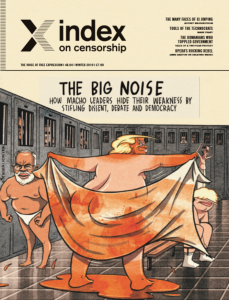 The Winter 2019 issue of Index on Censorship magazine looks at the current pack of macho leaders and how their egos are destroying our freedoms. In this issue Rappler news editor Miriam Grace Go writes about how the president of the Philippines, Rodrigo Duterte, tries to position himself as the man by being as foul-mouthed as possible. Indian journalist Somak Goshal reports on how Narenda Modi presents an image of being both the guy next door, as well as a tough guy – and he’s got a large following to ensure his message gets across, come what may. The historian Jeffrey Wasserstrom considers exactly who the real Chinese leader Xi Jinping is – a man of poetry or military might? And Stefano Pozzebon talks to journalists in Brazil who are right in the firing line of Jair Bolsonaro’s vicious attacks on the media. Meanwhile Mark Frary talks about the tools that autocrats are using to crush dissent and Caroline Lees looks at the smears that are becoming commonplace as a tactic to silence journalists. Plus a very special spoof on all of this from bestselling comedic writer Rob Sears.
In our In Focus section, we interview Jamie Barton, who headlined this year’s Last Night at the Proms, an article that fits nicely with another piece on a new orchestra in Yemen from Laura Silvia Battaglia.
In our culture section we publish a poem from Hong Kong writer Tammy Lai-ming Ho, which addresses the current protests engulfing the city, plus two short stories written exclusively for the magazine by Kaya Genç and Jonathan Tel. There’s also a graphic novel straight out of Mexico.
[/vc_column_text][/vc_column][/vc_row][vc_row][vc_column][vc_custom_heading text=”Special Report”][/vc_column][/vc_row][vc_row][vc_column][vc_column_text]Will the real Xi Jinping please stand up by Jeffrey Wasserstrom: China’s most powerful leader since Mao wears many hats – some of them draconian
Challenging Orbán’s echo chamber by Viktória Serdült: Against the odds a new mayor from an opposition party has come to power in Budapest. We report on his promises to push back against Orbán
Taking on the lion by Stefano Pozzebon: With an aggressive former army captain as president, Brazilian journalists are having to employ bodyguards to keep safe. But they’re fighting back
Seven tips for crushing free speech in the 21st century by Rob Sears: Hey big guy, we know you’re the boss man, but here are some tips to really rule the roost
“Media must come together” by Rachael Jolley and Jan Fox: Interview with the New York Times’ lawyer on why the media needs to rally free speech. Plus Trump vs. former presidents, the ultimate machometer
Tools of the real technos by Mark Frary: The current autocrats have technology bent to their every whim. We’re vulnerable and exposed
Modi and his angry men by Somak Ghoshal: India’s men are responding with violence to Modi’s increasingly nationalist war cry
Global leaders smear their critics by Caroline Lees: Dissenters beware – these made-up charges are being used across borders to distract and destroy
Sexism is president’s power tool by Miriam Grace Go: Duterte is using violent language and threats against journalists, Rappler’s news editor explains
Stripsearch by Martin Rowson: Putin, Trump, Bolsonaro – macho or… nacho?
Sounds against silence by Kaya Genç: Far from a bad rap here as Turkey’s leading musicians use music to criticise the government
Un-mentionables by Orna Herr: The truths these world leaders really can’t handle
Salvini exploits “lack of trust” in Italian media by Alessio Perrone: The reputation of Italian media is poor, which plays straight into the hands of the far-right politician
Macho, macho man by Neema Komba: A toxic form of masculinity has infected politics in Tanzania. Democracy is on the line
Putin’s pushbacks by Andrey Arkhangelskiy: Russians signed up for prosperity not oppression. Is Putin failing to deliver his side of the deal?[/vc_column_text][/vc_column][/vc_row][vc_row disable_element=”yes”][vc_column][vc_custom_heading text=”Global View”][vc_column_text]Trying to shut down women by Jodie Ginsberg: Women are being forced out of politics as a result of abuse. We need to rally behind them, for all our sakes[/vc_column_text][/vc_column][/vc_row][vc_row][vc_column][vc_custom_heading text=”In Focus”][vc_column_text]Dirty industry, dirty tactics by Stephen Woodman: Miners in Brazil, Mexico and Peru are going to extremes to stop those who are trying to protest
Music to Yemen’s ears by Laura Silvia Battaglia: Could a new orchestra in Yemen signal the end of oppressive Houthi rule? These women hope so
Play on by Jemimah Steinfeld: The darling of the opera scene, Jamie Barton, and the woman behind a hit refugee orchestra, discuss taboo breaking on stage
The final chapter by Karoline Kan: The closing of Beijing’s iconic Bookworm has been met with cries of sadness around the world. Why?
Working it out by Steven Borowiec: An exclusive interview about workplace bullying with the Korean Air steward who was forced to kneel and apologise for not serving nuts correctly
Protest works by Rachael Jolley and Jemimah Steinfeld: Two activists on how their protest movements led to real political change in Hungary and Romania
It’s a little bit silent, this feeling inside by Silvia Nortes: Spain’s historic condemnation of suicide is contributing to a damaging culture of silence today[/vc_column_text][/vc_column][/vc_row][vc_row][vc_column][vc_custom_heading text=”Culture”][vc_column_text]Hong Kong writes by Tammy Lai-ming Ho: A Hong Kong poet talks to Index from the frontline of the protests about how her writing keeps her and others going. Also one of her poems published here
Writing to the challenge by Kaya Genç: Orna Herr speaks to the Turkish author about his new short story, written exclusively for the magazine, in which Turkish people get obsessed with raccoons
Playing the joker by Jonathan Tel: The award-winning writer tells Rachael Jolley about the power of subversive jokes. Plus an exclusive short story set in a Syrian prison
Going graphic by Andalusia Knoll Soloff and Marco Parra: Being a journalist in Mexico is often a deadly pursuit. But sometimes the horrors of this reality are only shown in cartoon for, as the journalist and illustrator show[/vc_column_text][/vc_column][/vc_row][vc_row][vc_column][vc_custom_heading text=”Index around the world”][vc_column_text]Governments seek to control reports by Orna Herr: Journalists are facing threats from all angles, including new terrorist legislation[/vc_column_text][/vc_column][/vc_row][vc_row][vc_column][vc_custom_heading text=”Endnote”][vc_column_text]Culture vultures by Jemimah Steinfeld: The extent of art censorship in democracies is far greaten than initially meets the eye, Index reveals[/vc_column_text][/vc_column][/vc_row][vc_row][vc_column width=”1/3″][vc_custom_heading text=”Subscribe”][vc_column_text]In print, online, in your mailbox, on your iPad.
Subscription options from £18 or just £1.49 in the App Store for a digital issue.
Every subscriber helps support Index on Censorship’s projects around the world.
 SUBSCRIBE NOW[/vc_column_text][/vc_column][vc_column width=”1/3″][vc_custom_heading text=”Read”][vc_column_text]The playwright Arthur Miller wrote an essay for Index in 1978 entitled The Sin of Power. We reproduce it for the first time on our website and theatre director Nicholas Hytner responds to it in the magazine
READ HERE[/vc_column_text][/vc_column][vc_column width=”1/3″][vc_custom_heading text=”Listen”][vc_column_text]In the Index on Censorship autumn 2019 podcast, we focus on how travel restrictions at borders are limiting the flow of free thought and ideas. Lewis Jennings and Sally Gimson talk to trans woman and activist Peppermint; San Diego photojournalist Ariana Drehsler and Index’s South Korean correspondent Steven Borowiec
LISTEN HERE[/vc_column_text][/vc_column][/vc_row]