18 Jun 2018 | News
[vc_row][vc_column][vc_column_text]By Nicole Ntim-Addae and Long Dang. With additional reporting by Shreya Parjan and Sandra Oseifri.[/vc_column_text][vc_single_image image=”100888″ img_size=”full” add_caption=”yes”][vc_column_text]“What do we do next? We are losing our point of reference. The loss of the United States and the United Kingdom as democratic beacons for the rights of journalists and the freedom of information is a bad omen for the rest of the world.”
The question was raised by Javier Garza of Article 19, a British human rights organisation, at the discussion about the growing threats to press freedom in the United States that took place at the Free Word Centre on Thursday 14 June. The panel was held to explore the findings of the unprecedented mission to the USA undertaken by six press freedom groups — Index on Censorship, Article 19, Committee to Protect Journalists, IFEX, International Press Institute, and Reporters Without Borders—in January 2018. Representatives of the groups conducted interviews with journalists in St. Louis, Missouri, Houston, Texas, and Washington DC. Their findings were published in a mission report in May 2018.
Jodie Ginsberg, CEO of Index on Censorship, stated the motivation behind the mission. “It is unusual for press freedom organisations to take a mission to the US”, she said. “According to the findings of the mission, violations of freedom of press and freedom of information may be closer to home.” The mission was carried out in recognition that discussions regarding press freedom are taken for granted in democracies in a way that they are not in authoritarian states.
At the same time, Trump’s hostile rhetoric directed against the US press is problematic for press worldwide. Rebecca Vincent, UK bureau director of Reporters Without Borders, noted that the Trumpian denunciation of the press as “fake news” and “enemies of the people” is gradually becoming a global phenomenon.
Vincent, Ginsberg, and Dave Banisar, senior legal counsel of Article 19 were moderated by Paddy Coulter, director of communications at Oxford Poverty & Human Development Initiative and member of the Article 19 board, to review the mission.
According to the US Press Freedom Tracker, there were 34 arrests of journalists made by the authorities in 2017 alone. Along with that, there has been a noticeable uptick in border controls since 2017, with journalists being searched, forced to hand over their phones for inspection, and denied entry into the U.S. This kind of problematic border control renders it extremely difficult for journalists to travel for work. Moreover, the excessive phone screening not only poses a violation of journalists’ right to privacy, but also a risk to the safety of their sources.
“The US office [of RSF] now puts out a weekly violations report because there are so many of them” said Vincent. The UK is currently ranked 40th out of 180 countries in terms of press freedom, according to the 2018 World Press Freedom Index. The US is faring worse, ranking at 45th. Since the beginning of 2018 alone, two journalists have been arrested and 12 have been attacked. The panelists noted that these problems did not start with the Trump administration. “Don’t get complacent. The beautiful [Clinton-Bush-Obama] administration’s era when nothing went wrong hasn’t existed for a long time.” said Banisar.
Banisar explained how little protection there is for whistleblowers and their sources under the Espionage Act of 1917. It is important to note that the improper use of the act had started before the Trump administration: under the Obama administration, the act was used to prosecute more whistleblowers than ever before. Banisar highlighted the case of Reality Winner, the former NSA contractor who was incarcerated only a few days after she released information that the Russians had hacked the 2016 presidential election. Jen Robinson from Article 19, an Australian human rights lawyer and barrister with Doughty Street Chambers in London and advisor to Julian Assange WikiLeaks founder noted that Wikileaks’ 2010 investigation was unprecedented. Never before has the Espionage Act been used in a civil lawsuit as that would have set the stage for larger news agencies such as The New York Times.
How could we do better?
Ginsberg stressed the importance of “reverse education” – that is, showing people how to navigate the negative environments. Border stops, according to her, are “a deeply concerning intrusion on the confidentiality of a reporter’s sources”. Accordingly, when journalists travel to the US to work, they should be aware of the situation and take steps to protect themselves and their sources. In that vein, Index has provided a journalist tool kit drawing from the experience of journalists who have had to deal with problems first hand. It has also corroborated with the Missouri School of Journalism in Project Exile, which documents the experience of journalists forced to live in exile because of their work.
Vincent reaffirmed that the hostile rhetoric directed at journalists needs to stop, since “the line between hateful, hostile terms and violence against journalists is blurring”. Bainsar emphasized that legal changes needs to be made to facilitate the free flow of information. He also stated that the US government needs to strive to improve its laws on source protection, protection for whistleblowers and statutory rights. Banisar calls for the Espionage Act of 1917 to be “ceremonially buried”.
But it is not all doom and gloom. Ginsberg, pointing to the demonstrations taking place around the world, commented that there is “still a huge appetite to assemble freely”. Banisar reported that the influx of cash flow into organisations such as the ACLU and HRW shows citizens are aware that press freedom violations are not problems they want to see coming back. He also reminded the audience that the president could just serve four years, and there are rules and regulations that would keep him in check. Despite Trump’s adamant dismissal of climate change, 10,000 documents— obtained through the US’s landmark Freedom of Information Laws—from the Environmental Protect Agency were published in The New York Times this past week, demonstrating that there is still professionalism in the use of laws.
“There are still those with liberal values.” said Rebecca Vincent. “There is a younger generation of journalists who care about issues. It’s also about making people realize that this is not just the happening in the ‘world’. This is happening in our borders. We must stand up to our own standards.” [/vc_column_text][/vc_column][/vc_row][vc_row][vc_column][vc_basic_grid post_type=”post” max_items=”12″ style=”load-more” items_per_page=”4″ element_width=”6″ grid_id=”vc_gid:1529312741775-6402968b-d0c0-9″ taxonomies=”9044″][/vc_column][/vc_row]
15 Jun 2018 | Azerbaijan, Azerbaijan Statements, Campaigns -- Featured, Statements
Representatives of 42 international and national non-governmental organizations issue the appeal to the Parliamentary Assembly of the Council of Europe (PACE) to request the appointment of a Rapporteur to examine the situation of political prisoners in Azerbaijan.
Below is a short version of the document. Read the full statement here:  csp_letter_to_pace_on_az_political_prisoners_12_june.pdf
Civil society groups report that today there are at least 100 prisoners held on politically motivated charges in Azerbaijan. Among them are dozens of religious activists, at least nine journalists, editors and bloggers as well as members of the political opposition, human rights defenders and several persons who have been imprisoned in retaliation for the actions of their relatives who have fled the country. The most notable cases include the continued imprisonment of former opposition Presidential candidate Ilgar Mammadov, investigative journalist Afghan Mukhtarli, the leader of Muslim Unity Movement Tale Baghirzade, and Mehman Huseynov, young blogger and journalist who documented corruption among high-ranking government officials through his YouTube posts.
It is time for PACE to take decisive action to tackle the issue of political prisoners in Azerbaijan in order to hold the authorities accountable for implementing the commitments undertaken upon the country’s accession to the Council of Europe in 2001.
Resuming the work started by Christopher Strässer will send a first strong signal to the Azerbaijani authorities to demonstrate that the Assembly will not tolerate a continuation of this systematic repressive practice which has no place in a Council of Europe Member State. As politically motivated imprisonment violates the underlying principles of the Council of Europe, appointing a Rapporteur with the mandate to investigate the issue and make recommendations is consistent with the mandate of the organisation.
Reiterating our concerns about the widespread use of politically motivated imprisonment in Azerbaijan we, the undersigned civil society organizations call upon the members of the Committee on Legal Affairs and Human Rights the PACE, which has been mandated to make a decision on this matter, to:
- Appoint a Rapporteur to examine the issue of political prisoners in Azerbaijan;
- Ensure that the Rapporteur is appointed through a fully transparent process and in close consultation with civil society.
Signatures:
- ARTICLE 19 (United Kingdom)
- Association UMDPL (Ukraine)
- Austrian Helsinki Association (Austria)
- Bir Duino (Kyrgyzstan)
- Center for Civil Liberties (Ukraine)
- Center for Participation and Development (Georgia)
- Centre de la protection internationale (France)
- Centre for the Development of Democracy and Human Rights (Russia)
- Citizens’ Watch (Russia)
- Crude Accountability (USA)
- Freedom Files (Russia/Poland)
- Freedom Now (United States)
- German Russian Exchange – DRA (Germany)
- Helsinki Association (Armenia)
- Helsinki Foundation for Human Rights (Poland)
- Human Rights Club (Azerbaijan)
- Human Rights House Foundation (Norway)
- Human Rights Information Center (Ukraine)
- Human Rights Monitoring Institute (Lithuania)
- humanrights.ch (Switzerland)
- Index on Censorship (United Kingdom)
- International Partnership for Human Rights (Belgium)
- Italian Coalition for Civil Liberties – CILD (Italy)
- Kazakhstan International Bureau for Human Rights and the Rule of Law (Kazakhstan)
- Legal Policy Research Center (Kazakhstan)
- Macedonian Helsinki Committee (Macedonia)
- Moscow Helsinki Group (Russia)
- Netherlands Helsinki Committee (The Netherlands)
- Norwegian Helsinki Committee (Norway)
- OMCT (Switzerland)
- Promo LEX (Moldova)
- Protection of rights without borders (Armenia)
- Public Alternative (Ukraine)
- Public Association “Dignity” (Kazakhstan)
- Public Verdict Foundation (Russia)
- Regional Center for Strategic Studies (Azerbaijan/Georgia)
- SOLIDARUS (Germany)
- The Barys Zvozskau Belarusian Human Rights House (Belarus)
- The Kosova Rehabilitation Centre for Torture Victims (Kosovo)
- The Swedish OSSE Network (Sweden)
- Truth Hounds (Ukraine/Georgia)
- Women of the Don (Russia)
Individual signatories from Azerbaijan
- Zohrab Ismayil, Open Azerbaijan Initiative
- Khalid Baghirov, lawyer
- Khadija Ismayilova, investigative journalist
- Akif Gurbanli, Democratic Initiatives Institute
31 May 2018 | Mapping Media Freedom, Media Freedom, News
[vc_row][vc_column][vc_column_text]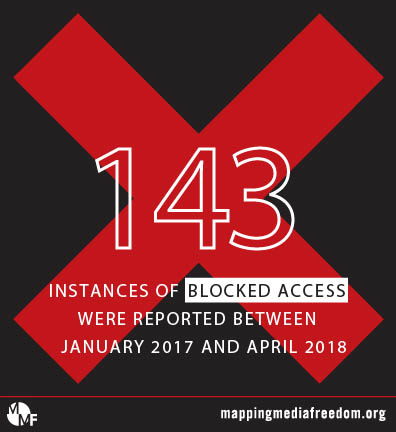 From the beginning of 2017 until April 2018, 143 reports of blocked access, in which journalists were expelled from a location or prevented from speaking to a source, were submitted to Index on Censorship’s Mapping Media Freedom project. Out of the 25 countries in which such violations have occurred, the five worst were: Ukraine, Russia, Belarus, Turkey and France.
“Mapping Media Freedom has highlighted is a continual prevention of journalists from doing their job by way of blocked access,” Joy Hyvarinen, head of advocacy at Index on Censorship, said. “For the sake of the public’s right to know, journalists must be granted access in order to eliminate the problem of important issues going underreported.”
Ukraine
With 20 separate incidents of blocked access, Ukraine tops the list. Thirteen of the reports involved Russian or Georgian media outlets, highlighting the tension between the three countries, with November 2017 being the busiest month, with five violations recorded. At least 12 journalists were barred from entering the country in the last 15 months, with another six being deported. Among those deported was Georgian television channel Rustavi-2 journalist Tamaz Shashvishvili, who was forcibly detained in November 2017 by around 15 armed members of Ukraine’s security services who stormed his apartment, hit him in the face with a pistol and blindfolded him.
In another case, two Spanish journalists were deported to the Netherlands in August 2017 and banned from entering the country for three years after being detained for about 20 hours at Kyiv International Airport. They say they were treated like “criminals” and blacklisted from the country until 2020. A spokeswoman for the Ukrainian secret service said that the journalists were barred because of their “activities that contradict the national interest of Ukraine”.
Russia
In Russia, journalists were denied access on 18 occasions, including 10 times from courtrooms and state assemblies. In March 2018, while live reporting from the Dzerzhinsky District Court of St. Petersburg, Sasha Bogino, a correspondent for the online news site Mediadzona, and her colleague photographer David Frenkel were dragged from the hall. In January 2018, journalists were barred from former Kirov governor Nikita Belykh’s court hearing for bribery.
In January 2018, investigative website Russiangate was closed down three hours after publishing an article claiming to have traced expensive properties to director of Russian secret service FSB Aleksandr Bortnikov, following a request of the General Prosecutor’s Office. Editor-in-chief Aleksandrina Elagina was subsequently dismissed from her position, with investors pulling funding for the site causing it to close.
Belarus
In Belarus eight cases, usually with inadequate explanation, were reported. Pavel Dailid, a journalist for the website Pershy Regiyon, was barred from reporting at a local council meeting in December 2017, when deputy chairman of the Ivatsevichi district Ideology department Aliaksandr Velikaselets demanded to see “an accreditation by the local government” despite the council meeting being as open to the public. In another case, a correspondent for the independent newspaper Hazeta Slonimskaya was barred from local meeting in May 2017 by a government official who stood in front of the entrance calling the paper biased. The journalist was invited to the meeting by local residents.
Photojournalists have also been targeted. In July 2017 city authorities in Babruisk banned photography and filming during Belarus’ Independence Day. Journalists for the newspaper Bobruiski Courier and others, therefore, had no opportunity to photograph the festivities during the public holiday. Two months later a journalist was denied accreditation by the Foreign Ministry for the eighth time. The ministry noted that Victar Parfionenka’s accreditation had been rejected because he “had carried out journalistic activities on behalf of a foreign media outlet without accreditation of the Ministry of Foreign Affairs in Belarus”.
Turkey
In the seven out of nine reports from Turkey, access to a number of websites and TV stations was denied. Sendika, a left-wing labour-oriented news website, has been blocked 23 times in all. In January 2018 access to five news websites was banned, including feminist and pro-Kurdish news website jinnews.org, over a report on the murder of three Kurdish women in Paris in January 2013. Access to daily-German newspaper BILD was blocked online in February 2017 after its harsh criticism of the arrest of German-Turkish reporter Deniz Yucel, a correspondent for daily newspaper Die Welt. Kurdish-language newspaper Rojava Medya was also blocked online in May 2017, most likely for its position as the informal successor of Azadiya Welat, which was shut down under State of Emergency rules introduced after the coup attempt on 15 July.
France
Eight reports of blocked access were reported in France. With a presidential election underway in 2017, five of these involved journalists being denied access to candidates, usually by force.
In April 2017, two Buzzfeed News journalists, David Perrotin and Paul Aveline, were physically prevented from filming a meeting with Francois Fillon. The journalists were filming two people who had interrupted a meeting with Filion when security personnel grabbed the men, threatened them and demanded they delete their footage. It was only when the journalists threatened to write an article about the incident that security backed off.
A similar incident occurred in February 2017 when three journalists were violently expelled from a conference with Marine Le Pen, president of the National Front. Working for the daily current affairs show Quotidien, the journalists were violently kicked out of a conference after attempting to ask Le Pen a question about claims she had misused European Parliament funds to pay her bodyguards. Before journalist Paul Larrouturou could finish his question, he was grabbed, ejected by security and was prevented, along with his two colleagues, to regain access, despite his official accreditation. [/vc_column_text][/vc_column][/vc_row][vc_row][vc_column][vc_basic_grid post_type=”post” max_items=”4″ element_width=”6″ grid_id=”vc_gid:1528726702751-832c0106-cd52-7″ taxonomies=”6564″][/vc_column][/vc_row]
21 May 2018 | Digital Freedom, European Union, Germany, News, Russia, United States
[vc_row][vc_column][vc_single_image image=”85524″ img_size=”full” alignment=”center”][vc_column_text]For around six decades after WWII ideas, laws and institutions supporting free expression spread across borders globally. Ever more people were liberated from stifling censorship and repression. But in the past decade that development has reversed.
On April 12 Russian lawmakers in the State Duma completed the first reading of a new draft law on social media. Among other things the law requires social media platforms to remove illegal content within 24 hours or risk hefty fines. Sound familiar? If you think you’ve heard this story before it’s because the original draft was what Reporters Without Borders call a “copy-paste” version of the much criticized German Social Network law that went into effect earlier this year. But we can trace the origins back further.
In 2016 the EU-Commission and a number of big tech-firms including Facebook, Twitter and Google, agreed on a Code of Conduct under which these firms commit to removing illegal hate speech within 24 hours. In other words what happens in Brussels doesn’t stay in Brussels. It may spread to Berlin and end up in Moscow, transformed from a voluntary instrument aimed at defending Western democracies to a draconian law used to shore up a regime committed to disrupting Western democracies.
US President Donald Trump’s crusade against “fake news” may also have had serious consequences for press freedom. Because of the First Amendment’s robust protection of free expression Trump is largely powerless to weaponise his war against the “fake news media” and “enemies of the people” that most others refer to as “independent media”.
Yet many other citizens of the world cannot rely on the same degree of legal protection from thin-skinned political leaders eager to filter news and information. The Committee to Protect Journalists (CPJ) has documented the highest ever number of journalists imprisoned for false news worldwide. And while 21 such cases may not sound catastrophic the message these arrests and convictions send is alarming. And soon more may follow. In April Malaysia criminalised the spread of “news, information, data and reports which is or are wholly or partly false”, with up to six years in prison. Already a Danish citizen has been convicted to one month’s imprisonment for a harmless YouTube video, and presidential candidate Mahathir Mohammed is also being investigated. Kenya is going down the same path with a draconian bill criminalising “false” or “fictitious” information. And while Robert Mueller is investigating whether Trump has been unduly influenced by Russian President Putin, it seems that Putin may well have been influenced by Trump. The above mentioned Russian draft social media law also includes an obligation to delete any “unverified publicly significant information presented as reliable information.” Taken into account the amount of pro-Kremlin propaganda espoused by Russian media such as RT and Sputnik, one can be certain that the definition of “unverified” will align closely with the interests of Putin and his cronies.
But even democracies have fallen for the temptation to define truth. France’s celebrated president Macron has promised to present a bill targeting false information by “to allow rapid blocking of the dissemination of fake news”. While the French initiative may be targeted at election periods it still does not accord well with a joint declaration issued by independent experts from international and regional organisations covering the UN, Europe, the Americans and Africa which stressed that “ general prohibitions on the dissemination of information based on vague and ambiguous ideas, including ‘false news’ or ‘non-objective information’, are incompatible with international standards for restrictions on freedom of expression”.
However, illiberal measures also travel from East to West. In 2012 Russia adopted a law requiring NGOs receiving funds from abroad and involved in “political activities” – a nebulous and all-encompassing term – to register as “foreign agents”. The law is a thinly veiled attempt to delegitimise civil society organisations that may shed critical light on the policies of Putin’s regime. It has affected everything from human rights groups, LGBT-activists and environmental organisations, who must choose between being branded as something akin to enemies of the state or abandon their work in Russia. As such it has strong appeal to other politicians who don’t appreciate a vibrant civil society with its inherent ecosystem of dissent and potential for social and political mobilisation.
One such politician is Victor Orban, prime minister of Hungary’s increasingly illiberal government. In 2017 Orban’s government did its own copy paste job adopting a law requiring NGOs receiving funds from abroad to register as “foreign supported”. A move which should be seen in the light of Orban’s obsession with eliminating the influence of anything or anyone remotely associated with the Hungarian-American philanthropist George Soros whose Open Society Foundation funds organisations promoting liberal and progressive values.
The cross-fertilisation of censorship between regime types and continents is part of the explanation why press freedom has been in retreat for more than a decade. In its recent 2018 World Press Freedom Index Reporters Without Borders identified “growing animosity towards journalists. Hostility towards the media, openly encouraged by political leaders, and the efforts of authoritarian regimes to export their vision of journalism pose a threat to democracies”. This is something borne out by the litany of of media freedom violations reported to Index on Censorship’s Mapping Media Freedom, which monitors 43 countries. In just the last four years, MMF has logged over 4,200 incidents — a staggering array of curbs on the press that range from physical assault to online threats and murders that have engulfed journalists.
Alarmingly Europe – the heartland of global democracy – has seen the worst regional setbacks in RSF’s index. This development shows that sacrificing free speech to guard against creeping authoritarianism is more likely to embolden than to defeat the enemies of the open society.[/vc_column_text][/vc_column][/vc_row][vc_row][vc_column width=”1/2″][vc_single_image image=”100463″ img_size=”full” onclick=”custom_link” img_link_target=”_blank” link=”http://www.freespeechhistory.com”][/vc_column][vc_column width=”1/2″][vc_column_text]
A podcast on the history of free speech.
Why have kings, emperors, and governments killed and imprisoned people to shut them up? And why have countless people risked death and imprisonment to express their beliefs? Jacob Mchangama guides you through the history of free speech from the trial of Socrates to the Great Firewall.[/vc_column_text][/vc_column][/vc_row][vc_row][vc_column][vc_basic_grid post_type=”post” max_items=”12″ style=”load-more” items_per_page=”4″ element_width=”6″ grid_id=”vc_gid:1526895517975-5ae07ad7-7137-1″][/vc_column][/vc_row]
