9 May 2018 | Cyprus, Europe and Central Asia, Media Freedom, media freedom featured, News
[vc_row][vc_column][vc_column_text]
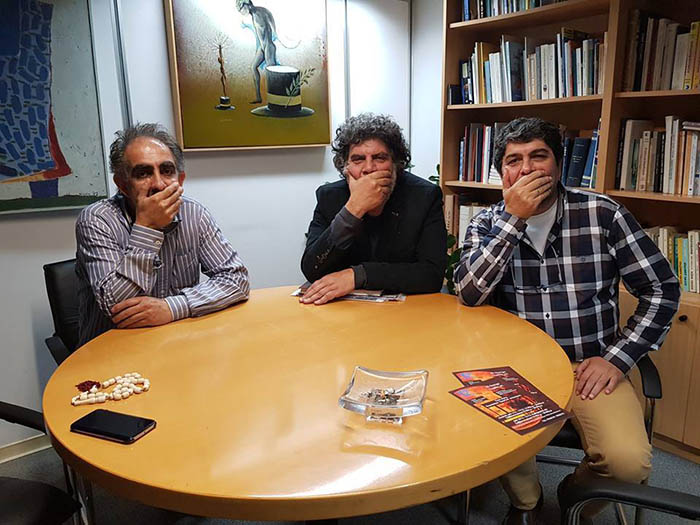
Politis journalists protest their gagging: Sotiris Paroutis, Dionisis Dionisiou and Manolis Kalatzis
In January 2018 a Cypriot court issued an injunction forbidding daily newspaper Politis from publishing emails that were hacked from the personal account of a suspended state attorney, Eleni Loizidou, news website newsit.com.cy reported.
Politis had re-published a number of emails Loizidou had sent from a Gmail account that had been made public by a Russian website. The emails suggested that Loizidou, who was formerly head of extradition requests, may have aided Moscow in the extradition cases of Russian nationals.
Loizidou requested an injunction against the newspaper, preventing it from publishing or using content from the hacked personal account she had used to communicate with the Russian judicial services. The ban is valid until the lawsuit against the newspaper is heard or until another court order is issued.
Loizidou has also filed a lawsuit against Politis seeking between €500,000 and €2 million in damages. The suit claims the newspaper violated her right to privacy and the law on the protection of personal data.
Police officers also demanded that Phileleftheros newspaper remove any articles that reported on the Loizidou case.
The head of Cyprus’ Union of Journalists, George Frangos, defended the newspapers and said: “In no case should the letter of the law be above the spirit of the law which is primarily to serve the common good and public interest.”
In February 2018, the Cypriot press reported that the police have been questioning journalists over the leaked emails. The attorney general, in his statements to the Cyprus News Agency on 4 January 2018, said that: “In a written letter dated 1 December 2017, the Prosecutor’s Office of the Russian Federation requested that a criminal investigation is carried out on the interception of electronic data concerning the Russian Public Prosecutor’s Office.”
Five journalists from the newspaper Politis, two journalists from the newspaper Phileleftheros, two journalists from the newspaper Kathimerini, two journalists from the Sigma TV and a journalist from the newspaper Alithia were summoned to question.
The first journalist who was called in was Manolis Kalatzis from Politis. “The investigators informed me of my rights and announced to me that I am suspicious of criminal offences,” Kalatzis told Mapping Media Freedom adding that he was asked to recognise his articles and reveal his sources.
“It was a clear attempt at gagging the press, as there were the civil lawsuits against journalists claiming compensations of millions of euros. At the same time, Loizidou remains in her post and is being audited only for offences punishable by reprimand,” Kalatzis said.
The Cypriot journalists’ union condemned that the questioning of journalists “constitute a hindrance to the freedom of expression and the media freedom”.
“Now, police are summoning journalists one after the other and question them as suspects of violating the law because in their articles they use one or two words or phrases already made public like ‘Dear Vladimir’ or ‘Really missed you’,” Philelftheros’ editor-in-chief, Aristos Michaelides, wrote in a front-page op-ed accusing the police of abusing their power.
“The authorities must stop harassing journalists and treating them as if they are criminals,” said the IFJ General Secretary Anthony Bellanger. “We stand in solidarity with all those seeking to expose the truth.”
OSCE representative on Freedom of the Media Harlem Désir also expressed concern about the court decision in Cyprus as well as the questioning by the police of several journalists of the daily newspapers Politis and Phileleftheros. “It is essential that journalists be free to report on issues of public importance,” Désir said after sending a letter to Foreign Minister Ioannis Kasoulides, referring to media reports about leaked emails between state attorney Eleni Loizidou and Russian officials. Désir also stressed that journalists should not be questioned by the police about their work.
Moreover, on 19 March, six Cypriot MEPs sent a written question to the European Commission, asking whether the Commission is aware that “journalists are being called in for questioning by the police authorities in Cyprus under suspicion of conspiring to commit an offence” and whether it considers that “there may be problems with freedom of the press and the freedom of expression of journalists in Cyprus”.
On the 3 April, Cyprus’ attorney-general decided not to prosecute journalists for the leaked emails. In an announcement from the Legal Service, it is noted inter alia that the decision was taken because it was concluded that the prosecution of journalists is not in the public interest.
It added that the case raised two kinds of public interest — one was safeguarding personal communications and the other was the public’s right to be informed about issues of public interest.
“Weighing the two…and after taking into account the relevant national and European case law, as well as more general legal principles, the attorney-general judged it would not serve the public interest if he launched a criminal prosecution,” the statement said. [/vc_column_text][/vc_column][/vc_row][vc_row][vc_column][vc_column_text][/vc_column_text][/vc_column][/vc_row][vc_row][vc_column][vc_basic_grid post_type=”post” max_items=”4″ element_width=”6″ grid_id=”vc_gid:1525771631211-2562d882-930f-2″ taxonomies=”6833″][/vc_column][/vc_row]
8 May 2018 | Campaigns -- Featured, Media Freedom, Statements
[vc_row][vc_column][vc_column_text]Index on Censorship is pleased to hear the amendments to the Data Protection Bill are likely not going ahead. One of the amendments, which was not voted on, would have left many newspapers having to pay both sides’ costs in a legal dispute – even if the media outlet won. This amendment had serious consequences for a free press, a cornerstone of democracy[/vc_column_text][vc_column_text]On Wednesday, the UK’s House of Commons will vote on the Data Protection Bill: a bill to regulate the way in which personal information is processed.
It is of course critical that we have robust protections over our personal data. Yet, as is so often the case with new laws, Index on Censorship believes we are in grave danger of ushering in one protection only to eliminate another: in this case, the protections afforded to and by a free press.
This is because members of both the House of Lords and Commons have sought to introduce amendments to this bill that would reintroduce into law restrictions on the press that the current government has rightly said it will not implement, namely forcing any publisher who refuses to sign up to a state-approved regulator to pay the legal costs of any data protection case brought against them, even if they win.
Such a measure would, in effect, invite anyone seeking to prevent exposure in the press – including those cases in which exposure, such as the Windrush scandal or MPs expenses, is in the public interest – to threaten legal action to silence a potential publisher. We urge MPs to reject these amendments.
In earlier proposed amendments, any organisation – including non-profit organisations like Index on Censorship – which refused to sign up to a state-approved regulator would have been liable to pay both sides’ costs. The latest amendments on the question of cost-shifting attempts to close that loophole by exempting small publishers but this just makes a mockery of the entire endeavour: either the rules apply to everyone or no one. The ability to hold power to account and expose the corrupt should not be left to one kind of media organisation.[/vc_column_text][/vc_column][/vc_row][vc_row][vc_column width=”1/4″][vc_icon icon_fontawesome=”fa fa-times” color=”black” background_style=”rounded” size=”xl” align=”right”][/vc_column][vc_column width=”3/4″][vc_column_text]
Index does not believe any media organisation should be forced to sign up to a regulator – especially one that has state approval, no matter how arm’s length.
[/vc_column_text][/vc_column][/vc_row][vc_row][vc_column][vc_column_text]Of course, there should be protections for those wronged by the press: but the threat of financial penalties on potential public interest journalism is not the way to do it. Far better is to encourage low-cost, easily accessible and swift redress for all.
Index does not believe any media organisation should be forced to sign up to a regulator – especially one that has state approval, no matter how arm’s length.
For the past five decades, we have monitored state interference in news reporting, from authoritarian Chile in the 1970s to North Korea today. With a history of scrutinising government pressure on media, we were never going to join Impress (currently the only state-approved regulator).
A free press is fundamental to democracy. Investigative and campaigning journalists have exposed scandals that have helped save lives: such as the work done by Index on Censorship’s patron, Sir Harold Evans, on the Thalidomide scandal while editor of the Sunday Times.
More recently, work by journalist Carole Cadwalladr at The Observer broke the Cambridge Analytica story wide open, while Amelia Gentleman’s reporting at The Guardian has driven the story on Windrush.
Without an environment in which such journalists are encouraged to report – without the fear that they might face costly court cases even for reporting stories that are true – who will hold the corrupt to account?
“It is easy to dismiss such concerns as the hysterical whinging of the mainstream media,” said Index on Censorship chief executive Jodie Ginsberg. “That would be a huge mistake. A genuinely free press – one in which both independent investigative journalist outfits and mainstream media organisations can operate – benefits everyone.”
We crush media freedom at our peril. The democratic gains being eroded in Turkey, Russia, Poland and Hungary and elsewhere have all been accompanied by a loss of press freedom: a freedom that is hard won but easily lost.
A version of this statement was first published on the Independent website.[/vc_column_text][/vc_column][/vc_row][vc_row][vc_column][vc_basic_grid post_type=”post” max_items=”12″ style=”load-more” items_per_page=”4″ element_width=”6″ grid_id=”vc_gid:1526037891828-b7251ca2-5483-4″ taxonomies=”6534″][/vc_column][/vc_row]
8 May 2018 | Europe and Central Asia, News, Serbia
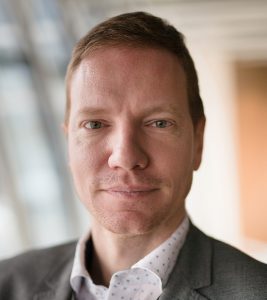
Milan Antonijević (Craig Jackson / Human Rights House Foundation)
As one of Serbia’s most influential activists, Milan Antonijević uses the rule of law as his main line of defence in human rights protection. This is a major accomplishment considering he was a law student attending Belgrade University at the end of Milošević era, a time of censorship. Before Antonijević had completed his degree, the government fired any Serbian professor lecturing on the importance of human rights, gutting the education system of these important ideas.
However, Antonijević had barely reached adulthood in the wake of the atrocities that coincided with the Balkan wars and the fall of Yugoslavia in the 1990s. Witnessing these events at a young age sparked a passion for activism in him, which was only further fuelled by his professors’ expulsion. He completed an informal education with these persistent lecturers, all of whom were human rights pioneers that bravely continued teaching despite losing their academic careers.
Antonijević has served as the director of YUCOM since 2005, joining the organisation in 2001 after formally receiving his MA in International Law, along with his human rights education on the side. Over the course of his career Antonijević has worked with a large number of human rights organisations, contributing to the creation of multiple campaigns and educational initiatives. This includes the Youth Group of the Belgrade Centre for Human Rights, where he advocated for tolerance and reconciliation to the youth of the Balkan region in 2000. He is also currently involved in a coalition project promoting LGBTQ rights in Serbia, Montenegro and Kosovo.
Many of Antonijević’s successes in activism were made during his time leading YUCOM, the Belgrade-based Lawyer’s Committee for Human Rights. Internationally recognised for its efforts in defence, its team of lawyers and experts provide legal assistance to victims of human rights violations before Serbian and international courts. YUCOM grants legal aid to more than 1,500 citizens annually and also represents other human rights organisations in court when needed. The organisation is currently aiding citizens in several cases and represents activist groups such as Woman in Black and Youth Initiative for Human Rights.
YUCOM advocates for the rule of the law and seeks court orders to ensure the proper implementation of Serbian legislation when required. With each case, the organisation works to ensure genuine commitment and implementation of new laws protecting human rights. These cases involve economic and social violations such as unequal access to public resources, hate crime, harassment, hate speech, and denied access to healthcare and education.
Many of Serbia’s citizens and marginalised communities are subject to these violations frequently. In addition to legal assistance, YUCOM also organises civic initiatives and campaigns to further advance their cause of human rights protection and defence. In January of 2018, they launched a project to bolster and improve the level of reporting on the rule of law in several Balkan nations.
Antonijević is also a founder and board member of Human Rights House Belgrade, which interacts with an international network to promote and defend human rights in Serbia. YUCOM is one of the five member organisations that contributes to the efforts of Human Rights House Belgrade, the other four being Belgrade Centre for Human Rights, Civic Initiatives, Helsinki Committee, and Policy Centre.
Despite a regime that tried to hinder the formation of activist minds like Antonijević’s, he’s persisted with dedication to his cause, proving that censorship cannot stop a new generation from fighting for the rights of their fellow citizens.
Milan Antonijević spoke with Index on Censorship’s Samantha Chambers about the state of human rights in Serbia and his organisation’s work. Below is an edited version of their interview:
Index: What would you say are the most pressing human rights issues affecting Serbia’s democracy today?
Antonijević: To start, we can look at the rule of law and the possibility of our legal system to provide solutions for human rights violations. First, we spot deficiencies in implementation of existing law in the protection of human rights. So from the point of view of legislation and constitution, we do not have as many deficiencies, but there are still things that should be polished and there are improvements that can be made on the legal side. We’re identifying it in areas of discrimination, hate speech, hate crime, and in freedom of expression. I cannot say that there is any true implementation that we can be proud of. There is improvement, but the whole system of protection and implementation of the laws should be listed in order to really answer the needs of citizens for their rights to be fully protected.
Index: Just to verify, its solely the issue of the implementation laws and not the laws themselves causing human rights issues at the moment?
Antonijević: Yes, only the implementation of the laws, the laws themselves are agreed on by experts and the senate commission and so on, so full standards are there.
Index: Which human rights issues do you find yourself needed to defend the most often? What marginalised communities are facing the biggest threats?
Antonijević: YUCOM usually has around 2,000 cases per year defending rights through representation before the court, so this is our day to day work. Within those, generally we can say that economic and social rights are the biggest challenge for Serbia. But when speaking about marginalised groups and underrepresented minorities, the Roma are subject to multiple forms of discrimination, and there’s a breach on their rights in every level. So, of economic and social rights, specifically in healthcare, education and non-equal opportunities. In the Roma situation, there is no accurate response from the country’s social workers. Things are moving, we used to have a large population of Roma who were not registered, who didn’t have identification, who didn’t have any access to health care or welfare. Now things are solid on the level of the law, and they are solid on the level of implementation. If they do not have an address or live in an informal supplement, there are mechanisms in order to bring them into the system so that the system recognises them and gives them support.
Another minority group, the LGBT community also experiences harassment through hate speech and hate crimes without any adequate response from the state or from the judiciary. In Serbia we recently had a prime minister who was openly a member of this community. However, it hasn’t lowered the number of incidents for hate speech in front of the media or parliament.
Index: Why did you decide to work for and become the director of an NGO (YUCOM) defending human rights? Why is your work so important in the nation’s current state?
Antonijević: My passion for human rights began as a very young student. Some of my professors at Belgrade law school, who were deeply involved in human rights protection were expelled from the law school, by the regime under President Milošević. A new law that was adopted in 1996 on education, and later on in 1999, completely cleared the professors who were dealing with human rights from the law school. I just continued working with them through informal lessons and lectures. From that, I became devoted to human rights. In addition, some of the injustice that I witnessed from the armies in 1994 and 1995. In 1994 and 95 as a young kid of 18 or 19 years, I witnessed some of the mistreatment, and international justice became important to me.
Index: Do you find that academic censorship is still a very pressing issue in Serbia today?
Antonijević: Academically, the moves of Milosevic had a big negative influence, and the law school never recovered from that.Those professors didn’t come back to university to raise new generations, so now the education from the law school is leaning towards disrespect of human rights. I’m sorry to say that now, very rare are the professors who share the ideas of human rights in this law school.
Index: How did continue to learn from these professors after they were expelled?
Antonijević: Those were some of the people who were initially starting the human rights organisations at that time. They met with special groups of students because many of us worked in the same organisations, so we were able to meet and continue our education. You had to do continue with both had the formal education where you could get your degree and your diploma and you’d stay with the informal classes, with professors who were expelled. They were really the pioneers of human rights in 70s, 80s, 90s and are still the names that you quote today.
Index: Do the Balkan wars have an impact on human rights work in Serbia?
Antonijević: Yes.The Balkan wars led to gross human rights violations and displacement of populations on all sides, so neither side is innocent in that sense. Serbs were forced to leave Croatia and parts of Bosnia, Kosovo and the same can be said for all nations that used to live in ex-Yugoslavia. Only the civil society is speaking on the victims of other nations, while politicians are stuck in the rhetoric of proving that the nation that they come from is the biggest victim, quite far from the restoration of justice and future peace. When you have mass murders, mass graves, and disappeared persons, speaking out about human rights becomes a harder task. Frustrations are high on all sides, with reason.
Index: Has media freedom declined under Aleksandar Vučić?
Antonijević: Funding has a negative influence on the media, because subsidies are only given to media if they are pro-government, not to others. Sometimes there are higher taxes for media that is independent and there’s a disregard for journalists posing questions from these organisations. There are also trends that are visible often in other European countries, with officials and others using social media and fake news, there is an atmosphere that you can easily create in a country with that kind of attitude. People are not questioning the information that they’re getting, and its really leaving a lot of space for malinformation, leaving many misinformed.
Index: What do you find is YUCOM’s biggest struggle working under a sometimes oppressive regime? What have been the biggest systematic barriers in accomplishing the goals of the organisation?
Antonijević: I wouldn’t call it oppressive. We’re in this strange situation where you’re sitting at the table discussing legislation with the democratic officials of your country, but — at the same time — not seeing the change of policy on every level. We’ve managed to influence the induction of the laws, and we’re still working on the changes with the government so it’s not a typical regime where you cannot say one word against the government. They have proven that they are able to allow separation of powers and debate in our society. We’re just now talking about the quality of the democracy, not the existence or non-existence of the democracy. The country is really leaning towards the EU and all the EU values are repeated from time to time by our officials. It’s not something that can be compared with Russia. It’s really a bit different, however, we need more commitment to the laws. Examples we see are going in the wrong direction, on an implementation level. We have sets of laws that are not being fully implemented, including the labor laws, the anti-discrimination laws, hate speech and hate crime laws, laws on environmental protection, etc. A few years ago YUCOM organised a panel with the minister of labour at that time, who is still in the government, and we discussed the new labour laws. The minister stated openly that there is no “political will” to implement the law. But we must note that the political will has to come from the government, parliament, judges and prosecutors. Only they can generate it. The public can demand it, but we as a civil society can only demand this implementation.
Index: How have the human rights violations occurring in Serbia affected you personally?
Antonijević: There is a constant side against us by different non-paid sectors. Some of the media that are not quite pro-government are reading that we work with the officials. Sometimes we receive threats but they are not coming from the state. Receiving threats is something that happens in this area of work, especially in issues on war crimes and cases that are more sensitive.
Index: Why is it important for Yucom to be part of a larger organisation like Human Rights House Belgrade? What has the support of the larger organisation done for Yucom?
Antonijević: I’m the director of YUCOM, but we also founded the Human Rights House Belgrade. It’s a new possibility, a new space to have one place dedicated to human rights and the promotion of human rights. The Human Rights House concept has helped YUCOM gain visibility and connect us to activism on an international level with other Human Rights Houses across Europe. There are 19 other houses and we all have one unanimous voice and find support from one another.
1 May 2018 | Europe and Central Asia, Mapping Media Freedom, News, Russia, Ukraine
[vc_row][vc_column][vc_single_image image=”100124″ img_size=”full”][vc_column_text]Flying from Moscow to Simferopol is quick and relatively affordable if you’re travelling out of season, but according to Ukrainian law it’s also illegal. After the 2014 Russian annexation of the peninsula, Ukraine passed a law that prohibits travelling to Crimea via Russia. Violating it can lead to a fine and a ban on entering Ukraine.
Journalists who travel to Crimea via Ukraine need the necessary documentation to work in a territory that is de facto controlled by Russia. In addition to a Russian accreditation and work visas — obtained at the end of a long and demanding process that can prove particularly difficult for freelancers — journalists also need to make their way to Kyiv and present a series of documents to Ukraine’s ministry of information and immigration service, to obtain a permit to enter Crimea, which takes a minimum of one or two days. Then they can head south and make their way to what has become the border with Crimea, 668 kilometres away. Once on the peninsula, they are usually interviewed by FSB officers.
Anton Naumliuk, a Russian journalist who covers Crimea for Radio Liberty, has been travelling to the peninsula about six times a year recently, always via Ukraine. He says he’s noticed that the procedure on the Ukrainian side is becoming simpler and faster. He’s also seen the border gradually built up. “Two years ago there was nothing, just the ground,” he said. Now there’s portacabins and fences. In the summer, there can be long queues.
Journalists often encounter difficulties on the Russian side, he explained. “[FSB officers] ask you who you’ll meet. This interrogation can take hours. If the journalist is quite well-known they try not to do it. If you’re young, if you’re Ukrainian, or carry equipment, you’re more likely to be interrogated. It can be quite nerve-wracking.”
Journalists can be asked to display the content of their phones or computers, although, according to Russian law, they cannot be forced to provide passwords to law enforcement. Officers can search hard drives or flashcards. This means journalists are advised to wipe any sensitive information which could compromise their sources before crossing the border. FSB agents have also been known to ask journalists for their phones’ IMEI number, which could allow them to track the person’s movements when they are reporting in the peninsula.
On my way back from a recent reporting trip to Crimea I met Tetiana Pechonchyk, who monitors human rights violations in Crimea at the Human Rights Information Centre in Kyiv. Her organisation has been campaigning for an easier access for journalists to the peninsula, in a context where coverage by Ukrainian journalists has gradually become near to impossible. “Almost no Ukrainian journalist is able to work in Crimea. A lot of Ukrainian journalists who covered the occupation and persecutions connected to it left Crimea. Ten Crimean media outlets moved to mainland Ukraine with their staff. They continue to cover Crimea but a majority of the websites are blocked on the peninsula, while not being blocked in Russia,” she said.
According to the Human Rights Information Centre’s monitoring, the number of assaults against journalists in Crimea has gone down, but for Pechonchyk, this does not mean much: “They pushed most of independent journalists out. Once you’ve emptied the field then you have no one to repress. They were lots of physical attacks in 2014. In 2015 Russia used legal tools against media outlets. They wouldn’t give a Russian license to outlets. Then they picked journalists who work for the Ukrainian media and terrified them one by one. Small media and bloggers have started appearing in Crimea. The role of professional journalists has been taken over by average citizens who film videos of searches in Tatar houses, go to politically motivated trials to cover them. Now authorities have started persecuting citizen journalists as well.”
Naumliuk began reporting from Crimea because he saw what was taking place there as a continuation of the war in Donbass. “It’s a lot more important than it seems at first glance and offers some understanding into what happened after the breakup of the Soviet Union and what will happen to such a big territory, in places like Belarus and Kazakhstan,” he said. He mostly covers court cases, with a focus on persecutions against Tatars. He says very few foreign outlets work with him regularly, they’ll only ask for his help if something happens.
“[Without constant coverage] it’s super difficult to understand the situation. There’s no human rights organisations working on the ground and very few independent journalists. Very little information on repression against political prisoners goes out. For this reason, it seems nothing is happening in Crimea. It’s all very quiet. But if you speak with Tatars the picture changes. A majority of kids live without their father because of what has been happening,”Naumliuk said.
“I think that not enough journalists go, and that’s there’s not enough stories coming from Crimea, because of the travel,” Ola Cichowlas, who recently travelled via Ukraine to spend two days reporting in Crimea for the Agence France Presse, said in an interview.
“Meanwhile, the world has gotten tired of the story,” Pechonchyk said. Foreign journalists often come for the anniversary of the annexation, do a quick story and then leave.
According to the State Migration Service of Ukraine, 106 foreign journalists have travelled to Crimea via Ukraine between 2015 and March 2018.
In this context, the Human Rights Information Centre and other organisations have tried to push for a facilitated access for foreign journalists who travel to Crimea, but also for aid workers and lawyers for whom it can take much longer to obtain a permit. “The first issue in terms of access is security,” says Pechonchyk. “For a foreign journalist it’s safer to come to Crimea via the Russian Federation than enter via mainland Ukraine. You’re almost always interrogated by the FSB when you go via Ukraine, with a higher risk of being put under surveillance. If you fly to Crimea from Moscow you violate Ukrainian law but it’s safer.”
Pechonchyk believes the process enabling foreign journalists to travel to Crimea should be made simpler: “It shouldn’t be a permission, but a notification. People should be allowed to do it from abroad, via a consulate or an embassy through an online form, and they should be able to apply in English – it’s all in Ukrainian at the moment. This should be a multi-entry permit and the number of categories able to get it should be extended.” At the moment, the list only includes journalists, human rights defenders, people working for international organisations, travelling for religious purposes, to visit relatives or people who have relatives buried in Crimea. Researchers and filmmakers, for instance, are not included and struggle to go to Crimea legally.
Pechonchyk also believes there should be exceptional cases – emergencies – where journalists and lawyers are allowed to travel from Russia, to attend a trial, or report on an arrest, for instance. The existing legislation offers little clarity and seems to be mostly applied when Ukraine wants to punish individuals who supported the annexation, as happened in 2017 when they banned a Russian singer who was to take part in the Eurovision and had performed in Crimea.
But there seems to be little room for a debate on this in Ukrainian society at the moment. Difficulties of access also apply to journalists who visit the self-proclaimed separatist republics of Donetsk or Luhansk, who need a series of accreditations from the Ukrainian and the separatist side, are not supposed to enter the separatist republics from Russia, and can face backlash once they have travelled to the republic. This is what happened when in May 2016, personal information of journalists having visited DNR and LNR was leaked to Myrotvorets, a Ukrainian website known to be supported by Ukrainian police and secret services. The leak included journalists from more than 30 media outlets, who had been merely covering the war on the rebel side but were depicted by nationalists as “collaborating with terrorists”. No one was prosecuted for the leak.
Johann Bihr, who covers Eastern Europe for Reporters Without Borders, told Index: “It’s important that foreign journalists keep heading to Crimea and going back there. And we encourage Russia and Ukraine to facilitate access for journalists. If they fail to do so we face some kind of double penalty, where Crimea is abandoned by the international community because it has not been recognised and turns into an information black hole.”[/vc_column_text][/vc_column][/vc_row][vc_row][vc_column][vc_basic_grid post_type=”post” max_items=”12″ style=”load-more” items_per_page=”4″ element_width=”6″ grid_id=”vc_gid:1525192972009-6f6057be-6973-0″ taxonomies=”6564″][/vc_column][/vc_row]
