14 Dec 2017 | Mapping Media Freedom, Media Freedom, media freedom featured, News
[vc_row][vc_column][vc_single_image image=”81191″ img_size=”full” alignment=”center”][vc_column_text]Are you a working journalist? Do you want to see better protections and freedoms for reporters?
This survey aims to take a snapshot of how financial pressures are affecting news reporting. The openMedia project will use this information to analyse how money shapes what gets reported – and what doesn’t – and to advocate for better protections and freedoms for journalists who have important stories to tell.
Your responses will be anonymous, and this survey has been designed so that the openMedia project team – openDemocracy and its project partners Index on Censorship, King’s College London, the European Federation of Journalists — cannot have access to your IP address or geolocation. The information you provide will be stored on encrypted servers and is the property of openDemocracy. The project will treat any documents you may attach in strict confidence, unless otherwise stated.
It would be very helpful to the research if the project team could contact or quote you; if you are comfortable with this, please include your contact details. If you would rather communicate anonymously you can do so by emailing [email protected], PGP fingerprint: 665E EBD6 3CF6 D734 CE4D 5497 39A4 7083 6EC8 8D30. There is no obligation to provide any contact information.
You can choose to take the survey with your current work in mind, a former role, or a combination of different roles over the past five years. Your opinion is just as important to the survey whether you are a freelancer or hold a staff position.
Please don’t take this survey more than one time.
Your contribution is greatly appreciated
[/vc_column_text][vc_separator][vc_row_inner][vc_column_inner width=”1/4″][vc_icon icon_fontawesome=”fa fa-pencil-square-o” color=”black” background_style=”rounded” size=”xl” align=”right”][/vc_column_inner][vc_column_inner width=”3/4″][vc_column_text]
The survey is available in:
[/vc_column_text][/vc_column_inner][/vc_row_inner][vc_separator][/vc_column][/vc_row][vc_row][vc_column][vc_custom_heading text=”More about the openMedia project” use_theme_fonts=”yes”][vc_row_inner][vc_column_inner width=”1/2″][vc_single_image image=”96949″ img_size=”full” alignment=”center” onclick=”custom_link” link=”https://www.opendemocracy.net/openmedia/mary-fitzgerald/welcome-to-openmedia”][/vc_column_inner][vc_column_inner width=”1/2″][vc_column_text]
Forget fake news. Money can distort media far more disturbingly – through advertorials, and through buying silence. Here’s what we’re going to do about it.
This article is also available in Dutch | French | German | Hungarian | Italian | Serbian | Spanish | Russian[/vc_column_text][/vc_column_inner][/vc_row_inner][/vc_column][/vc_row]
14 Dec 2017 | Mapping Media Freedom, Media Freedom, News
[vc_row][vc_column][vc_column_text]Veteran Belgian journalist and author of Terrorism and the Media, Jean-Paul Marthoz delivered the following remarks on 5 December 2017 at a round-table debate in the European Parliament hosted by MEPs Barbara Spinelli and Curzio Maltes:
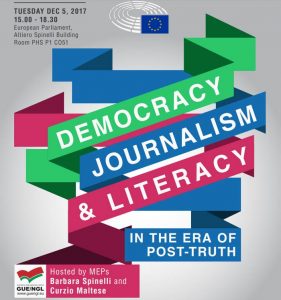
Democracy, journalism and literacy in the era of post-truth
Everything has been said on fake news. Since the word ‘post-truth’ was chosen as the word of the year in 2016 by the Oxford dictionary there is not one day without an evocation of the ‘new kingdom of lies’.
Fake news however, as it is currently understood, is not any kind of lie. It is a deliberately mendacious or misleading information, specifically designed to have a disrupting impact (on society, geopolitics, etc.) and to become viral in the media and on social networks.
The word has taken on an eminently political connotation with Donald Trump’s 2016 campaign. The unexpected candidate of the Republican Party turned it into a brand, not only by filling his speeches and tweets with approximative or even false facts but also by accusing quality media of being the ones producing fake news.
The word has taken on a strategic dimension with accusations of Russia’s intervention in the US electoral campaign. In the current remodeling of the world, fake news is part of strategies of influence and belongs to the arsenal of asymmetrical warfare.
Migration has been none of the privileged targets of these rogue concepts of information. During his campaign Donald Trump lambasted Mexican ‘bad hombres’. The Brexit campaign was polluted from end to end by made-up stories on Syrian refugees and Polish plumbers.
Migrations have always lead to fabrications and exaggerations. Before the word fake news even appeared, many media, UK tabloids in particular, exploited the vein, with extravagant headlines on migrants. It was a banal case of media sensationalism. Today however the theme of migrations is used strategically in order to sow confusion within European countries and to support populist movements who, nearly everywhere in Europe, question the foundations and values inscribed in EU treaties. It is one of the most efficient levers of populism and far right extremism.
Such strategy benefits from an exceptional soundboard in social networks. These are not only used by millions of citizens who intervene, sometimes wisely, sometimes through their hat, in information flows and public debates, but also by organized, and at times even robotised, groups who pursue a deliberate policy of occupation and agitation on the social networks.
Some have made disinformation a business, like these Macedonian kids who had their moment of fun when they informed about the Pope’s endorsement of Donald Trump, leading to millions of clicks and thousands of dollars of ad money. But this is an epiphenomenon, an anecdote, when compared with the political strategies that have been put in place.
Fake news is a direct attack against the democratic ethos. It aims at polluting the agora, leading, in Matthew D’Ancona’s words in his book Post Truth (Ebury Press, 2017, p. 2) to ‘the infectious spread of pernicious relativism disguised as legitimate skepticism’.
The labelling of prestigious media as ‘fake news’ outlets by those who are the major emitters of fake news is part of a determined attack against the system of checks and balances which define and protect liberal democracy. The purpose is to delegitimize the ‘elites’, the ‘Establishment’. It is to weaken counter-powers and in particular legacy media which in the US case constitute one of the brakes on the impulsive matamorism of Donald Trump. In Germany too, attacks against the « lying press », a reminiscence from the Nazi years, or in France, the denigration of ‘merdia’ and ‘presstitute’ have a strategic aim: to discredit those who decode and denounce the lies of surging populist leaders and movements.
Fake news is also a revealer of our societies and their drifts. It is part of a digital universe which is at the same time fascinating and destabilizing. Words like phishing, spoofing, hacking, filter bubbles, testify to the anxiety which corrodes a digitalized world that cannot just be candidly described as liberating and empowering.
Fake news also reveals the state of opinion. It measures its knowledge and critical sense, or the lack of it. Post truth, writes the Oxford Dictionary, means that ‘objective facts are less influential in shaping public opinion than appeals to emotion and personal belief’. One of the problems lies in the fact that part of public opinion does not seem to care about lies from personalities that it supports. Fact-ckecking bumps into a wall of mistrust and dogmas which the unquestionable presentation of verified facts cannot shake.
Much more fundamentally, as EU Commissioner Mariya Gabriel in charge of digital economy and society, said in an interview with Le Soir, ‘disinformation is also a political and a societal problem. Our societies’ vulnerabilities open the doors to disinformation. I am referring to unequalities, social fractures, mistrust in society and the rejection of elites’.
How can we explain the resurgence, especially among the young, of conspirationism, of an attraction for suspicious explanation of events? This phenomenon is the barometer of a loss of trust in institutions and not only in the education system and the media. It should lead to reflecting on the profound reasons of such disorientation and disarray. ‘Is not fake news a symptom rather than a cause of our crumbling democracies?’, asked François-Bernard Huyghe, founder of the Observatoire géostratégique de l’information en ligne (Paris).
Fake news also exposes the vulnerabilities and failings of our media system. In fact it should seriously alert us about significant developments in a sector which is crucial to democracy. The malaise which has gripped legacy media, deprived of a business model, the migration of a great part of the audience, the youth in particular, towards platforms like Facebook, threaten a media system which remains a crucial element in the democratic accountability process.
The focus on fake news, to the extent that it is described as information disseminated by adversaires or enemies, entails another risk: intolerance towards sources of information or opinions which we don’t like or find inconvenient.
RT and Sputnik news, for instance, are undoubtedly state media, of an authoritarian state, Russia, which has suffocated freedom of expression internally. They are undoubtedly tools of Russia’s strategy of influence with regard to the West. But should they be targeted by special measures aimed at excluding them from the democratic agora? Let us remember that authoritarian states, like terrorist or far right organizations, endeavor systematically to demonstrate that liberal democracy is a sham, a thin veneer covering a system of domination and exploitation. Banning them would be entering into a trap. The risk of witch hunts is never far away.
The rigorous assessment of the reach of fake news is a precondition to any reasoned and efficient response. Studies disagree on the place and the real impact of fake news. Their mode of production, their strategies of dissemination and the way they are received should be thoroughly and serenely studied.
The appeal to the responsibilisation of digital platforms appears evident. Some governments have put pressure on Facebook, Twitter, YouTube, Google and others to push them to police what remains their private domain and to excise the most extreme forms of disinformation. But there is a limit and a danger: converting these platforms in private censors, beyond the norms and guarantees of the rule of law. In September 2017, for instance, the World Socialist Website, a trotskyist media, estimated to have lost 70% of its search engine-led traffic because of a change introduced in April by Google.
Such risks imply a need to seriously question the hegemony of these platforms, which is, as much as or even more than fake news, a threat for democracy.
Fact-checking has become a household word in journalism. It is surprising that it is sometimes presented a specialized form of journalism where it should be a banal, obvious, element of all forms of journalism. It is undoubtedly more necessary today because of the bulk and the speed of information but if the purpose is to convince the gullible, it might not be efficient since it is being practiced mostly by these ‘stenographers of power’ who are accused by populists of ‘hiding the truth’.
Media literacy is again without doubt a crucial element. Most of the public does not master the media codes. It does not acknowledge the silos of certainties in which it encloses itself. Such media education, however, must cover all the media, even the video games, and should start very soon, with young children. And it must be part of a more comprehensive approach to education as such, of a permanent learning system and process which in all its expressions develops critical thinking, judgment and openness to diverse opinions. To scotch media literacy programs on failing or dogmatic schools will be vain.
Support to public interest media seems likewise essential. Now, in many European countries, public service broadcasting is on the defensive, when it does adopt itself populist practices which contradict their proclaimed values. However when they are well-conceived and protective of freedom, independence and pluralism, such support to media (public or private) « in the public interest » can really promote experiences and initiatives which go against the trends of disinformation and trivialization. Such measures should not benefit only legacy media but also to the web where the most decisive battles for the formation for public opinion are being fought.
Finally the fear of fake news should not become obsessive. It should not sub-estimate the capacity of citizens to identify falseness nor the capacity of journalism to renew itself, as has been demonstrated by the ICIJ (International consortium of investigative journalism) with its groundbreaking forms of collaborative transnational journalism projects.
It should not ‘relativise’ either the imperative for democracies not to over-react and the urgency to stay faithful to their most essential principles.
It has become banal to quote Benjamin Franklin’s famous (and contested) phrase: ‘those who would give up essential liberty, to purchase a little temporary safety, deserve neither liberty nor safety’. It has become banal to quote it because the temptation to give in to censorship or control is increasingly present.[/vc_column_text][/vc_column][/vc_row][vc_row][vc_column][vc_basic_grid post_type=”post” max_items=”12″ style=”load-more” items_per_page=”4″ element_width=”6″ grid_id=”vc_gid:1513269834820-b5b02dbd-a0e2-0″ taxonomies=”8996″][/vc_column][/vc_row]
5 Dec 2017 | Europe and Central Asia, Mapping Media Freedom, Media Freedom, media freedom featured, Montenegro, News
[vc_row][vc_column][vc_single_image image=”96761″ img_size=”full” alignment=”center”][vc_column_text]This article was originally published by Osservatorio Balcani e Caucaso.
Read in Italian.
Jovo Martinović is a freelance investigative journalist in Montenegro, who has worked for a number of international outlets — National Public Radio, BBC, VICE, CBS, Canal Plus, The Economist, TIME, Global Post, BIRN — and is known for his reports on organised crime in Europe and war criminals in the Balkans. His investigations brought him in close contact with persons involved in drug-trafficking as well as members of the Pink Panthers, an international network of jewellery thieves.
In October 2015, he was arrested after being charged with drug trafficking and participation in a criminal organisation. The prosecution by the Montenegrin state – as well as the long, unjustified pre-trial detention – was highly criticised by international media freedom and human rights organisations. Martinović proclaimed his innocence and – as a well-known, respected investigative journalist – could convincingly state that the contacts were part of his investigation.
Martinović was released at the beginning of 2017 after 14 months in prison, but is still on trial, facing up to ten years in prison. Francesco Martino, a correspondent for Osservatorio Balcani e Caucaso, met him in Pristina, during a conference organised by Le Courrier des Balkans.
Do you see your case as unique, or as part of a general strategy to undermine freedom of the press in Montenegro?
In Montenegro, in these last years, several cases were registered of physical attacks against journalists, and in 2013 the premises of the leading independent newspaper Vijesti were bombed. So, yes, the media and journalists have been under pressure in Montenegro. My personal case was somehow different, probably because I have always worked for the Western media. The approach taken against me was definitely unique: no other journalist in Montenegro has spent fourteen and a half months in prison. Cases like mine have been registered in countries like Russia, Turkey, and Venezuela, where last year investigative journalist Braulio Jatar was accused of money laundering and imprisoned after appearing as an opponent of Venezuelan president Nicolás Maduro.
In the past, were you ever “warned” to stop your investigations by representatives of the political power?
I was warned – to put it that way – several times in the past, when I worked in some investigations that were not particularly well-received, to say so. Sometimes, I was even suspected for reports which appeared in the foreign media that I had nothing to do with.
How were you treated during your long imprisonment?
I was treated fairly during my stay in prison. While filming a documentary film on the main defendant in my case, Dusko Martinović, I had been several times in prison to interview him, so they already knew me there. I enjoyed a fair treatment, and I didn’t receive any pressure from the prison staff while being detained.
How do you explain your incarceration? Which are the reasons for such a long time behind bars?
When I was arrested, I was working on a documentary film for the French channel Canal Plus about smuggling of weapons from the Balkans – Albania and Bosnia and Herzegovina in particular – into France, weapons that eventually ended up in the hands of terrorist groups. Back then, I was working on the Bosnian case and filming in Serbia, so our investigation wasn’t linked to Montenegro at all. I find it difficult to link it with my incarceration unless we’re speaking of pure communist paranoia on the part of someone in power. I rather believe that they used the documentary as an opportunity for pay-back for my non-compliance and “insubordination” in earlier cases.
You have always worked for international media rather than for local ones. Do you think this puts you in a more delicate position?
Yes, sure. Balkan governments are much more scared and worried about what big international media report about them than the local ones. So, working for international media puts you under a stronger pressure, because if governments or the security structures aren’t happy about the way a certain matter has been reported, the easiest way to retaliate is to put the blame on the local stringer.
What was the reaction of journalist’s organisations and the Montenegrin media to your arrest? Did you receive tangible solidarity?
Initially, local media picked the news from international organisations that wrote to the Montenegrin government on my behalf. In the beginning, the reaction was quite humble, maybe because I wasn’t really perceived as part of the Montenegro media community since, as I already stressed, I never worked for the local media. But when my incarceration was prolonged, Montenegrin independent media started to focus on my case and were very supportive. On the other hand, though, the state-controlled media basically ignored my story.
Do you think journalists and media in Montenegro are eager to support each other in defending freedom of speech in the country?
Montenegro is a small country with a small media market, so petty rivalries among journalists are quite common. Nevertheless, when it comes to serious matters like protecting media freedom, I think solidarity and mutual support prevail.
Is there any real room for investigative journalism in Montenegro? Are there concrete opportunities to denounce corruption, links between political power and organised crime, and effective channels to reach the public?
Sure, freedom of expression does exist and in these past years, some local media have done an extremely good job. There have been several good stories, scoops, which haven’t produced any big change in society yet. Of course, as in many other countries in transition, opportunities for good journalism in Montenegro are accompanied by risks and challenges. What’s worse, though, is that good investigations usually have no impact, even if they’re substantiated by facts and documents. In the Balkans, and particularly in such a small country as Montenegro, you don’t have the same public response to news criticising the government as in Western Europe. I think this is partly explained by a weaker democratic tradition.
Montenegro is currently an EU candidate state: do you think the European monitoring linked with accession negotiations is helping to improve media freedom in the country?
It’s difficult to give a clear-cut answer, but I believe the EU is generally playing a positive role. Endorsing a Western system of values in the framework of the EU accession process is relatively easy, while it’s way more challenging to actually implement those values, transforming Balkan countries into viable realms of rule-of-law.
This publication has been produced within the project European Centre for Press and Media Freedom, co-funded by the European Commission. The contents of this publication are the sole responsibility of Osservatorio Balcani e Caucaso and its partners and can in no way be taken to reflect the views of the European Union. The project’s page[/vc_column_text][/vc_column][/vc_row][vc_row][vc_column][vc_basic_grid post_type=”post” max_items=”12″ style=”load-more” items_per_page=”4″ element_width=”6″ grid_id=”vc_gid:1512410060523-0e52f5ac-262f-7″ taxonomies=”9043, 4612″][/vc_column][/vc_row]
4 Dec 2017 | About Index, History, Magazine, News
[vc_row][vc_column][vc_custom_heading text=”The first editor of Index on Censorship magazine reflects on the driving forces behind its founding in 1972″ google_fonts=”font_family:Libre%20Baskerville%3Aregular%2Citalic%2C700|font_style:400%20italic%3A400%3Aitalic”][vc_column_text][/vc_column_text][vc_row_inner][vc_column_inner][vc_column_text]A version of this article first appeared in Index on Censorship magazine in December 1981. [/vc_column_text][/vc_column_inner][/vc_row_inner][/vc_column][/vc_row][vc_row][vc_column][vc_column_text]
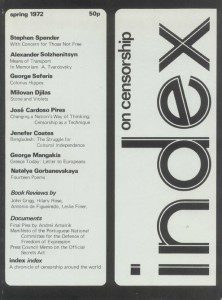
The first issue of Index on Censorship Magazine, 1972
Starting a magazine is as haphazard and uncertain a business as starting a book-who knows what combination of external events and subjective ideas has triggered the mind to move in a particular direction? And who knows, when starting, whether the thing will work or not and what relation the finished object will bear to one’s initial concept? That, at least, was my experience with Index, which seemed almost to invent itself at the time and was certainly not ‘planned’ in any rational way. Yet looking back, it is easy enough to trace the various influences that brought it into existence.
It all began in January 1968 when Pavel Litvinov, grandson of the former Soviet Foreign Minister, Maxim Litvinov, and his Englis wife, Ivy, and Larisa Bogoraz, the former wife of the writer, Yuli Daniel, addressed an appeal to world public opinion to condemn the rigged trial of two young writers and their typists on charges of ‘anti-Soviet agitation and propaganda’ (one of the writers, Alexander Ginzburg, was released from the camps in 1979 and now lives in Paris: the other, Yuri Galanskov, died in a camp in 1972). The appeal was published in The Times on 13 January 1968 and evoked an answering telegram of support and sympathy from sixteen English and American luminaries, including W H Auden, A J Ayer, Maurice Bowra, Julian Huxley, Mary McCarthy, Bertrand Russell and Igor Stravinsky.
The telegram had been organised and dispatched by Stephen Spender and was answered, after taking eight months to reach its addressees, by a further letter from Litvinov, who said in part: ‘You write that you are ready to help us “by any method open to you”. We immediately accepted this not as a purely rhetorical phrase, but as a genuine wish to help….’ And went on to indicate the kind oh help he had in mind:
My friends and I think it would be very important to create an international committee or council that would make it its purpose to support the democratic movement in the USSR. This committee could be composed of universally respected progressive writers, scholars, artists and public personalities from England, the United States, France, Germany and other western countries, and also from Latin America, Asia, Africa and, in the future, even from Eastern Europe…. Of course, this committee should not have an anti-communist or anti-Soviet character. It would even be good if it contained people persecuted in their own countries for pro-communist or independent views…. The point is not that this or that ideology is not correct, but that it must not use force to demonstrate its correctness.
Stephen Spender took up this idea first with Stuart Hampshire (the Oxford philosopher), a co-signatory of the telegram, and with David Astor (then editor of the Observer), who joined them in setting up a committee along the lines suggested by Litvinov (among its other members were Louis Blom-Cooper, Edward Crankshaw, Lord Gardiner, Elizabeth Longford and Sir Roland Penrose, and its patrons included Dame Peggy Ashcroft, Sir Peter Medawar, Henry Moore, Iris Murdoch, Sir Michael Tippett and Angus Wilson). It was not, admittedly, as international as Litvinov had suggested, but it was thought more practical to begin locally, so to speak, and to see whether or not there was something in it before expanding further. Nevertheless, the chosen name for the new organisation, Writers and Scholars International, was an earnest of its intentions, while its deliberate echo of Amnesty International (then relatively modest in size) indicated a feeling that not only literature but also human rights would be at issue.
By now it was 1971 and in the spring of that year the committee advertised for a director, held a series of interviews and offered me the job. There was no programme, other than Litvinov’s letter, there were no premises or staff, and there was very little money, but there were high hopes and enthusiasm.
It was at this point that some of the subjective factors I mentioned earlier began to come into play. Litvinov’s letter had indicated two possible forms of action. One was the launching of protests to ‘support and defend’ people who were being persecuted for their civic and literary activities in the USSR. The other was to ‘provide information to world public opinion’ about this state of affairs and to operate with ‘some sort of publishing house’. The temptation was to go for the first, particularly since Amnesty was setting such a powerful example, but precisely because Amnesty (and the International PEN Club) were doing such a good job already, I felt that the second option would be the more original and interesting to try. Furthermore, I knew that two of our most active members, Stephen Spender and Stuart Hampshire, on the rebound from Encounter after disclosures of CIA funding, had attempted unsuccessfully to start a new magazine, and I felt that they would support something in the publishing line. And finally, my own interests lay mainly in that direction. My experience had been in teaching, writing, translating and broadcasting. Psychologically I was too much of a shrinking violet to enjoy kicking up a fuss in public. I preferred argument and debate to categorical statements and protest, the printed page to the soapbox; I needed to know much more about censorship and human rights before having strong views of my own.
At that stage I was thinking in terms of trying to start some sort of alternative or ‘underground’ (as the term was misleadingly used) newspaper – Oz and the International Times were setting the pace were setting the pace in those days, with Time Out just in its infancy. But a series of happy accidents began to put other sorts of material into my hands. I had been working recently on Solzhenitzin and suddenly acquired a tape-recording with some unpublished poems in prose on it. On a visit to Yugoslavia, I called on Milovan Djilas and was unexpectedly offered some of his short stories. A Portuguese writer living in London, Jose Cardoso Pires, had just written a first-rate essay on censorship that fell into my hands. My friend, Daniel Weissbort, editor of Modern Poetry in Translation, was working on some fine lyrical poems by the Soviet poet, Natalya Gorbanevskaya, then in a mental hospital. And above all I stumbled across the magnificent ‘Letter to Europeans’ by the Greek law professor, George Mangakis, written in one of the colonels’ jails (which I still consider to be one of the best things I have ever published). It was clear that these things wouldn’t fit very easily into an Oz or International Times, yet it was even clearer that they reflected my true tastes and were the kind of writing, for better or worse, that aroused my enthusiasm. At the same time I discovered that from the point of view of production and editorial expenses, it would be far easier to produce a magazine appearing at infrequent intervals, albeit a fat one, than to produce even the same amount of material in weekly or fortnightly instalments in the form of a newspaper. And I also discovered, as Anthony Howard put it in an article about the New Statesman, that whereas opinions come cheap, facts come dear, and facts were essential in an explosive field like human rights. Somewhat thankfully, therefore, my one assistant and I settled for a quarterly magazine.
There is no point, I think, in detailing our sometimes farcical discussions of a possible title. We settled on Index (my suggestion) for what seemed like several good reasons: it was short; it recalled the Catholic Index Librorum Prohibitorum; it was to be an index of violations of intellectual freedom; and lastly, so help me an index finger pointing accusingly at the guilty oppressors – we even introduced a graphic of a pointing finger into our early issues. Alas, when we printed our first covers bearing the bold name of Index (vertically to attract attention nobody got the point (pun unintended). Panicking, we hastily added the ‘on censorship’ as a subtitle – Censorship had been the title of an earlier magazine, by then defunct – and this it has remained ever since, nagging me with its ungrammatically (index of censorship, surely) and a standing apology for the opacity of its title. I have since come to the conclusion that it is a thoroughly bad title – Americans, in particular, invariably associate it with the cost of living and librarians with, well indexes. But it is too late to change now.
Our first issue duly appeared in May 1972, with a programmatic article by Stephen Spender (printed also in the TLS) and some cautious ‘Notes’ by myself. Stephen summarised some of the events leading up to the foundation of the magazine (not naming Litvinov, who was then in exile in Siberia) and took freedom and tyranny as his theme:
Obviously there is a risk of a magazine of this kind becoming a bulletin of frustration. However, the material by writers which is censored in Eastern Europe, Greece, South Africa and other countries is among the most exciting that is being written today. Moreover, the question of censorship has become a matter of impassioned debate; and it is one which does not only concern totalitarian societies.
I contented myself with explaining why there would be no formal programme and emphasised that we would be feeling our way step by step. ‘We are naturally of the opinion that a definite need {for us} exists….But only time can tell whether the need is temporary or permanent—and whether or not we shall be capable of satisfying it. Meanwhile our aims and intentions are best judged…by our contents, rather than by editorials.’
[/vc_column_text][/vc_column][/vc_row][vc_row][vc_column width=”1/4″][vc_icon icon_fontawesome=”fa fa-quote-left” color=”custom” align=”right” custom_color=”#dd3333″][/vc_column][vc_column width=”3/4″][vc_custom_heading text=”My friends and I think it would be very important to create an international committee or council that would make it its purpose to support the democratic movement in the USSR.” google_fonts=”font_family:Libre%20Baskerville%3Aregular%2Citalic%2C700|font_style:400%20italic%3A400%3Aitalic”][/vc_column][/vc_row][vc_row][vc_column][vc_column_text]
In the course of the next few years it became clear that the need for such a magazine was, if anything, greater than I had foreseen. The censorship, banning and exile of writers and journalists (not to speak of imprisonment, torture and murder) had become commonplace, and it seemed at times that if we hadn’t started Index, someone else would have, or at least something like it. And once the demand for censored literature and information about censorship was made explicit, the supply turned out to be copious and inexhaustible.
One result of being inundated with so much material was that I quickly learned the geography of censorship. Of course, in the years since Index began, there have been many changes. Greece, Spain, and Portugal are no longer the dictatorships they were then. There have been major upheavals in Poland, Turkey, Iran, the Lebanon, Pakistan, Nigeria, Ghana and Zimbabwe. Vietnam, Cambodia and Afghanistan have been silenced, whereas Chinese writers have begun to find their voices again. In Latin America, Brazil has attained a measure of freedom, but the southern cone countries of Chile, Argentina, Uruguay and Bolivia have improved only marginally and Central America has been plunged into bloodshed and violence.
Despite the changes, however, it became possible to discern enduring patterns. The Soviet empire, for instance, continued to maltreat its writers throughout the period of my editorship. Not only was the censorship there highly organised and rigidly enforced, but writers were arrested, tried and sent to jail or labour camps with monotonous regularity. At the same time, many of the better ones, starting with Solzhenitsyn, were forced or pushed into exile, so that the roll-call of Russian writers outside the Soviet Union (Solzhenitsyn, Sinyavksy, Brodsky, Zinoviev, Maximov, Voinovich, Aksyonov, to name but a few) now more than rivals, in talent and achievement, those left at home. Moreover, a whole array of literary magazines, newspapers and publishing houses has come into existence abroad to serve them and their readers.
In another main black spot, Latin America, the censorship tended to be somewhat looser and ill-defined, though backed by a campaign of physical violence and terror that had no parallel anywhere else. Perhaps the worst were Argentina and Uruguay, where dozens of writers were arrested and ill-treated or simply disappeared without trace. Chile, despite its notoriety, had a marginally better record with writers, as did Brazil, though the latter had been very bad during the early years of Index.
In other parts of the world, the picture naturally varies. In Africa, dissident writers are often helped by being part of an Anglophone or Francophone culture. Thus Wole Soyinka was able to leave Nigeria for England, Kofi Awoonor to go from Ghana to the United States (though both were temporarily jailed on their return), and French-speaking Camara Laye to move from Guinea to neighbouring Senegal. But the situation can be more complicated when African writers turn to the vernacular. Ngugi wa Thiong’o, who has written some impressive novels in English, was jailed in Kenya only after he had written and produced a play in his native Gikuyu.
In Asia the options also tend to be restricted. A mainland Chinese writer might take refuge in Hong Kong or Taiwan, but where is a Taiwanese to go? In Vietnam, Cambodia, Laos, the possibilities for exile are strictly limited, though many have gone to the former colonising country, France, which they still regard as a spiritual home, and others to the USA. Similarly, Indonesian writers still tend to turn to Holland, Malaysians to Britain, and Filipinos to the USA.
In documenting these changes and movements, Index was able to play its small part. It was one of the very first magazines to denounce the Shah’s Iran, publishing as early as 1974 an article by Sadeq Qotbzadeh, later to become Foreign Minister in Ayatollah Khomeini’s first administration. In 1976 we publicised the case of the tortured Iranian poet, Reza Baraheni, whose testimony subsequently appeared on the op-ed page of the New York Times. (Reza Baraheni was arrested, together with many other writers, by the Khomeini regime on 19 October 1981.) One year later, Index became the publisher of the unofficial and banned Polish journal, Zapis, mouthpiece of the writers and intellectuals who paved the way for the present liberalisation in Poland. And not long after that it started putting out the Czech unofficial journal, Spektrum, with a similar intellectual programme. We also published the distinguished Nicaraguan poet, Ernesto Cardenal, before he became Minister of Education in the revolutionary government, and the South Korean poet, Kim Chi-ha, before he became an international cause célèbre.
[/vc_column_text][/vc_column][/vc_row][vc_row][vc_column width=”1/4″][vc_icon icon_fontawesome=”fa fa-quote-left” color=”custom” align=”right” custom_color=”#dd3333″][/vc_column][vc_column width=”3/4″][vc_custom_heading text=”Looking back, not only over the thirty years since Index was started, but much further, over the history of our civilisation, one cannot help but realise that censorship is by no means a recent phenomenon.” google_fonts=”font_family:Libre%20Baskerville%3Aregular%2Citalic%2C700|font_style:400%20italic%3A400%3Aitalic”][/vc_column][/vc_row][vc_row][vc_column][vc_column_text]
One of the bonuses of doing this type of work has been the contact, and in some cases friendship, established with outstanding writers who have been in trouble: Solzhenitsyn, Djilas, Havel, Baranczak, Soyinka, Galeano, Onetti, and with the many distinguished writers from other parts of the world who have gone out of their way to help: Heinrich Böll, Mario Vargas Llosa, Stephen Spender, Tom Stoppard, Philip Roth—and many other too numerous to mention. There is a kind of global consciousness coming into existence, which Index has helped to foster and which is especially noticeable among writers. Fewer and fewer are prepared to stand aside and remain silent while their fellows are persecuted. If they have taught us nothing else, the Holocaust and the Gulag have rubbed in the fact that silence can also be a crime.
The chief beneficiaries of this new awareness have not been just the celebrated victims mentioned above. There is, after all, an aristocracy of talent that somehow succeeds in jumping all the barriers. More difficult to help, because unassisted by fame, are writers perhaps of the second or third rank, or young writers still on their way up. It is precisely here that Index has been at its best.
Such writers are customarily picked on, since governments dislike the opprobrium that attends the persecution of famous names, yet even this is growing more difficult for them. As the Lithuanian theatre director, Jonas Jurasas, once wrote to me after the publication of his open letter in Index, such publicity ‘deprives the oppressors of free thought of the opportunity of settling accounts with dissenters in secret’ and ‘bears witness to the solidarity of artists throughout the world’.
Looking back, not only over the years since Index was started, but much further, over the history of our civilisation, one cannot help but realise that censorship is by no means a recent phenomenon. On the contrary, literature and censorship have been inseparable pretty well since earliest times. Plato was the first prominent thinker to make out a respectable case for it, recommending that undesirable poets be turned away from the city gates, and we may suppose that the minstrels and minnesingers of yore stood to be driven from the castle if their songs displeased their masters. The examples of Ovid and Dante remind us that another old way of dealing with bad news was exile: if you didn’t wish to stop the poet’s mouth or cover your ears, the simplest solution was to place the source out of hearing. Later came the Inquisition, after which imprisonment, torture and execution became almost an occupational hazard for writers, and it is only in comparatively recent times—since the eighteenth century—that scribblers have fought back and demanded an unconditional right to say what they please. Needless to say, their demands have rarely and in few places been met, but their rebellion has resulted in a new psychological relationship between rulers and ruled.
Index, of course, ranged itself from the very first on the side of the scribblers, seeking at all times to defend their rights and their interests. And I would like to think that its struggles and campaigns have borne some fruit. But this is something that can never be proved or disproved, and perhaps it is as well, for complacency and self-congratulation are the last things required of a journal on human rights. The time when the gates of Plato’s city will be open to all is still a long way off. There are certainly many struggles and defeats still to come—as well, I hope, as occasional victories. When I look at the fragility of Index‘s a financial situation and the tiny resources at its disposal I feel surprised that it has managed to hold out for so long. No one quite expected it when it started. But when I look at the strength and ambitiousness of the forces ranged against it, I am more than ever convinced that we were right to begin Index in the first place, and that the need for it is as strong as ever. The next ten years, I feel, will prove even more eventful than the ten that have gone before.
[/vc_column_text][/vc_column][/vc_row][vc_row][vc_column][vc_column_text]
Michael Scammell was the editor of Index on Censorship from 1972 to August 1980.
[/vc_column_text][/vc_column][/vc_row][vc_row content_placement=”top”][vc_column width=”1/3″][vc_custom_heading text=”Free to air” font_container=”tag:p|font_size:24|text_align:left” link=”url:%20https%3A%2F%2Fwww.indexoncensorship.org%2F2017%2F09%2Ffree-to-air%2F|||”][vc_column_text]Through a range of in-depth reporting, interviews and illustrations, the autumn 2017 issue of Index on Censorship magazine explores how radio has been reborn and is innovating ways to deliver news in war zones, developing countries and online
With: Ismail Einashe, Peter Bazalgette, Wana Udobang[/vc_column_text][/vc_column][vc_column width=”1/3″][vc_single_image image=”95458″ img_size=”medium” alignment=”center” onclick=”custom_link” link=”https://www.indexoncensorship.org/2017/09/free-to-air/”][/vc_column][vc_column width=”1/3″ css=”.vc_custom_1481888488328{padding-bottom: 50px !important;}”][vc_custom_heading text=”Subscribe” font_container=”tag:p|font_size:24|text_align:left” link=”url:https%3A%2F%2Fwww.indexoncensorship.org%2Fsubscribe%2F|||”][vc_column_text]In print, online. In your mailbox, on your iPad.
Subscription options from £18 or just £1.49 in the App Store for a digital issue.
Every subscriber helps support Index on Censorship’s projects around the world.
 SUBSCRIBE NOW[/vc_column_text][/vc_column][/vc_row]
