9 Dec 2016 | Europe and Central Asia, Hungary, Mapping Media Freedom, News, Russia, Turkey, United Kingdom
[vc_row][vc_column][vc_column_text]
25 November: The Finnish prime minister, Juha Sipilä, pressured the national broadcasting company Yle by claiming they had published false information about him and acted unprofessionally.
Sipilä sent 20 emails to two journalists working at Yle who published an article observing his connection to government investment in Terrafame, a mining company which Sipilä’s family has a 5% share.
Three journalists as Yle, who have chosen to remain anonymous, told Suomen Kuvalehti that at least two Sipilä stories were censored after receiving the emails. The Office of Parliamentary Ombudsman is investigating complaints that the prime minister has limited press freedom.
29 November: A motion to stop the sale of the Daily Mail, the Sun and the Daily Express at a Plymouth University shop was passed by the Plymouth University Student Union Executive Council.
The University of Plymouth Students’ Union-run shop will no longer carry these news outlets. “Whilst we believe that freedom of expression and speech are inalienable human rights… a number of British tabloids are known to express hateful views,” the union stated.
According to the union, the publications “demonise certain groups in society, such as immigrants, refugees, asylum seekers, disabled people, the LGBTIQA+ community, Muslims, Black and Asian communities.”
The union further explained: “UPSU is a safe space in which any abusive language or behaviour is not tolerated. UPSU opposes hatred, discrimination…Because of these very values that we hold and we are proud of, we believe that it is unethical for us to profit out of the sale of hateful, non-factual and anti-scientific media platforms.”
These newspapers will not be banned from Plymouth University, students will still be able to access them online or from alternative stores.
30 November: A former presenter for the now closed pro-Kurdish outlet Özgür Gün TV, Müjgan Ekin, was abducted on 24 October, and there is still no news of her whereabouts.
While on her way to a friend’s house, Ekin was dragged into a police car by individuals who posed as police officers. There were multiple eyewitness accounts of the incident. The police officers told Ekin’s family that she was detained for being a suspected suicide bomber.
According the the Human Rights Association there doesn’t seem to be any official report of Ekin’s suspected detention.
There is a history of disappearances in Turkey’s Kurdish provinces: these disappearances peaked in the 1990s when Turkey’s security forces allegedly carried out extrajudicial executions.
1 December: István Tiborcz, the son-in-law for the Hungarian prime minister, Viktor Orbán, has requested through his lawyer that news outlet 444.hu takes down a video of him and to issue him a written apology because they used the footage without his consent.
Hír TV originally aired the video on 28 November. It was filmed from a distance and shows a Hír TV reporter speaking to Tiborcz on the street, asking him questions about his role in a company involved in real estate. Tiborcz responds with: “Why do you care?” He then proceeds to tell the reporter she is beautiful, and asks if she is married.
Tiborcz claims the footage is a violation of his privacy.
2 December: Dozhd cameraperson, Sergey Petrov, was detained on 2 December while investigating property illegally built on a nature preserve in the northern Caucasus.
Yevgeny Prigozhin, Putin’s personal chef, allegedly owns the property. While working on a report covering the property, Petrov and several environmental activists were detained in Kabardinka village by private security guards in a wooded area. According to Petrov’s wife, Irina Kovalenko, they were not trespassing on Prigozhin’s property.
The security guards deleted the information Petrov had gathered on his flash drive. Afterwards, Petrov and the activists were taken to the police station to give an explanation. They were later released.
Click on the bubbles to view reports or double-click to zoom in on specific regions. The full site can be accessed at https://mappingmediafreedom.org/
[/vc_column_text][/vc_column][/vc_row][vc_row][vc_column][vc_basic_grid post_type=”post” max_items=”4″ element_width=”6″ grid_id=”vc_gid:1481284570656-21bf3167-fdb5-8″ taxonomies=”6564″][/vc_column][/vc_row]
8 Dec 2016 | Event Reports, News
[vc_row][vc_column][vc_column_text]
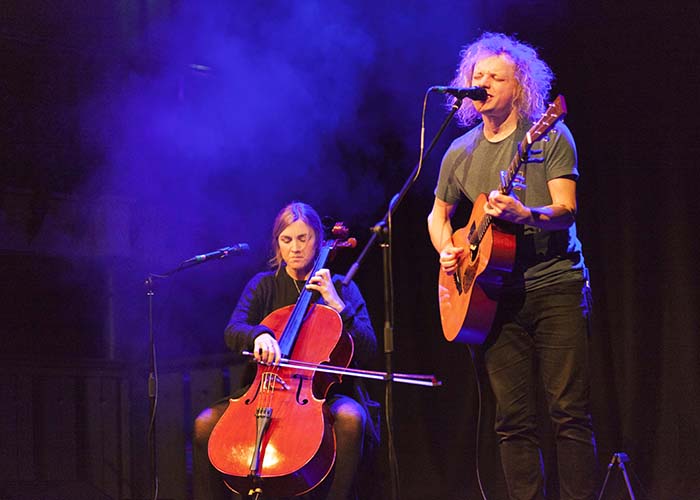
Moddi and Katrine Schiott (Photo: Sean Gallagher / Index on Censorship)
Speaking during his Unsongs set at Hoxton Hall benefit in support of Index on Censorship on Wednesday 7 December, Norwegian musician Moddi warned that censorship can’t be thought of just happening somewhere else.
“Wherever there is power, there is censorship,” he told the audience.
Moddi’s path to his latest album began with a phone call from Norwegian singer Birgitte Grimstad, who told him of Eli Geva, a song about an Israeli officer who refused to lead his forces into battle in 1982. The song had not been performed for more than 30 years. That conversation led him to create Unsongs, a collection of 12 songs that had been silenced in 12 countries.
Jodie Ginsberg, Index CEO, introduced Moddi by reminding the audience of the importance of freedom of expression, something that most take for granted. She told of Zunar, who faces over 40 years in jail for drawing cartoons lampooning Malaysia’s prime minister and his wife, and Baharani Nabeel Rajab, who faces up to 15 years in jail for tweets and retweets.
The evening of censored music also included covers of works by Kate Bush, which had been banned during the first Gulf War by the BBC, and Pussy Riot, which Moddi was dropped from a Norwegian playlist after inquiries from the Russian consulate.
Guests were greeted with a complimentary beer courtesy of cult craft brewery Flying Dog on arrival.
[/vc_column_text][/vc_column][/vc_row][vc_row][vc_column][vc_media_grid element_width=”3″ grid_id=”vc_gid:1481214789969-4bae6e58-980c-0″ include=”82439,82438,82437,82436,82435,82433,82434,82432,82431,82430,82429,82428,82427,82426,82424,82425,82423,82421,82419,82418″][/vc_column][/vc_row][vc_row][vc_column][vc_video link=”https://youtu.be/ZV2oKMkHi8I”][vc_basic_grid post_type=”post” max_items=”4″ element_width=”6″ grid_id=”vc_gid:1481214790025-0b2eb275-288e-6″ taxonomies=”8497″ exclude=”82268″][/vc_column][/vc_row]
5 Dec 2016 | News, Turkey, Turkey Uncensored
[vc_row][vc_column][vc_column_text]
Turkey Uncensored is an Index on Censorship project to publish a series of articles from censored Turkish writers, artists and translators.
This is the second instalment of Ece Temelkuran’s periodic diary of developments in Turkey’s age of emergency rule.[/vc_column_text][vc_column_text]23 November: The women around me are more alert to the Turkey’s situation than the men are. The comfortable male universe is full of denial encased in a constantly refreshed argument: “It cannot go on like this; this is not sustainable.” And my reiterated response to this denial: “What will stop it?” There are neither domestic nor international limits to the resident’s ambitions. While the world is rightly horrified by the jailing of writers and journalists, the objections fall on the president’s deaf ears. Turkey’s opposition is spent, its strength consumed by endless court appearances. A handful of lawyers are trying to catch their breath while running between courtrooms to represent or witness the trials of Turks caught up in the witch hunt that swept the nation in the wake of the failed 15 July coup.
24 November: Just another day in a land of insanity. The EU Parliament announced its decision to freeze Turkey’s accession talks due to the government’s suppression. Three soldiers were killed by a Syrian jet, interestingly on the anniversary of Turkish jets bringing down a Russian plane last year. There was no news due to the traditional news ban so we don’t know if there will be a war tomorrow. And Ahmet Türk, the most prominent and dovish figure of Kurdish politics was jailed. He is 74 years old. Turkish lira dipped to a new record.
On the streets, the humour is in accordance with the insanity: “Make Turkey so-so again!”
 25 November: Castro dies. As with everything else, this also becomes a subject of dispute between opposition and government supporters. Nothing can escape being the object of polarisation in the country. After some people say goodbye to Castro on social media, government supporters revolt: “How can you support a dictator?” If the partisanship can make you defend child rapists, which happened recently due to a child abuse case in a government-affiliated charity foundation, it can make you do anything.
26 November: President Erdogan is threatening the European Union. “We will open the borders for refugees and you will see,” he says. His reckless statements are on one side, Europe’s ethical failure about refugees on the other. Erdogan now seems to be the bull abducting Europa. As the fundamentals of Western civilisation and democratic values come to pieces, the bulls around the globe find their way to the top.
One perfect Balkan noir scene at a Zagreb cafe. At each table there is a grumpy old man reading a newspaper while the young waiter plays high volume Riders on the Storm at high volume. He asks where I am from. “Oh Istanbul! Never been there,” he says. I smile. “Go before it is too late.” He smiles back with sarcasm: “I am from Bosnia. Everywhere is too late.” Maybe true. Maybe it’s a bulls’ world now.
27 November: I was avoiding this piece of news for two days. I have finally read it. A nine-year-old girl died of a heart attack because she couldn’t take the pressure of facing her rapist during her hearing in court. One friend asked: “Why have the men all of sudden became so evil in this country?” My answer is “Because they can!” When the rule of law is damaged and basic human values are shaken, they can. And we, stunned like a beaten dog, just murmur: “It cannot go on like this.” But it does.
28 November: Came to Copenhagen for NewXChange, the meeting point for the world of journalism. I will be speaking in a panel with the title Are we out of Touch? Well, Trump is tweeting: “CNN is so embarrassed by their total (100%) support of Hillary Clinton, and yet her loss in a landslide, they won’t know what to do.” He knows that attacking established media will get him more points than anyone can imagine. While talking about Operation Euphrates Shield president Erdogan said: “We entered Syria for nothing else but to end cruel reign of Al-Assad” It is as if Turkey declared war on Syria. People are asking, “How can he say that?” Well, shall I repeat it once more? Because he can.[/vc_column_text][/vc_column][/vc_row][vc_row][vc_column][vc_basic_grid post_type=”post” max_items=”4″ element_width=”6″ grid_id=”vc_gid:1485774671069-2b48111f-e2eb-10″ taxonomies=”8607″][/vc_column][/vc_row]
2 Dec 2016 | Mapping Media Freedom
[vc_row][vc_column][vc_column_text]Each week, Index on Censorship’s Mapping Media Freedom project verifies threats, violations and limitations faced by the media throughout the European Union and neighbouring countries. Here are five recent reports that give us cause for concern.
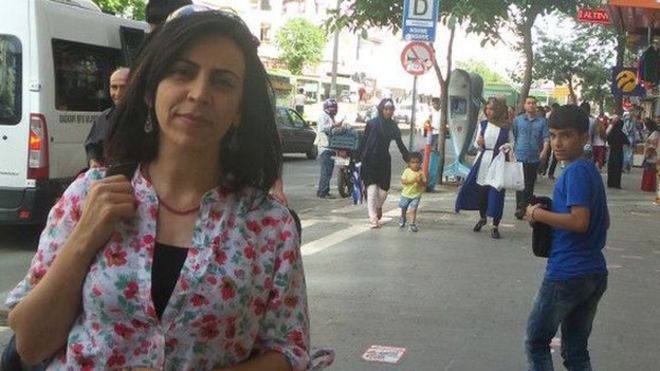
Hatice Kamer (Photo: BBC)
Hatice Kamer, also known as Khajijan Farqin, is a freelance journalist for BBC Turk and Voice of America. She was detained in Diyarbakir on 26 November while reporting on a landslide that killed at least ten workers in a copper mine.
Kamer was taken into custody in Siirt province at a police checkpoint; reasons for her detention remain unclear. Due to the state of emergency declared in Turkey, even the journalist’s attorney was unable to contact her.
On 27 November Kamer was released after spending a night in jail. She was told she would face charges of supporting the Kurdistan Workers Party (PKK) through her reporting. The journalist states there is no evidence of supporting the outlawed party through her work.
Dutch-American journalist Kevin Roberson, owner of the online news portal Roberson Report, was attacked at an anti-Black Pete demonstration in Utrecht.
Black Pete is a character in Dutch folklore said to be a servant to Saint Nicholas. The character is often portrayed by a white person in blackface and has become subject to controversy in the Netherlands, many claiming the inclusion of the character in Sinterklaas traditions is racist.
At the event, a group of Black Pete defenders emerged, identifying themselves as members of the alt-right movement Nederlandese Volks-Unie (NVU).
One of the members attacked Roberson from behind, hitting him on the head and neck then running away. Roberson posted the video online. The journalist told Mapping Media Freedom that he is fearing for his safety. “My home address is circulating in right-wing social media groups,” Roberson stated, “I don’t feel safe anymore.”
Roberson is pressing charges against the attacker.
On 25 November, Russian TV channel Dozhd reported that two of its correspondents, Sergei Polonsky and Vasiliy Yerzhenkov, were detained by intelligence agencies in the self-proclaimed Donetsk People’s Republic.
Dozhd reported that, “Three employees of the Ministry of State Security were involved in the interrogation. They watched videos and deleted them. They also blocked Polonsky’s phone, broke Yerzhenkov’s phone and destroyed his notebook.”
Polonsky stated that they did not receive physical abuse, only psychological. The reporters were told that the reason for their detention was “false information” in their accreditation, but Polonsky proved that the information was correct.
Yerzhenkov and Polonsky were in the region to interview Alexey Khodakovsky after receiving permission from the Security Service of Ukraine and the ministry of the Donetsk People’s Republic.
The two reporters are now banned from entering the area after giving “biased” and “provocative” reports on Donetsk.
At a rally for the main Macedonian opposition party, the Social Democratic Union of Macedonia (SDSM), a TV journalist and cameraperson for the Macedonian TV channel MTV 1 were insulted by party supporters.
In Tetovo, this was not the first time an incident like this occurred. “We would like to emphasise that this is not the first time our journalists have been insulted during an SDSM rally,” an MTV 1 report stated, “Our journalists are being blocked from fulfilling their professional duties.”
The reporters were harassed, insulted and spat on as they attempted to report from the rally. The SDSM condemned the incident, saying they were against any negative treatment of the media regardless of its beliefs.
A film crew for REN TV in Moscow was assaulted after investigating fraud at a candle company. According to the clients, the company was offering candle-making lessons which clients would pay for, but the company would take the money and leave the clients without lessons.
While speaking to the director of the company, the crew was attacked by him after he blocked one of the cameramen and pushed reporter Dariya Ermakova to the ground. The incident was caught on video by one of the other cameramen.
Ermakova filed a report to the police who are currently investigating. [/vc_column_text][/vc_column][/vc_row][vc_row][vc_column][vc_column_text]
Click on the bubbles to view reports or double-click to zoom in on specific regions. The full site can be accessed at https://mappingmediafreedom.org/
[/vc_column_text][vc_basic_grid post_type=”post” max_items=”4″ element_width=”6″ grid_id=”vc_gid:1480680872724-f03c210d-ad9e-2″ taxonomies=”6564″][/vc_column][/vc_row]
