30 May 2014 | News, Politics and Society, United Nations
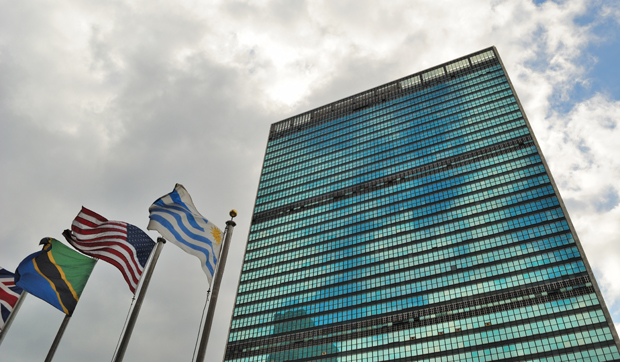
In a discretion well known to diplomatic circles, the United Nations so-called Committee on NGOs is meeting in New York this week. It is to select which NGOs fit the institution. The 19-member body’s aim could be to ensure a high-level and quality participation of independent NGOs to the United Nations – it is instead the 21st century censorship bureau.
Any governmental institution has to establish mechanisms by which participation of external organisations and lobbyists is regulated. The role of the Committee on NGOs of the United Nations is to look into applications of NGOs from all around the world. It is supposed to assess, case by case, whether the applicant NGO respects the Charter of the United Nations and abides by basic principles such as non-violence and democracy.
We know how much civil society has contributed to the development of the United Nations as such, and has been a force in pushing States to adopt a set of internationally binding standards to protect human rights and so many other issues. Access to the international bodies allowed NGOs to have a direct and formal input into the discussions. Unlike lobbyists at parliaments, representatives of NGOs can officially participate in the debates at the United Nations Human Rights Council. No need to be invited by an official or find strategies to get in contact with decision-makers. The access guaranteed to independent civil society, representing values and principles, not financial interests, is at the very core of the United Nations and a consequence of the organisation recognising it would be nothing if it had to count only on States to build itself and its standards up.
Some of those States are indeed the ones most willing to silence critical NGOs.
Throughout the globe, NGOs are fighting more and more for their own space in society, for their ability to work and defend victims of human rights violations. The work used to be all about those who loose their lives working as slaves, those who end up behind bars because of their beliefs, their engagement or their sexuality, those who loose their houses because from a day to another a ruler wants the land or a country believes it has the absolute right over it. Human rights defenders used to give body and soul to those people, and to so many others. Now, we need to include that we need to challenge governments shrinking the ability of those fighting for rights – human rights defenders need more and more to fight for themselves and their own space.
The United Nations should be an arena of dialogue aspiring to protect victims and promote peace. To do so, various voices are needed at the table. However, those who shrink space for civil society at home certainly do not want to see them at the table in New York or Geneva, or at any other international forum for that matter.
Along with inter alia Cuba, Pakistan and Venezuela, China and Russia are long-standing members of the Committee of NGOs. Both can proudly wear a label of censorship. Following President Vladimir Putin’s third election in March 2012, the country is undergoing a wave a repression and has adopted some of the most draconian laws against independent civil society. Dissenting with the Chinese regime is at the cost of one’s life, safety and integrity. The same behaviour is being observed by China and Russia at the Committee on NGOs – the institution is its tool to repress those the countries’ leadership do not agree with. And the consequences are grave. As world powers and permanent members of the Security Council, the two countries are already immune to critics within the UN on their rights record. The repression against political activists, human rights defenders and their NGOs, should have brought both countries to the centre of debates at the Human Rights Council and the General Assembly. It did not because they effectively prevents critics from getting into the room. Other States are now following the same strategy; one cannot believe that Azerbaijan, which will become a member of the Committee in 2015, shows a genuine interest in NGO participation in the international debate when it jails those who want to monitor the public life in Azerbaijan, such as the leader of the country’s only independent election monitoring group Anar Mammadli.
Member States of the Eastern European Group in the United Nations (the geographical groups are one of the legacies of the post world war era) should have run against Azerbaijan and Russia. Many of those Eastern Europe States are within the European Union. The Union was a step behind others by omitting to see that its willingness to promote rights and democracy in its direct neighbourhood will be affected by leaving a censorship tool in the hands of people who enjoy it.
Western countries have on their side left Turkey run unopposed for the Committee. The country has singled itself out recently, from all members of the Western European and Others Group, in blocking access to social media, especially Twitter. The single fact that a leader believes the power held in his hands allows him to block freedom of expression on the media of one’s choice should imply that that leader’s government is not to participate in the selection of civil society organisations participating in shaping the international arena.
Within the protected compound of the United Nations in Manhattan, the Committee on NGOs is this week looking into accepting those NGOs nobody will oppose, whilst blocking those NGOs publicly and forcefully engaging for human rights, including rights of people belonging to minorities or espousing minority beliefs. States should stand up for the space for critical NGOs. They might have the numbers and if they do not they are on the honourable side trying to support those NGOs that deserve to be at the United Nations. There is no shame in losing against censors – there is one in not trying to oppose them.
This article was posted on May 30, 2014 at indexoncensorship.org
27 May 2014 | News, Politics and Society, Ukraine
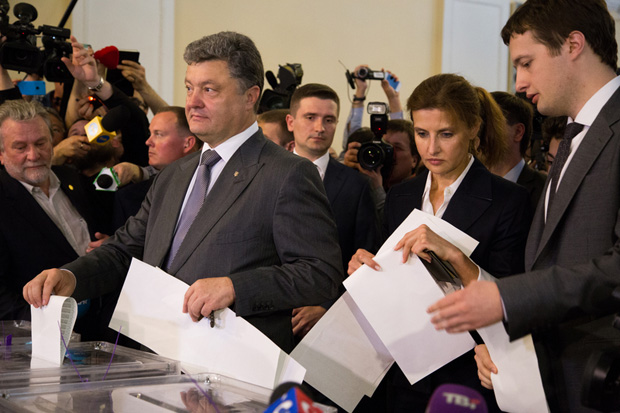
Petro Poroshenko at a polling station (Photo: Oleksandr Ratushniak/Demotix)
Petro Poroshenko has won the Ukrainian presidential election in the first round, as preliminary results and exit polls show he received over 50% of votes. A billionaire, sometimes dubbed “the Chocolate Oligarch” (his main asset is Roshen, the largest confectionery manufacturer in Ukraine) gained his popularity during the Euromaidan protests in November 2013 – February 2014. Many in Ukraine consider Poroshenko to be a controversial figure as the head of the country; he represents a revolutionary, pro-European, but still old, oligarch-driven elite, and a system the Euromaidan protests were aimed against. Yet, the huge support he received shows Ukrainians are tired of the period of uncertainty, and united to give their country a new legitimate leader who can deal with unrest in the south-east regions, where pro-Russian militants continue their attempts to destabilise the situation.
Poroshenko’s first-round victory is a sign of national agreement, but is hardly a final remedy for all the problems Ukraine faces, both externally — like the military threat from Russia, including the occupation of Crimea — and internally. The latter applies not only to economic difficulties, but also to the necessity of extensive reforms that deal with the whole system of interrelations between the state and the society, ensuring real rule of law and putting end to corruption and human rights abuses.
Events in Ukraine over the last six months have made the country one of the most dangerous places for journalists in the world. According to the Institute of Mass Information, there have been 218 cases of physical attacks against reporters in Ukraine in 2014. Viacheslav Veremiy, a reporter for Ukrainian Vesti newspaper, was shot during events on Maidan on 19 February. Vasily Sergiyenko, a journalist and a civic activist, was tortured and then killed in Cherkassy in April. The death toll continued to rise even on the eve of the election, as Andrea Rocchelli, an Italian photo reporter, and his interpreter Andrei Mironov, a Russian human rights activist and a Soviet-era political prisoner, were killed on 24 May near Slovyansk, in the Donetsk region.
“It is still difficult to say if the free speech situation will improve after the election, especially in the east of Ukraine. It will depend on effectiveness of work of the new president and development of relations with Russia,” Tetiana Pechonchyk, the head of the Human Rights Information Centre, told Index on Censorship.
But it is not only the areas of military conflict that are dangerous for journalists. Sergiyenko’s murder and the case of Evgen Polozhiy, the editor of Panirama newspaper from Sumy, who was severely beaten, show reporters’ work is becoming increasingly risky business in Ukraine.
“There were quite a number of journalistic investigations before the Euromaidan, but they led to no official reaction or criminal cases about corruption revealed. Now that the society has changed, corrupt officials and criminals are especially afraid of critical reporting as they can lose their positions or even go to prison; they choose different methods to silence investigative journalists,” Pechonchyk says.
Another important aspect of a media reality around events in Ukraine is the massive information war, launched by Russia. The aim is to show a distorted picture of a modern Ukraine as a state where right-wing extremists and “fascists” seized power, in spite of the fact that the leader of the notorious “Right Sector” organisation got less than 1% of votes during the presidential election. They also aim at perplexing the foreign audience by mixing the terms “Russian-speaking” and “Russian”, for instance to justify invasion of Crimea or actions of pro-Russian militants in Donetsk region.
“That’s what you expect Russia to do — blow the country over with lots of stereotypes, lies and myths. Unfortunately, the Ukrainian government lost this information war. But what is great is that civil society, bloggers, ordinary young people on Facebook confronted Putin’s lies with their activity and creativity, with websites that disprove Russian TV channels’ propaganda or fake news,” says Michael Andersen, a journalist who made a documentary for Al Jazeera about typical stereotypes around Ukraine and Ukrainians.
The latter still have a long way to go to ensure the Maidan changes a lot more than just the name of the president and the faces of the governmental officials. Civil society and the media have a vital role to play on this path to future reforms.
This article was published on May 27, 2014 at indexoncensorship.org
23 May 2014 | Europe and Central Asia, News, Ukraine
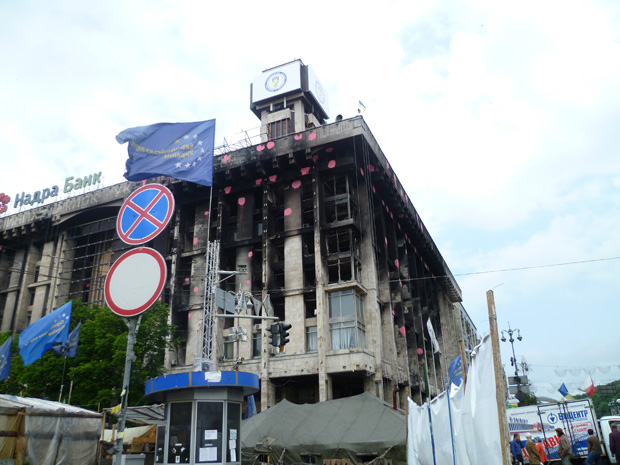
(Image: Index on Censorship)
Ukraine is seeing a “concerning pattern of grave violations of media freedom commitments” warns OSCE press freedom boss Dunja Mijatovic in a new report.
“As we know too well, in times of crisis and conflict, journalists and members of the media are among the first to be attacked, both physically and psychologically. Because those in power during periods of conflict demand complete control of all information free media is often their first target,” the report, published on Friday, states. Covering the time between 28 November 2013 and 23 May 2014, these are the three key findings.
1) Journalists face serious threats to their safety
There have been “nearly 300 reported cases of violence against journalists, including murder, physical assaults, kidnappings, threats, intimidations, detentions, imprisonments, and damage and confiscation of equipment”. These attacks are divided into two phases — the first covering the Maidan protests in Kiev, and the second the ongoing crisis in the east of the country. In Maidan, journalist Viacheslav Veremyi was killed, while almost 200 others were victims of violence. These include the over 40 journalists who were assaulted while covering protests on 13 December 2013. “In some cases,” the report states, “journalists were specifically targeted by law enforcement despite displaying clear identification as members of the press.” Since March, attacks on journalists in the east have intensified and gone without prosecution — something that “points to the breakdown of the rule of law in the parts of Ukraine affected by conflict”. On 18 May, Ukrainian military arrested two Russian journalists from LifeNews, while two journalists from Otkritiy Krymskiy Kanal were detained, interrogated, beaten and had their equipment seized by a group of people wearing military uniforms. Journalists in Crimea — recently annexed by Russia — who are not considered loyal to the region’s authorities, and who refuse to change citizenship, have been faced with regular threats, harassment and the possibility of eviction.
2) Ukraine is in the middle of an information war
There have been a number of accusations of the media being used to disseminate propaganda. “Propaganda and the deterioration of media freedom combine to fuel and contribute to the escalation of conflict, and once it starts they contribute to its escalation,” the report states. Among other thing, broadcasting stations “and related infrastructure” in Crimea, Sloviansk, Donetsk and Luhansk, have been attacked by unidentified and often armed individuals who supplanted regularly scheduled television programming with Russian state media. In March, the National Television and Radio Broadcasting Council of Ukraine ordered all cable operators to stop broadcasts of several Russian state TV channels. “No matter how loud and outrageous certain voices are, they will not prevail in a competitive and vibrant marketplace of ideas,” the report argues. “Therefore, any potentially problematic speech should be countered with arguments and more speech, rather than engaging in censorship.”
3) Media workers are being denied entry
In the past months, the OSCE has intervened in some 30 cases of journalists being denied entry into Ukraine and Crimea. “I have serious concerns about excessive restrictions on such travel, which ultimately affects the free flow of information and free media,” writes Mijatovic. Recently, Russia Today’s Arabic news crew, who travelled to Kiev to cover Sunday’s presidential election, were denied entry at immigration. Two crews from the All-Russia State Television and Radio Broadcasting Company (VGTRK) were not allowed to enter Ukraine, despite having all required accreditations. On a related note, a Rossiya-1 TV crew were this week deported from Ukraine.
This article was posted on May 23, 2014 at indexoncensorship.org
22 May 2014 | Europe and Central Asia, News, Politics and Society, Ukraine
(Photo: Milana Knezevic/Index on Censorship)
Walking around Kiev’s Maidan Nezalezhnosti square, months after the protest that enveloped the city and toppled the corrupt government of Viktor Yanukovych died down, is a strange experience. International attention has understandably shifted, the images now beamed across the world are from the ongoing crisis in eastern Ukraine. The capital is calm these days, so I don’t know exactly what I was expecting as I made my way down Mykhailivska street.
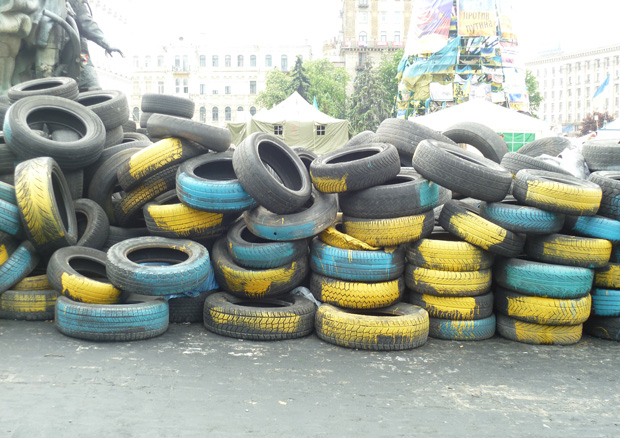
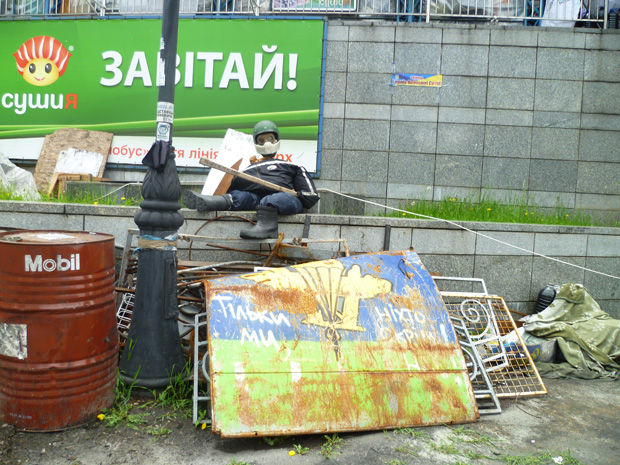
Tents still populate Maidan, with young and old lounging, talking and cooking in the May sunlight. I walked past sandbag barricades, and ones made of tyres painted in the blue and yellow of the Ukrainian flag. There were flags were everywhere — EU, American, British, and many more. I walked past the independence monument, juxtaposed against the new year tree, covered by protesters in posters, and yet more flags. Music was blaring out from the small stage facing these towering structures. The lyrics I couldn’t understand, apart from the cry of “Ukraina” in the chorus. I made my way past the Maidan press centre, towards a bridge which had a large banner emblazoned with names and faces hanging from it. The Hotel Ukraina behind me, I looked out over the square.
(Photo: Milana Knezevic/Index on Censorship)
The only thing missing was the crowds. It felt like they had just taken a break — gone for lunch, to return at any moment. Perhaps I arrived with a naive “out of sight, out of mind”, mentality, subconsciously assuming that the square would to an extent have been cleared out. But Maidan seems to be, for now at least, a living monument to the profound change, and crisis, Ukraine is going through.
It was against this backdrop, and with the country’s general elections set for this Sunday, I travelled to Kiev to take part in the conference Ukraine: Thinking Together. The brainchild of Yale University history professor Timothy Snyder and the New Republic’s Leon Wieseltier, its purpose was “to meet Ukrainian counterparts, demonstrate solidarity, and carry out a public discussion about the meaning of Ukrainian pluralism for the future of Europe, Russia, and the world.” The guest list included academics like Bernard-Henri, Lévy Timothy Garton Ash and Ivan Krastev, and journalists like The New York Times’ Roger Cohen and The Atlantic’s David Frum. Former Swedish prime minister Carl Bildt also made an appearance at the welcome reception.
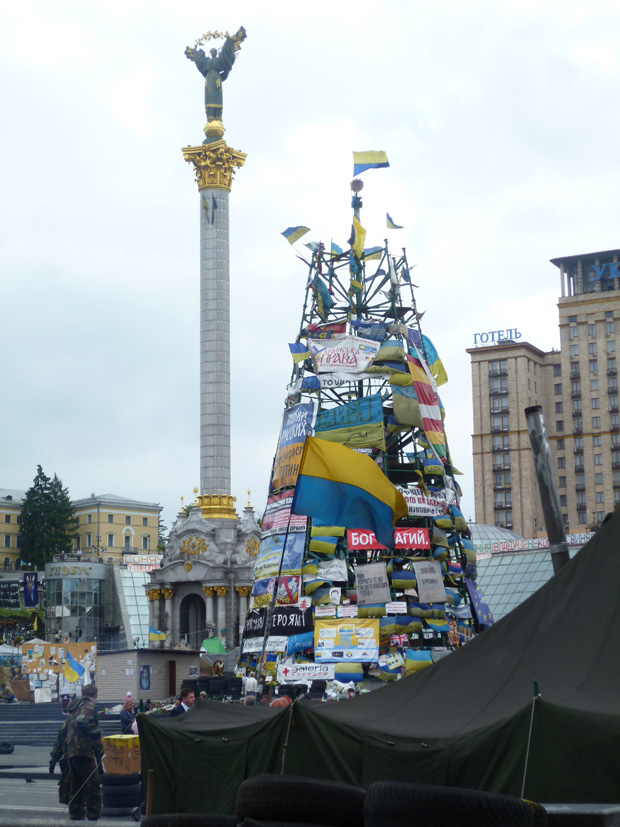
(Photo: Milana Knezevic/Index on Censorship)
One could question what, if any, effect the discussions of a group of intellectuals might have on the very real crisis on the ground. Over the weekend, there were among other things, a Crimean Tartar journalist was detained in Simferopol, while the Ukrainian military arrested two Russian reporters. But Kiev-based journalist Maxim Eristavi told me, and tweeted, that it was “surreal” to have the “intellectual powerhouse of the West in one room in Kyiv”. If nothing else, organising a big-name gathering to talk about Ukraine, in Ukraine, makes a bold statement — and one likely to be heard all the way to Moscow.
A range of topics were tackled in five days of panel debates and public lectures. The Maidan protest was applauded, with Wieseltier in his opening remarks calling it “one of the primary sites of the modern struggle for democracy”. Carl Gershman, President of the National Endowment for Democracy, called Maidan a geopolitical move, but by a people rather than a government.
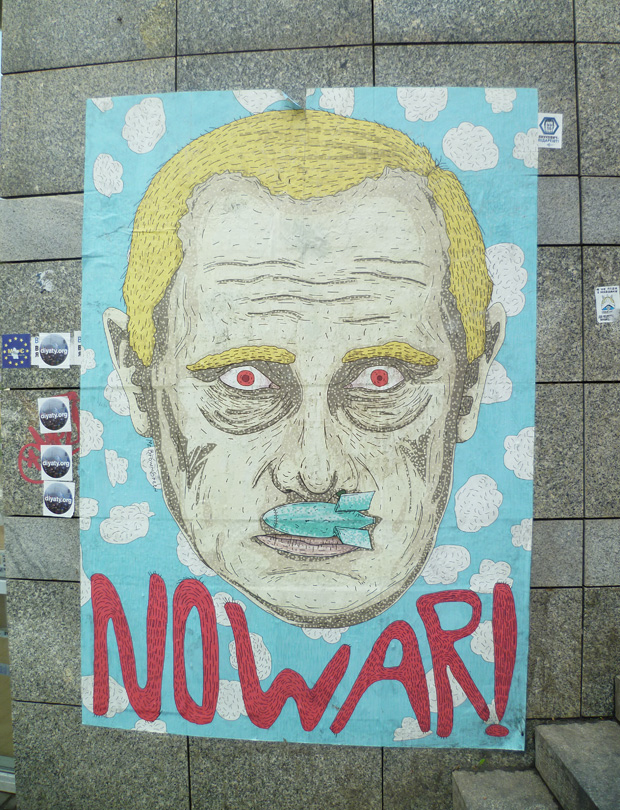
(Image: Milana Knezevic/Index on Censorship)
Bernard-Henri Lévy spoke of his recent visits to eastern Ukraine, explaining that while they might be fewer than in the Maidan, there are people in these areas who support a unified Ukraine. He contested what he believed to be the image presented in western media that people in the east are all separatists. While the point was made that flags, national symbols and the Maidan movement is not perceived as positively in all parts of the country as in Kiev, Constantin Sigov, professor at the National University of Kyiv-Mohyla, argued that the Ukrainian crisis is first and foremost civil and political, not one of identity.
Russia’s foreign policy and Russian President Vladimir Putin were unsurprisingly recurring themes. “He has values. They are not our values, but they are values,” said François Heisbourg, chairman of the International Institute for Strategic Studies, talking on the panel of geopolitics after Crimea. Writer Paul Berman argued, in the same panel, that Putin is acting from a position of weakness, and fear that Russia is not stable. Others, meanwhile, were uncomfortable with the term geopolitics, saying it legitimises Putin’s world view.
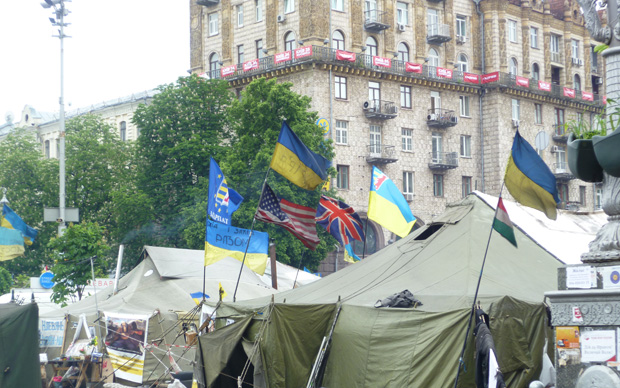
(Photo: Milana Knezevic/Index on Censorship)
Russia’s propaganda strategy was also a hot topic and elicited strong responses, with one audience member referring to it as a weapon of mass destruction. “Propaganda is the beginning of bloodshed, it precedes bloodshed,” said Alexandr Podrabinek, editor-in-chief of Prima information agency, on the panel discussing whether rights make us human. State-run news channel RT, formerly Russia Today, got several mentions. Academic Anton Shekhovtsov argued that RT gives space to democratic consensus in its coverage, but also to left-wing, far right and libertarian narratives, and even conspiracy theories. Because each is treated in roughly the same way, the democratic narrative becomes just one of many. He said this explains why RT appeals to some people in the west, but stressed that they’re pushing an overall Russian agenda.
Podrabinek, despite dubbing RT “hateful”, argued that while there might be a temptation to shut down views we don’t like, this is not a good way of confronting them. If we want freedom of expression, he said, we can’t do that. On a related note, Carl Gersham argued that while Ukraine needs to be supported economically and militarily, they also need support in modernising the media landscape, to foster internal dialogue.
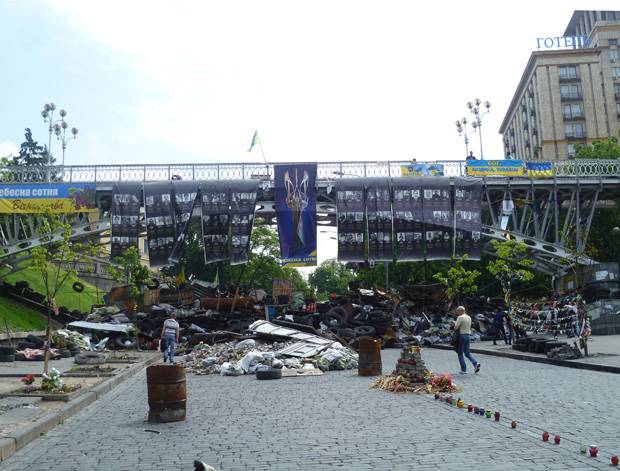
(Photo: Milana Knezevic/Index on Censorship)
And while the regime was criticised by speaker after speaker, ordinary Russians and their rights were not forgotten. Sergei Lukashevsky, director of the Sakharov Museum and Public Centre, put the support for Putin into the context of fear. When people see that the state is cracking down on human rights again, he argued, they make themselves fit in — go into survival-mode. While rights exist formally in Russia, he explained the practical situation through an old Soviet joke: “Do I have the right? Yes. Can I? No.”
In a weekend of intellectuals discussing how to solve a crisis, novelist and non-fiction writer Slavenka Drakulic gave a sobering lecture on the role of intellectuals in causing crises, specifically the Balkan wars. To be able wage war, to kill, you have to create an enemy and dehumanise it, she argued. Here is where academics, poets, journalists came in handy in former Yugoslavia — by preparing people psychologically for conflict, “using words almost like bullets”.
(Photo: Milana Knezevic/Index on Censorship)
And this leads well into the final panel of the conference, on the role of history and memory in politics, the difference between official history and collective and personal memories of the people, and how especially the former can be manipulated. We’re arguably seeing that today already, with Timothy Snyder saying that with events in Ukraine, a European revolution is being contested even as it’s happening. The Russian Ministry of Education is already writing new chapter to explain Crimea, said acclaimed Ukrainian novelist Andrey Kurkov. “And Ukraine might have their version.”
After my trip to Maidan, I asked a Ukraine-based AP journalist what the future might bring for the square. There are only a specific type of people still there, she explained, and they might see how the elections go before they decide to stay or leave.
Or as Myroslav Marynovych, the founder of Amnesty International Ukraine, said during the conference — when there is democracy, there will be no need to go to Maidan.
This article was published on May 22, 2014 at indexoncensorship.org
