International summits and fora over the next two years will be critical in determining the internet’s future. The open and inclusive multistakeholder model of internet governance has been called into question, with some governments – namely China, Iran and Russia – advocating for more control. As an influential state in our increasingly digital and multipolar world, India has the opportunity to push policies that promote digital freedom. Yet, India is still very much a swing state in these internet governance debates.
After initial scepticism, India has now joined the European Union (EU) and the US in resisting the call for a top-down government-led approach for global internet governance. At the World Conference on International Telecommunication in Dubai in December 2012, India was one of the few countries to side with EU member states and the US in supporting the current multistakeholder status quo. This was the result of a debate in India, in which the key battle line was whether internet freedom constituted a daunting threat to security that required top-down national control or not.
India’s hesitation increased after the 2008 Mumbai attacks when Jaider Singh, Secretary of the Department of Information Technology, described the internet as “both a vehicle and a target of criminal minds”.[49] Concerns over security and spam led India to advocate for more national control over internet governance, through the creation of a United Nations committee.[50] Earlier in 2011 at the Internet Governance Forum in Nairobi, India, along with South Africa and Brazil – two other crucial swing states in the internet governance debate – proposed a similar initiative.
While such top-down control has long been advocated by the likes of China and Iran – countries with a poor domestic track record on digital freedom – it is a direct threat to internet openness and the exercise of human rights online by placing too much control of the process in the hands of national governments. The EU and US tried to address India’s concerns diplomatically by agreeing to a working group.
It is positive that India is now willing to play an important role in defending the multistakeholder model of internet governance against calls for more top-down state regulation. Yet, it is clear that with a sixth of the world’s population, it is not just important for India’s government to defend internet freedom globally, but also ensure that its domestic record stands up to scrutiny and is a model for the rest of the world to adopt. Currently, this is not the case.
India is not only setting internet policies for its 10 percent of users today, but for its 1 billion citizens yet to come online. The decisions it makes, both domestically and on the international stage, are likely to set powerful precedents for regional neighbours, and other emerging democratic powers.
[49] Jaider Singh, speaking at the third annual Internet Governance Forum in Hyderabad, India, in 2008 with the theme ‘Internet for All.’ Internet Governance Forum, ‘Internet Governance Forum Concludes Hyderabad Meeting’ (6 December 2008), http://www.elon.edu/docs/e-web/predictions/IGF 08 Daily Highlights Dec 6.pdf accessed on 10 September 2013.
[50] In 2011, India proposed a United Nations Committee for Internet-Related Policies (CIPR) be established to develop and oversee internet policies that would affect the world’s users. Techdirt, ‘India Want UN Body To Run The Internet: Would That Be Such A Bad Thing?’ (2 November 2011), http://www.techdirt.com/articles/20111102/04561716601/india-wants-un-body-to-run-internet-would-that-be-such-bad-thing.shtml accessed on 2 September 2013.
Bryan faces a charge of ‘hooliganism’ after he was arrested while filming a Greenpeace protest on an Arctic Ocean oil rig.
Hooliganism is defined in article 213 of the Russian criminal code as “a gross violation of the public order which expresses patent contempt for society, attended by violence against private persons or by the threat of its use, and likewise by the destruction or damage of other people’s property”
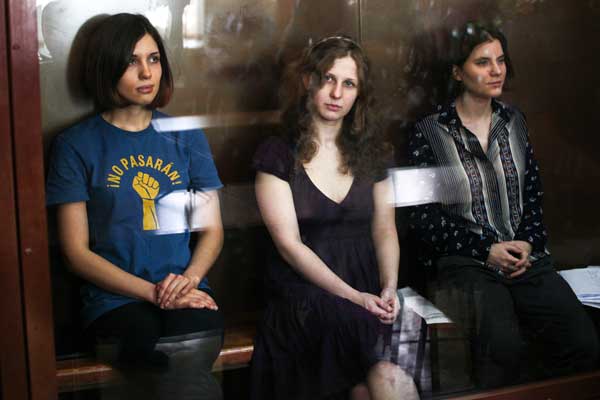
Bryon could end up with a two-year sentence should he be convicted. That’s what Nadezhda Tolokonnikova, Maria Alekhina and Ekaterina Samutsevic of Pussy Riot received after they were convicted of “hooliganism motivated by religious hatred” in October 2012. Samutsevic has been released on bail, but Alekhina and Tolokonnikova remain in prison. There were fears for the wellbeing of Tolokonnikova recently after authorities could not confirm her whereabouts in the course of a prison transfer.
In the past week, artist Pyotry Pavlensky was charged with hooliganism for nailing his scrotum to Red Square, in what he said was a protest against political apathy.
Azerbaijan meanwhile, defines it as “deliberate actions roughly breaking a social order, expressing obvious disrespect for a society, accompanying with application of violence on citizens or threat of its application, as well as destruction or damage of another’s property…”
In May of this year, Azerbaijani activist Ilkin Rustamzadeh was sentenced to two months pre-trial detention for a hooliganism charge after he allegedly took part in a “Harlem Shake” video. Rustamzadeh, who had been active in calling for investigations into the deaths of young soldiers in Azerbaijan’s army, denied ever having taken part in the videos.
Before that, in 2009, Azerbaijan had jailed two young activists for hooliganism after they posted a video on YouTube satirising the government’s expenditure on importing donkeys from Germany.
It was suggested that the donkey import was a cover for money laundering. Shortly after the video was posted, the activists, Emin Milli and Adnan Hadjizadeh, were attacked in a Baku cafe. They were blamed for the fight and sentenced two and a half years and two years respectively.
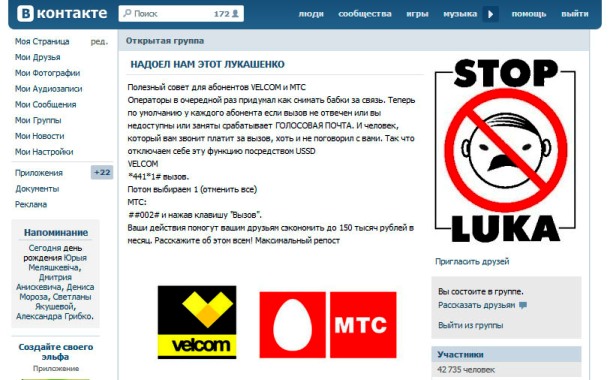
In Belarus, Alexander Lukashenko’s regime frequently uses hooliganism charges to harass journalists and activists. Lukashenko is so paranoid about dissent that he at one point banned clapping in public, so its unsurprising that moderators of online anti-government groups get arrested. In August 2012, Pavel Yeutsikheieu and Andrei Tkachou, administrators of the “We are fed up with Lukashenko” group on Russian social network VKontakte, were both given short prison sentences for “minor hooliganism”.
In the old Soviet Union, inconvenient people were often declared mad and locked up by the authorities. Now, they’re classified as hooligans.
This week saw some movement in the debate over NSA and GCHQ surveillance, and a court case that could have very serious consequences.
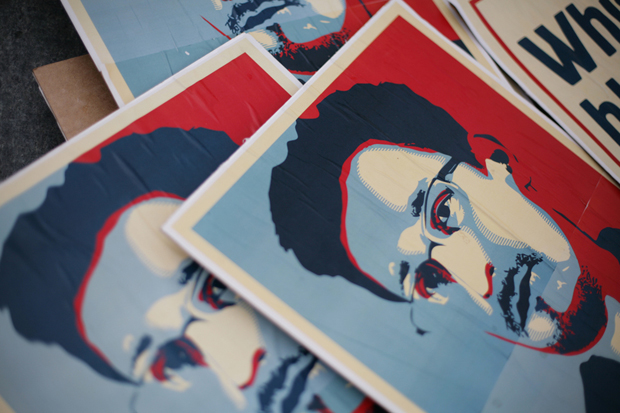
The court case first. One Wednesday and Thursday, the court of Appeal held a judicial review into the use of Schedule 7 of the Terrorism Act taken by David Miranda, partner of journalist Glenn Greenwald. Miranda was detained in transit at Heathrow airport under Schedule 7 while carrying encrypted documents that had emanated, ultimately, from whistleblower Edward Snowden.
The question was whether the authorities, knowing who Miranda was, what he was likely to be carrying, and his purpose for holding the documents, had a right to detain him under that particular piece of law.
It’s quite technical, but it comes down to whether carrying the documents Miranda was carrying could be seen as an act of terrorism or an act that could potentially aid terrorism (as the government and police argue) or as part of a journalistic enterprise (in essence, what Miranda is arguing).
Index and other organisations have weighed in in support of the argument put forward by Miranda’s team, as we worry that a ruling against Miranda could have serious implications. Journalism can often operate in dubious areas: whether material “leaked” or “stolen” for example, is a question that can have very different answers depending on who you ask.
In this case, the UK government very clearly maintains that the documents have been stolen and should be given back. Furthermore, they believe that they could fall into the hands of the wrong people – terrorists or hostile states, if not in the control of security services.
That, by the way, was very interesting indeed. The Home Office’s case suggested Russia, where Edward Snowden has been granted temporary asylum, is a hostile state.
The other side of this argument is that Miranda was assisting in journalism. This will involve, on occasion, having documents others would rather you did not have. The act of journalism is to sift these documents and decide where the stories lie within them. There was considerable back and forth on what “responsible journalism” constitutes during the hearing, but ultimately, it must be up to an editor what goes into a paper.
The Guardian’s Alan Rusbridger maintains he has acted with absolute responsibility. And GCHQ have as yet not claimed that agents have been endangered as a result of the Guardian’s revelations.
But at a hearing of parliament’s Intelligence and Security Committee (the ISC) on Thursday, spy chiefs insisted that Britain’s enemies were “rubbing their hands with glee” at the Guardian’s publications, and that terrorist chatter online had “gone dark” (i.e. more difficult to trace) since the first stories had appeared.
What next for the surveillance debate? The ISC performance was generally held to be weak. Rory Stewart MP has suggested it be composed more democratically, with an opposition MP at its head. The general demand on surveillance seems fairly low key: more scrutiny, less scope for random snooping.
Meanwhile the judges will mull over the Miranda case, and, we hope, come to the conclusion that whatever the young Brazilian was doing, it wasn’t terrorism.
The United Nations got together yesterday to adopt a resolution calling for a world truce during the Winter Olympics kicking off in Sochi, Russia in exactly three months. This has become a tradition over the past 20 years — a symbolic gesture in the months leading up to the games. For the first time, however, it called upon the host country to “promote social inclusion without discrimination of any kind.”
Obviously a thinly veiled reference to the overtly anti-LGBT legislation Russia passed back in June. The vaguely worded ban on “gay propaganda” aimed at minors has sparked outrage across the world, with some activists calling for a boycott of the games.
But have no fear — Sochi Games chief Dmitry Chernyshenko, present at the UN, reminded us all that President Putin has repeated “three times” that there will be “no discrimination”.
THREE TIMES, YOU GUYS.
While you will forgive me for reserving my judgment on that particular guarantee for now, it is worth noting what was not mentioned in the resolution and what we were not given any assurance about. The right to freedom expression — or rather lack thereof — stands at the core of this issue. Since the law came into power, LGBT protesters have been attacked and arrested. Authorities have warned that spectators and athletes can be fined for “gay propaganda”, like displaying rainbow flags.
I don’t know about you, but to me that seems to fly in the face of the the universal human right to freedom of expression and assembly. But maybe it was simply an oversight, and this is next on the agenda. In which case, I’ve got a few suggestions on where to start.
For one, there are currently 28 Greenpeace activists and two journalists under arrest in Russia. They were staging a peaceful protest by a Gazprom oil rig on September 18, when their ship was boarded by Russian security forces. They are currently detained in a prison in St Petersburg. Initially held on piracy charges with a potential 15 year sentence, they have now been downgraded to hooliganism. This could still mean up to seven year in jail. Again, that’s for a peaceful protest.
Then there’s the case of the TV crew from the Norway’s Olympic broadcaster TV2. While filming a recent report in Sochi, they were taken into custody, interrogated, harassed and denied contact with the Norwegian embassy. The journalists were also told that they were now ‘blacklisted’. Not very encouraging to hear if you’re a critical foreign reporter heading to Sochi in February, never mind a member Russia’s perpetually repressed independent press.
And of course, you can’t talk about freedom of expression in Russia without mentioning Pussy Riot. Two members of the feminist punk group have been in prison since February 2012. The latest news was the apparent disappearance of Nadezhda Tolokonnikova as she was moved between prisons. This came after the Guardian published an open letter where she detailed the horrible conditions they were being held under. It soon emerged that she might be, like in some sort of Soviet nightmare, sent to Siberia.
One of the fundamental principles of the Olympics deals with “preserving human dignity”, and there is no doubt that freedom of expression is a pretty big part of that. Rather than listening to Putin’s empty promises, we should be measuring up Russia’s commitment to “human dignity” where it counts.