25 Jul 2013 | Volume 42.02 Summer 2013
Writer and artist Htoo Lyin Myo gives his personal account of working under government censorship in Burma
I became familiar with censorship as a boy in the 1990s, when certain pages of the monthly magazines I read were covered with black ink, which censorship officials manually brushed over printed words. The paragraphby- paragraph, line-by-line ink-covered pages made me curious, so I would place them on a lit-up surface in order to have a peek. Indeed, the hidden words covered with ink criticised government economic policy or local businessmen.
But when the ink was changed from black to silver, I could hardly see those hidden words: it was a totally hidden, reflective surface, like metallic camouflage.
Burma’s notorious censorship developed alongside the dictatorship, a government that created the 1962 Printers’ and Publishers’ Registration Act. So censorship is ‘the problem child’ of the dictatorship. Currently, Burma has nine laws that provide for censorship both directly and indirectly, including the Electronic Transactions Law (2004). It carries with it a penalty of up to 15 years’ imprisonment for internet users who receive email messages that are deemed to be detrimental to the security of the state.
From about 2005, browsing the internet became part of my daily routine. Low-speed internet connection, which continues today, made it difficult to access information.
In addition, though, a great number of websites were banned, including the BBC, Voice of America (VOA) and Radio Free Asia (RFA). At that time, most of my friends who used the internet exchanged proxy website addresses in order to access government-banned websites. Hardly anyone was astonished when, in 2009, the Committee to Protect Journalists (CPJ) ranked Burma the worst country in the world to be a blogger.
As the decade went on, I internalised the censorship I experienced in my journalistic career.
FROM INDEX ON CENSORSHIP MAGAZINE
Global view: Who has freedom of expression? | The multipolar challenge to free expression | News in monochrome: Journalism in India
This article appears in the current issue of Index on Censorship, available now. For subscription options and to download the app for your iPhone/iPad, click here.
INDEX EVENTS
18 July New World (Dis)Order: What do Turkey, Russia and Brazil tell us about freedom and rights?
Weekly journals were required to submit samples to the Press Scrutiny and Registration Division (PSRD) of the Ministry of Information before publication. So a full-page translated article about the Dalai Lama was banned. A so-called PR clerk, a post appointed in every publishing house to deal with the PSRD, sent the article back, telling me to ‘substitute’ it with another ‘lighter’ one. This happened on the day of our deadline and the team, like so many others in the media business, had to pull the front page at the last minute.
I experienced censorship, too, when it came to my work as a performance artist. At one of the international performance festivals held in Rangoon, local and international artists were scrutinised by an army of censorship board officials from the Ministry of Foreign Affairs, the Ministry of Homeland Affairs, the Ministry of Information and so on. Artists had to queue to be granted permission to perform and officials checked each participant artist’s materials, making sure their chosen colours and ‘ideas’ complied with guidelines to protect the ‘security of the state’. If officials suspected that an artist’s materials might go against the ‘will’ of the state, these materials were prohibited and the artist banned from using them. In addition to jeopardising the security of the state, artwork and materials could be banned on grounds of religion (offending Buddhism, mainly) or for posing a threat to law and order.
If an artwork was deemed to be critical of the state or going against its ‘will’, an artist could be completely rejected and denied permission to exhibit or perform that particular work. In order to avoid including anti-social materials in their art, artists often had to self-censor, imagining a potential ‘justification’ for banning pieces prior to the ‘permission hearing’. In 2008, I took part in a clandestine international performance festival held in a compound in a countryside township an hour outside of Rangoon. The event was moved there after local authorities denied permission for it to take place in a public park in the city.
Visiting foreign artists also had to practise self-censorship. During a workshop in 2009, a renowned Chinese artist originally suggested participants walk down the streets of Rangoon, pointing to the sun with their index fingers. Later, he rejected this performance art idea because, in Burma, the sun, ne in Burmese, implicitly refers to the late dictator Ne Win. The artist said he ‘understood’ why the activity might be refused and decided to withdraw it from the workshop.
Self-censorship evolved in the print media in a superficially different way: if the PSRD was known to reject a certain kind of front-page headline, journalists and editors made changes before submitting them for approval. However, occasionally a newspaper’s once-rejected headline could, with luck, be approved upon its second submission to the censor board, so journalists often kept this in mind when planning headlines.
After the 2010 elections – perhaps as a reaction to widespread accusations that the election was rigged – some subjects covered in the print media, including sport, health and entertainment, did not require censor officials’ approval prior to publication. News stories and articles about politics and religion, however, were still required to be submitted for approval. Leading print media companies seldom faced week-long publication bans for subversive stories on front pages, but journals could be subject to defamation lawsuits – and this law still exists today.
Since September 2011, formerly banned websites VoA, BBC Burmese and RFA have been accessible, as have the websites of some Burmese exiled media outlets like Irrawaddy and Democratic Voice of Burma. The latter are popular among the Burmese middle class because of their critical insight into the military government. With a handful of amnesties for journalists, activists, whistleblowers and bloggers, who had been given sentences of decades-long prison terms, the Burmese media environment has become more relaxed.
Almost overnight it became possible to report on land seizures for state projects like dams or for use by regional military bases, or on workers’ protests against unjust wages and corruption. Yet the silence around taboo subjects has not altogether lifted.
In terms of democracy, Burma is in its infancy. Freedom of speech is not 100 percent guaranteed. And government cronies have their eyes on the print media as a viable market they can control and which will earn them a nice profit. In Burma, the ruling party owns one of the most prominent daily newspapers and crony businessmen own a number of weekly and monthly journals.
The last time I confronted pressure from local authorities was after I joined a temporary art space called 7000 Padauk in March 2013. On the second day of opening, a group of ward-level authorities ordered those wanting to enter the space to formally check in, resulting in a dispute with artists. The ward official insisted it was illegal to use the premises for such events, demanded to know who the owner was, asked for information about planned events, the names of those involved, and so on. I have witnessed firsthand that people on both sides – those who rule and those who are ruled over – still engage in a process of ‘bargaining’. A free space like 7000 Padauk is very much needed at this time of so-called transition for Burma. But when I arrive there, I still look over my shoulder.
©Htoo Lwin Myo
Htoo Lwin Myo is a journalist, translator and artist living and working in Rangoon. His translation of a biography of the Dalai Lama, the first of its kind to be published in Burmese, was published in 2012
24 Jul 2013 | In the News
INDEX EVENTS
NSA, surveillance, free speech and privacy
Edward Snowden’s leaks about the US’s international mass surveillance programmes has prompted perhaps the definitive debate of our age: How free are we online? Can we ever trust technology with our personal details?
25 July, Time 6.30pm, Free, but RSVP required. Space is limited.
Doughty Street Chambers, WC1N
(More information)
BELARUS
Belarus internet infested with spammers
Almost 30% of all net addresses in Belarus are blocked by anti-spam firms because of the amount of junk mail passing through them, says a report.
(BBC)
CANADA
Threats against lesbian couple aren’t a free speech issue. They’re a crime
A lesbian couple in Kingston, Ontario, has been on the receiving end of a couple of appalling, hateful letters, which are also certainly against the law.
(National Post)
CHINA
Chinese censorship will fail to hide Shenhua’s ruthless water grab
A Greenpeace East Asia investigation exposing how a Chinese state-run coal company is overexploiting water resources and illegally discharging toxic wastewater has made global headlines today.
(Greenpeace)
INDIA
India moves toward media regulation
As talk in India turns to media plurality and regulation, attention is turning to murky ownership structures and monopolistic practices. But some see the government’s moves as attempts to muzzle the press.
(Index on Censorship)
CJI criticises media excesses, but bats for ‘self-regulation’
Less than a week after taking over as head of the apex judiciary, Chief Justice of India P. Sathasivam plunged straight into key debates on the changing nature of the Indian media and the policy framework that should govern it. In a speech here on Tuesday, the CJI, while praising the media, also pointed to its excesses but favoured ‘self-regulation.’
(The Hindu)
RUSSIA
What Russia blocked in May
The Russian authorities came out with two new categories of website to be banned in May: on manufacturing explosive devices and bribery. If the first is the reaction of the authorities to the Boston bombings, the latter reflects major social problems of the society in Russia.
(Index on Censorship)
TUNISIA
Tunisia PM: Tamarod is danger to democratic process
Tunisia’s Tamarod movement, which has called for the dissolution of the National Constituent Assembly, is endangering the country’s democratic process, Islamist Prime Minister Ali Larayedh said on Monday.
(Middle East Online)
TURKEY
Turkey’s main opposition leader lambastes PM over media freedom
Turkey’s main opposition leader accused Prime Minister Tayyip Erdogan on Tuesday of cowing local media into self-censorship after a journalist group said dozens of reporters were fired for their coverage of anti-government protests.
(Reuters)
UNITED KINGDOM
David Cameron’s online porn ban unravels amid debate over internet censorship
David Cameron is facing serious questions over how his plan for automatic internet “porn filters” in every British home would work – after he suggested that topless images such as those used on the Sun’s page three would be still be accessible online.
(Belfast Telegraph)
Author Marcus Hearn reveals censorship issues in his book The Bamforth Collection: Saucy Postcards
They have delighted millions in Britain’s seaside resorts over the years. But the cheeky cartoon postcards produced in Holmfirth also fell foul of the censorship laws. So much so that no less a figure than author George Orwell was involved in a campaign against them.
(The Huddersfield Daily Examiner)
UNITED STATES
East Bay commission tries to quell ‘hate speech’ directed at gays
Prompted by a series of controversies and ugly episodes at City Council meetings swirling around the local gay community and its critics, the city’s Human Rights and Human Relations Commission explored the line between free speech and hate speech late Monday.
(Mercury News)
#RushforSubway: Citizens show support for Limbaugh, free speech, and sandwiches
Mmm, freedom. Tastes like … sandwiches! While bitter #StopRush bullies and their doofus pals freak out over Subway having the gall to advertise on Rush Limbaugh’s radio show, hungry Dittoheads and free speech proponents are rushing out to show their support for the sandwich purveyor
(Twitchy)
Banned from campus over ‘Hot for Teacher’ essay, college student loses free speech suit
A federal judge in Michigan has dismissed a free-speech suit filed by an Oakland University student who was banned from campus for several semesters after writing an essay about his attraction to his creative writing instructor.
(ABA Journal)
Previous Free Expression in the News posts
July 23 | July 22 | July 19 | July 18 | July 17 | July 16 | July 15 | July 12 | July 11 | July 10 | July 9 | July 8 | July 5
23 Jul 2013 | In the News
INDEX EVENTS
NSA, surveillance, free speech and privacy
Edward Snowden’s leaks about the US’s international mass surveillance programmes has prompted perhaps the definitive debate of our age: How free are we online? Can we ever trust technology with our personal details?
25 July, Time 6.30pm, Free, but RSVP required. Space is limited.
Doughty Street Chambers, WC1N
(More information)
BRAZIL
Pope visits Brazil amid social upheaval
Bringing his message of a “poor Church for the poor,” Pope Francis headed for Brazil on Monday to find a country facing a shrinking Catholic flock and anger over government waste.
(News24)
EUROPEAN UNION
Europe divided over mass surveillance?
There have been some sharply contrasting political reactions to the US and UK’s mass surveillance programmes in European countries in recent days. Could the US perhaps play divide and rule in managing the fallout from Snowden’s revelations in Europe? Or is there enough common ground between German, UK or even Russian politicians to push for real changes in US (and UK and French) snooping?
(Index on Censorship)
GREECE
Greece confirms libel complaint against former U.N. Ambassador Wallace
The Office of the Athens District Attorney in Greece announced on Wednesday it has confirmed receipt of a criminal complaint for libel against former United Nations Ambassador Mark D. Wallace.
(BioPrepWatch)
INDIA
Muslim leaders slam Shakeel Ahmed’s ‘irresponsible’ remark
Congress general secretary Shakeel Ahmed’s tweet that the 2002 Gujarat riots led to the formation of terror outfit Indian Mujahideen (IM) seems to have backfired. Muslim leaders said such an “irresponsible” remark, made with an eye on the 2014 Lok Sabha polls, would harm rather than help the community.
(Times of India)
MACEDONIA
Jailed Macedonian journalist begins hunger strike
A Macedonian investigative journalist has gone on hunger strike today, in protest against his continued detention.
(Index on Censorship)
PHILIPPINES
What PNoy didn’t say on the state of free expression
President Benigno Aquino III has again betrayed himself as enamored of his own propaganda, of valuing the form over the substance, of a glaring inability to keep what he claims is most precious to him – his word.
(National Union of Journalists of the Philippines)
SOUTH AFRICA
South Africa’s censors ban film about predatory teacher as ‘child porn’
Film board criticised for apartheid-style curbs on freedom of expression after first mainstream movie banned since 1994
(The Guardian)
UNITED KINGDOM
David Cameron’s King Canute moment
The Prime Minister’s touching belief that he can clean up the web with technology is misguided and even dangerous, says Padraig Reidy
(Index on Censorship)
Index concerned by Cameron’s filter proposals
Index on Censorship is concerned that David Cameron’s internet filtering proposals may cause unwarranted censorship.
(Index on Censorship)
Our last, best, hope?
Technology writer and broadcaster Bill Thompson spoke at the recent ISPA Awards dinner. ISPA, the Internet Service Providers Association, represents the companies that connect us all to the Net, and Thompson called on them to stand up for freedom, however hard that may be. This is an edited version of his talk.
(Index on Censorship)
Full Text of Speech: David Cameron: Protecting our children online
Today I am going to tread into territory that can be hard for our society to confront, that is frankly difficult for politicians to talk about — but that I believe we need to address as a matter of urgency.
(Index on Censorship)
UNITED STATES
The Case for Censoring Hate Speech On the Internet
For the past few years speech has moved online, leading to fierce debates about its regulation. Most recently, feminists have led the charge to purge Facebook of misogyny that clearly violates its hate-speech code. Facebook took a small step two weeks ago, creating a feature that will remove ads from pages deemed “controversial.” But such a move is half-hearted. Facebook and other social networking websites should not tolerate hate speech and, in the absence of a government mandate, adopt a European model of expunging offensive material.
(Policy Mic)
State suspends vanity plates over free speech suit
Indiana will stop offering vanity plates until the outcome of a class-action lawsuit challenging the constitutionality of the agency’s restrictions on tags’ wording.
(Greater Fort Wayne Business Weekly)
Previous Free Expression in the News posts
July 22 | July 19 | July 18 | July 17 | July 16 | July 15 | July 12 | July 11 | July 10 | July 9 | July 8 | July 5 | July 4
22 Jul 2013 | Comment, Digital Freedom, Europe and Central Asia, News, United Kingdom, United States
There have been some sharply contrasting political reactions to the US and UK’s mass surveillance programmes in European countries in recent days. Could the US perhaps play divide and rule in managing the fallout from Snowden’s revelations in Europe? Or is there enough common ground between German, UK or even Russian politicians to push for real changes in US (and UK and French) snooping?
(Photo: Gonçalo Silva / Demotix)
At first glance, it seems the issue is being damped down in the UK in contrast to angry and sustained political debate in Germany, and a more nationalist and opportunistic response by Russian politicians.
Last week British MPs on parliament’s intelligence and security committee confirmed that GCHQ, the UK’s signals intelligence HQ, had indeed obtained intelligence from the US Prism programme. But they concluded, remarkably quickly (no long investigation here), that allegations of law-breaking were “unfounded”. Whether the MPs are right or not, their report in fact only concerns part of Prism – the ‘content’ data GCHQ accessed and not the reams of metadata which can be equally or more revealing about individuals’ activities; and it doesn’t touch at all on the so-called Tempora programme by which, according to Snowden, the UK has been accessing massive amounts of data, by tapping into underwater cables, on a scale that goes beyond even US activities.
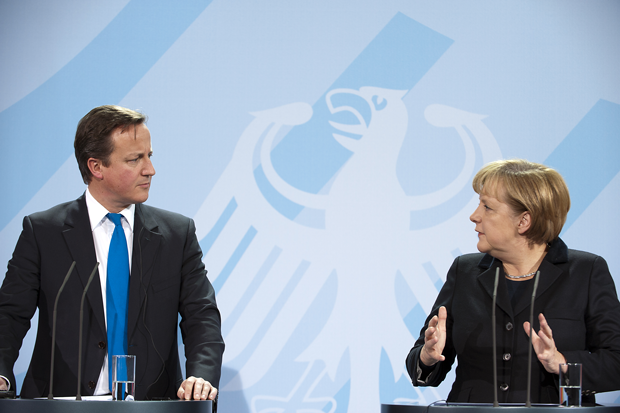
Meanwhile in Berlin last week, German politicians on the Bundestag’s control committee – were demanding answers on the NSA revelations from interior minister Hans-Peter Friedrich, who admitted he was still trying to get enough information out of the US on the reach of American surveillance. The following day, German journalists grilled Chancellor Angela Merkel’s spokesman for an hour and half about what the German government and security services already knew about US snooping, and how they will stop it.
Merkel has called on Obama to respect German laws though adding, rather curiously, “on German territory” – snooping on Germans on servers in the US or as their communications pass through underwater cables are side-lined by this emphasis. Merkel is also pushing for action at EU level, promising she will demand much tougher EU data protection laws – due to be agreed in the coming months. Germany’s political response seems in a much higher gear than in the UK.
Over in Moscow, some Russian MPs too are emphasising safeguards to protect personal data from US snooping. But with demands for big companies like Google and Facebook to respect Russian laws and pass on user data when requested (just as they have been in the US), this is not a sudden shift to political support for digital freedom in Russia. It is simple political opportunism taking full advantage of the NSA’s activities and revelations to reinforce Russia’s determined attempts domestically and internationally to control, monitor and impede a free and open internet.
But German, British or EU criticism of Russia’s attacks on digital freedom will be ignored and labelled hypocritical unless there is a much stronger condemnation of mass surveillance from European leaders and action to limit future abuses. Nor is this simply about whether intelligence services are operating within the law (and whose laws) important though that is. It is about ensuring laws do not allow the sort of mass surveillance domestically and internationally that the NSA, GCHQ – and it would seem France too – have been carrying out.
Here the report from the MPs on the British intelligence and security committee potentially opens up a vital debate. Incautious language, the MPs say that existing legislation is “expressed in general terms” and that GCHQ itself was right to put more detailed practices into place to ensure compliance with UK human rights law. Crucially, though a studied understatement, they say that the “complex interaction” between UK human rights laws and security laws needs further consideration – and commit the security committee to investigate further.
So more digging will happen in the UK, in Germany – and too at EU level thanks to the efforts of the European Parliament.
But the UK is clearly as complicit as the US in mass surveillance. And there is growing and sharper questioning in Germany of how much the government and the security services previously knew about US and UK snooping.
So where new revelations and investigations will take European countries in the coming weeks is an open question. And whether we will see a united defence of digital freedom in Europe and an end to mass surveillance is at best unclear for now and, more probably, highly unlikely.
Kirsty Hughes is the CEO of Index on Censorship. She tweets @Kirsty_Index
