6 Jul 2012 | Europe and Central Asia
[vc_row][vc_column][vc_column_text]“I will be arrested the minute I land in Uzbekistan and then thrown in prison,” an Uzbek human rights activist tells me, “and what happens with me afterwards is a good question.”
For his family’s safety, I cannot tell you the name of the young man. Let’s call him Rustam, a common name in Uzbekistan.
“I only have five minutes, then they cut off the phone,” the 26-year old explains.
Since 12 June he has been held at the immigration services detention centre in Oslo, Norway, after having received the third and final rejection of his appeal for political asylum. He will be deported on 12 July.
Looking at his case it is obvious that the Norwegian authorities are ignoring evidence showing that returning Rustam to Uzbekistan is as good as sentencing him to torture, even death. They have also disregarded UN evidence that says returned Uzbek dissidents who sought refugee status abroad have been disappeared and subjected to torture.
It is easy to detect the fear in Rustam’s voice. In 2004, he and some friends started an NGO called Movement for Freedom and initiated a campaign against child slave labour. Every year, two million Uzbek school children — the youngest just 7 years old — are forced to spend six to eight weeks picking cotton, eight to 10 hours a day.
Uzbekistan has been heavily criticised for this abuse of children. But the income from cotton exports runs into hundreds of millions of dollars, and much of it falls into the pockets of the Uzbek dictator Islam Karimov, who has been in power for 23 years since Soviet times.
When Rustam and his friends started their campaign against child slavery, he was detained and tortured. Upon his release, Rustam fled to Russia. While he was in hiding, he heard that one of the Movement’s co-founders had been killed in an Uzbek prison. He decided to move on to Norway.
I understood how dangerous it would be for me if I returned or was extradited…I too could very easily be killed.
Russia, a close ally of the Karimov regime, routinely extradites Uzbeks. Afterwards many of them ‘disappear’.
The authorities in Norway have two problems with Rustam’s plea for asylum:
1/ Rustam does not have a passport. Rustam says he threw it away when he smuggled himself out of Uzbekistan to ensure he could not be identified by the police if he was apprehended. But it means outside Uzbekistan Rustam now cannot prove that he is who he claims to be.
2/ While Rustam was in Norway hoping to be granted asylum, he started working as a volunteer for the Uzbek human rights defender Mutabar Tadjibaeva. This is now the heart of Rustam’s appeal: the Norwegian authorities do not believe that he worked as her webmaster.
Because of her international standing, Tadjibaeva is hated by the Karimov regime; working with her would land Rustam in very serious trouble in Uzbekistan.
Tadjibaeva has been living in exile in France since in 2008 escaping after three years of prison, rape and torture in Uzbekistan. The country has more than 10,000 political and religious prisoners and experts put it amongst the harshest dictatorships in the world, on par with North Korea.
Tadjibaeva runs the website Jayaron, one of very few independent sources of information about Uzbekistan, a country in which media are strictly controlled by the regime. She has established a widespread network of informants inside the country who send her details about corrupt court cases, unfair imprisonments and cases of torture. Her site is a thorn in the side of a regime that has almost managed to completely isolate its population from the outside world.
The Karimov regime call Tadjibaeva an “extremist” and accuse her of planning to overthrow the government, which is rather difficult to imagine when you meet her in person — a small, soft-spoken 49-year-old woman, her health scarred by years of torture and prison.
In 2008 the US State Department gave Tadjibaeva the prestigious Woman of Courage award. After Tadjibaeva received it, a Wikileaks telegram revealed that the American ambassador in Tashkent received a “tongue lashing” from the Uzbek dictator, who threatened to block US transit to Afghanistan in retaliation.
The ambassador advised his government to tone down the criticism of the Uzbek regime, advice they took. And relations are nearer to the close relationship the countries enjoyed before Karimov’s army killed 800 demonstrators, many of them women and children, in May 2005.
Mutabar Tadjibaeva stresses to me that Rustam has worked with her since August 2010. She cannot understand why the Norwegian immigration authorities rejected Rustam’s asylum plea, stressing that they do not believe that he and Mutabar work together.
We have worked closely together, you can even find his name on our website. Because of this, his life would be in great danger if he were returned to Uzbekistan.
“The Uzbek regime does not like people telling the truth,” she adds. “I have no less than 343 emails here in which we discuss Rustam’s work with our website and my blog,” she tells me, “that obviously prove that we worked closely together.”
“If the Norwegians really wanted to know the truth, all they have to do is check his computer, mobile phone and emails.” She showed me the email and text communication between the two.
“I have even transferred money to him in Norway, so he could buy a computer and work on our website,” Mutabar explains. She shows me receipts.
If he is sent back to Uzbekistan, a long time in prison and severe torture awaits him. There is a real risk that the regime will kill him, as a warning to others to stay away from human rights work.
At the moment it looks like that Rustam will be deported to Uzbekistan within the next week.
But in June something happened which Mutabar hopes will help Rustam. The UN Committee against Torture censured Kazakhstan — Uzbekistan’s neighbour — for deporting 29 Uzbek asylum seekers in 2010. Several of the 29 were later given lengthy prison sentences, kept in isolation and therefore, say analysts, most likely tortured.
UN conventions forbid states deporting people to their home countries if there is a risk that they will be tortured.
Exact numbers are impossible to come by — this is Uzbekistan — but according to local human rights organisations dozens of people are tortured to death each year in Uzbek prisons, and the favourite victims of the security police are those who have been in the West asking for asylum or even speaking poorly about the regime. This description clearly applies to Rustam.
Mutabar Tadjibaeva hopes that the UN decision will make Norway re-consider his case. “But,” she adds, “so-called democratic countries in Europe have often shown themselves full-willing to close their eyes to the atrocities of the Uzbek regime. I have lost all faith in them.”
Michael Andersen is a Danish journalist who has covered Central Asia for more than 10 years. His newest feature-length documentary on Uzbekistan is called Massacre in Uzbekistan.[/vc_column_text][/vc_column][/vc_row]
5 Jul 2012 | Europe and Central Asia, News
Tens of people gathered near Moscow’s Tagansky Court on Wednesday to protest against the prosecution of members of feminist punk group Pussy Riot.
Three activists locked themselves in a cage near the court building and police struggled hard to unlock it and detain them “for taking part in an unsanctioned rally”. Six other activists were detained for having stood in the traffic area near the court. They later faced administrative charges for “breaking the rules of the rally organisation”.
Maria Alekhina, Nadezhda Tolokonnikova and Ekaterina Semutsevich have been accused of hooliganism for allegedly staging an anti-Putin performance in Moscow’s Christ the Saviour Cathedral. They face up to seven years in prison if convicted.
The court set a deadline for the women to acquaint themselves with the criminal case reading materials. They have until 9 July to read the volumes which, according to one of their lawyers, Mark Feigin, “violates the defence’s rights to get prepared for the proceedings,” as they do not have enough time to read them. The trio announced a hunger-strike in protest.
Outside the court building, people wore t-shirts with the band’s picture and white ribbons, a symbol of protest against Vladimir Putin’s authoritarian policy. Most of them told Index they did not believe their actions could influence Pussy Riot’s destiny, but nor could staying silent
Russian intellectuals and artists have condemned Pussy Riot members’ persecution in an open letter, stating the criminal case “compromises the Russian judicial system” and “undermines the confidence in Russian authorities”. The letter was signed by notable directors, writers and actors, including Viktor Shenderovich, Dmitry Bykov, Chulpan Khamatova, Mikhail Zhvanetskty, Eldar Ryazanov.
Rock group Faith No More invited free Pussy Riot members to participate in their Moscow concert on 2 July, where the women asked to “support their sisters” and chanted out:
Russian rebellion. We do exist. Russian rebellion. Putin has pissed with fear.
However, the number of protesters near the court on 4 July did not exceed 300 people. One of them, notable Russian poet Lev Rubinstein, told Index that in spite of international rights activists’ community concerns over Pussy Riot’s persecution, “most people in Russia are simply not aware of Pussy Riot case, or have heard the name and condemn the women without finding out the details.”
This lies in two things: censorship on Russian television prevents the public from understanding the Pussy Riot story in detail, and the lack of solidarity between activists in Moscow and other Russian cities prevents others from protesting against the group’s prosecution outside the capital.
18 Jun 2012 | News, Volume 41.02 Summer 2012
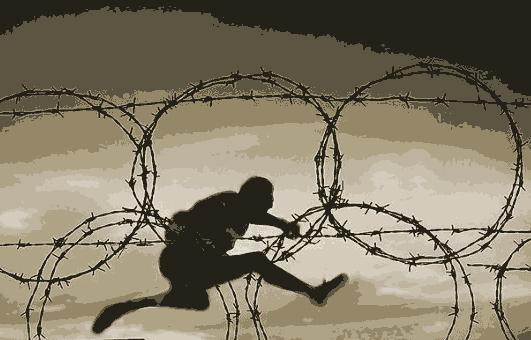
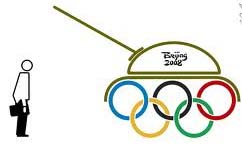 Despite talk of reform, the Bahrain Grand Prix and the Beijing Olympics proved to be catalysts for rights abuses. Mihir Bose asks whether human rights should be a criterion for hosting coveted international sporting events
On the evening of 13 July 2001, as Beijing held a press conference in Moscow to celebrate securing the 2008 Olympics, they had an unexpected visitor: François Carrard, the Swiss lawyer who was executive director of the International Olympic Committee (IOC). Normally on such occasions the IOC keeps its distance and lets the victorious city have its moment in the sun. But Carrard felt he had to address the media on the human rights issue.
In the lead-up to the vote, Beijing’s rivals, in particular Toronto and Paris, had made much of China’s human rights record. As the members gathered, some 50 protesters assembled outside chanting “Free Tibet”. The Russian police, some wearing riot gear, broke up the protest and six people were seen being taken away in a waiting bus after demonstrators tried to unfurl three banners on the Moscow River embankment, opposite the World Trade Centre where the IOC was meeting. There were reports of 12 arrests.
 The IOC had so far refused to discuss human rights, arguing that it was only concerned with making a decision about sport. Nor was the issue addressed by the Evaluation Commission that visited the bid cities and whose assessment formed the basis of the IOC members’ decision. The report of the commission was crucial as, following the revelation of the 1998 Salt Lake City corruption scandal in which IOC members were accused of taking bribes, they were subsequently barred from visiting bid cities. Just before the vote for the 2008 Games, Hein Verbruggen, the Dutch chairman of the Evaluation Commission, summarised to his fellow members the various potential risk factors of the bidding cities. But he did not mention human rights.
Beijing did face a question on human rights during its presentation. But this was delivered in such a roundabout way that only seasoned IOC observers could have understood it. Roland Baar, a rower from Germany, raised the ethical issue of playing beach volleyball in Tiananmen Square. Beijing had proposed this idea, but it had been shelved after objections from the Evaluation Commission that it was not a suitable venue. Baar was so circumspect that he did not even utter the words “Tiananmen Square”, lest it offend the Chinese.
But now Carrard felt free to talk about human rights. At the press conference, apologising profusely for intervening at the Chinese party, he revealed, “On human rights we had two choices — a decision we close the door and that is a hugely respectable decision. The other way is to bet on openness. We bet that in seven years’ time the interactions, the progress and the development will be such that human rights can be improved.”
Beijing Olympics: China’s coming-out party
Long before the Beijing Olympics was staged it was clear that this was an impossible bet, and in the end Jacque Rogge, who was elected president of the IOC a few days after the vote in Moscow, made it clear that it was no business of the committee to monitor China’s moral development. Indeed, Rogge confessed that the IOC neither had the power nor the ability to do anything on human rights. The result: China rode out the protests that accompanied the Games, in particular the ones that marked the torch relay. China, as it had always planned, used the Games to show they could take the Olympics, a western invention, and do it better. By the end of it, IOC members were applauding the Games as China’s giant coming-out party and declaring the bar had been raised to such an extent that other countries would struggle to match it. All talk of human rights and opening up the country had vanished.
The fact was that the Games went to Beijing not because the Olympic movement thought it could change China, but because of wider geopolitical considerations. The overwhelming view of IOC members was that the Games had to go to the most populous country in the world. China had been a good Olympic member. Whatever its human rights record, there was no Olympic reason to refuse the bid. There was also a fear that Beijing, having failed in 1993 when it lost to Sydney by two votes, might walk out of the Olympics if China did not succeed this time.
There was a dominant view in the Olympic movement that, with the collapse of the Soviet Union, a strong China was needed to balance the all-powerful Americans. Ivan Slavkov, the IOC member from Bulgaria — later expelled from the movement in 2005 when he was caught by an undercover reporter saying he would take bribes in exchange for votes — said at the time: “We need China to act as a check on the US. The US is the only superpower. It dominates everything, including the Olympics and the medal tables. China is coming up fast and, by giving the Games to them, we can make sure they develop in the right direction.”
The legacy of the 1936 Berlin Olympics
The IOC’s dance round the issue of human rights over the decades illustrates a wider problem for all sports organisations faced with such ethical concerns. The classic example of this was the 1936 Berlin Olympics. The award of the Games to Berlin was intended to symbolise the re-admission of a peaceful, democratic Germany to the family of nations after the horrors of the First World War. By a supreme irony, the Games have gone down in history as a triumph of Nazi propaganda. As the official Olympic-Zeitung proudly asked on 19 August 1936: “Do we have to point out that the great victor at the Olympic Games is Adolf Hitler?”
The 1936 Olympics, which left us the legacy of the torch relay, offers a template for the use of sport for ulterior purposes with its extraordinary mixture of opportunism, improvisation and attention to detail in the Nazi preparations for the Games. But Hitler could not have fulfilled his agenda to show how normal his regime was if leaders of international sport had not played into his hands, with their willingness to believe dishonest public assurances and to accept gestures and symbols rather than look at reality.
Since then, sports leaders have often looked the other way when major sporting events are held against a background of state violence, in countries whose repressive regimes seek to present themselves as open societies to the outside world. The list includes rebel South African cricket tours of the apartheid era, financed by tax concessions by the white regime, the 1968 Mexico Olympics, the Ali-Foreman fight in 1974 in a Zaire ruled by the brutal and corrupt despot Mobutu Sese Seko, and the 1978 World Cup in Argentina, organised by a junta which, even then, was embarking on a massive programme of killing people opposed to the regime.
Back in 1851, when Prince Albert wished to advertise the might of Queen Victoria’s realm he held a Great Exhibition — essentially a trade fair displaying the works of industry of all nations. There was culture in the form of Charlotte Bronte, Lewis Carroll and George Eliot, but no sport.
Sport, morality and character
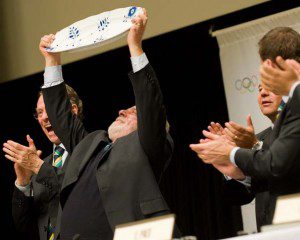 Today, sporting events have come to replace trade expos as a symbol of national success. Nelson Mandela used the power of sport, particularly rugby, to woo the whites, and felt that the rainbow nation had arrived when in 2010 it became the first African country to stage the football World Cup. In Copenhagen in 2009, President Lula of Brazil shed tears after Rio won the right to stage the 2016 Olympics. “Everybody talks of Brazil as the country of tomorrow,” he said. “Here in Copenhagen tomorrow has arrived.” His pleasure was all the greater as Rio had beaten Barack Obama’s Chicago, despite the fact that the most powerful man in the world made a personal plea to the IOC.
But the problem for sport is that, unlike expos, it carries a moral dimension. It is interesting to note that Beijing’s rivals made much of this distinction. Claude Bébéar, president of the Paris bid, made it clear he would have no problems with a Chinese city hosting an expo, but not the Olympics. Giving China the Games, he argued, would indicate moral approval for the regime.
The idea that sport had universal significance emerged only in the 19th century as the rules for modern sports were being formulated. In his fictional novel Tom Brown’s Schooldays, Thomas Hughes presented his headmaster at Rugby, Thomas Arnold, as a sporting guru. His message, said Hughes, was that sport could reach out beyond the playing fields more effectively than any other form of human activity. Indeed, sport could shape society for the greater good.
The headmaster of Hughes’s book was an invention — the real life Arnold had no interest in sport. But the idea proved so powerful that it seduced a French baron, Pierre de Coubertin, who came to Rugby to worship at Arnold’s shrine and used his principles to revive the Olympics, setting it a high political goal. As he put it:
It is clear the telegraph, railways, the telephone, the passionate research in science, congresses and exhibitions have done more for peace than any treaty or diplomatic convention. Well, I hope that athletics will do even more … let us export runners and fencers; there is a freetrade of the future, and on the day when it is introduced within the walls of old Europe the cause of peace would have received a new and mighty stay.
Modern sport is essentially the marriage of Hughes’s big idea in the private realm – that sport develops character — with Coubertin’s big idea in the public realm — that sport can transmit values within and between nations through regular international competition.
Bahrain and Formula One
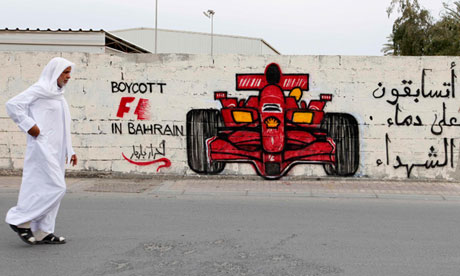
The problem arises when sport collides with political reality, as it did in the wake of the Arab spring. As millions rose up in the Arab world last year to challenge and even change their despotic rulers, in Bahrain the desire for freedom came into conflict with modern sport. In the picturesque words of the Daily Mail’s Martin Samuel, the result of “little brown people” wanting freedom meant “the next thing you know is there is one less place for rich white guys to race cars”.
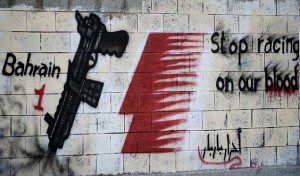
Formula One’s first Grand Prix of the season was due to take place in Bahrain in March, just weeks after the kingdom had been engulfed by protesters demanding more freedom. There had been highly publicised protests at the main Pearl Roundabout in the financial district of Manama with some 31 protesters killed. Armoured cars, including Saudi troops and forces from Qatar and UAE, had rolled into the kingdom to restore order. How could a sports event take place in such a climate? And where was the moral compass of sport in even thinking it could?
The race was the dream of Crown Prince Sheikh Salman bin Hamad bin Isa al Khalifa, who had made it clear that money was no object in bringing one of the most high profile world events to his desert kingdom. The Bahrain government funded the race. The Sakhir circuit, where the Grand Prix had been run since 2004, had cost some £92m. The F1 organisers had been paid £24.6m to allow Bahrain to organise the opening race of the 2010 season, and this had risen by 60 per cent for the 2011 race. The protesters knew how dear the race was to the Crown Prince and that if they wanted to wring political concessions from him, they had to hit at his beloved sport.
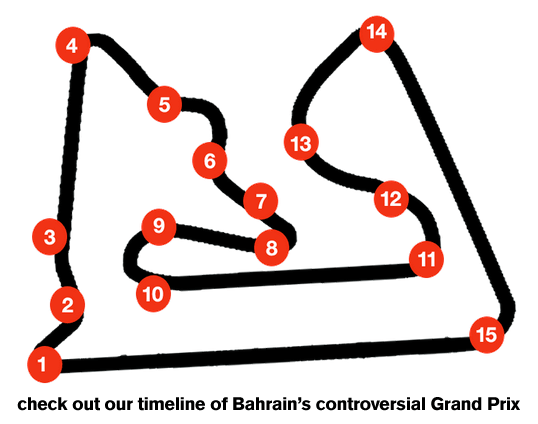 However, the F1 organisers of the race did not seem to understand the moral questions involved. Neither FIA, the governing body, nor Bernie Ecclestone — the F1 rights holder — wanted to put their heads above the parapet. Their reluctance, it was assumed, was due to the fear that if they cancelled the race they would stand to lose £37m in rights fees.
In the end, the Crown Prince himself decided the race had to be put back, hoping it could be held later in the year. His wish appeared to have been granted when, following an FIA inspection team visit, FIA’s World Council unanimously agreed that the Bahrain Grand Prix would now be held on 30 October. The decision provoked outrage from human rights activists and race fans. Many argued that for all the talk of high values, sport was more bothered about Mammon and ended up conspiring with despots.
The FIA’s judgement was further called into question when details of the inspection report emerged. Over a two-day trip, the FIA had met the minister of culture and tourism, the minister of the interior, had had lunch with the board that runs the Grand Prix, met circuit personnel and visited a shopping centre. But they had not met any of the dissidents. It was clear that the race could now not go ahead at the rescheduled date either. However, it was logistics not morality that was given as the reason for the cancellation. The new date for the race in October meant Bahrain would get India’s Grand Prix schedule – the new Formula One commercial centre – and extend the calendar into December. The teams just could not cope with the pressures this would create.
 The whole affair brought little credit to Formula One, least of all the highly paid drivers. Apart from Red Bull’s Mark Webber, who acknowledged the moral question of sport taking place in the wake of a bloodbath, nearly all the other drivers avoided the moral issue. I could not even coax Britain’s most successful F1 driver, Nigel Mansell — who has chalked up 31 race wins and the 1992 world title — to take a stand on this issue. When I asked in the middle of the crisis whether it would be morally justified to stage the Bahrain Grand Prix, Mansell replied: “There are great people involved in Formula One who are in charge and it is up to them to speak to the power brokers of the country.”
The problem here, as Max Mosley, the former head of FIA, astutely put it was:
The Formula One world did not seem to appreciate that the government in Bahrain was about to use the Grand Prix in support of suppressing human rights.
For all the moral high ground Formula One may like to claim, when faced with a stark ethical issue it is powerless and has to duck and dive. The same drama has played itself out again this year, with F1 facing international condemnation for holding the race in Bahrain.
Sports administrators may present themselves as the Vatican of sport, beyond the control of any authority but their own. Yet the money needed to run modern sport means they have to compromise with dubious governments and regimes. The result is that the high moral purpose of sport is sacrificed if not totally ignored. And until sport can deal with this basic contradiction, problems such as Bahrain will continue to appear. The worrying thing is that few in sport seem willing or able to deal with it.
 Mihir Bose is the author of The Spirit of the Game: How Sport Made the Modern World (Constable)
This article appears in the summer 2012 edition of Index on Censorship magazine. Click on
The Sports Issue for subscription options and more