22 Dec 2025 | Europe and Central Asia, News, Serbia
On the second evening of my stay in Belgrade, I wondered if someone had been rummaging around in my Airbnb. I was pretty sure that I’d double-bolted the door, but when I came back from the restaurant the door wasn’t bolted at all. It was as if it had just been pulled shut. There was nothing missing, though I searched the high-ceiling-ed narrow studio flat just to make sure someone wasn’t hiding behind a curtain or in a cupboard. The apartment was empty. And I comforted myself with the thought that an intruder wouldn’t have found much anyway. I only had a small backpack, and I had decided to take my phone and laptop everywhere I went.
Belgrade is a city which induces paranoia. I’d spent the last couple of days listening to journalists and human rights defenders talking about the unknown sonic weapon used against student demonstrators in March, and about an activist who had been arbitrarily detained for hours while spyware was installed on his phone. Amnesty International reports this is common practice now, and human rights defenders I spoke to try to check their phones regularly for spyware.
The Serbian authorities are not very friendly to foreign journalists either. Tamara Filipović, the secretary general of the Independent Journalists Association told me that Croatian and Slovenian reporters had been turned away at the border in March because they were a “threat to the country”.
But even more worrying, from my point of view, was the sinister camp just a five-minute walk away from my apartment known locally as Ćaciland. I was staying in the very centre of Belgrade and Ćaciland was in the Pionirski (Pioneer) park in front of the National Assembly building, a large baroque revival edifice in the centre of the city. The encampment was the brainchild of Serbian President Aleksandar Vučić, who had called on the Serbian people to come and defend the parliament to protect it from student demonstrators.
The students have been up in arms for more than a year marching and blockading streets and university buildings, since the collapse of a concrete canopy in the newly rebuilt Novi Sad station which killed 16 people and injured many more in November 2024. Their initial demands: an investigation into why the station was so unsafe, and the suspected government corruption around the entire building project.
As the protests became more vociferous and attracted more members of the public, Vučić and his Serbian Progressive Party (SNS) decided to mount a counter demonstration. People – supposedly “students who wanted to study” – were recruited from round the country to come defend the parliament ahead of the March demonstrations (which were attended by more than 300,000 anti-government protesters). At one point in the recruitment drive, a phone line was set up and a local investigative journalist from the news channel N1 rang it to find out what would happen. He was told that he would be paid between 50 and 80 euros a day to sit and lie down. Women were paid the lower rate, according to one human rights defender I met.
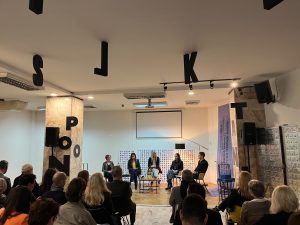
Human Rights House Serbia celebrates Human Rights Day despite threats. Photo: Sally Gimson
In reality, it wasn’t students who were attracted to the camp, but, according to various sources, petty, and even some more serious criminals. The camp now extends to the whole park and into the carpark in front of the parliament building. I saw white tents with music, portable toilets and swarms of police officers, there “to protect” the demonstrators. I also saw what seemed to be more disturbing elements, older men in masks and woollen hats, who I was told were likely Serbian veterans from the 1990s Balkans war. Even if they weren’t, they were dressed to suggest that. The whole place was fenced off with provisional metal railings, used the world round for crowd control. A few days before I arrived the top of the fencing had been greased and no one knew what the substance was.
I didn’t take any pictures on my phone and was warned not to peer too closely as I walked past. Last month, a television crew from N1, which is one of the few independent TV companies in the capital, was attacked by a man from the camp who turned out to be a convicted murderer. He was identified through footage recovered by the cameraman after his equipment was smashed. In July 2025 reporters filming Ćaciland had eggs thrown at them.
A journalist told me that the camp combined the dystopian aspects of Black Mirror mixed with the comedy of The Simpsons. It is called Ćaciland because when the students first started blockading universities and striking over the Novi Sad disaster, someone scrawled graffiti outside a local secondary school urging students in the town to go back to school. The graffitist spelled the word students as Ćaci instead of the correct spelling of Đaci. It led to a joke about their lack of education, hence Ćaciland (probably best rendered in English as Chavland).
The worst thing according to human rights defender Uroš Jovanović is that the police didn’t defend the attacked journalists but allowed them to act with impunity. Most prosecutors’ offices are dragging their feet when complaints are made to them. Students and journalists on the other hand have been detained and charged with “not following police instructions”. In August in some parts of the country – this is not just a Belgrade movement – demonstrations turned violent, with police beating protesters and some masked people throwing fireworks and stones.
The fight in Serbia is between students and a president they accuse of deep-seated corruption. Academics and schoolteachers have supported their students too. One human rights campaigner said that 100 secondary school teachers have been laid off because of their support, and some 25 headteachers and co-principals dismissed. Many ordinary members of the public have joined the protests, like the 50-year-old woman I met in a café who had been on the marches and started talking to me unprompted. She told me she had lived through five regimes in her lifetime and Vućić’s was by far the worse. She hoped the government would be overthrown soon.
Like Gen Zers around the world the students eschew politics, discuss actions through “forums” and have no leadership structure so they can’t be dismantled by the authorities. They organise primarily over social media. Those who have broken cover or have been arrested have found intimate pictures of themselves disseminated online and in government media. They’ve also been doxxed and smeared. Women have been particularly affected. Biljana Janjic, the executive director of FemPlatz, said out of 170 female activists they talked to, 87 had been assaulted and attacked by the police and pro-regime activists, and that sexual violence and rape threats had been normalised by the police. In smaller communities, women have been much more vulnerable to such attacks. The students’ ideology is unclear, except they dislike mainstream politics which they believe is so fundamentally corrupt that it resembles a big pot of shit – as one disillusioned politician described it – so that anyone who takes part becomes covered in excrement.
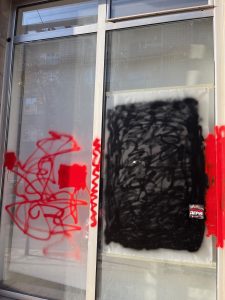
Graffiti on the HRH headquarters in Belgrade. Photo: Sally Gimson
I heard a lot about the suppression of protest and the media, not only through individual conversations, but also at the Human Rights House (HRH), just down the road from the National Assembly and the Ćaciland encampment. The front of the office has been daubed with red graffiti which covers the HRH logo: the authorities have refused to remove it for them. At least the building still rents space to the HRH Serbia team, alongside other civic society organisations.
Last week the House organised an event to celebrate Human Rights Day. The meeting was open and defiant. The leaders were mainly women. They discussed the situation in Serbia and their fears about increasing repression. Prizes were given to the director of news at N1, who HRH workers said had been vital in defending them and giving them “the courage to stay and fight”. Prizes were also given to a small group of prosecutors called Let’s Defend our Professionalism, who were praised for defending the rule of law where most of their colleagues had toed the government line. A representative from the Russian HRH in exile handed on to the director Sonja Tosković and her team the Golden Dove of Peace.
Despite their mistrust of politics and the persecution of many activists and journalists, students are organising for elections and announcing their candidates on 28 December. But there is deep tension in Serbia. Students have a history of toppling governments they don’t like. In October 2000, Slobodan Milosevic, the Serb leader in the 1990s war, was forced from power by a student-led revolution. In Belgrade’s Museum of Yugoslavia there is an celebratory exhibition about the 20th century revolutionary socialist politician Veljko Vlahović, a former student leader, and one of the leading figures in the communist government after the Second World War. In neighbouring Bulgaria, the government was overthrown by Gen Z students this December.
I’ll never know if someone really was in my apartment, but paranoia is rife in Serbia, and all have good cause to feel that way.
10 Mar 2025 | Europe and Central Asia, News, Newsletters, Serbia
According to some analysts, the largest student-led demonstrations in Europe since 1968 are taking place today in Serbia. I almost missed that sentence in this story from the Sunday Times last weekend given all of the other news vying for my attention. I’m glad I didn’t. The article itself is well worth reading – a story that pulls in Abu Dhabi developers and Donald Trump’s son-in-law Jared Kushner. Now dodgy planning regulations aren’t exactly the lane of Index. But protests and the crushing of dissent most firmly are. So here is what you need to know.
For months now, Serbia has been rocked by huge demonstrations throughout the country, led by students. What began in November 2024 as a movement demanding accountability for a tragic railway station accident in Novi Sad, which claimed 15 lives, has transformed into a broader call for transparency, fair elections, media freedom and an end to corruption.
The protests have resulted in tangible outcomes, such as the resignation of Prime Minister Miloš Vučević and charges against 13 individuals over the train disaster. Serbia is a country where “there is no such thing” as free speech, according to Bosnian actor Fedja Stukan – who was deported in 2024 after speaking openly about his experiences in the 1990s war. The country’s ruling party has been accused of “a textbook process of state capture” and the protests have, unsurprisingly, been marked by serious violations to free speech.
Journalists covering them have faced harassment described as “escalating” and “systematic”. These attacks have included death threats against journalists like Ana Lalić Hegediš, and physical assaults, such as the forced removal of reporters from Novi Sad City Hall in January 2025. Additionally, NGOs critical of the government have been raided by Serbian police.
The students driving the protests have been careful to maintain their distance from political parties from the get-go, which they must have felt vindicated by this week – dramatic scenes emerged from parliament when opposition members launched a smoke bomb and flare protest, leading to injuries and damage. This has only added ammunition to government claims that the protests are part of a “colour revolution”, and that NGOs are foreign-funded agents destabilising the country. Hungarian Prime Minister Viktor Orbán, clipping scenes from parliament, was quick to support this narrative on X.
Expect more dramatic events from Serbia in the coming weeks. Sources on the ground tell me an extra big strike is planned for today and another for 15 March. And with that, be on guard – if history tells us anything, when it’s students versus state, it’s rare that the former win.
2 May 2019 | Media Freedom, media freedom featured, News, Serbia
[vc_row][vc_column][vc_single_image image=”106589″ img_size=”full” add_caption=”yes”][vc_column_text]Every Saturday, for the past five months, thousands of people have gathered on the streets of Serbian capital Belgrade to voice their dissent against President Aleksandar Vučić’s authoritarian tendencies and increasing control over the country’s media.
“Initially the protests were named ‘Stop the Bloody Shirts’,” Serbian journalist Lazara Marinkovic said. “And this was a reaction to an incident that happened in one city in Serbia, where Borko Stefanaović, an opposition leader, was physically beaten.”
Stefanaović, who was attacked last November in Kruševac, is the president of the political party Serbian Left and a founder of opposition coalition Alliance for Serbia. His assault, in which a masked group of assailants armed with bats and steel bars beat him, led to a rally in Belgrade.
“These people were saying that the beating happened as a result of political violence that the opposition is exposed to,” continued Marinkovic. “After one or two weeks, our president vucic had a reaction to those protests. He said ‘even if five million people were on the streets, (he) wouldn’t concede to their demands.’”
This sparked the formation of protests dubbed “one in five million” – a name lifted directly from Vučić’s comment. Though it remains uncertain whether the ongoing rallies will bring about change, Mitra Nazar, a Balkans correspondent for Dutch public broadcaster NOS, says it is “important” for protesters to demonstrate their unhappiness with Vučić.
“At this moment it’s about showing presence in the street more than actually having the feeling that they could change something,” said Nazar, who currently lives in Belgrade.
“I don’t think anybody in these protests believes that this could turn around now, but they do see this as part of a bigger movement that could eventually grow into something substantial, that could challenge the ruling party at elections.”
The demonstrations are the biggest since the fall of former President Slobodan Milosevic in 2000 – though lack of coverage in mainstream Serbian media would suggest otherwise. With Vučić pushing for Serbia to join the European Union, his grip on the media has tightened in efforts to appear stable to Brussels.
“Vučić wants to be the person that brings Serbia into the EU,” continued Nazar, “and in Brussels Vučić is still seen as a leader who can guarantee stability in the Balkans, and someone who’s willing to negotiate about a solution for the frozen conflict in Kosovo.
“His critics say the EU does not pressure Vučić enough on topics like media freedom, whilst they see his control over the media getting stronger.”
The country’s public broadcaster RTS has been targeted by demonstrators who are critical of the outlet’s coverage of the protests. The opposition says that, although reporting is completely neutral, it fails to ask why such a huge amount of people gather outside its headquarters in Belgrade every week.
“They are being biased,” added Marinkovic. “There was an incident when people who were demonstrating went inside the (RTS) building.
“They say that they didn’t go inside violently but some violence did happen because there was a lot of police who started kicking them out. Many people will agree that if these people do something violent, or vandalise something, it would be immediately used against them.
“They are trapped in a way they cannot really radicalise their protest. Nobody listens, nobody cares. It’s just like an echo chamber basically.”[/vc_column_text][vc_basic_grid post_type=”post” max_items=”4″ element_width=”6″ grid_id=”vc_gid:1556799282299-4d20cd01-70c2-7″ taxonomies=”7370, 113″][/vc_column][/vc_row]
26 Mar 2019 | Awards, News
[vc_row][vc_column][vc_video link=”https://youtu.be/LOW-DW-P-DM”][vc_column_text] The Center for Investigative Journalism of Serbia (CINS) is an independent group of investigative journalists exposing corruption in Serbia and stands out as one of the last independent outlets left in a country where the media environment has become increasingly partisan.
Investigating corruption is one of the most dangerous jobs in journalism. Three investigative journalist in the Europe Union have been murdered in the past year and a half alone. Hundreds of journalists face daily threats. Many have been attacked physically, hit with crippling legal actions or forced to live with 24-hour security because of their work.
The European Commission has raised concern over Serbia’s judiciary, police, health and education sectors as particularly vulnerable to corruption. According to Global Corruption Barometer 2016, 22% of Serbian citizens who had contact with public institutions — from traffic police to public health and educational systems, as well as courts and departments responsible for social welfare — had paid bribe at least once in the previous year.
In the last few years, media organisations have faced increasing political and financial pressure. According to CINS, many local media outlets have shut down or cut their print publications – even though only 65% of Serbs used the internet regularly in 2017.
Physical attacks against journalists and death threats have also intensified, and under president Aleksandar Vučić’s administration, both the government and pro-government tabloids have run smear campaigns portraying investigative journalists, including CINS, as foreign-backed propagandists working to destroy the country. The staff have report being surveilled and intimidated.
To support their reporting, the CINS team submitted more than 500 FOIA requests, creating databases based on thousands of pages of documents—often in difficult circumstances, requiring repeated petitions. Hoping to inspire a new generation of young investigative reporters, CINS are also providing hands-on investigative journalism training for journalists and editors.
CINS is funded by donations so as to avoid being influenced by the revenue generated commercial and political advertising.
In 2018, CINS has increasingly focussed on the Serbian media landscape. Some of its stories have detailed how pro-government tabloids and TV channels received funds and loans from public and private entities despite the fact that they had been found in breach of the code of ethics of journalists.[/vc_column_text][vc_separator][vc_row_inner][vc_column_inner width=”1/2″][vc_single_image image=”104691″ img_size=”full” onclick=”custom_link” link=”https://www.indexoncensorship.org/2019/01/awards-2019/”][/vc_column_inner][vc_column_inner width=”1/2″][vc_column_text]
Index on Censorship’s Freedom of Expression Awards exist to celebrate individuals or groups who have had a significant impact fighting censorship anywhere in the world.[/vc_column_text][/vc_column_inner][/vc_row_inner][vc_separator][/vc_column][/vc_row][vc_row][vc_column][vc_basic_grid post_type=”post” max_items=”4″ element_width=”6″ grid_id=”vc_gid:1553517795280-275e7e6c-234a-2″ taxonomies=”26925″][/vc_column][/vc_row]
